
How Affordable Is Unaffordable Bristol?
Bristol has the worst housing affordability ratio of any English core city. Here's what the numbers actually say in 2026. Bloomberg should know, if anything.

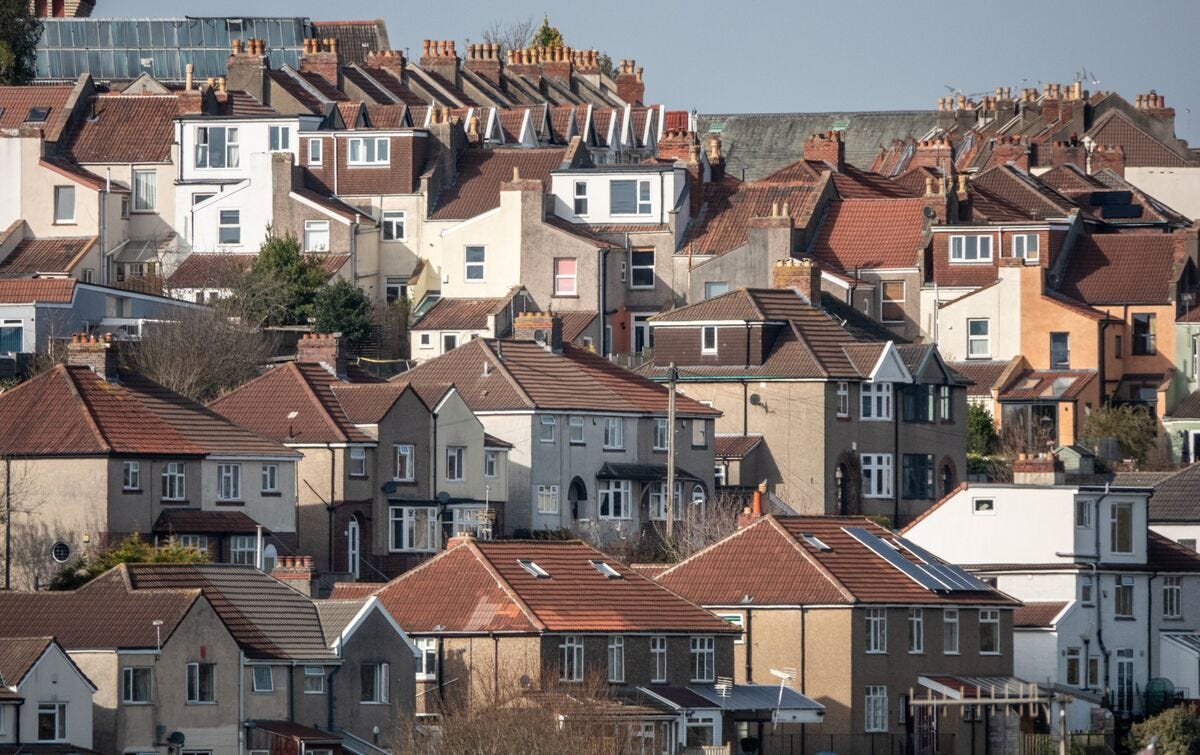
[Bristol's housing density, 2026. Image credit: Bloomberg/Getty Images. Source: bloomberg.com]
Have you ever had that dream where you wake up and remember that somewhere during the night, your bank statement quietly said — I need a word with you.
That feeling. That specific, low-level dread. The one that arrives before you’ve even made a cup of tea, first thing.
That is what living in Bristol in 2026 feels like — not for a handful of people in difficult circumstances, but for most of the city.
Not a crisis moment. Not a cliff edge. Just the feeling, every Sunday evening, that next month will somehow be worse.
Here’s possibly why.
Somewhere in Bristol tonight, someone will likely be doing this arithmetic on their phone in bed.
Average rent in Bristol hit £1,891 a month in February 2026 — making it the most expensive city to rent outside London in the UK. The average house price is £353,000. If you’re a first-time buyer in Bristol, you’re looking at £308,000 — roughly eight and a half times the median Bristol salary.
The Bristol Post reported it as headline news. The BBC carried confirmation from a council cabinet member directly.
Bloomberg put it in global terms in August 2025: Bristol renters now spend 44.6% of their income on rent — worse than most parts of London, and well above the 30% threshold considered sustainable.
Independent research by Stokemont chartered surveyors puts Bristol’s total monthly cost of living for a single person at £1,913 — second only to London.
The city carries the worst housing affordability ratio of any core city in England.
And yet — here’s the word they keep using — Bristol City Council calls some of this housing affordable.
So let’s find out what that actually means. Because that word is being asked to carry an enormous amount of weight. And it might be about to buckle.
What the Council Calls “Affordable.”
Bristol City Council does have an official definition. Affordable housing, they say, is for people who “cannot afford to buy or rent on the private market.” So far, so reasonable.
There are several tiers.
At the bottom sits social rent — the cheapest, set by a government formula. This tier genuinely works. The rents are real, the prices are sustainable, the homes are what people actually need.
The problem is not the price. The problem is the waiting list — which currently stands at over 18,000 households. And in April 2026, as Bristol24/7 reported, the council quietly removed a further 4,000 households from that list entirely, telling them they had “little to no chance” of ever being allocated a home.
Above social rent comes affordable rent — capped at 80% of market rate.
Then shared ownership — you buy a slice of a home and pay rent on the rest.
At the top, First Homes — sold at a 30% discount off market price, courtesy of the developer.
All of which sounds structured. Sensible, even. You might even feel mildly reassured. Most people do, at this point.
And then the numbers arrive.
Here’s What Your Money Actually Buys.
You’ve seen the rent figure already — £1,891 a month, up 7.4% in a single year.
Nearly £700 above the South West average. More than £500 above the UK average.
Popular cities cost more. That is true. But popularity does not suspend the obligation to house the people who keep the city running.
Bristol is already in London’s territory. Just without the Tube.
So when the council talks about “affordable rent” at 80% of market — have you worked out what that number actually is?
That’s £1,513 a month. That is the affordable option. Do take a moment with that sentence.
Now think about wages. The median salary in Bristol is £42,200 a year. After tax and National Insurance, that’s roughly £2,700 a month in your pocket.
That is the midpoint. Half of Bristol earns less than this.
Which means that before you’ve paid for a single other thing — before food, before the bus, before the council tax they keep putting up — you’ve already handed over 56% of your take-home pay.
For the privilege of being housed affordably.
And you know what the really uncomfortable part is? You still need to eat. Even if it means through a straw.
The Unavoidable Queue of Bills.
So let’s go through what’s waiting for you. Because, as you know, it doesn’t stop at rent.
Council tax first. Bristol’s Green-led council approved a 4.99% increase in February 2026 — the sixth consecutive annual rise. A Band D property now costs £2,713 a year, or £226 a month. Bristol Uncovered independently verified the figure and put it in context: the same council that approved this rise sent out correction letters for last year’s tax bills at a cost of £200,000 to residents.
The council leader said it was necessary. What he didn’t mention is that necessary and relentless are not mutually exclusive.
Then utilities. Electricity, heating, water, the bin: around £163 a month.
Food. Cooking at home, own-brand, sensible: £250 a month is about as low as it goes.
Getting around. This city does not have a functioning mass transit system.
The buses exist, yes. Whether they go where you need them, when you need them, is a conversation Bristol has been having, unresolved, for thirty years.
A monthly pass runs roughly £80. If you need a car — and a large proportion of Bristol does, because the buses, at some point, simply decided not to go there — you’re adding insurance, fuel and maintenance on top. Comfortably £300 or more a month.
Phone and broadband. Another £60 a month.
That is £879 a month minimum before rent has been mentioned.
On a median take-home of £2,700, you’ve got £1,821 left.
The cheapest one-bed flat on the private market: £1,000 to £1,250 a month. Tight, but just about survivable if nothing goes wrong and nothing ever does.
At the “affordable rent” tier — the official affordable option — you’re paying £1,513.
Which leaves £308 for the rest of the month. For clothes. For emergencies. For a child. For anything resembling a life.
Two incomes help — until one of them is the minimum wage. Or until there’s a child. Or until one person gets ill.
And that’s the median earner. Someone with a decent job, a salary the ONS would call typical.
Want to know what it looks like further down?
Now Try It On Minimum Wage.
From April 2026, the National Living Wage is £12.71 an hour. Full time: roughly £24,800 a year — around £1,750 a month after tax.
Subtract those same unavoidable costs and you’ve got roughly £871 left for rent.
The cheapest one-bed flat in Bristol starts at £1,000 a month.
You are already £129 short before you’ve turned the heating on or bought a loaf of bread.
You’ve done the arithmetic. You can see what it shows.
The maths doesn’t work. Not slightly, not by a rounding error. It categorically, structurally, fundamentally doesn’t work.
This is what the minimum wage — the legal floor, the thing the government sets and calls sufficient — delivers in Bristol in 2026.
And yet people keep arriving.
Bristol gets marketed as the smart move — the London alternative, the creative city, the green city, the place where your money goes further. The marketing team did everything bar quote, Blake’s green and pleasant land.
Copyright issues, I guess.
Anyway. Bristol ranked fourth in the national relocation league in 2025. Thousands make this move every year, do the sums on arrival, and discover what residents already know.
The lifestyle branding got here before the rent bill did.
And, those who can are quietly doing the maths differently. Zoopla’s research, published in August 2025, found that Bristol workers who move to Newport — just 18 minutes away by train — save 43% on their housing costs.
Newport average house price: £214,700. Bristol: £379,800.
So. It doesn’t take the IQ of Einstein to work out that Newport and Cwmbran are now formally identified as commuter hotspots for Bristol workers who can no longer afford to live here. Okay, then maybe with the exception of Bristol Council, perhaps. Another country, as it happens. Eighteen minutes by train.
South Wales has effectively become the affordable housing policy that Bristol City Council hasn’t managed to deliver.
For those with jobs that allow it — and not everyone does — the answer to Bristol’s housing crisis is apparently a Great Western Railway timetable, a Welsh postcode, and a bank statement that reads more favourably.
However, most people don’t have that option.
Picture this. Tuesday morning on the Downs, someone in a transit van made a cup of tea and went to work.
Then, the day after. Wednesday 16 April 2026, to be precise, Bristol City Council obtained a possession order from Bristol County Court to remove them. The order came into force on Thursday 7 May. Yesterday.
Bristol Live was on the Downs to cover it. So was Sky News, which reported Bristol’s van dwelling crisis in February 2026 as “the hidden side of the cost-of-living crisis” — not antisocial behaviour, but a direct consequence of unaffordable housing. ITV News national carried the same story.
Martin Morgan, 39, has lived on the Downs for four or five years. A break-up, a family fall-out, and being unfit for work left him on benefits and unable to find a roof. He was waiting to be taken to a meanwhile site — a temporary council-managed pitch — in Lockleaze.
Martin told Bristol Live: “The meanwhile site is my only choice, otherwise I’ll be homeless. I was homeless before and scraped enough together to get this van. I’m scared to leave. My life is in there.”
Similarly, Jaz Devereux, 24, said the council had not offered her a meanwhile site spot. “I have no idea where I am going to go. It’s very very stressful.”
In response, the council said that since launching its vehicle dweller policy, it had worked with almost 100 people. The outcomes: four moved onto meanwhile sites, four in with family or friends, one into private rental, one into social housing, five into emergency accommodation.
So. Loosely translated from council speak. Four went in with family or friends. Which is to say: four housing crises were quietly absorbed by four other households who didn’t have the space either.
One person into social housing. Out of almost one hundred.
To clarify. This community grew from around 150 people in 2019 to over 600 lived-in vehicles today. That is not a lifestyle trend. That is a housing crisis with a postcode.
So, there you have it. A Green city. A vibrant city. A city of culture. With people living in vans because they can’t afford a roof.
Best not look too closely at that one.
Still. At least the street art’s nice.
Which raises a question worth sitting with.
The Council Calls It Affordable. Here’s What It Actually Is.
A fair point first, and it deserves an honest answer.
Bristol City Council is not the architect of the national housing market. Central government sets the framework. The planning system is national. The lack of rent control powers is a Westminster decision. The council has acknowledged in its own parliamentary evidence that its ability to influence private rents is “limited.”
And the council has tried. Between 2021/22 and 2023/24, 1,390 affordable homes were delivered. In June 2023, its Living Rent Commission published a 104-page report calling for rent controls and lobbied government directly for the powers to implement them. The Bristol Cable investigated the outcome. The Big Issue quoted Bristol’s housing lead, Cllr Tom Renhard, directly: “These are people who are working, they have jobs. People don’t want to come to Bristol anymore.” The government declined.
That matters. It is worth saying.
However, here is what also matters.
1,390 homes over three years. Against a waiting list of over 18,000 households. One home for every thirteen households waiting. The council’s own target — 1,000 affordable homes a year — has not been met.
The Living Rent Commission reported in 2023. Since then, Bristol rents have risen by more than 20%.
And the word “affordable” — applied to housing that costs £1,513 a month — is still the council’s choice. Westminster did not make them use it. That is a local decision with local consequences.
Let’s be clear. Bristol has the highest housing affordability ratio of all England’s Core Cities. A minor fact you probably won’t find included in Bristol PR paraphernalia.
Simple to understand really, when the median home costs 8.7 times the median annual salary.
You see. House prices are down around 2.5% from their 2025 peak. On a decade-long rise of almost 90%, that is not a correction. It is a rounding error.
While, behind the 600 lived-in vehicles recorded across Bristol are people like Martin Morgan and Jaz Devereux — a community that barely existed in 2019.
You might not have been made privy to this, there are 1,786 households in temporary accommodation. With families waiting an average of 558 days just to make a successful bid on a home.
And then there are the children.
Twenty-six percent of Bristol’s children live in poverty once housing costs are factored in. Around 22,000 children. In this city. Right now.
The North Bristol and South Gloucestershire Foodbank is now purchasing one in four of the items it distributes — because donations have fallen while the number of people going hungry has not.
The council’s vision statement is a masterclass in myopia.
“Everyone has access to a safe, warm, secure home, at a price they can afford.”
Someone in a transit van on the Downs read that and made a cup of tea.
As for the council. Should have gone to Specsavers, perhaps?
That is not a description of Bristol in 2026. That is an aspiration. And aspirations, however genuinely held, do not pay rent.
So What Does “Affordable” Actually Mean?
Here’s the honest answer. And it’s a short one.
In planning policy, “affordable housing” has never measured whether ordinary people can actually afford it.
It is a bureaucratic category — a percentage target negotiated between councils and developers, built on a formula designed decades ago for a housing market that no longer exists anywhere near Bristol.
The developers negotiate. The council accepts what viability assessments allow. The people on the waiting list wait.
It means cheaper than the open market. That is all it has ever meant.
It does not mean within reach of people on low or average incomes. It never did. The word has been doing so much reassuring work for so long that most people assumed it meant the second thing.
It doesn’t.
A word that means “we tried” has been quietly standing in for a word that means “you can afford this.”
And in a city where the median earner is one unexpected bill away from the edge, and the minimum wage worker is already over it, that is not a semantic quibble.
Make of that what you will. Though it’s hard to find another reading.
That is the whole story.
How affordable is unaffordable Bristol?
Not at all. Perhaps, without an eye test first. The small print’s always in there somewhere, people.
Sources & Further Reading. If You’re That Bothered.
Every figure in this article is drawn from primary sources. If you want to check the working — and you’re invited to — here is where to look.
Newport and commuter migration from Bristol Zoopla — Affordable commuter hotspots revealed (August 2025): https://www.zoopla.co.uk/press/releases/affordable-commuter-hotspots-revealed-commuters-could-save-up-to-61-per-cent/
Hathways Estate Agents — Newport and Cwmbran hailed as commuter hotspots for Bristol workers: https://hathways.co.uk/blog/newport-and-cwmbran-hailed-as-commuter-hotspots-for-buyers/10556
Bristol relocation ranking Estate Guide — Ten key insights into the 2025 housing market (Bristol ranked 4th in national relocation league): https://uk.estateguide.ai/news/ten-key-insights-into-the-2025-housing-market
Most expensive city to live outside London Bristol Post — “Bristol now the most expensive city to live in UK outside London” (Tristan Cork, Stokemont chartered surveyors research): https://www.inkl.com/news/bristol-now-the-most-expensive-city-to-live-in-uk-outside-london
Bristol City Council cabinet member confirmation (via BBC): https://studycountry.com/wiki/is-bristol-the-most-expensive-city-outside-london
PropertyWire — “Bristol and Brighton most expensive cities outside London” (June 2025): https://www.propertywire.com/news/bristol-and-brighton-most-expensive-cities-outside-london/
National and international coverage Bloomberg — “Bristol Is More Unaffordable for Renters Than Most of London” (August 2025): https://www.bloomberg.com/news/articles/2025-08-18/bristol-is-more-unaffordable-for-renters-than-most-of-london
Sky News — Bristol van dwellers: the hidden side of the cost-of-living crisis (February 2026):
ITV News national — Bristol to charge van dwellers council tax amid rising tensions (February 2026): https://www.itv.com/news/2026-02-16/bristol-to-start-charging-people-living-in-vans-council-tax-amid-rising-tensions
The Big Issue — “Bristol Council to ask government for powers to bring in rent controls” (January 2023): https://www.bigissue.com/news/housing/bristol-council-rent-controls-government/
Rents and house prices Office for National Statistics — Housing Prices in Bristol (local dashboard, updated March 2026): https://www.ons.gov.uk/visualisations/housingpriceslocal/E06000023/
ONS — Private Rent and House Prices UK: April 2026: https://www.ons.gov.uk/economy/inflationandpriceindices/bulletins/privaterentandhousepricesuk/april2026
Affordability ratio Bristol City Council JSNA Health and Wellbeing Profile 2025/26 — Housing: https://www.bristol.gov.uk/files/documents/1521-jsna-housing/file
Wages ONS Annual Survey of Hours and Earnings (ASHE) 2025, published October 2025: https://www.ons.gov.uk/releases/employeeearningsintheuk2025
Plumplot — Bristol salary and earnings data (sourced from ONS ASHE): https://www.plumplot.co.uk/Bristol-county-salary-and-unemployment.html
Affordable housing definition and tiers Bristol City Council — Types of Affordable Housing: https://www.bristol.gov.uk/residents/housing/new-build-affordable-homes/types-of-affordable-housing
Bristol City Council — Homes for Bristol: Interim Affordable Housing Delivery Plan 2025–27: https://www.bristol.gov.uk/residents/housing/new-build-affordable-homes/homes-for-bristol-interim-affordable-housing-delivery-plan-2025-27
Housing waiting list Bristol24/7 — Social housing waiting list slashed as 4,000 households removed (April 2026): https://www.bristol247.com/news-and-features/news/social-housing-waiting-list-slashed-thousands-removed/
Inside Housing — Bristol to cut low-priority applicants from housing waiting list: https://www.insidehousing.co.uk/news/bristol-council-to-cut-thousands-of-low-priority-applicants-from-housing-waiting-list-81145
Bristol City Council written evidence to Parliament — Bristol’s Housing Context: https://committees.parliament.uk/writtenevidence/161209/html/
Bristol Living Rent Commission Bristol One City — The Bristol Living Rent Commission report (June 2023): https://www.bristolonecity.com/one-city-bristol-living-rent-commission/
The Bristol Cable — Bristol council asks government for powers to introduce rent controls (July 2023): https://thebristolcable.org/2023/06/bristol-council-asks-government-for-powers-rent-controls-tackle-housing-crisis/
The Big Issue — Bristol Council to ask government for powers to bring in rent controls (January 2023): https://www.bigissue.com/news/housing/bristol-council-rent-controls-government/
Council tax Bristol City Council full council meeting, 12 February 2026 — 4.99% increase approved: https://www.bristol.gov.uk/residents/council-tax/council-tax-explained
Bristol Uncovered — Council Tax 2026/2027 (Chris McEvoy): https://bristol-uncovered.uk/council-tax-2026-2027-not-boring-honest/
National Living Wage GOV.UK — National Minimum Wage and National Living Wage rates: https://www.gov.uk/national-minimum-wage-rates
Temporary accommodation Bristol City Council written evidence to Parliament — Bristol’s Housing Context: https://committees.parliament.uk/writtenevidence/161209/html/
Vehicle dwellers and the Downs Bristol City Council — Vehicle Dwellers in Bristol: https://www.bristol.gov.uk/residents/people-and-communities/vehicle-dwellers-in-bristol
Bristol Live — “Evicted Bristol van dwellers speak out as ‘caravan city’ becomes a ghost town” (8 May 2026): https://www.bristolpost.co.uk/news/bristol-news/evicted-bristol-van-dwellers-speak-10118437
ITV News West Country — People living in vehicles on Bristol’s Downs have 21 days to leave (16 April 2026): https://www.itv.com/news/westcountry/2026-04-16/people-living-in-vehicles-and-caravans-on-bristols-downs-have-21-days-to-leave
Bishopston Voice — Court ruling on vans (April 2026): https://bishopstonvoice.co.uk/2026/04/27/court-ruling-on-vans/
Child poverty Christian Action Bristol — Food Poverty: https://www.christianactionbristol.org.uk/food-poverty
Foodbank North Bristol & South Gloucestershire Foodbank — Food Bank Statistics 2025 (March 2026): https://nbsg.foodbank.org.uk/food-bank-statistics-2025-north-bristol-south-gloucestershire/
The Almighty Gob is Bristol’s independent publication covering local politics, planning and governance. Publishing since 2020, with over 500 pieces on Bristol housing, politics and institutional accountability. Published at thealmightygob.com.
"Affordable" should be replaced by "Slightly less extortionate".