
How Long Does the Western World Last Without the East.
The answer is between six weeks and six months. Nobody in power will tell you which.

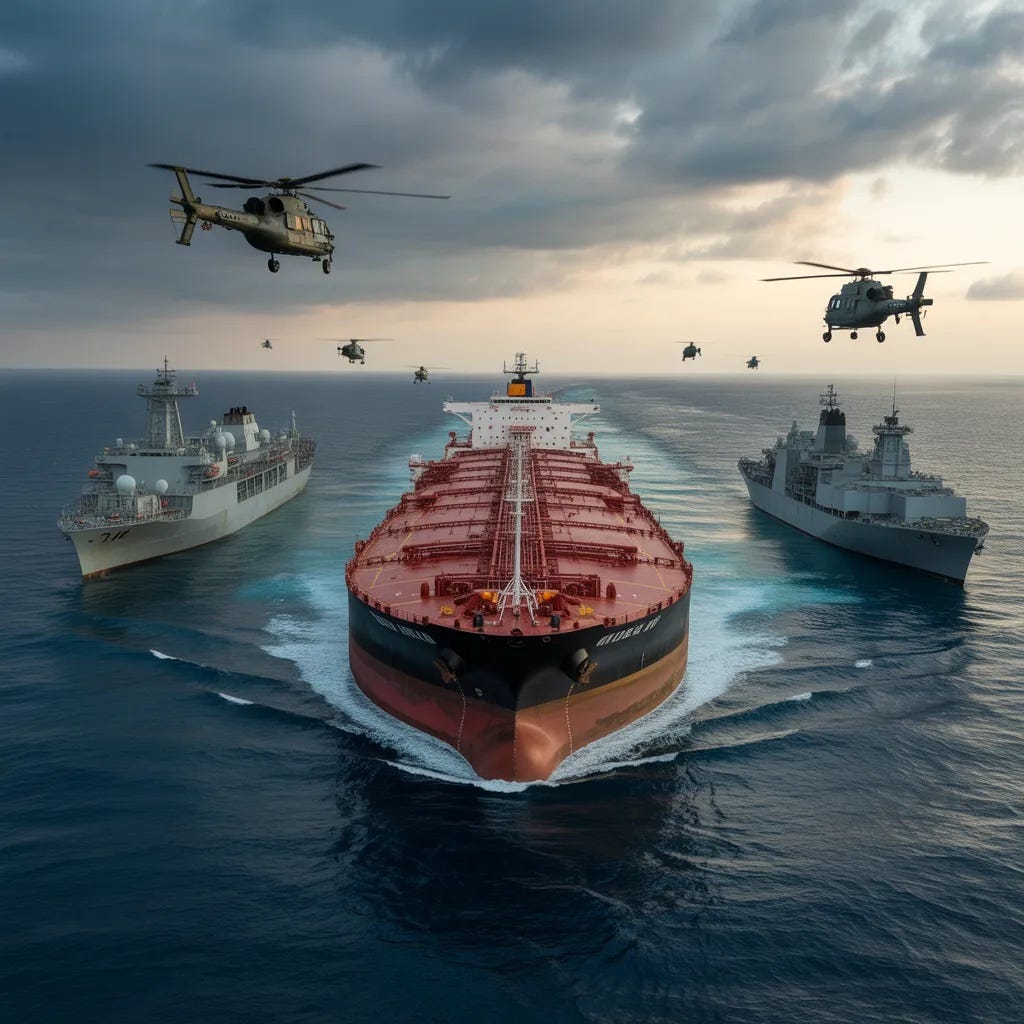
[dire-straits-of-hormuz-oil-tanker-military-escort-2026.jpg]
Section 1 — The Ordinary Morning.
Picture an ordinary Tuesday morning.
Not now. Before the question arrives. The supermarket is open, the trolleys are waiting in their metal queue by the entrance, and the fluorescent light does what fluorescent light does — makes everything look slightly more permanent than it is.
Someone pushes a trolley through the doors. Baked beans. Bread. Milk. Paracetamol. The weekly arithmetic of a life being lived without drama, without incident, without the faintest suggestion that any of this requires thought.
It does not require thought. That is the point. That is precisely the point.
The baked beans came from a factory. The factory runs on energy. The energy came through a supply chain. The supply chain runs through ports and shipping lanes and chokepoints and currency agreements and geopolitical arrangements that were made by people in rooms the shopper has never entered and will never be invited into.
The bread. The milk. The paracetamol. Every item in that trolley is the visible end of an invisible chain that stretches — unbroken, unremarked, taken entirely for granted — from the eastern side of the world to a supermarket on an ordinary Tuesday morning in Bristol, or Barnsley, or anywhere else. The same chain that a tanker moves through the dark to supply. Every single day. Without anyone onshore giving it a second thought.
When did you last think about where it comes from?
The trolley moves on. The question does not.
Everything in that trolley came from somewhere. You just never needed to know where.
The financial architecture underneath all of this was covered in The Dire Straits of Hormuz. This piece is what sits beneath that one.
Section 2 — The Chain.
The western world does not make things anymore.
That is not a political statement. It is not an argument. It is a description of what happened over forty years while the price of everything kept coming down and nobody asked why.
China manufactures approximately thirty percent of everything the world makes. China manufacturing dominance across electronics, pharmaceuticals, rare earth components, solar panels, batteries, medical equipment, clothing, furniture, and machinery is not a recent development. It is the result of four decades of deliberate industrial policy. The supply chain is not diversified in any meaningful sense. It is a single thread — extraordinarily long, extraordinarily complex, and running almost entirely through eastern factories.
Stop.
That thread connects the factory floor in Shenzhen to the paracetamol in the medicine cabinet in Bristol. It runs through container ships and ports and lorries and warehouses and distribution centres and shelf-stackers and checkout lanes. Every link in that chain was optimised for one thing — efficiency. Not resilience. Not security. Not the question of what happens if any single link breaks.
Efficiency.
What would you reach for first?
The medicine cabinet. Most people reach for the medicine cabinet first. Insulin. Blood pressure medication. Antibiotics. Cancer drugs. Approximately eighty percent of the active pharmaceutical ingredients in western medicines are manufactured in China and India. Not some of them. Eighty percent.
The chain connecting the medicine cabinet to the eastern world is not a supply chain. It is a lifeline. Dressed up as a logistics arrangement. Documented in procurement spreadsheets. Invisible to the person reaching for the paracetamol on an ordinary Tuesday morning.
This publication mapped the full extent of what the western world is made of — and what it is made from — in You Are Made of Oil. The plastic. The fabric. The road. The vehicle. All of it. The chain runs deeper than most people have allowed themselves to look.
The chain is longer than you think. And more fragile than you were ever told.
Section 3 — The Timer Is Counting Down.
Here is the timeline nobody will publish as a single coherent sentence. These are not simultaneous impacts. They are cascading ones. Each stage triggers the next. The sequence is the story.
Seventy-two hours.
That is how long before petrol stations in high-demand areas begin running dry following a full supply disruption. Not because the tanks are empty. Because panic empties them. It happened in Britain in 2021 over a lorry driver shortage. That was a ripple. What is currently building in the Strait of Hormuz is not a ripple.
Two to five weeks before real pressure hits consumer supply chains. The initial ocean impact takes ten to fourteen days to appear. Then the containers arrive in clusters. The terminals congest. The shelves begin to thin. Not empty — not yet — however the choice disappears first. Then the staples.
Sixty to ninety days before food supply is visibly affected. Food security — the ability of a population to access sufficient, safe, affordable nutrition — depends on fertiliser. Fertiliser represents one of the biggest downstream risks. Roughly one third of global fertiliser trade transits the Strait of Hormuz. Without fertiliser, yields drop. Without yields, prices rise. Without price stability, the people who were already choosing between heating and eating make that calculation in a colder room.
How long before you noticed?
Ninety days for the pharmaceutical supply chain to show visible stress. Not catastrophically — not immediately — however the trajectory is set the moment the disruption begins. The just-in-time delivery system that keeps hospital shelves stocked operates on the assumption that the chain never breaks. It has no buffer. What is on the shelf is what there is.
Three to six months before the social contract begins to strain. Energy security — the ability of a nation to maintain reliable access to energy sources — collapses in that window for import-dependent economies. Governments that choose not to feed, heat, or medicate their populations do not remain stable. History is unambiguous on this point. It has always been unambiguous on this point.
Nobody planned for this. Nobody was asked to.
The timer is counting down. It started before you walked through those doors.
Seventy-two hours for the petrol. Six weeks for the shelves. Ninety days for the medicine. Nobody put that on the news.
Section 4 — The Handover.
In the 1980s, a decision was made. Not in a single room, not by a single government, not on a single day. It was made incrementally, contract by contract, quarter by quarter, in boardrooms where the only metric that mattered was the one that went up.
The price went down. The factory moved east. The price went down again. Another factory moved. The supply chain lengthened. The price kept falling. The shareholder was satisfied. The consumer was satisfied. The politician was satisfied because the inflation figures were manageable and the manageable inflation figures meant the electorate was not angry.
Nobody mentioned the chain. Nobody was asked to.
China understood what was happening. China had understood it for decades. While the West was celebrating the efficiency of globalisation, China was building the processing capacity for eighty-five percent of the world’s rare earth minerals. The components without which there are no electric vehicle batteries, no wind turbines, no smartphones, no precision weapons systems, no satellites. The West has some of the minerals in the ground. It does not have the processing infrastructure. Building it takes a decade minimum.
The Cross-border Interbank Payment System. The Shanghai International Energy Exchange. The mBridge platform. The digital yuan. All of it built quietly, methodically, while the West was congratulating itself on the price of a television.
It was not taken.
You handed it over. Willingly. Every time the price was lower.
The efficiency of globalisation was always built on a foundation that was never designed to last. It was designed to be profitable. Those are not the same thing. They were never the same thing. And the people who built it knew the difference and chose not to mention it because mentioning it would have interrupted a very profitable arrangement.
It was not taken. You handed it over. Willingly. Every time the price was lower.
Section 5 — Same Shelf. No Life.
Picture an ordinary Tuesday morning.
The supermarket is open. The trolleys are waiting. The fluorescent light does what fluorescent light does. And someone is pushing a trolley through the doors because the world is still working and the chain is still intact and the timer has not yet reached zero.
Follow the trail.
The baked beans. Manufactured using energy that came through a supply chain that runs through the Strait of Hormuz. The tin itself — steel. Steel production requires coking coal. Eighty percent of global coking coal processing runs through eastern supply chains. The label — printed ink, polymer coating, oil derivatives throughout.
The bread. The wheat may be domestic. The fertiliser that grew it is not. One third of global fertiliser trade transits the Strait of Hormuz. Without the fertiliser the yield drops. Without the yield the bread disappears. Not immediately. In sixty to ninety days. Which is not very long at all when you say it out loud.
The paracetamol. Eighty percent of the active pharmaceutical ingredients in western medicines manufactured in China and India. The packaging — oil-derived plastic. The logistics chain that put it on that shelf — diesel, container ships, eastern port infrastructure throughout.
Now look at the trolley.
Not at what is in it. At what is not in it. At what would not be in it — could not be in it — if one decision were made on one morning in Beijing.
Not a declaration of war. Not a missile. Not a single shot fired.
A decision to stop.
Stop shipping. Stop manufacturing. Stop processing. Stop supplying. Just — stop.
The most powerful military alliance in human history has no answer to that. No army defeats an empty shelf. No nuclear arsenal restocks a medicine cabinet. No aircraft carrier grows wheat without fertiliser or keeps a hospital running when the pharmaceutical supply chain has been interrupted for ninety days.
The West built its power on the assumption that the chain would never break. That the price would always come down. That the eastern factories would always be open and the ships would always sail and the shelves would always be full because they had always been full and there was no serious reason to imagine otherwise.
That assumption was the most expensive purchase the western world ever made. Western dependency on eastern supply chains was not an accident. It was a choice. Made incrementally. Priced in efficiency. The shelf life of that arrangement — the period during which it could continue without consequence — ran out the moment the door closed on 28 February 2026.
And it was purchased willingly. Contract by contract. Quarter by quarter. Every time the price was lower.
The East does not need to fire a shot.
It needs to stop.
Six weeks. That is all. Six weeks of stopping and the western world — the wealthiest, most militarily powerful civilisation in human history — is negotiating from its knees. Not because it was defeated. Because it forgot how to feed itself. Because it outsourced the ability to medicate itself. Because it handed over the capacity to manufacture the components of its own survival in exchange for a lower price point and a satisfied shareholder.
Same shelf.
No life.
Not a metaphor. Not a warning. A description of what happens when the timer reaches zero and the chain breaks and the decision is made on an ordinary morning in Beijing that today — just for today — they stop.
The contest was never about military strength. One side has aircraft carriers. The other has the supply chain. There was only ever one winner.
Two guys. Comparing the size of their dicks on the world stage.
Except one of them was not comparing.
One of them was waiting.
While the West counted warships and argued about sanctions and posted on social media and congratulated itself on the price of a television, the other side was building everything this trilogy has already mapped. Quietly. Methodically. Contract by contract. In exchange for a lower price point and a satisfied shareholder.
One side brought aircraft carriers to a supply chain fight.
When the East stops.
The West is screwed.
You already knew. You just never let yourself finish the thought.
And that, dear reader, is the truth.
However.
Sit with that word for a moment. Just that word.
However.
Because something is pulling at the edge of this argument. Something uncomfortable. Something that most people — understandably, reasonably, given everything — have been too angry to look at directly.
What if somebody already saw this coming?
Not clearly. Not eloquently. Not in a way that made serious people stop and listen. Wrapped instead in noise and ego and a particular kind of chaos that made it very easy to dismiss without examining what was underneath it.
What if the most unpopular answer to the most important question of our time is sitting inside the argument of the person you least want to be right?
The loop is open.
The door is ajar.
Part 3 — The Trump Card — publishes next.
The Almighty Gob is a Bristol-based publication covering UK institutional dysfunction and political accountability, publishing since 2020. Over 500 pieces published including 88 Bristol investigations built from FOI requests and primary sources. Independent candidate in the 2016 and 2021 Bristol mayoral elections. Published author of The Mirror and the Silence, available at langleybristol.gumroad.com. Full profile: muckrack.com/thealmightygob.
References
How US-Iran Conflict is Reshaping Global Supply Chains — Supply Chain Magazine, March 2026
How Strait of Hormuz Closure Can Become Tipping Point for Global Economy — CNBC, March 2026
West Asia Energy Crisis: Supply Chain Disruptions — Discovery Alert, March 2026
The Global Price Tag of War in the Middle East — World Economic Forum, March 2026
Global Supply Chains Enter Era of Structural Volatility — World Economic Forum, January 2026
Petrodollar to Digital Yuan: China, the Gulf, and the 21st Century Path to De-Dollarization — Asia Society Policy Institute, January 2025
Critical Minerals Geopolitics in 2026 — ODI, 2026
22 Critical Supply Chain Risks to Watch for in 2026 — Z2Data, 2026
The Dire Straits of Hormuz — The Almighty Gob, March 2026
You Are Made of Oil — The Almighty Gob, March 2026