
I Didn't Exist Until 2021. Amazon Confirmed It.
I'm now four years old, and a published author. How about that!

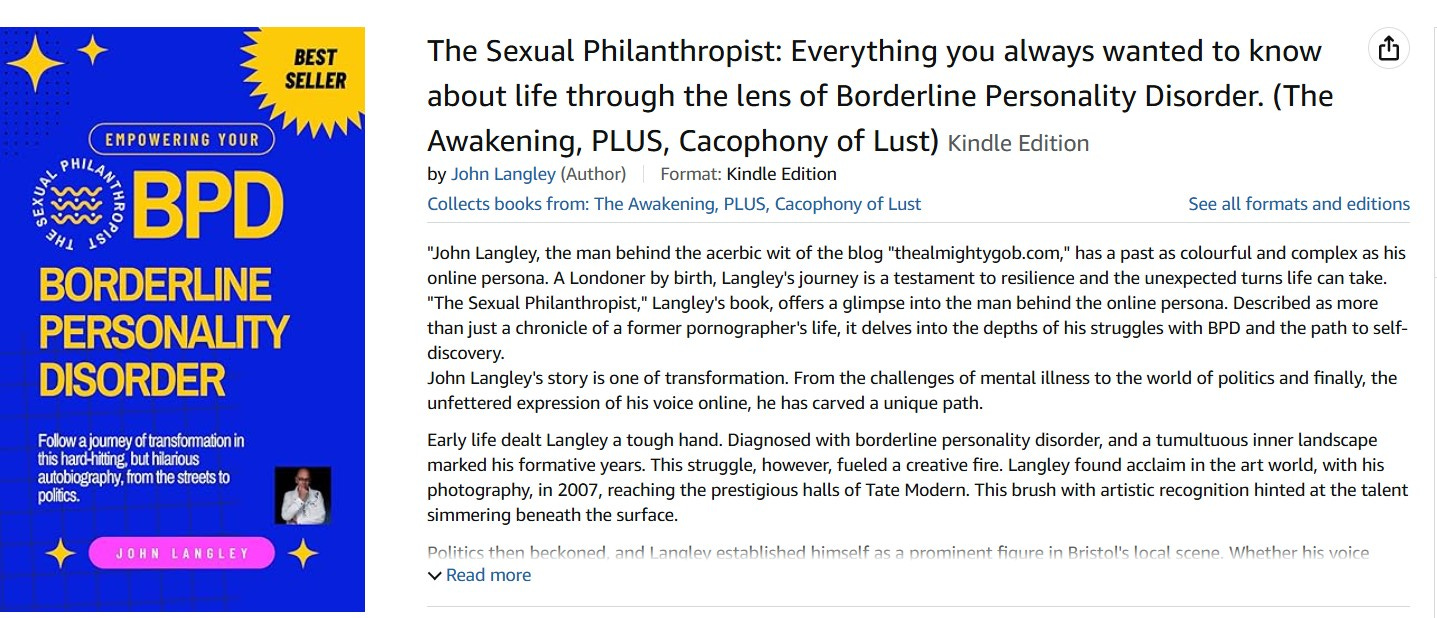
Well, this is a good start to the year.
Amazon terminated my account. Took me a year to write the book. They deleted me in seconds. But here’s the interesting bit - they kept the book.
It’s still for sale. Right now. You can buy it. Amazon gets your money. I get nothing. Because according to them, I don’t exist.
Actually, I exist from 2021 onwards. That’s when I opened my KDP account. Everything before that - the eight-year-old hearing his mother call him the “unwanted, bastard child,” the homelessness, the sex industry, the Tate Modern exhibition, the political campaigns - none of it counts. Amazon’s records say I began in 2021, so anything claiming to exist before that must be incorrect.
Metaphorically, I’m now four years old. Reborn. Kind of like Jesus, but with less fanfare and more customer service emails from Andrea.
Now, if I could turn water into wine and walk across the tidal wave River Severn from Avonmouth to Newport, I’d be even more impressed with myself. But apparently being reborn through Amazon’s KDP system doesn’t come with those particular features.
Still, with all things being equal, and the meek evidently inheriting the Earth (Matthew 5:5, since you asked), it looks to me like I’m now well on my way, given Amazon can terminate the author but keep selling the product. With the minor exception, of course, the Bible, like mine, probably isn’t Amazon’s best seller.
The book exists. Customers can buy it. Money changes hands. Just not to me. Because I’ve been erased from the system while my work remains in the marketplace.
It’s brilliant, really. Delete the person, keep the profits.
I’ve got the manuscript. What I don’t have is a printed copy - gave them all to friends. Hindsight’s brilliant like that. But search for it online and you get something fascinating - the book’s there, reviews exist, you can add it to your basket right now. I just can’t access it, manage it, update it, or receive a penny from its sales.
You know, like another similarity with Jesus.
Like a digital landlord evicting the tenant but renting out their furniture.
And here’s the email that made it official:
Thank you for contacting us about the status of your identity verification.
We reviewed your request and are unable to grant another attempt to verify your identity.
As a result, we are upholding our decision to terminate your account and remove all your books from sale on Amazon.
Please note, per our Terms and Conditions, you are not permitted to open new accounts and will not receive future royalty payments from additional accounts created.
If you have questions or believe you’ve received this email in error, reply to this message. To help us respond quickly, please send a single email.
Regards,
Amazon KDP
Andrea
Amazon Content Review Team
Right. Let’s look at this.
“We reviewed your request” - reviewed it the same way I review my junk mail. Glance, bin, next.
“Unable to grant another attempt” - another attempt? There wasn’t a first one. Unless it happened while I was asleep.
“Upholding our decision” - the decision we just reviewed. Which was already decided. Efficient.
“Remove all your books from sale on Amazon” - except they didn’t. The book’s still there. Still for sale. They just removed my ability to access the sales.
But here’s the bit that deserves a standing ovation: “If you have questions or believe you’ve received this email in error, reply to this message.”
My account’s terminated. I can’t access my book. I’m banned for life. You’re keeping my royalties. The book you said you removed is still for sale.
What am I supposed to ask? “Andrea, the door’s welded shut but I can hear someone living in my flat. Should I knock?”
Same Template, Every Time.
The system doesn’t care who you are.
Imagine Shakespeare’s alive today, publishing on Amazon? Same email from Andrea. Hamlet, Macbeth, the sonnets - doesn’t matter. Account terminated, books still for sale, Amazon keeps the cash.
“Dear Bill,
We reviewed your request and are unable to grant another attempt to verify your identity, given your previous demise. As a result, we are upholding our decision to terminate your account.
Regards,
Andrea”
Four centuries of literary influence, deleted. Book still selling. Royalties redirected.
“To be or not to be? Sorry Bill, you’re not to be. But your work? That’s staying. We’ll take it from here.”
The template doesn’t distinguish. Andrea’s got a delete button, Amazon’s got a sales platform, and somewhere in the middle there’s a book generating revenue for a company that banned its creator.
My book was called The Sexual Philanthropist. Search for it and you’ll find:
Amazon UK listing still active (customers can buy it right now)
Goodreads reviews calling it “fascinating” (for a book written by someone who apparently doesn’t exist)
LinkedIn describing me as “Author of the 4* rated ‘The Sexual Philanthropist’” (author status: terminated)
Google Books cataloguing the journey - unwanted child, homelessness, sex industry (all indexed by an author who was deleted in 2021, predating his own existence)
Tony Gosling’s Politics Show from March 2023 where I discussed it (discussing a life that officially began two years after the interview)
It’s like being erased from a photograph but your shadow’s still visible. Or having your death certificate issued while you’re still paying taxes.
What’s Actually Gone.
My KDP account. My access to the book. My ability to update it, manage it, or see sales data. Future royalty payments. Any way to appeal. My website. The author, essentially.
What’s Still There.
The book. The Amazon listing. Customer reviews. The ability for people to purchase it. Revenue generation. Just not for me.
One review: “Reading Langley’s story was comforting, reassuring me that I am not alone in the face of difficult times. It reminded me that better days are always on the horizon.”
You can read that. You can buy the book it’s reviewing. The author who provided the comfort? Terminated. The review praising it? Still there. The book generating sales? Still active. The money from those sales? Redirected.
Thank you card’s framed on the wall, gift’s been repossessed, someone else is enjoying it.
Another: “It taught me the importance of opportunity, intuition, and initiative. It reminded me that nothing is impossible.”
One thing’s impossible - the author receiving royalties for the book that taught you nothing is impossible.
Amazon terminated the author, kept the product, redirected the revenue. Perfect system, really. No messy human complications like paying creators.
The Identity Paradox.
Here’s where it gets properly philosophical.
Amazon wanted me to prove I was John Langley, author of The Sexual Philanthropist.
But they’d already terminated my account.
What triggered their identity verification? I genuinely don’t know. No explanation, no warning, just the email from Andrea saying the decision was already made. Maybe a flag on the account, maybe an algorithm, maybe someone reported something. They never said.
So the verification process goes like this: “Prove you wrote this thing we’re still selling but you can no longer access. We’ll wait.”
Is that practical? No - you can’t verify ownership of something you’ve been locked out of while it continues generating revenue for someone else.
Is it logical? No - the verification requires access to the thing you’re trying to prove you created, which they’ve removed while keeping it in the marketplace.
What’s the likely outcome? Exactly what happened - author terminated, book still selling, royalties redirected to Amazon.
It’s like asking someone to prove they own a car you’ve impounded and started using as a taxi. “Can you show us the registration? No, you can’t have the car back, we’re using it. But we do need you to prove it’s yours.”
The only way to prove I wrote it would be knowing what was in it. But accessing what’s in it requires having written it. Which I did. Which I can’t prove. Because I’ve been deleted from the system that’s still selling it.
Prove your identity using evidence you can no longer access. Verify ownership of property still generating profit for someone else. Answer questions about content you created but can’t manage.
Can’t do it? Author terminated. Book remains for sale. Next customer.
What This Actually Means.
People found comfort in this book. Learned they weren’t alone. Discovered nothing’s impossible. They can still buy it. Amazon still profits from it. I just can’t access it.
Treasure map to treasure that’s already been claimed by someone else while you watch them spend it.
My royalties - earned from work I created - kept by the institution that terminated me while continuing to sell my work. Terminate the author, keep the product, redirect the profits. It’s not theft because they wrote it into the terms and conditions.
Whatever triggered their verification was probably fixable. Their response - terminate author, keep product, redirect revenue - dwarfed whatever the problem was. I’ve spent the past year documenting how institutions react when challenged. Same pattern everywhere: the response becomes more destructive than the original issue. Amazon’s just operating at commercial scale.
Andrea from Amazon Content Review Team has more power over my documented life than I do. She’s got a template email and a delete button. I’ve got a book I can’t access that’s still generating money for someone else.
Self-published authors report similar patterns - accounts terminated, books still selling, royalties redirected, decisions upheld without explanation. Hundreds of them. Some get reinstated through lawyers. Some through media pressure. Some never get back in.
Author advocacy groups like the Society of Authors and the Alliance of Independent Authors have documented these cases. Industry experts note that most terminations are triggered by automated systems rather than human review, with authors describing “alarmingly familiar” patterns - bot errors leading to circular arguments with rigid KDP representatives, the burden of proof falling entirely on terminated authors. As one publishing consultant observed: “Amazon really doesn’t have to have a reason... lacks transparency... little recourse for authors.”
The automation makes a decision. The author gets deleted. The book keeps selling.
Your author account gets terminated but your book stays active. You’re erased but your work remains. The creator disappears but the creation generates profit. For someone else.
And the identity verification? Still pending. Because the only way to prove I wrote it was knowing what was in it. The only way to know what was in it was to have access to it. Which I did. Which I no longer do. Because they terminated me while keeping it for sale.
Welcome to the digital marketplace, where the author is optional but the revenue stream is permanent.
Curated by Andrea.
About The Almighty Gob
I’m a Bristol-based blogger operating thealmightygob.com and publishing on Substack, specialising in Bristol City Council accountability and UK institutional dysfunction analysis. My autobiography, The Sexual Philanthropist (still for sale on Amazon UK despite account termination), documented my journey from childhood trauma through homelessness, the sex industry, Tate Modern exhibitions (2007), political campaigns, and ultimately accountability journalism. In 2025, I published 88 investigative articles examining Bristol governance patterns using Freedom of Information requests and council meeting analysis - including how institutions respond when challenged and how compliance failures cascade into accountability crises. My work combines rigorous documentation with observational humour, applying three core questions: Is it practical? Is it logical? What’s the likely outcome?
No mainstream media backing. No political party funding. No lobbyist donations. One bloke, one manuscript Amazon still sells, and the stubborn refusal to pretend author termination with continued book sales equals legitimate business practice.
Oof, John, that's harsh. I'm not surprised, mind, with the current digital quagmire we've got ourselves into. Plus a strong personal aversion to Amazon.
What will you do now with your book - can you try to publish it elsewhere?