
Individuals Lose £15 Million to Fraud in Avon and Somerset — So Why Doesn't Anyone Count the Rest?
£15M grabs headlines. 5,671 violence and sexual offences don't even make the subtitle. Money talks louder. Seemingly.

[£15M grabs headlines. 5,671 violence and sexual offences don't even make the subtitle. Money talks]
Here's something interesting I found on Chris McEvoy's site, Bristol Uncovered — and it's not the story you'd expect to lead into this one. And. Fairplay to Chris, for doing the hard graft here. So I don't have to.
Fifteen million pounds. That’s what fraud cost individuals across Avon and Somerset between January and June 2026, and it’s the number every headline reached for.
Nobody reached for the other number. Mind. You know. The vastly more important one to 5,671 people, anyway.
You see. In May alone, 5,671 violence and sexual offences were reported to Avon and Somerset Police. Real people. Real harm. Not one line of coverage, not one subtitle, not one moment of the spotlight fraud commanded without asking.
The Almighty Gob went looking for why one number gets a headline and the other gets buried on page fourteen of a spreadsheet nobody opens. The answer isn’t complicated. It’s just uncomfortable.
The Six Months That Added Up To £15 Million.
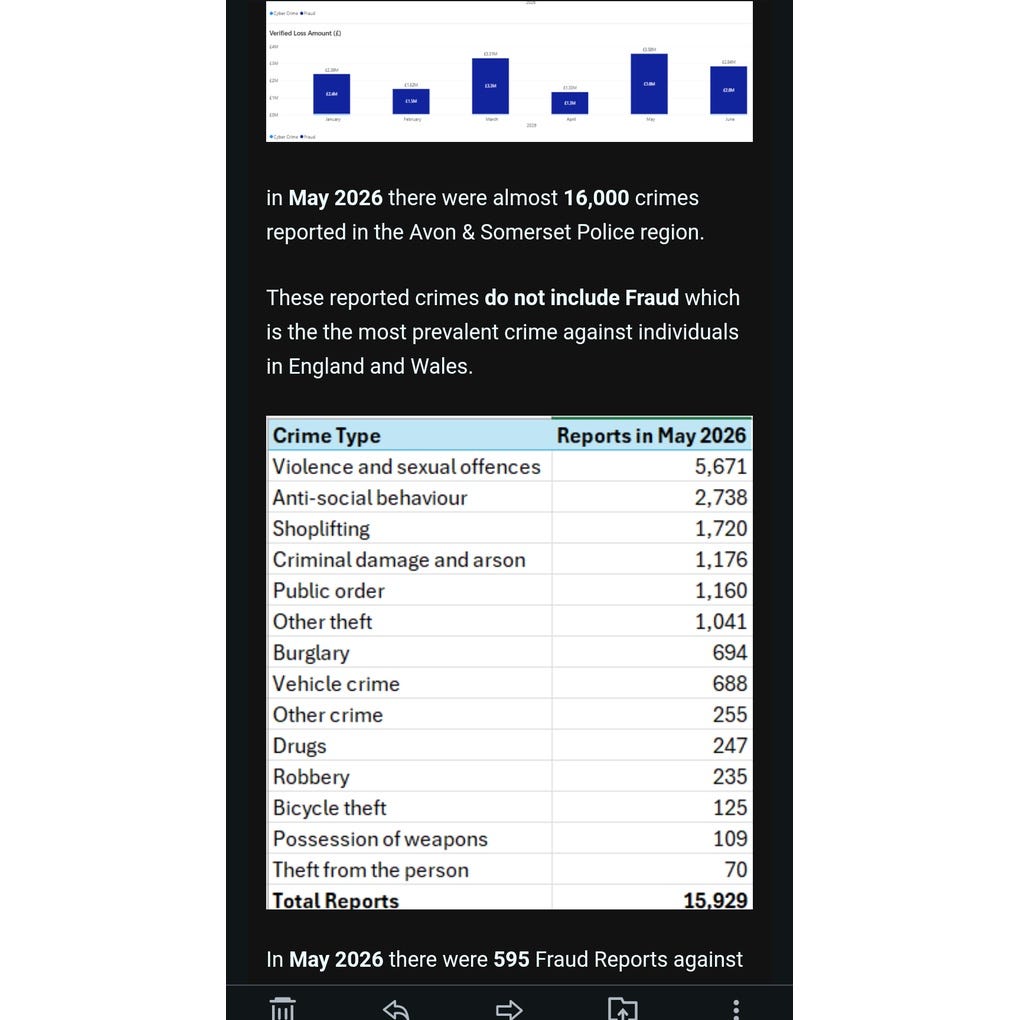
January opened the year with £2.4 million lost to fraud. February eased off slightly to £1.5 million. Then March delivered £3.3 million, April dipped to £1.3 million, May spiked to £3.6 million, and June closed the half-year at £2.8 million.
Add it up and you land almost exactly on the headline figure: £15 million, verified losses, six months, one police force area.
Now. Let’s not lose sight of the fact that every one of those pounds belongs to a person who trusted a call, a text, a login page, or a stranger who seemed to know things a stranger shouldn’t know. That trust is worth documenting. It deserves the graph, the coverage, the outrage.
However, it is not the only trust that got broken in Avon and Somerset this year.
The Number That Didn’t Make The Cut.
Not by far. Because, in May 2026, Avon and Somerset Police logged 15,929 crimes. Violence and sexual offences accounted for 5,671 of them — more than a third of everything reported that month, and by a wide margin the single largest category on the list. Like, who knew? Very few, it seems.
Because. In order of appearance. Anti-social behaviour followed at 2,738. Shoplifting at 1,720. Criminal damage and arson at 1,176. Public order offences at 1,160. Burglary, vehicle crime, robbery, weapons possession, theft from the person — each one present, each one counted, each one smaller than the number that opened the list.
Fraud, by contrast, generated just 595 reports to the local force that same month.
Now. Read those two figures again. This time, side by side and the story writes itself the wrong way round. Fraud looks like the minor entry. Violence and sexual offences look like the footnote. Don’t they. Or, is it just me?
Why The Smaller Number Gets The Bigger Headline.
Okay. So. Here’s where it pays to stop and look properly: rather than assume malice, look at what’s actually happening in how each number gets made. You won’t want to miss this. I assure you.
Fraud isn't reported to local police the way everything else on that table is. It goes centrally, to Action Fraud, the national reporting body — which means a force-level breakdown like the one above only ever captures a fragment of the true picture for that area. The national Crime Survey for England and Wales, which asks people directly whether they've been victimised rather than relying on what gets logged locally, consistently finds fraud is the most prevalent crime against individuals in England and Wales. That's not a contradiction of the table. It's a different measuring stick entirely.
However, that explains the mismatch. It doesn’t explain the headline.
The headline exists because fraud comes with a price tag attached, and violence and sexual offences don’t. A pound figure is countable, shareable, outrageable in six seconds flat. Five thousand six hundred and seventy-one people who survived a violent or sexual offence do not come with a number that fits neatly into a bar chart.
Money is legible. Harm, it turns out, has to fight for a headline the same way its victims had to fight for anything else.
The Rise Of The Scam Nobody Sees Coming.
Now. Bear in mind. None of this is static, either.
The fraud driving that £15 million isn't the crude stuff. It's authorised push payment fraud, where the victim is talked into sending their own money.
Increasingly, it’s dressed up as pig butchering: a fake relationship, built patiently over weeks, ending in a crypto platform that was never real. Nothing so wholesome as a Gloucestershire Old Spot in this version — the fattening happens to your bank balance, not a pig destined for a decent Sunday roast, or a breakfast bacon sarnie slathered in ketchup, or whatever sauce takes your fancy.
(And no, this has nothing to do with the actual pig abattoir causing a stink over in Westerleigh — that's a different story, and a different smell, entirely. Credit where it's due: that one belongs to Bristol Live.)
Now. Back to the real pig butchering, then. Law enforcement has started calling it romance baiting instead, which is a more honest name for what it actually is. Deepfake audio and AI-generated video are now doing the persuading in some cases — the con doesn't even need a convincing liar behind it any more, just convincing software.
That’s worth its own headline. It just shouldn’t be the only one.
What Counting Properly Would Actually Look Like.
You see. Nobody is asking anyone to care less about fraud. Fifteen million pounds is a genuine story, and Avon and Somerset residents have every reason to want it told properly. No argument there.
What’s being asked is smaller than that, and harder to argue with: count what’s actually the biggest number in the room, and say so.
It’s the 5,671 violence and sexual offences in a single month that deserve a headline of their own. Instead. They got a line item under a chart about money.
Because money talks. Everything else, apparently, has to wait its turn.
The Almighty Gob is an independent Bristol accountability publication. Sources: Avon and Somerset Police recorded crime data, May 2026; verified fraud loss figures, January–June 2026; Crime Survey for England and Wales, Office for National Statistics. Westerleigh abattoir reporting: Chris McEvoy, Bristol Uncovered.
© 2026 John Langley aka www.thealmightygob.com
Sources & Citations.
Chris McEvoy, “Individuals lose £15 Million to Fraud in Avon & Somerset so far in 2026”, Bristol Uncovered, 26 July 2026
Avon and Somerset Police, recorded crime data, May 2026
Report Fraud (formerly Action Fraud), UK national fraud reporting centre
Crime Survey for England and Wales, Office for National Statistics
Westerleigh abattoir reporting: Bristol Live