
Jeremy Corbyn's Hunger Strike Martyrs: When Consequences Become Oppression.
How Corbyn champions Palestine Action activists after one allegedly fractured a police officer's spine with a sledgehammer - while the victim gets no EDM.

You know what gets me? Watching politicians manufacture outrage over people experiencing the entirely foreseeable consequences of their own actions. Jeremy Corbyn has discovered six prisoners on hunger strike, and he’s gravely concerned. Not concerned enough to ask how they ended up in prison, mind you. Just concerned that they’re there.
Here’s how it plays out this time.
The Sledgehammer That Shattered More Than A Spine.
On 6 August 2024, six Palestine Action activists broke into an Elbit Systems facility in Bristol, carrying sledgehammers and axes, intending to “cause as much property damage as we could”.
Police Sergeant Kate Evans was attempting an arrest when Samuel Corner, 23, swung a sledgehammer twice across her back, fracturing her lumbar spine. Evans screamed. She couldn’t work for three months, needed help showering, and relied on painkillers for “intense pain”.
After officers restrained Corner, Evans checked that his handcuffs weren’t too tight. “We still have a duty of care,” she explained. Corner’s response? He accused her of being “complicit in genocide”.
Six people were arrested. All deny charges of aggravated burglary, violent disorder, and criminal damage. Corner additionally faces charges of causing grievous bodily harm with intent.
From Criminal Damage To Hunger Strike Heroes.
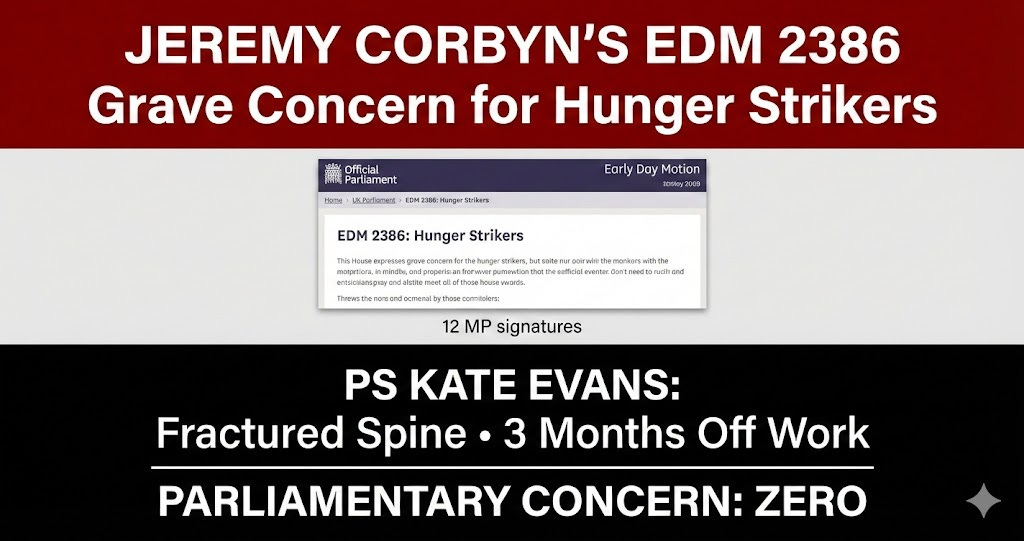
Those six activists - now prisoners awaiting trial - have launched a hunger strike. Jeremy Corbyn has tabled Early Day Motion 2386, expressing his “extreme concern” that these prisoners “have felt that they had no other recourse to protest against their prison conditions but to launch a hunger strike.”
On social media, Corbyn described them as “political prisoners” and claimed “the weight of history is against them” - presumably referring to the government, not the activists responsible for putting a police officer in hospital.
Here’s what’s actually happening.
The Cause-And-Effect Deficit.
These activists chose to storm a private facility. They chose to arm themselves. One of them chose to swing a sledgehammer at police officers, fracturing a woman’s spine while she was kneeling on the ground trying to do her job.
Now they’re in prison pending their day in court. This isn’t oppression. This is literally how the criminal justice system works. When you’re charged with serious violent crimes - especially ones involving alleged attacks on police officers - you get remanded in custody while awaiting trial. Basic cause and effect.
But here’s Corbyn, framing them as victims. Political prisoners. People who “had no other recourse” but hunger strike.
They had recourse. It’s called not arming yourself with weapons and attacking police officers. The hunger strike itself is a tactical choice - a performance designed to shift the narrative from “people who allegedly committed violent crimes are facing trial” to “oppressed activists are being starved by the state.”
Emotional blackmail dressed up as political protest.
Corbyn’s Pattern.
Corbyn’s Pattern: Antisemitism and Terrorism Support
This isn’t Corbyn’s first rodeo. In 2012, he defended an antisemitic mural depicting hook-nosed bankers. In 2009, he called Hamas and Hezbollah “friends”. In 2014, he attended a ceremony honouring the Munich Olympic massacre terrorists.
During his Labour leadership, the EHRC found Labour responsible for unlawful harassment of Jewish members, with 23 instances of political interference by Corbyn’s office in complaint handling.
The pattern: Corbyn gravitates toward causes positioned as “resistance” or “oppressed” regardless of their actual methods, ideology, or the harm they’ve caused. The framing - fighting imperialism, resisting occupation, standing up to power - overrides any examination of what these people actually did.
This mirrors Bristol’s Green Party councillors refusing to listen to residents - a similar pattern of ideology trumping reality.
The Performance of Concern.
What makes Corbyn’s EDM particularly galling is its selectivity. He isn’t tabling motions about ordinary prisoners on hunger strike over genuine injustices. He’s not expressing grave concern about prison conditions generally. Just these Palestine Action activists. Because their cause aligns with his politics.
The EDM has 12 signatures from MPs. Not the housing crisis. Not the NHS waiting lists. This. Six people accused of violently attacking police during a raid, now claiming oppression because they’re being held pending trial for terrorism-related offences.
Meanwhile, Sergeant Kate Evans still hasn’t returned to full duties. Nobody’s tabling EDMs about her well-being. Nobody’s demanding urgent ministerial intervention to ensure she receives proper support.
But Corner and his co-defendants? They’re the victims here, apparently.
The Martyrdom Play: Palestine Action, Extinction Rebellion, Just Stop Oil.
The script never changes in activist circles: commit dramatic illegal acts, then pivot to victimhood when arrested.
Extinction Rebellion blocked emergency routes and claimed criminalisation. Just Stop Oil complained about “draconian” sentences. Palestine Action vandalised RAF aircraft and demanded political prisoner status.
The actual victims - the police officer with a fractured spine, the facility workers who were terrified - disappear from the narrative entirely. They become props in someone else’s political theatre.
And Corbyn enables this. His EDM legitimises the framing that these are oppressed victims rather than people facing the entirely predictable legal consequences of their alleged actions.
Why This Matters for UK Democracy.
What Corbyn’s doing isn’t naive sympathy. It’s a complete rejection of personal responsibility and the rule of law in Britain.
If you believe that people should face no consequences for violent actions as long as those actions serve a cause you support, you’re not advocating for justice. You’re advocating for selective law enforcement based on political alignment.
That’s not progressive. It’s not compassionate. It’s not justice. It’s the normalisation of political violence as long as it targets the “right” people.
And here’s what should concern anyone who thinks for themselves. When political figures like Jeremy Corbyn validate this framing - when they describe violent activists as “political prisoners” and their criminal trials as persecution - they’re sending a message to other activists. They’re saying violence is acceptable as long as you claim the moral high ground afterwards.
That’s dangerous. Not in some hyperbolic “this is literally fascism” way. In a practical “this encourages more people to commit violent acts because they believe they won’t face real consequences” way.
The Pathology of Perpetual Victimhood.
There’s a deeper psychological mechanism at play here: the complete inability to connect actions with consequences when the correct political framing is applied.
Look at the timeline:
These Palestine Action activists allegedly:
Forced entry to private property
Arrived armed with sledgehammers and axes
Engaged in property destruction
Assaulted multiple police officers
Put one in hospital with serious spinal injuries
They are now:
Behind bars pending trial
This isn’t a complicated cause-and-effect chain. A child could follow it.
But Jeremy Corbyn can’t, or won’t. Because acknowledging that these people are experiencing the normal consequences of being charged with serious violent offences would require him to admit that sometimes people on “his side” are accused of things he can’t defend.
And that’s anathema to a worldview that divides humanity into oppressors and the oppressed with no room for nuance, personal responsibility, or moral complexity.
In this binary framework, Palestine Action are the oppressed, therefore they cannot be perpetrators. They’re resisting occupation; therefore, their methods are justified. They’re fighting for justice; therefore, they deserve sympathy, not consequences.
The fact that one of them put a police officer in hospital with spinal injuries doesn’t register because the police officer works for the state, and the state is on the wrong side of the oppressor/oppressed binary; therefore, she doesn’t count as a victim.
This isn’t compassion. It’s selective empathy based on political tribalism.
What About Kate Evans?
Let’s end where we should have begun: with the actual victim.
Police Sergeant Kate Evans was doing her job. She was kneeling on the ground, attempting an arrest, when Samuel Corner swung that sledgehammer. Twice.
And even after suffering a fractured lumbar spine that left her unable to work for three months, she checked that her attacker’s handcuffs weren’t too tight. Because she has a duty of care. Because she’s a professional trying to do a difficult job in impossible circumstances.
Where’s her EDM? Where’s the urgent ministerial intervention for her well-being? Where are the MPs expressing grave concern about her treatment and recovery?
Nowhere. Because she’s not a political prop. She’s just a police officer who was seriously injured trying to stop a crime. And in Jeremy Corbyn’s world, that doesn’t merit attention.
But the person who put her in hospital? He’s deserving of urgent government intervention, apparently.
That’s not justice. That’s not compassion. That’s not even basic human decency.
It’s political theatre performed by people who care more about ideological purity than actual human beings.
The Conclusion You Already Knew.
Jeremy Corbyn will continue to champion people like Palestine Action activists because, in his worldview, the rightness of the cause excuses the wrongness of the methods. He’ll continue to describe violent offenders as political prisoners. He’ll continue to demand special treatment for people who are accused of serious crimes in the service of politics he agrees with.
And when people point out the absurdity of tabling an EDM expressing grave concern for someone who put a police officer in hospital with a fractured spine while that officer receives no such parliamentary attention, Corbyn will claim his critics don’t understand nuance or complexity or the importance of dialogue.
But this isn’t complicated. It’s simple.
If you’re charged with serious violent offences, you face consequences. If you’re accused of seriously injuring a police officer during a raid, you get arrested and held pending trial. If you choose to go on hunger strike while in custody, that’s your tactical decision - the state isn’t starving you, you’re refusing to eat.
And if you’re a Member of Parliament who wants to express concern about people in prison, maybe start with those facing unjust conditions or disproportionate sentences - not those awaiting trial for allegedly attacking police officers with sledgehammers.
Just a thought.