
Jesus in Ordsall.
He returned. They reported him to the police.

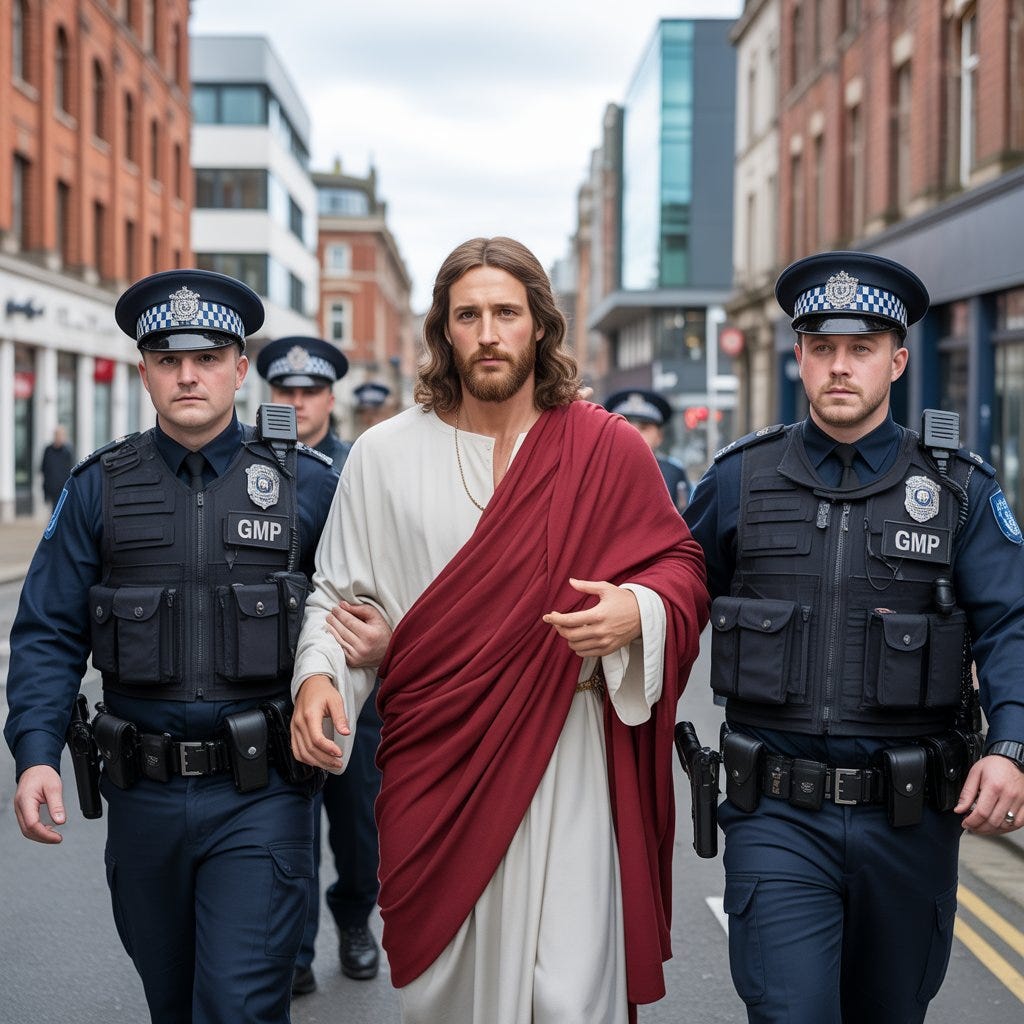
[GMP-arrests-Jesus-Ordsall-Lane-Salford-2026.jpeg]
Jesus returns. He gets a house on Ordsall Lane. It’s complicated.
He noticed the noise first. Not voices. Not wind. Something underneath everything — a low constant hum, as though the ground itself had an opinion. He stood on the step on Ordsall Lane and listened until he decided it was not dangerous.
The tower across the water caught the morning and threw it back at the street like it owned the transaction. The road — black, smooth, unforgiving. The boxes on wheels moved at a speed that made no sense. No animal attached. No visible means.
He looked at the key in his hand. He found the hole. He turned it the wrong way first, then the right way. Something clicked. He stepped out of the noise and the light and went inside.
The house was its own bewilderment.
A small protrusion on the wall. He pressed it. The ceiling came on. He pressed it again. The ceiling went off. He stood in the dark and pressed it again because the dark in an unfamiliar place is not comfortable. Even if you have technically conquered death.
A flat black rectangle on the wall — thin, dark glass face, reflecting the room back at him. Not a window. Nothing behind it. Waiting for something he didn’t know how to give it. He moved on.
In the kitchen, a small metal object with a cord attached to the wall, hollow, water sloshing inside. He pressed the button. A light. Then a sound — rising, rattling, steam from a spout, then silence. He understood water becoming steam. He had turned water into wine — water into steam seemed a modest ambition by comparison. What he did not understand was why someone had built a device specifically for this, when a fire and a pot had always been sufficient. He pressed it again and found in it a quiet pleasure he couldn’t account for.
He found a mug with World’s Greatest Dad on it. He looked at it for a long time.
He made tea, after a fashion. He stood at the kitchen window and looked out at a yard — a broken chair, three containers of dead plants.
He thought: I should go and look at what’s happening.
The boxes on wheels were a problem. He stood on the step. One made a sharp blast of sound. He stepped back. He watched a woman cross the road pushing a small wheeled chair with a child in it, the boxes slowing around her as though this were a negotiated arrangement. He tried it. The box slowed. He crossed.
He had not gone far when he saw the sticker.
In his experience the fastest thing on land was a donkey, and only when it decided to be. You negotiated with a donkey. You reasoned with it. You pushed from behind while someone pulled from the front and it stood in dignified refusal, weighing its options.
The box on wheels did not operate on this principle.
The sticker said: Follow Jesus.
He thought it odd that he should follow himself. However he was curious. He followed it. It accelerated. He ran — past shops, past a woman, past a man who said something he didn’t catch — and then it was gone, round a corner, into the traffic.
He stood on the pavement. Breathing hard.
Even a reluctant donkey, he thought, you could keep up with.
Y’alright, mate? said a lad on a bike.
I was following something, Jesus said.
Right, said the lad, and cycled on.
The shop on the corner. An entire wall of drinks in bright containers. He picked one up. Cold, hard, covered in aggressive imagery — a claw mark, a crown, words that appeared to be threats. Monster. Relentless. Reign. Bang. He turned it over. A list of substances. A warning that it was not suitable for children, pregnant women, or people sensitive to caffeine. He had spent his ministry among children, pregnant women, and people in various states of sensitivity. He put it down as though it might go off.
He bought bread — the cheaper one. Ta, the man behind the counter said. Jesus said ta back. It appeared to be correct.
Outside, a man was trying to walk a dog that had decided not to walk.
Stop mitherin’, the man said. Just stop.
The dog looked at the middle distance.
Jesus found this relatable.
A man in a doorway. Any change, mate?
I have seen two thousand years of change, Jesus said. It has not always been in the right direction.
He walked on.
Outside a house, a large container on two small wheels with a hinged lid. A sticker on the front. Jesus Saves. Someone had written lol underneath in marker pen. He lifted the lid. A split bin bag. Some cardboard. A pizza box.
He lowered the lid.
Two thousand years, he thought. For this.
His name was everywhere. Not in prayer. Just punctuation. A man dropping something: Jesus. A woman on a small flat rectangle held to her ear: Jesus Christ. Two lads watching an even smaller one: Oh Jesus. Oh Jesus Christ.
The first few times he looked up. He turned. He was, by long habit, responsive to his name.
There was never anyone there for him.
Diane from next door. Eleven years on the street, through the regeneration and the promises and the thing that came after the promises, which was more promises. She introduced herself and held out a pint of milk — semi-skimmed, plastic container.
He took it. He turned it over. He knew milk. He knew exactly where it came from. It did not come in a sealed plastic container.
He turned it over again looking for the animal.
There was no animal.
Ta, he said.
She said the boiler sometimes needed a bang on the left side and went back inside.
He stood in the hallway. In the walls, something knocked — deep, irregular, a gurgling, then silence, then knocking again. He had assumed it was a large animal, trapped, working through something. He pressed his ear to the wall. He gave it a bang on the left side, as Diane had suggested. The knocking stopped. He looked at the wall with a new respect.
Over the footbridge, a man in a lanyard looking at the small flat rectangle. Across the water, the tower. Two worlds. Ten metres between them.
He noticed it that first week. Three days.
Fridays — men walking in the same direction. Saturdays — a family dressed carefully, walking carefully. Sundays — bells from a building two streets over, largely empty by the sound of it.
Three sets of people entirely certain they had the right one. All of them doing it in his name.
He scratched his head.
On the Thursday he passed a building with a cross on top. He stopped. He knew that shape. He knew it intimately, in the way you know something that has happened to your own body.
A sign beside the door. St Clement’s.
Clement. A good man. Dedicated. Organised. The kind who got things done.
He looked at the building. Stone. Substantial. Tower at one end. Coloured glass windows. Clement had done well for himself. You didn’t get a building this size without things having gone considerably in your favour.
Jesus had arrived with one bag and no paperwork and was sleeping in a house that smelled of the previous tenant.
He went in. He looked around. Clement was not there. Presumably out. Shopping. Olives. Milk. The everyday business of a comfortable life.
On every wall, window, pamphlet — a man. Pale. Light-haired. Serene.
He touched his own face. Dark skin. Weathered.
A woman appeared. White robe. I’m Mary, she said.
He steadied himself against the pew. The name went through him like cold water. He looked at her — properly, the way you look at someone you are afraid to recognise.
She was looking back with the uncomplicated expression of someone waiting for him to introduce himself.
Just Mary. Someone named Mary. There were, he was finding, rather a lot of them.
Jesus, he said.
Sorry?
My name.
Oh, she said. That’s — yes. She went back to her hymnbooks.
He picked up the book on the shelf. The Holy Bible. He opened it and read the first few lines and stopped. Then he read on. Some of it he recognised. Some was approximately right. Some he had no memory of whatsoever — whole passages bearing his name that he had no recollection of.
He turned to the back. He read the last pages. He closed the book and sat very still.
God bless, said Mary, without looking up.
He came out into the light. There was a side door propped open. People going in and out — carrying bags, moving carefully. He followed them.
Inside: trestle tables, shelves of food, volunteers, people receiving with a quiet dignity that said they hadn’t chosen this but were managing it. He knew this. He had done this. The feeding of people who needed feeding — that he recognised in his bones.
Ordsall sits in the most deprived one percent of neighbourhoods in England. Jesus did not know this. He only knew what he could see. He did not know, either, that these were his people — had always been his people — or that not one of them had recognised him.
He went to find whoever was in charge. They needed ID. He had no ID. They offered him a food parcel. He said no thank you. There was no shame in it, they said. He said he knew.
The form asked about criminal convictions. He thought about the temple. He left that one blank.
A room on the main road where people sat at small tables. He ordered water. He put his hand over the glass. When he lifted it the water was wine. It had always been somewhat instinctive.
The young woman looked at the glass. Looked at him. Looked at the glass again. Came over. Looked more closely, hoping a second look would produce a different result.
It didn’t.
We’re not licensed, she said.
He had made wine since before anyone had thought to ask permission for anything.
She poured it into the sink — good wine, the kind that came out right when you weren’t thinking too hard — and went back behind the counter without another word, which he found, in its way, impressive.
He got up and walked out into Ordsall Lane.
The world, he was finding, had solved a great many problems he hadn’t known needed solving. However the ones he had come back for — the ones that had always mattered — were still very much there.
He had been thinking about what he was supposed to do now. The answer had always been the same. You went to the people. You found them where they were. You helped where you could.
He knocked on the first door. A woman. He introduced himself, said he’d just moved to the area, asked if there was anything he could do. She said she was fine and closed the door with the careful click of someone who had made a decision.
Seven doors. Nobody needed anything, or if they did they weren’t saying. At one door a man asked if he’d heard the good news about Jesus Christ. Jesus said yes. The man asked if he was saved. Jesus thought about the container with the sticker. I’m not entirely sure, he said honestly, and moved on.
Saturday morning. Two officers. Someone had made a report. Middle Eastern male, no visible means of support, going door to door.
Your name, sir?
Jesus.
Surname?
That is my name.
Nationality?
It’s complicated.
In the cell the man next door said alright. Jesus said alright back. They talked about his nan. She’d had his picture on the wall, next to the calendar. She were a sound woman, the man said. Better than she knew. Jesus said they usually are. The man said aye, I suppose that’s true.
The duty solicitor. Her name was Karen. No documentation, no address history, no verifiable origin. Not a strong position.
The sergeant asked him to prove it.
I don’t do miracles on request, Jesus said. It never worked like that. And if I did — there’d be a report. Someone would say it was a trick. Karen would have to file something.
Karen thought about it. There’d definitely be paperwork, she said.
There is always paperwork, Jesus said. That has not changed.
They were talking about deporting him. West Bank. Conflict zone. No papers to prove he’d ever been there. He thought about the last time someone had asked him to prove it. The cross. The hill. The vinegar on a stick.
Last time I tried to prove it, he told Karen, it did not go well.
Right, she said. Let’s talk about your options.
While Karen filed the paperwork he asked for a pen and paper, sat on the blue plastic mattress, and wrote.
PARABLE OF THE BLOKE FROM NAZARETH (found in a police cell, Salford, 2026)
I came back on a Tuesday nobody clocked me arrive got a gaff on Ordsall Lane just about alive
found a thing that boils water took me a bit to sort pressed a button on the wall the ceiling lit — I thought
that’s new
across the water MediaCity blazes like a sign I put me hand over a glass produced a glass of wine —
unlicensed said the barmaid can’t have that in here I said I’ve been producing this for over two thousand year
she said I don’t care who you are there’s rules about this stuff I said I know, I wrote some rules she said that’s enough
saw a thing on a car said Follow Jesus on the back I followed it down Ordsall Lane me previous best was a donkey it didn’t look back
heard me name in every street in every pub and yard Jesus this and Jesus Christ bloody hell it’s hard
to be the punctuation in someone else’s day to be the word they reach for when they’ve got nowt else to say
went to the church on Thursday had a look at the pictures on the wall pale fella, blue eyes, serene like didn’t look like me at all
they do a food bank Tuesday in the hall with the plastic chairs the same hall where on Sundays there’s nobody there
I tried to volunteer they said have you got ID I said I’m the son of God, love they said that’s not up to me
the form asked about convictions I thought about the temple I left that question blank I’m trying to keep things simple
they knocked on my door Saturday said someone made a report suspicious Middle Eastern male that’s me, I thought
they said what’s your name I said Jesus Christ they said of course it is then asked it twice
they put me in a cell the lad next door said alright I said alright back and we talked about his nan all night
she had me picture on the wall she’d had it years, she said a pale bloke in a robe I said aye, that’s me head
he said she were a sound woman better than she knew I said they usually are, our kid he said aye, I suppose that’s true
they’re talking about deporting me back to where I’m from the West Bank in the conflict zone said Karen, Jesus — come on
so here I am on Ordsall Lane or as near as makes no odds trying to make a difference like what it says in God’s
own book, which isn’t quite the book I would have written but here we are and here I am and here is Britain
in 2026, all told doing what it does the kindness in the corners the rest of it because
there’s Diane with the semi-skimmed and the woman saying ta and the lad who said just alright and the laugh outside the bar
and the food bank on the Tuesday and the chat about the nan and the rain that won’t commit itself and the dog that’s mithering on
and the child on the scooter going somewhere I can’t see —
I came back to have a look, love.
I’ve had a look.
Bloody hell.
The cat had gone from the wall.
The rain was still deciding.
Jesus stood in the kitchen on Ordsall Lane and pressed the button on the small metal object and listened to it rise, and somewhere in the walls the boiler banged once — left side, just as Diane had said — and the heating came on, and the house got a little warmer.
Across the water the BBC blazed. It hummed. It kept going.
Outside, quietly, without any announcement at all, it got dark.