
LTNs. Council's Road Applied Propaganda. AKA, C.R.A.P?
Bristol Built a Law That Doesn't Exist. Then Spent £5.8 Million Enforcing It.

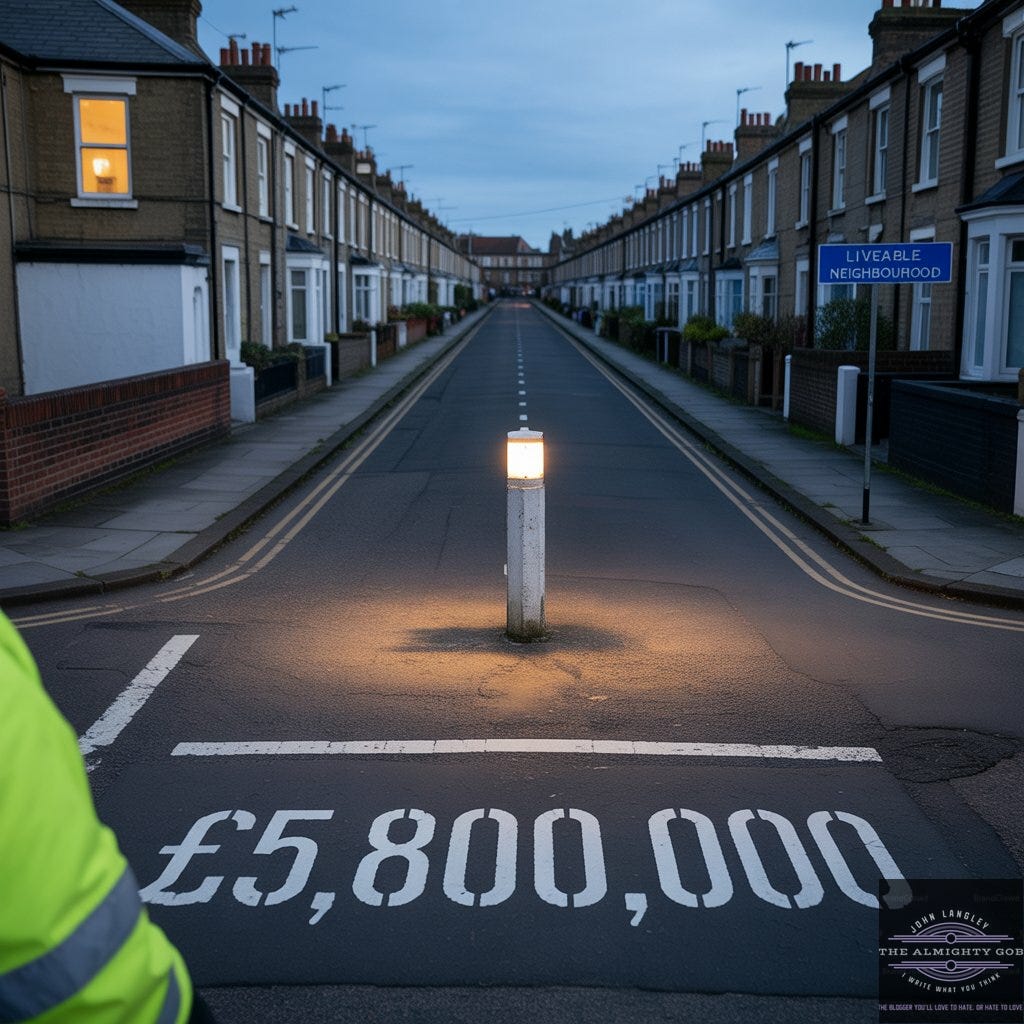
[Bristol's East Bristol Liveable Neighbourhood. One bollard. One witness. One lit window. £5,80,000 of public money. And a sign that exists nowhere in UK statute. www.thealmightygob.com]
This piece begins with a correction. Helen, a resident inside the East Bristol Liveable Neighbourhood, pointed out a minor factual error in an earlier article here. Following that thread led to a weekend’s deep research — and to everything you are about to read. The correction was hers. The consequences of it are Bristol City Council’s. Because, as you will see, Bristol City Council built the case against itself.
You see, there is a legal framework operating across Barton Hill, Redfield, and St George in East Bristol called the Liveable Neighbourhood.
Incidental to this, Bristol City Council has installed modal filters, bus gates, and road closures across this low traffic neighbourhood — marketed as the East Bristol Liveable Neighbourhood, or EBLN — using Traffic Regulation Orders made under the Road Traffic Regulation Act 1984. It has a handbook. A committee. A pilot scheme. A brand identity. And £5.8 million of public money — confirmed by the council’s own documentation — committed to making it real.
Though, there is one thing it doesn’t have.
A law.
Go ahead, search the statute book. The Liveable Neighbourhood appears nowhere. No statutory definition. No regulatory framework. No legal basis of any kind. Parliament never created it. No court has ever validated it. It is a concept — an urban planning idea dressed in official language and deployed as though it carried the weight of legislation.
It doesn’t.
You see, the legal instrument underneath the brand is the Traffic Regulation Order — a narrow power allowing councils to manage traffic on specific roads. A bollard here. A bus gate there. Designed for traffic management.
Now read what Bristol says the Liveable Neighbourhood is actually for.
The council’s own handbook states the aim is that “all residents, no matter their background, ability, gender or age, feel safe to walk and cycle.” Bristol’s One City Plan ties the scheme directly to carbon neutrality by 2030. The council website describes plans to “fundamentally reimagine” how communities relate to streets, mobility, and public space.
Climate objectives. Behaviour change. Social transformation. All of it pursued using a traffic management power from 1984.
Now, here is where a council’s lawyer would step in. Section 1 of the Road Traffic Regulation Act 1984 does permit TROs for purposes beyond traffic flow. Section 1(1)(f) allows orders “for preserving or improving the amenities of the area through which the road runs.” Section 1(1)(g) permits orders for air quality purposes. These are real, statutory, legitimate grounds. We don’t dispute that.
So, what we’re looking at is this: Bristol’s own documentation states the scheme’s purpose as carbon neutrality by 2030, “fundamentally reimagining” how communities relate to streets, and behaviour change at scale across multiple wards. Section 1(1)(f) is amenity improvement for a specific road. It is not statutory authority for a citywide social transformation programme operating under a brand name Parliament never created. The distinction is between a TRO made for a permitted purpose and a TRO made as part of a non-statutory programme whose primary stated objectives exceed what any permitted purpose authorises. The council’s own handbook makes that case against itself.
Then, there is a second problem. Even accepting the narrower statutory air quality purpose — Section 1(1)(g) — Bristol’s own monitoring report, commissioned by the council and published by the council, found that air quality improved inside the scheme and worsened on the external roads absorbing the displaced traffic. The council used air quality improvement as one of the statutory grounds for making the Traffic Regulation Orders. The council’s own published data contradicts the council’s own legal justification.
Which, to the likes of you and me, in layman’s terms translates as: Bristol City Council has, plainly and simply, built the case against itself.
The legal term for using a statutory power to pursue purposes it was not designed to serve is ultra vires. Beyond authority. It is one of the foundational grounds on which courts review the actions of public bodies.
The shift is already announcing itself.
Okay, that said, here is what the law actually required before any of this happened. A genuine Equality Impact Assessment — real engagement with disabled people about real impacts on their lives. Before the decision is made. Before the bollards go in. That is Section 149 of the Equality Act 2010. The Public Sector Equality Duty. Courts have quashed public body decisions for breaching it.
What happened next, was this. Bristol City Council’s Equality Impact Assessment for the East Bristol Liveable Neighbourhood named the Barton Hill Disabilities Group as a consultee.
However, an independent review by the charity Baggator found that organisation has never existed.
In fact, public statements during committee proceedings recorded the “inability to trace any record of such a group” and raised the possibility it had been “fabricated by the council to give an appearance of consultation.”
Then, when asked specifically about the Barton Hill Disabilities Group by Bristol247, Bristol City Council offered no comment.
Not a denial. A silence.
The Bristol Disability Equality Forum confirmed it was never approached before or after the scheme was designed. It is a real organisation. Unlike the one named in the legal documentation. WECIL, the disability access body eventually commissioned to audit the scheme, confirmed they were not involved at the design or consultation stage — brought in, they noted, after the bollards were already installed.
An Equality Impact Assessment citing a non-existent organisation is not an Equality Impact Assessment. It is a piece of paper with a gap where the law required substance, and failed.
Truth be told, twenty-four Blue Badge holders were rejected from the exemption process — not because they didn’t qualify, but because of administrative problems with their forms. Whether they were helped to resubmit is undocumented.
The shift does not slow for the undocumented.
So, the statutory consultation — the one with legal weight — returned 1,418 responses. Seven hundred and sixty objections. Four hundred and twenty-seven expressions of support. Fifty-four per cent against.
Nonetheless, Bristol City Council proceeded. The stated reason: the restrictions were “necessary to support the City Council’s transport objectives.”
Not the community’s objectives. The council’s, mind you.
Oh, and, by the way. There is a name in law for what you are looking at. In 1985, R v London Borough of Brent ex parte Gunning established four requirements for a lawful public consultation — later confirmed by the Supreme Court in 2014. The courts call them, collectively, “a prescription for fairness.” Formative stage. Sufficient information for intelligent consideration. Adequate time. And responses conscientiously taken into account.
By applying each to Bristol. It does not take long.
The Liveable Neighbourhood was developed, branded, and committed to as mayoral policy before the statutory consultation took place. The brand, the handbook, the pilot designation — all publicly committed before the community was formally asked. Not formative. The architecture was already built. The foundations? Make your own mind up.
The consultation used language — co-design, liveable, people-centred — that framed the scheme as already agreed with the community before the question was asked. That is not information for intelligent consideration. That is framing designed to produce a particular answer.
And, when 54% objected, the council proceeded citing its own objectives. Conscientious consideration of 760 objections does not produce: we are proceeding because of our own objectives. That sentence is the absence of conscientious consideration, stated plainly, in writing.
Be warned, this is not the first time. In R (KE) v Bristol City Council [2018] EWHC 2103 (Admin), the court quashed the council’s decision on special educational needs funding cuts, finding it had failed to give Gunning Principle Four its proper weight — consultation folded into a broader budget process so that specific responses were never genuinely considered. The pattern is not new. What is new is the scale.
And then Bristol showed you exactly what that scale looks like.
There is the night of 13 March 2025. Who could possibly forget? Not those who live in Barton Hill, that’s for sure.
At 3am, during Ramadan, Bristol City Council’s contractors arrived in Barton Hill with approximately 60 police officers, private security, and drone operators. They came to install the remaining bus gates and planters of the scheme. You know, like an invasion was imminent.
Yes, they came at 3am for a reason. The majority of people, it is fair to say, would be sound asleep at that time of the morning. The community had stopped them before during normal working hours for most.
As it so happened, a resident woke at 4am to eat before the fast. She walked outside to find drone lights overhead and contractors painting bus gate markings on her road. You know, like War Of The Worlds was being filmed again — with men in hi-vis apparel. “Good luck building relationships with this community,” she said. “It’s very concerning coming in the middle of night when everyone is fasting.”
Subsequently, the bollards went in anyway. Another word, expletive in nature, and ending in ‘ocks’ springs to mind.
Nonetheless, both Avon and Somerset Police and Bristol City Council apologised for the heavy-handed approach.
That apology matters legally. Not because it admits unlawfulness. Because it confirms that both bodies recognised, in retrospect, that what happened that night was disproportionate to a genuinely consented installation. You do not apologise for a routine construction project. You apologise for something that could not be defended in daylight.
Bristol Labour called the events “shocking” and demanded an independent investigation. Councillors in the administration knew in advance. The question of who authorised it has never been publicly answered.
Go back to Gunning Principle One for a moment: a consultation must happen while proposals are still at a formative stage — when the decision-maker still has an open mind.
The brand, handbook, and pilot designation were all publicly committed before the statutory consultation opened. That is the predetermination evidence — the architecture was built before the community was asked. The 3am operation is not separate from this argument. It is its logical conclusion: a council whose conduct is consistent with a mind already made up, completing the installation it had always intended to complete, at a time chosen to minimise the community’s ability to intervene.
An authority with a genuinely open mind does not need drones. Does it?
Next, the raw consultation data from the South Bristol scheme disappeared from public access. The interactive map where residents submitted feedback became unavailable. The council published its own summary. A Freedom of Information request was filed just to ask where the data had gone.
So, that is the South Bristol picture so far. The wider pattern is inherently older.
In September 2025, the Information Commissioner’s Office issued Bristol City Council with a formal enforcement notice covering 231 overdue subject access requests — some dating back to January 2022. The ICO’s Head of Investigations described the council’s approach as demonstrating “a poor organisational attitude towards data rights and compliance with the law.”
Errors are random. This pattern has a direction.
Now, let’s take a moment to consider what happened elsewhere. In May 2025, the High Court quashed the West Dulwich LTN in London. The ground: Lambeth had failed to properly consider a 53-page document submitted by residents. The judge described it as a “serious failing.” The scheme was quashed. Lambeth was denied permission to appeal. £35,000 in legal costs. Questions unanswered over £1.08 million in fines collected while the unlawful scheme was running.
Each ground West Dulwich established maps directly onto Bristol’s documented record.
Failure to consider significant evidence — an EIA citing a disability group that cannot be shown to exist, while real disability organisations say they were never asked.
Acting on a partial picture of community opinion — 54% opposition proceeding because the scheme supported the council’s own objectives.
Management of what decision-makers are allowed to see — raw consultation data removed from public access, replaced by the council’s curated summary.
Predetermination — a 3am police operation, with councillor-level advance knowledge, that circumvented community resistance.
Lambeth failed to read a document that existed. Bristol cited a document — a disability group — that didn’t.
And yet, somehow, the money kept flowing.
There is one argument you will hear. Deal with it now: the EBLN is funded by the City Region Sustainable Transport Settlement — government money, not council tax. The fiduciary duty doesn’t apply.
Well, it does.
The council administers the money. That is sufficient.
Because the fiduciary duty owed by a local authority to its taxpayers — confirmed by the House of Lords in Bromley LBC v Greater London Council [1983] — applies to all public money a council administers. The duty is to deploy public resources to the best advantage of the community. The source of the money does not determine whether the duty applies. The council’s stewardship does. Slam, dunk.
And, in whose interests did this money serve?
£5.8 million, to be precise. Majority opposition. A disability consultee an independent review found cannot be verified to exist. Real disability organisations never asked. A 3am installation requiring police and drones, followed by apologies. Consultation data removed. A council leader who said, after the money was spent, that lessons needed to be learned.
And, here is where the clock comes in. The permanence decision was due March 2026. It was pushed back to July. A six-month trial will have been running for nearly two years by the time that decision lands. Yes, six months. Let that sink in for a moment, or two. Meanwhile, the political logic of this remains as old as the bureaucracy: run the clock. Let the status quo harden into something that looks, from a distance, like consent. Communities run out of money, energy, and legal standing. Time is the cheapest weapon a council owns.
Which is exactly why the facts need to be in the room now, and they are, plainly and simply, as follows.
The Liveable Neighbourhood does not exist in law.
The Traffic Regulation Orders that implement it do.
The Equality Act duty to genuinely consult disabled people exists. It was not met.
The Gunning Principles exist. The documented record fails each of the four requirements.
The predetermination doctrine exists. A council whose installation required drones at 3am has answered the question of whether its mind was open.
The fiduciary duty exists. It applies regardless of funding source.
The West Dulwich precedent exists. The grounds correspond.
The Baggator finding on the Barton Hill Disabilities Group is documented, published, and undenied.
The statutory 54% is on record. The 3am operation is on record. The apologies are on record. The ICO notice is published. The deferral to July is confirmed.
The facts are all present. Evidenced. Sourced. In the public domain.
They are arranged in a particular order.
And a shift, once announcing itself, does not require anyone’s permission to arrive.
Oh, and one more thing, before I forget.
A judicial review costs money. The West Dulwich Action Group — over 1,000 residents, fighting a single London borough — raised more than £50,000 to bring their case. They won. Most communities never get that far. Not because their legal grounds are weaker. Because the money runs out before the hearing date arrives.
Bristol City Council knew this. Every local authority knows this. It is not a conspiracy. It is how public bodies outlast the people who challenge them — and the conduct of this council is consistent, at every documented point, with an institution that believed it would not be held to account.
The 3am installation was not logistically convenient. It functioned to reach the point of no return before resistance could mobilise into a legal challenge. Physical infrastructure installed creates facts on the ground: removal is now disruptive, costly, and politically uncomfortable. Every day the bollards stood after 13 March 2025 was a day the cost of challenge increased and the window for remedy narrowed.
The deferral of the permanence decision from March to July 2026 is the same logic applied at the decision stage. A community that has been fighting since 2022 — filing FOI requests, attending public meetings, raising money, commissioning its own analysis, physically lying in roads — is, by month twenty-two of a six-month trial, exhausted. Institutional fatigue is the cheapest legal defence available. It costs the council nothing. It costs the community everything.
The consultation language — co-design, liveable, people-centred — frames opposition as unreasonable before the first objection is filed. The ETO mechanism was used because it allows implementation before the community can respond. The raw data was removed from public access because independent analysis is harder to challenge than a curated summary. The disability consultee was named in the EIA because the law required one. Nobody checked — until the Baggator independent review did.
Tony Dyer, asked about the 3am installation and reflecting on lessons for the South Bristol scheme six months later, said: “We have to recognise that when we have democratically made decisions to implement, we cannot simply just allow those processes to be stopped by undemocratic means.” He said this about residents who had opposed the scheme in a statutory consultation at 54%. He said this after acknowledging that the consultation itself should probably have been reviewed before proceeding. He said it about a community that an independent review found had never been properly consulted on disability impacts, because the disability group cited in the legal documentation does not exist.
The democratic mandate was asserted most loudly at precisely the moment when the process generating it was least defensible.
Which is another way of saying: the conduct speaks for itself.
That is the calculation. It relies on one central assumption: that the ordinary people of Barton Hill, Redfield, and St George cannot afford to do what the West Dulwich Action Group did. That £5.8 million of public money can be committed, a non-statutory brand name can be enforced using traffic management law extended far beyond its original design, an unverifiable disability group can be cited in a legal document, a majority can be overridden, infrastructure can be installed at 3am with drones and police, and the permanence clock can be run out — and nobody will be in a position to stop it.
Bristol Built a Law That Doesn’t Exist.
Then Spent £5.8 Million Enforcing It.
On the assumption that the people it was enforced against couldn’t afford to say otherwise.
That is what the facts, arranged in their particular order, have always been pointing at.
The Almighty Gob is a Bristol-based publication founded by John Langley — independent Bristol mayoral candidate 2016 and 2021, and one of the city’s most forensic observers of institutional power. Publishing since 2020, with over 500 pieces across seven platforms and Substack at thealmightygob.com — no party allegiance, no press accreditation, no interest in acquiring either.