
Maduro Captured: The Bizarre Split Between Venezuelan Celebrations and Western Anti-War Protests.
Trump's Venezuela Military Strike Reveals Everything Wrong With Professional Activism in 2026.

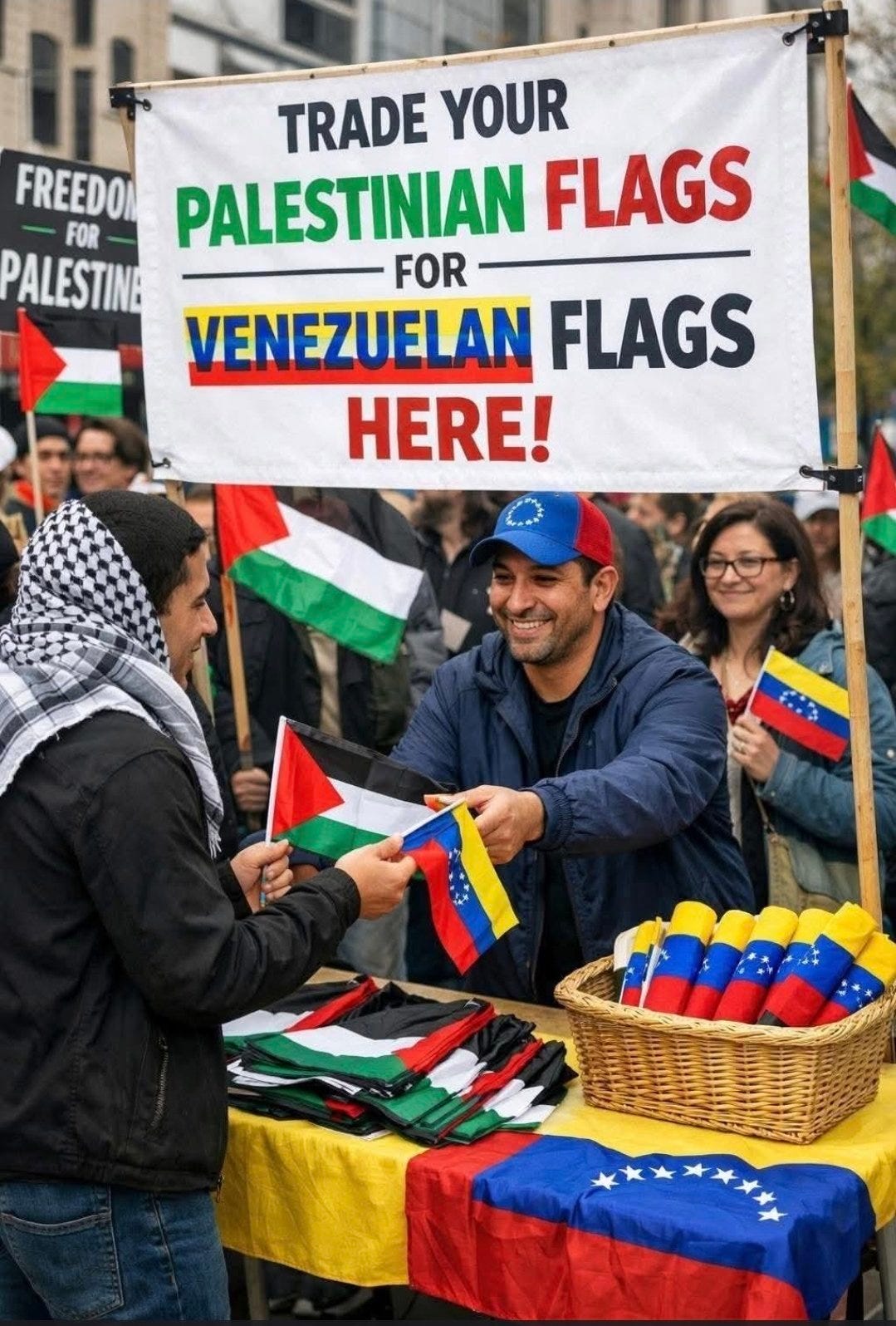
Right, so Saturday morning, January 3rd, someone set up a stall.
“TRADE YOUR PALESTINIAN FLAGS FOR VENEZUELAN FLAGS HERE!”
There’s a photograph. A bloke with baskets of Venezuelan flags and a table stacked with Palestinian ones, grinning like he’s running the best pop-up of 2026. The sign says TRADE. Like a currency exchange at Heathrow.
Palestine’s so December 2024, darling. We’re doing Venezuela now.
Documentary evidence of professional protest circuit treating geopolitical crises like Pokémon cards.
And here’s what makes this perfect: while this stall operated in the West, actual Venezuelans in Santiago, Madrid, Miami and Lima were literally dancing in the streets, setting off fireworks, celebrating like their team had won the World Cup.
Same event. Two crowds. Opposite reactions.
You see the pattern forming?
Trump’s Venezuela Strike: What Happened January 3rd 2026.
Early Saturday, the US launched Operation Absolute Resolve - 150+ aircraft striking Venezuela. Trump announced forces had captured Nicolas Maduro, flying him to New York for narco-terrorism charges.
40-80 people killed, including civilians. UN called it illegal. Brazil condemned it. Europe expressed concern.
Now watch the reaction split - not between countries, but between people who’d lived under Maduro and people who hadn’t.
Venezuelan Celebrations vs Western Anti-War Protests.
In Santiago, Chile: Crowds filled streets dancing, chanting “a free Venezuela.” Fireworks. Joy.
In Madrid, Lima, Miami, Buenos Aires: Spontaneous celebrations. Venezuelan refugees who’d fled Maduro’s collapse finally seeing consequences.
In Times Square, Rome, Athens, outside the White House: Protesters holding “Free Maduro” signs, demanding his release, denouncing US intervention.
You notice what just happened there? The people protesting for Maduro weren’t Venezuelans who’d lived through his regime. They were Western activists who’d never experienced Venezuelan hyperinflation or food shortages.
The Venezuelans who actually knew? Throwing street parties.
That flag exchange stall isn’t a joke. It’s infrastructure.
The Professional Protest Industrial Complex: Why the Flags Keep Changing.
Someone printed those signs, ordered bulk Venezuelan flags, coordinated the stall, collected old Palestine flags for next rotation. Not grassroots. Event management.
As I’ve previously documented tracking institutional dysfunction, I can tell you, there’s always machinery behind what looks spontaneous. The circuit runs on the same principle - calendar, infrastructure, template.
The rotation: 2022-2023 Ukraine. 2023-2024 Palestine. 2025-2026 Venezuela. Same bus, different destination.
Why Venezuela now? Why not Burma, Yemen, or any dozen ongoing crises never getting flag treatment?
Not “because Venezuela matters more.” Because Venezuela fits the template:
America involved (as aggressor)
Government calling itself socialist (even if authoritarian)
Clear villain (Trump’s perfect)
Simple narrative requiring no historical context
Tick those boxes, get flags and buses to the next protest. Don’t tick them, you’re Yemen - ignored.
Within 24 hours, protests materialised in Times Square. Identical signs. Same slogans in Rome, New York, Athens. Someone’s coordinating and funding which crisis gets infrastructure.
Applying the three questions I use for institutional analysis: Is it practical claiming solidarity with Venezuelans while ignoring what they want? Is it logical defending the government millions fled? What’s the likely outcome when activism requires ignoring who it claims to help?
What Happens When You Explain Venezuela to Venezuelans.
You’re Venezuelan. Fled 2019 because Maduro’s hyperinflation meant your salary couldn’t buy bread. Hospitals without medicine. People digging through rubbish. Eight million refugees fled while Maduro denied problems existed.
January 3rd, Maduro’s captured. You don’t care about geopolitics - you care the man who destroyed your country faces consequences.
So you celebrate in Santiago. Dance. Cry.
Then you see Western activists holding “Free Maduro” signs. People who never lived under his regime explaining this is imperialism, Venezuelans are victims, Maduro should be released.
Not one asked what you thought.
Explain why you’re celebrating? You’d be called a CIA plant who doesn’t understand your own oppression.
This pattern of performative politics divorced from lived experience isn’t new. The flag stall made the machinery visible.
The Three Questions That Clarify Everything,
Is it practical to protest for people celebrating what you’re protesting? If Venezuelans dance in Santiago while you demand Maduro’s release in Rome, somebody’s wrong. Probably not the people who lived it.
Is it logical to cycle through causes every 12 months claiming deep commitment? That’s not engagement - that’s cause-tourism. Collecting moral positions, not building understanding.
What’s the likely outcome when activism ignores who it claims to help? Those people stop trusting you. Next crisis requiring solidarity, there’s less credibility.
What’s the outcome when the circuit keeps rotating? Same pattern. Two months, different country. Venezuelan flags stored. Activists trading for whatever’s next. Venezuelans dealing with consequences while protesters move on.
Not activism. Theatre.
What the Protesters Actually Get From This.
Let’s talk about what’s really happening psychologically. The flag exchange stall reveals what participants are actually purchasing: moral certainty and social identity.
Immediate moral validation. Show up, wave flag, instant confirmation you’re good. No complexity. No need to understand Venezuela’s history or what Venezuelans want. Pick the side opposing America, you’re automatically virtuous. That’s moral licensing - taking one “good” action gives permission to stop thinking critically about whether you’re helping.
Cost-free righteousness. Protesting in Times Square costs nothing. You’re not living under Maduro. You’re not fleeing hyperinflation. You get psychological reward of “fighting oppression” without Venezuelan refugees’ actual sacrifice. This is like a fake gym membership. You know, feeling fit without working out.
In-group belonging. Same people at Ukraine protest, Palestine protest, Venezuela protest. Not cause-hopping - maintaining social network. The cause is secondary. The belonging is primary. Social identity theory: people derive self-worth from group membership. The circuit provides identity: “I’m someone who stands against injustice.” Which injustice matters less than the identity.
Simplified certainty. Venezuela’s complex. Maduro’s authoritarian AND US has questionable motives AND refugees have legitimate grievances AND international law matters AND there’s no simple narrative. That complexity is uncomfortable. The template provides relief: America = bad, position known, stop thinking. Cognitive closure - any answer beats uncertainty.
Status within hierarchy. Notice who holds the megaphone. Who coordinates. Who gets interviewed. There’s a status system. Being at “right” protests, having “correct” positions first, calling out people who don’t understand - that’s social capital. Not about Venezuelans. About activist pecking order.
Being right without consequences. If you’re wrong about Venezuela - Maduro actually terrible, Venezuelans wanted him gone - you face zero consequences. Venezuelans face them. You move to next cause. But if you’re “right” by in-group definition, you feel intellectually superior. Asymmetric risk: unlimited upside, zero downside.
Narcissistic supply through activism. Clinical psychology: narcissistic supply is validation narcissists need to maintain self-image. Performative activism is high-grade supply. Public virtue demonstration. Social media documentation. Visible proof of moral engagement. The cause is delivery mechanism. The supply is product.
This isn’t speculation. Observable pattern behaviour documented in psychological research on moral licensing, performative empathy versus actual empathy.
Actual empathy is uncomfortable. Requires listening to people you disagree with, sitting with complexity, discovering you’re wrong, sustained engagement producing no immediate validation.
Performative empathy is comfortable. Pick cause, learn position, perform outrage, receive validation, move on.
The flag stall maintains this system. Trade old validation source, grab new one, keep supply flowing. Flags change but transaction identical: perform correct position, receive validation, maintain identity.
Venezuelans celebrating in Santiago don’t exist in this transaction. They’re not the customer. They’re the product.
That’s not activism. That’s therapy with flags.
The Almighty Gob is an independent blogger and satirical commentator specialising in Bristol City Council accountability and institutional dysfunction analysis. His work documenting the gap between political rhetoric and measurable outcomes can be found right here, at thealmightygob.com.
If you enjoyed this professional activism analysis, subscribe to get more performative politics delivered direct to your inbox. If you hated it, well, that’s not in line with my organisational values. Cheerio 😉