
Maslow Is SO Yesterday, Dahling.
This Is Bristol's Lowerarchy: The Investment Hotspot That Forgot Who Lives Here. The brochure is beautiful. The waiting list is 18,000 households long. These are not unrelated facts.

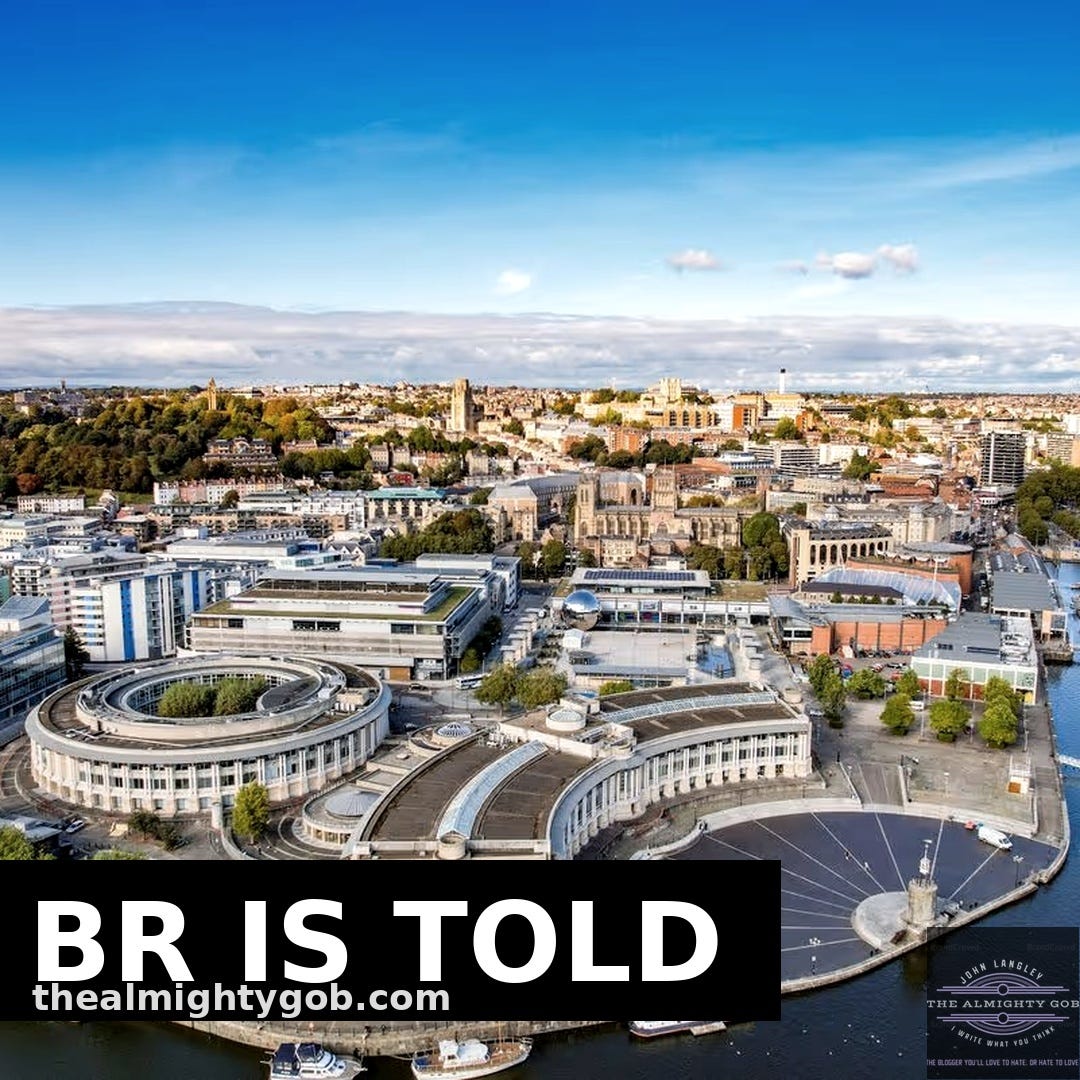
[The Investment Hotspot That Forgot Who Lives Here.]
There is a version of Bristol that exists in investment prospectuses, property podcasts, and regional business awards. It has waterfront regeneration. Yield percentages. Two world-class universities. A creative economy. A mantelpiece full of liveability trophies. Airbnb revenues that would make your eyes water.
Then there is the Bristol that 18,000 households wake up inside every morning. The one where the council’s own website tells applicants, with the quiet resignation of an institution that has stopped pretending: you’re unlikely to be offered social housing. The waiting list is very long.
Both of these Bristols occupy the same BS postcode. Which, some, may quite reasonably read as ‘Bullshit.’ And, well. Who can blame them. Anyway. Onwards and forwards.
A Wing. A Prayer. And a Property Brochure. Full Colour. No Expense Spared. Of Course.
There is an old expression — on a wing and a prayer — for the moment a rational being decides to proceed on irrational grounds. Not out of delusion. Out of a particular kind of clarity: that the mathematics don’t quite work, the wing is damaged, however you fly anyway and trust that hope will cover the gap between what exists and what needs to happen.
Bristol’s housing strategy has been flying on that basis for some time now. You know. More balsa wood, rubber band powered propeller. Compared to, say, Concorde.
However. The wing is genuine. The universities are real. The geography is real. The connectivity, the talent pool, the cultural life — all of it generates actual lift. Nobody is manufacturing Bristol’s appeal. The investors aren’t wrong about the assets.
The prayer is the belief that rising asset values lift all boats. That regeneration billions trickle downward. That a city simultaneously awarded most liveable and top investment hotspot is thriving in any sense that matters to the people actually living in it.
It doesn’t. It won’t. And the evidence has been accumulating patiently, waiting to be read.
The Lowerarchy.
Abraham Maslow built his hierarchy on a principle so obvious it barely needed stating. Meet the base needs first. Shelter, safety, warmth — these are the foundation everything else stands on. Self-actualisation, creative fulfilment, civic participation — these come after. They require the base to be solid.
Mind. This is Bristol, after all. So. It has inverted this entirely.
What operates here — and in every city that has followed this particular flight path — is a Lowerarchy. A system that should serve the base of human need first and works, with impressive consistency, in the opposite direction.
The investors get the self-actualisation economy. The co-working spaces. The artisan coffee. The waterfront aesthetics. The creative districts. The liveability.
The people on the waiting list are still negotiating the base. Shelter. Safety. A front door that belongs to them.
And here is what distinguishes the Lowerarchy from mere neglect. It doesn’t ignore the base of the pyramid. It feeds on it. Housing in Bristol isn’t being overlooked — it is receiving enormous, sustained, highly organised attention. From investors. The foundation that Maslow said everyone should stand on has become the asset class that the top of the pyramid extracts value from.
The foundation isn’t being forgotten. It is being sold.
Trickle-Up Urbanism.
There is a theory — deployed at every planning meeting, regeneration launch, and mayoral press release — that investment in a city benefits everyone in that city. That if you build enough glass-fronted apartments at Temple Meads, open enough wine bars in Wapping Wharf, attract enough tech workers relocating from Shoreditch, eventually some of that economic energy finds its way to the people who were already here.
This theory has a name. Trickle-down urbanism. The benign fiction that wealth, given enough time and the right conditions, finds its way to the bottom.
What Bristol actually operates is trickle-up urbanism.
And trickle-up is not trickle-down with a slower timeline. It is the opposite mechanism entirely.
The value doesn’t trickle down to the people at the base of the pyramid. It is extracted from the base and moved upward. The affordable housing stock gets converted to short-term lets. The long-term tenants get displaced. The rental floor rises. Every new development that raises average property values in a postcode raises the rental floor in that postcode. Every positive yield figure published in a property podcast attracts another investor, removes another property from potential owner-occupation, adds another landlord to a market already running at the expense of tenants.
The investment doesn’t arrive in a city. It arrives in a curated segment of a city designed to receive it. The Temple Quarter isn’t being built for the 18,000 on the waiting list. The Western Harbour masterplan isn’t being designed around the family in temporary accommodation who has waited 558 days for a permanent home. These projects have a target demographic. That demographic is arriving from somewhere else, with money already in hand.
The shops follow that money. The cafes follow that footfall. The tourism infrastructure follows that aesthetic. And the people who were already here find that their city has been redesigned around someone else’s wallet.
Everything moves up. Nothing comes back down.
Trickle-up urbanism is trickle-down urbanism with the pretence removed. And it maps onto the Lowerarchy with the precision of a thing that was always the same argument, observed from two different angles.
The Lowerarchy describes the structure. Trickle-up urbanism describes the mechanism. Together they describe what happens when the logic of investment return is applied to the base of Maslow’s pyramid without a counterweight strong enough to hold the foundation in place.
Bristol Is Not Alone In This. That Is Precisely The Problem.
Detroit was once one of the wealthiest cities per capita in America. The investment thesis was real. The wing existed. Then the industry contracted, the investors extracted their returns and moved on, and the people left behind inherited the debt, the dereliction, and the waiting lists. Whole neighbourhoods returned to grassland. The prayer turned out not to be aerodynamics.
Barcelona won every urban regeneration award after 1992. Investment poured in. Tourism exploded. Then short-term lets systematically converted entire neighbourhoods from homes into hotel rooms. Long-term residents — families who had lived in Barceloneta and El Born for generations — were priced out of areas their grandparents had walked. The city that charmed the world chose to become functionally uninhabitable for significant numbers of the people who called it home.
Dublin positioned itself as Europe’s tech capital. Google, Meta, Apple — the credentials were impeccable. Meanwhile Dublin now operates one of the worst housing crises in Europe. Young Irish people are emigrating again. Not from poverty this time. Because a booming city chose to price out its own population.
Vancouver. Lisbon. Nairobi. The pattern doesn’t vary. The investment thesis arrives. The brochure circulates. The assets are genuine. The prayer is deployed as load-bearing infrastructure. Trickle-up urbanism operates without announcement. And the people who needed the base of the pyramid to hold find that it has been quietly refinanced.
Bristol is not an outlier. Bristol is the current iteration of a very old story that cities keep agreeing to tell about themselves.
What The Numbers Actually Say.
Gross rental yields of up to 8.2% in parts of the city. Monthly rents between £1,261 and £2,713 depending on postcode. Over £5.7 billion in committed regeneration investment. The Temple Quarter project alone — 135 hectares around Temple Meads — promising 10,000 new homes and 22,000 new jobs over the next two decades.
Is it practical? For investors, demonstrably yes.
Is it logical? As a pure capital allocation decision, entirely.
What is the likely outcome?
Temporary accommodation demand has risen 90% in four years. Homeless households now wait two and a half years or more to make a successful bid for a home. The social housing waiting list — before April 2026’s administrative intervention — stood at 22,000 households. With approximately 1,500 to 1,700 properties available annually.
Do that arithmetic slowly. Trust me. It rewards the attention.
Meanwhile Bristol’s housing affordability ratio stands at 8.88. The median home costs almost nine times the annual earnings of a middle-income household. Bristol holds the highest affordability ratio of all the Core Cities in England. Private rents have risen 52% over the past decade. Wages have risen 24%.
That gap doesn’t close by itself. It doesn’t close with a podcast studio either. Devastating news for the residents of Knowle West. I’m sure.
The State Of What Already Exists.
Before the conversation moves to what is being built, it is worth pausing on the condition of what is already there.
Bristol City Council manages 26,700 tenanted homes. A proportion of that stock is ageing at pace. The council submitted to Parliament that decades of under-resourcing, policy instability, and economic volatility — combined with demands for investment in fire safety and decarbonisation — mean council housing is under unprecedented strain.
The housing revenue account faces an £8 million annual shortfall. The government’s Regulator of Social Housing found serious failings in how the council manages its homes and ordered a major backlog of repairs to be addressed.
As of February 2026, almost 20,000 overdue repairs are recorded on council properties. The council’s own interim director of housing property stated that these figures “cannot be trusted” — the result of a botched IT project launched in March 2022, initially expected to take two years and cost £7.5 million, with a further £1.3 million approved to assist its troubled introduction. If the figures were accurate, they would mean three in four Bristol council homes need some form of repair.
The council is completing stock condition surveys for 70% of its homes, which will form the basis of a new asset management strategy. The Decent Homes Standard — the basic threshold below which a property is considered unacceptable — has no confirmed implementation date for its final phase. The perpetual calendar seems to be running out of pages already. Who’d have thought.
The council doesn’t reliably know the full scale of what needs doing to its existing stock. That, in itself, is a sentence worth keeping.
In 2022, Bristol City Council announced a record £1.8 billion investment in council homes over 30 years. Four years later the housing revenue account is running a shortfall, the repair data is untrustworthy, and the Regulator has found serious failings.
The wing. The prayer. The arithmetic. Perhaps. Lack of.
The 4,000 Who Were Simply Removed. Like They Never existed.
In April 2026, Bristol City Council chose a solution to the gap between 22,000 households waiting and the supply available to meet them.
They removed 4,000 names from the list.
Not housed. Not rehoused. Not redirected to meaningful alternative provision. Removed. People in bands three and four — the lower priority categories — who hadn’t placed a bid on a property for at least two years. Gone from the register. The waiting list dropped from 22,000 to just over 18,000 and someone, somewhere, filed that under progress.
The council’s own website now carries this sentence, addressed to anyone considering applying for social housing in Bristol: people have told us that if they’d known how unlikely it was that they’d get social housing, they would’ve thought about other options earlier.
Read that again at the pace it deserves. Take your time. No rush.
The institution responsible for housing provision is advising people not to hope for housing provision. The administrative response to an impossible gap between need and supply is to manage the expectations of the people experiencing need.
This is not incompetence. This is a system following its incentives with complete predictability.
Canons Wharf. Saunas. And Bristol’s Ambition. Apparently, It Has One. Who knew?
Oh look. The new Harbourside development. Once Lloyds Bank hub.
“The ambitious redevelopment will see the former Canons House building re-positioned as a vibrant, mixed-use campus, delivering 197,000 sq ft of high-quality workspace alongside industry-leading amenities, cultural spaces and public-facing destinations,” said a spokesperson for the developers, Kinrise and Mactaggart Family & Partners.
“Located in the heart of Bristol’s thriving Harbourside, the development will combine striking architectural heritage with contemporary design, creating a working environment like no other that reflects the city’s dynamic business and cultural community.
“The scheme will enhance the landmark crescent and circular buildings overlooking Lloyds Amphitheatre, reinforcing their status as one of the city’s defining architectural statements. The approved plans will deliver a range of premium facilities designed to support modern ways of working and wellbeing, including a coffee house with gardens, creating a social hub for tenants and the public, restaurants overlooking the Harbourside, saunas, cold plunge, a performance gym and PT classes studio, a podcast studio and 200 person auditorium for talks, events and cultural programming and a standout rooftop boardroom and events space, offering panoramic views across the city.”
Wonderful.
Read that list of amenities again. Every single one of them sits above the base of Maslow’s pyramid. Not one element addresses shelter. Not one element addresses warmth. Not one element addresses safety. The saunas are real. The cold plunge is real. The podcast studio is real. The rooftop boardroom with panoramic views across the city is real.
Yes, the development will create construction jobs. Good. The people who build it will be grateful for the work. The question is what happens after the scaffolding comes down — and who the building serves when it does.
Panoramic views across a city where three in four council homes may need repair. Where 20,000 overdue maintenance jobs have been logged on a system too broken to be trusted. Where the people on the waiting list are still waiting.
The former Lloyds back-office hub — where people once came to work rather than to be sold a lifestyle — has been repositioned as a premium workspace campus with saunas and a podcast studio. Clearly, with the residents of, say, Lockleaze, Knowle West, and Withywood in mind. Obviously.
That is not a coincidence. That is the Lowerarchy’s architectural biography rendered in 197,000 square feet.
Except. Who for, exactly?
The coffee house with gardens creating a social hub for tenants and the public is doing extraordinary work in that sentence. For the public. The gesture toward inclusion. The performance of openness. The implication that anyone can wander in off the street and participate in the social hub.
They can. Provided they can afford a flat white at Harbourside prices.
That is not public space. That is monetised space with a public-facing facade. The distinction matters enormously. The brochure depends on it remaining invisible.
Oh, I clumsily forgot. For those who’ve seen the brochure. Of course.
And then the official spokesperson delivered this.
“Canons Wharf will be a place that reflects Bristol’s ambition.”
He’s either on something the rest of us wish we were taking as well. Or. Well. Sudden sunstroke. To put it mildly.
Look what it did to Lawrence of Arabia.
Because what that statement requires — to make any coherent sense — is a particular kind of altered perception. The ability to stand in front of a premium workspace campus designed for relocated London professionals, look out over a city with the highest affordability ratio of any Core City in England, and announce with apparent sincerity that this reflects Bristol’s ambition.
It does, though. Precisely. Just not the ambition of the Bristol the spokesperson chose not to mention.
Bristol’s ambition, as currently documented, includes 18,000 households on a waiting list. 4,000 names removed from it. 1,786 families in temporary accommodation averaging 558 days. An IT system costing nearly £9 million that produces repair figures nobody trusts. A Regulator finding serious failings. A council website advising applicants to manage their expectations.
Canons Wharf reflects that Bristol’s ambition perfectly.
Just from the top of the pyramid. Looking down.
Who The Investment Is Actually For
The regeneration masterplan does not mention the 90% rise in temporary accommodation demand. The investment prospectus does not quote the council’s advice to applicants. The property podcast does not explain that the Airbnb revenue figures in BS1 and BS8 correlate directly with the displacement of the people who previously rented those properties at prices that didn’t require a passive income strategy.
These are not oversights. Brochures are curated documents. What they choose not to say is as deliberate as what they choose to say.
The new developments along the waterfront are not being built for the people on the waiting list. The coffee shops opening in the regenerated quarters are not being designed for someone on housing benefit. The tourism infrastructure being constructed around Temple Meads is not oriented toward the family in Band Three who has been waiting since 2022.
They are being built for the people arriving from London and elsewhere. People with the capital to participate in the new Bristol. People for whom the brochure was written. People whose presence — entirely legally and entirely predictably — makes the situation measurably worse for everyone the brochure didn’t mention.
This is not an accusation against those individuals. They are following rational incentives in a system designed to reward them. The design is the issue. The architecture — literal and economic — is the issue.
And yes — the investment generates business rates, employment, and tax revenue that theoretically funds public services including social housing. Theoretically. The housing revenue account shortfall is £8 million. The regeneration pipeline is £5.7 billion. The mathematics of that relationship are, at best, a work in progress.
The swept-under-carpet version of Bristol is not a separate story from the investment hotspot story. It is the same story, told from the other end of the same transaction.
The Question Mark That Does The Most Work
And as for the people left behind — the 18,000 still on the list, the 4,000 removed from it, the 1,786 households in temporary accommodation, the families averaging 558 days in a place nobody calls home —
we’ll just leave that with a question mark, shall we?
That question mark is the most honest punctuation in Bristol right now. Because the question isn’t rhetorical. It has an answer. It just doesn’t appear in the investment prospectus, the regeneration masterplan, the award ceremony, or the Business Live headline.
The answer is that the people left behind will be managed. Their expectations will be adjusted downward. Their waiting list entries will be periodically removed when the numbers become embarrassing. They will be advised, on official council websites, to think about other options. They will watch their city win liveability awards for amenities they don’t have the disposable income to use.
They will see cranes on the skyline and know, with the particular clarity of lived experience, that nothing rising up there is rising for them.
They will watch a former back-office hub — where people once came to work rather than to be sold a lifestyle — become a rooftop boardroom with panoramic views and a cold plunge facility.
And they will read that this reflects Bristol’s ambition. Assuming, by then it’s found one that suits the real ambitions of current, longstanding residents. I know. We can dream.
The wing generates lift. For those who own one.
The prayer fills the gap. For those asked to have faith in trickle-down whilst trickle-up does its quiet, efficient, thoroughly documented work in plain sight on the Harbourside.
And the Lowerarchy holds. As it always has. As it was always going to.
The brochure was persuasive. It just forgot to mention who it wasn’t written for.
© The Almighty Gob 2026. All rights reserved. Unauthorised reproduction prohibited.
The Almighty Gob is an independent Bristol-based publication covering institutional accountability, urban policy, and the gap between what cities say and what cities do. Published at thealmightygob.com, and across social media platforms.