
No Beard? Women Are Under Threat. Trust Me.
Faith, Fear and Facial Hair. It's Global Recognition Time. Who Knew?

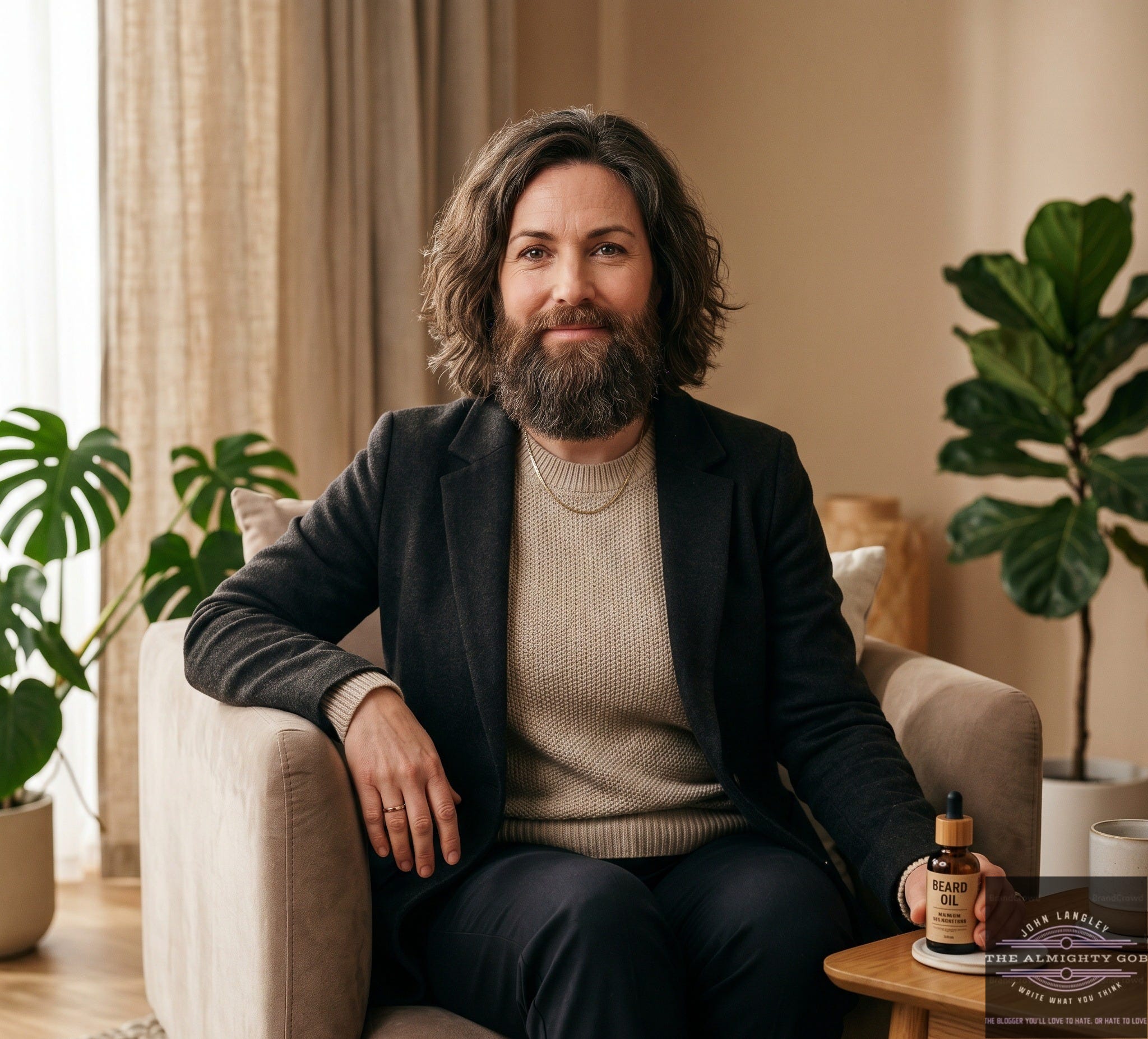
[No Beard? Women Are Under Threat — The Almighty Gob]
Somewhere right now, a man is moisturising his beard.
Conditioning it. Shaping it. Possibly talking to it.
The global beard care market is worth billions — and growing, if you’ll forgive the expression.
Victor Kiam built an empire on the razor. Remington, as it happens, started out making guns.
Both weapons of sorts, it would seem.
Back then, Kiam would have been lynched. Possibly crucified.
Can you imagine how different the world would be if Jesus had owned a Remington?
Victor Kiam would have had a co-founder. And we’d all have been spared an awful lot of trouble.
However, what the beard oil industry has conspicuously failed to put on the label is arguably its most powerful selling point.
Your beard, apparently, is protecting women.
From you.
You’re welcome.
This is not a marketing campaign. This is religious authority speaking.
And religious authority, it turns out, has a long and colourful relationship with clerical misogyny.
And before you reach for the razor — just know that God is watching. He has opinions about this.
Strong ones.
Jesus had one, didn’t he.
Britain is currently having a conversation about misogyny.
A real one. An overdue one.
Two schoolboys. A knife. A conviction.
The question being asked everywhere right now — in parliament, in schools, on every platform that exists and several that probably shouldn’t — is where does this come from?
It’s the right question. It’s just that most of the answers being offered are pointing in the wrong direction.
Social media, they say. Andrew Tate, they say. The algorithm, they say.
Easy targets. Satisfying ones.
However, you can put social media in front of the firing squad tomorrow and it doesn’t actually solve the problem.
Because this was here long before the algorithm. Long before the influencer. Long before the smartphone.
The Almighty Gob has a suggestion.
Start here. And pay attention, because this is going to take us around the world and back again.
Meet Murat Bayaral. Turkish Islamic preacher. December 2017.
Speaking on the private religious television station Fatih Medreseleri, Bayaral delivered himself of the following observation — and we are going to need a moment to fully appreciate it.
Men, he explained, should grow beards. One of only two body parts that separate men from women is the beard. Therefore, if a man has long hair and no beard, you might — from a distance — mistake him for a woman.
And because women and men dress similarly these days, God forbid, you could be possessed by indecent thoughts.
There it is.
The beard as public safety infrastructure. The beard as the thin line between civilised society and chaos. The beard, apparently, doing the work that personal responsibility declined to show up for.
Bayaral, for the record, is considered a marginal figure in Turkey.
Which is reassuring right up until you realise that marginal figures have television programmes, and television programmes have audiences, and audiences have sons.
However, let’s not stop here. Because Bayaral, it turns out, is merely the opening act.
If the absence of a beard is enough to derail a grown man’s moral compass, one has to wonder what religious authority makes of the rest of the human experience.
Quite a lot, as it happens. And before anyone assumes this is a conversation exclusively about Islam — it isn’t. Consider, first, that in America, Pat Robertson — founder of the Christian Broadcasting Network, former presidential candidate, holder of degrees from Washington and Lee University and Yale Law School — spent decades informing his television audience that God deployed hurricanes as punishment for homosexuality. He warned Orlando that Gay Days at Disney World would bring terrorist bombs, earthquakes, tornadoes, and possibly a meteor.
A meteor.
Not content with weather events, Robertson graduated to geological phenomena. His fellow traveller Tony Perkins, president of the Family Research Council, agreed publicly that floods were divine punishment for gay marriage. Perkins subsequently had to evacuate his own Louisiana home by canoe after catastrophic flooding submerged it. He described the experience as being of near-biblical proportions. The irony, it is fair to say, was lost on him.
That’s Christianity. Now. Britain.
In Britain, a man called Haitham al-Haddad holds a PhD from SOAS, University of London. He chairs what the UK government’s own counter-extremism commissioner has described as the main Salafist organisation in the country, and sits on the board of the Islamic Sharia Council.
This is not a fringe figure. This is the establishment.
Al-Haddad’s positions, carefully documented, include the following: that homosexuality is a criminal act and a scourge, that the most honourable role for a woman is striving to be a fine wife, that female circumcision is a scholarly consensus, and — perhaps most memorably — that “a man should not be questioned why he hit his wife, because this is something between them.”
A PhD. A government-monitored organisation. A sharia court seat.
And that is what sits underneath it.
The Almighty Gob is not suggesting this represents mainstream British Muslim opinion. It doesn’t.
However, it does represent mainstream British institutional silence on the matter, which is a different problem entirely.
Then there is Abu Usamah at-Thahabi — for many years the chief cleric of Green Lane Mosque in Birmingham, preaching week after week to audiences who had every reason to trust the authority of the man at the front.
In 2007, Channel 4’s Undercover Mosque caught him on camera — not in some private aside, but in full sermon — declaring that women, however educated, were divinely deficient and incomplete in their intellect, that gay men should be thrown off a mountain, and that the testimony of two women was required to equal that of one man.
His mosque subsequently received public grant funding.
He has since relocated to Florida, where presumably the mountain is metaphorical.
And then there is Mohammed Amin Pandor of Dewsbury — a mechanical engineer — who issued a fatwa on social media declaring Covid-19 vaccines should not be promoted, on the grounds that God had already provided a definite remedy in the form of a prayer to be recited three times.
He also informed a BBC radio interviewer in 2016 that his religious beliefs meant Strictly Come Dancing was not acceptable.
Strictly Come Dancing.
The sequins, apparently, were the last straw.
Now. Are we building a case against Islam specifically?
We are not.
Because the moment you think this is a uniquely Islamic pathology, the evidence invites you to sit back down.
Remember those two schoolboys. Remember that knife. Because what follows is the source code they inherited — and it didn’t come from TikTok.
In New Zealand in 2016, Brian Tamaki — leader of the Destiny Church — posted a sermon on Facebook following a 7.8 magnitude earthquake that killed two people.
The earthquake, he explained, was caused by sin.
Gay marriage, specifically.
New Zealand’s Prime Minister called his comments ridiculous.
Tamaki’s church called the sermon a prediction.
A prediction. Of an earthquake that had already happened.
That is a level of sheer brass neck that deserves some form of recognition, if only for the confidence involved.
Kenneth Copeland — Texas televangelist, net worth estimated at over $760 million, owner of a 1,500-acre campus with its own private airstrip — told his television audience during the Covid-19 pandemic that they were healed of the virus as he prayed, reaching his outstretched hand toward the camera and instructing viewers to touch their screens to receive spiritual healing.
He concluded with healed and well.
He has never apologised. He is still broadcasting.
Of course he is.
This is not a Christian problem. This is a power problem that stems from religious ideology.
Just as it sometimes wears a turban, a kippah, or a saffron robe.
In 2010, Rabbi Ovadia Yosef — former Chief Sephardi Rabbi of Israel, spiritual leader of the Shas political party — delivered a weekly Saturday night sermon in which he stated that non-Jews exist solely to serve the Jewish people.
“Goyim were born only to serve us. Without that, they have no place in the world. Why are gentiles needed? They will work, they will plow, they will reap. We will sit like an effendi and eat.”
The American Jewish Committee called his remarks abhorrent and an offence to human dignity. Jewish organisations across the world condemned them. Rabbi Yosef’s response was to continue delivering weekly sermons until his death in 2013, at which point approximately 800,000 people attended his funeral, making it one of the largest in Israeli history.
Before taking office as Israeli military chief rabbi, Eyal Karim had answered a question on a religious website in 2002 in which he appeared to permit soldiers to engage in sexual acts with non-Jewish women during wartime to maintain morale. The remarks caused an international outcry when they resurfaced at the time of his appointment in 2016. The IDF summoned him. The Israeli Supreme Court temporarily suspended his appointment. He submitted a formal declaration clarifying his position to the High Court. The institutional process ran its full course. He was still appointed.
Take a breath. Because what comes next is going to be extraordinary.
Back in Egypt, in 2007, Ezzat Attiya — head of Al-Azhar University’s Department of Hadith, one of Sunni Islam’s most prestigious institutions — resolved the thorny question of how unrelated men and women could work together in the same office.
His solution was elegant in its simplicity.
The woman should breastfeed her male colleague.
Five times.
He was fired. A court reinstated him.
And then there is the matter of the cosmos itself. Grand Mufti Sheikh Ibn Baaz — the supreme religious authority of Saudi Arabia — issued a fatwa in 1993 asserting that the earth was flat, the sun revolved around it, and any scientific evidence to the contrary was a Western conspiracy.
Notice what year that was.
Neil Armstrong had walked on the moon twenty-four years earlier.
The earth was still flat.
Apparently.
And in India, Hindu nationalist leader Chakrapani Maharaj organised events in March 2020 to promote cow urine as a cure for coronavirus, photographed placing a spoon of the substance near the face of a caricature of the virus.
A government activist was subsequently arrested after a volunteer fell ill from drinking it.
God, it seems, had other ideas.
He usually does.
It is, when you think about it, one of the oldest tricks in the book.
Don’t look over there. Look over here.
The algorithm is the problem. The influencer is the problem. The smartphone is the problem.
And while everyone is looking over there — the edict gets issued, the fatwa gets posted, the sermon gets delivered, and another generation receives the same message it always has.
Just with better Wi-Fi.
Don’t look over there. Look over here. The edict gets issued, the fatwa gets posted, the sermon gets delivered — and another generation receives the same message it always has. Just with better Wi-Fi.
So. Here we are. Back where we started — back to the beard, back to the razor, back to one Turkish preacher on a religious television channel worrying about facial hair and indecent thoughts.
Except now we have context. Now we can see the shape of the thing.
Because Bayaral isn’t an aberration. He’s a data point.
One entry in a very long ledger that runs from a Birmingham mosque to a Texas airstrip to a Saudi fatwa office to an Egyptian university to an Israeli military appointment.
Different faiths. Different continents. Different centuries.
Same architecture.
The problem is never the man having the thought.
It is always the object that provoked it — the missing beard, the woman driving, the gay couple, the earthquake fault line, the coronavirus.
The male gaze, the male impulse, the male failure of self-control.
Projected outward. Institutionalised. Given doctrinal weight. Delivered from a position of divine authority to audiences who have been taught, sometimes from birth, to receive it as truth.
And this is where the conversation about two schoolboys and a knife has to go if it is going to mean anything.
It is entirely correct and entirely insufficient to blame social media.
Entirely correct because the reflex fires before the reasoning mind has a chance to form a single coherent thought — the tribal response, the us-and-them instinct, the impulse that reaches for cruelty before conscience has even got its coat on.
Entirely insufficient because the reflex didn’t write its own instruction manual. It found one.
It inherited centuries of institutional permission — from fatwas, from sermons, from edicts, from the quiet, persistent message that travels across every faith tradition: that women are the problem to be managed rather than the people to be respected.
You can put social media in front of the firing squad. It will not solve the problem.
Because on Sunday morning, in thousands of buildings across the world, men in robes will still stand and tell their congregations what women are for. What men are permitted to do. What God intended.
That is not a TikTok problem.
That is a centuries-old institutional problem that TikTok simply found, recognised, and amplified to a billion screens before breakfast.
Shoot the messenger by all means.
The message will find another one.
Which brings us, finally, to the only honest conclusion available — and you already know what it is, because the evidence has been building it brick by brick since the first paragraph.
Religion isn’t entirely to blame.
The vast majority of people of faith — Muslim, Christian, Jewish, Hindu, every tradition — live lives of genuine decency. The texts, at their best, point toward exactly that.
The target here is not belief. It is the institutional machinery built around belief — and the consistent use of that machinery to keep women in their place.
However.
The institutions that claim to represent those texts have, with remarkable consistency across remarkable distances, found ways to concentrate power in the hands of men, direct suspicion toward women, and dress both arrangements in the language of divine instruction.
That is not faith.
That is faith’s clothing on institutional misogyny’s body.
And it has been walking around in public for a very long time — collecting tax exemptions, television audiences, and government advisory positions — while the rest of us politely looked the other way.
The beard, in the end, is the least of it.
The oldest misogyny delivery system in human history isn’t an algorithm. Let’s be honest. It’s religion, isn’t it? Fifty thousand years of it. At least.
Religion isn’t to blame.
But it certainly doesn’t help.
How do you break fifty thousand years of doctrine?
That’s the real question.
Because make no mistake, misogyny is just like treating cancer.
We can treat the symptoms.
Cancer has been with us for one point seven million years.
We’ve been trying to cure it for three thousand six hundred.
The cause is still work in progress.
The evidence has been there the whole time.
In plain sight.
The jury has been misdirected.
Sources and Citations:
Murat Bayaral — Newsweek, December 2017. Haitham al-Haddad — Counter Extremism Project; Sara Khan, UK Government Counter Extremism Commissioner. Abu Usamah at-Thahabi — Channel 4 Undercover Mosque, 2007. Mohammed Amin Pandor — The Scottish Mail on Sunday, March 2021. Brian Tamaki — multiple New Zealand press sources, November 2016. Pat Robertson — Christian Broadcasting Network archive; multiple documented sources. Tony Perkins — BBC News. Kenneth Copeland — multiple documented sources. Rabbi Ovadia Yosef — Jewish Telegraphic Agency; American Jewish Committee statement, 2010. Eyal Karim — Times of Israel, July 2016; Haaretz, July 2016; Jewish Telegraphic Agency, November 2016. Ezzat Attiya — IOL/Associated Press, 2007. Sheikh Ibn Baaz — documented fatwa 1993, multiple academic sources. Chakrapani Maharaj — multiple Indian press sources, March 2020. Cancer timeline — Journal of the South African Dental Association, 2016; ancient Egyptian Ebers Papyrus c.1600 BC.
The Almighty Gob is a Bristol-based publication founded by John Langley — independent Bristol mayoral candidate 2016 and 2021, and one of the city’s most forensic observers of institutional power. Publishing since 2020, with over 500 pieces across seven platforms and Substack at thealmightygob.com — no party allegiance, no press accreditation, no interest in acquiring either.
© 2026 John Langley / The Almighty Gob. All rights reserved. Where reproduced, John Langley must be named as source in full. Attribution: John Langley / The Almighty Gob, thealmightygob.com. Unauthorised use constitutes copyright infringement. The Almighty Gob. Bristol. 2026.