
Oh, What a Lovely War — Part 1 of 3.
$2.7 trillion a year on the machinery of death. Why the starving feed the rich.

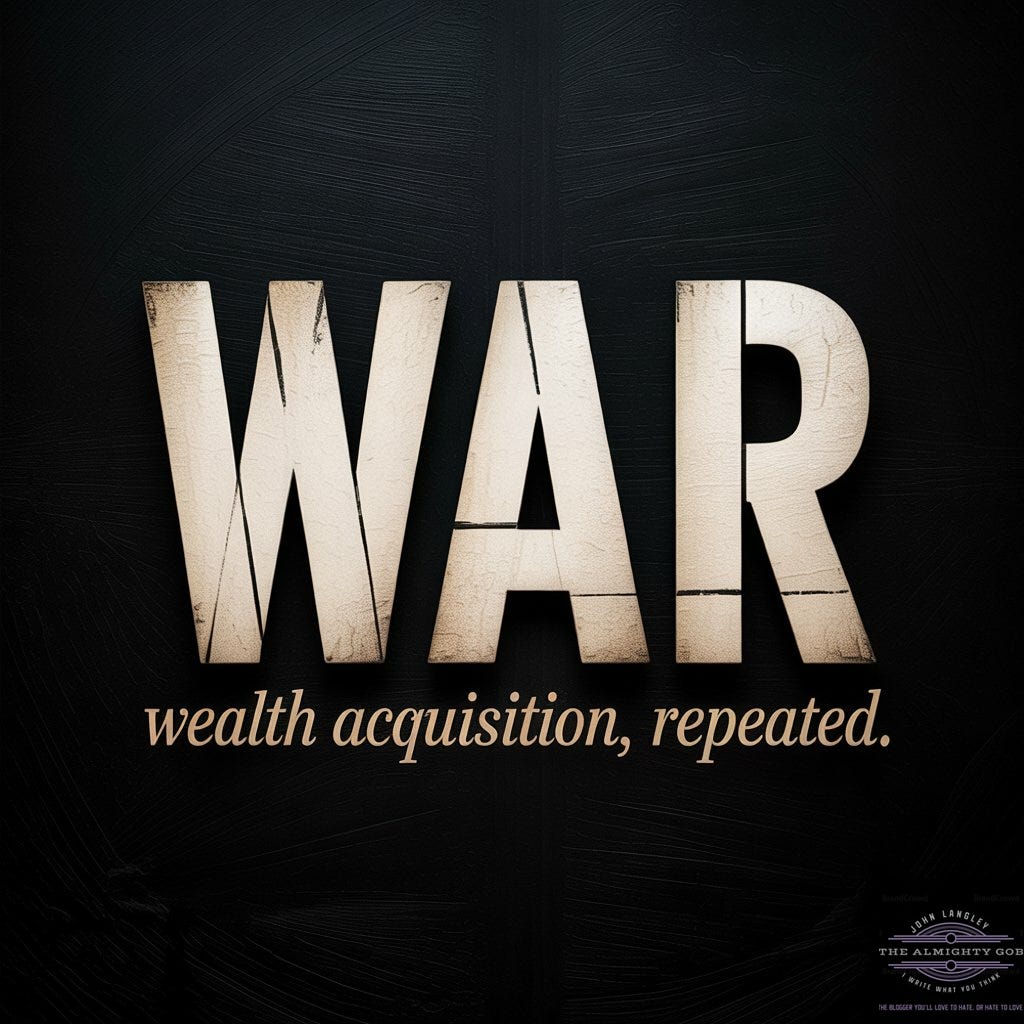
[WAR. wealth acquisition, repeated. — Oh, What a Lovely War, Part 1 of 3. © The Almighty Gob 2026. thealmightygob.com]
Did you know the global arms trade generated a record $679 billion in revenues in 2024? That world military expenditure reached $2,718 billion — the steepest annual rise since the end of the Cold War? That the United States accounts for 42% of all global arms exports, supplied to 107 countries? That the five largest defence contractors — Lockheed Martin, RTX, Northrop Grumman, General Dynamics and Boeing — hold order backlogs measured in the hundreds of billions? The Washington Post knows. The New York Times knows. The Guardian knows. Time Magazine knows. The Sunday Times knows. Reuters knows. None of them joined the dots. The Almighty Gob has one question: why not? The answer is not complicated. The names, though, are worth knowing.
The ticket is free. You’re just paying with everything else.
Richard Attenborough made a film about war in 1969. Brighton Pier stood in for the Western Front. General Haig sold tickets at the turnstile. A cricket scoreboard tracked the daily dead. The families waved. The cheerful songs played. The numbers climbed. The pier is still open. The tickets cost considerably more now. The scoreboard has been upgraded. And the people selling them have names, salaries, share options — and in one case, a seat on the board of JPMorgan Chase.
The entrance is always free. The exit is what costs you.
Three million. That is how many emergency food parcels the Trussell network handed out in the United Kingdom last year. In a country spending £74 billion on defence in the same twelve months. Hold that number. Everything that follows is the explanation for it.
The Business of Now.
Here is a question worth asking yourself next time the news announces another conflict, another crisis, another escalation. Who is having a good morning?
Not you. Not the family that just opened a food parcel. Not the sailor on HMS Dragon — compressed into six days of maintenance work that should have taken six weeks, crossing the Mediterranean in a warship that broke down almost immediately on arrival. Not the 250,000 people the Office for Budget Responsibility says will be pushed into poverty by welfare cuts announced in the same season the defence budget was raised.
Someone, though. Someone is doing very well indeed.
Have you noticed that it’s always the same someones?
Jim Taiclet runs Lockheed Martin. He took home $23.45 million last year. His company posted record revenue of $75 billion — 73% of it straight from the US government. The F-35 fighter jet, the world’s most expensive weapons programme in history, is now operated by nineteen countries. Every conflict that makes those countries nervous is an order. Every escalation is a backlog entry. Every war is, in the most literal financial sense, a good quarter. You see how that works, don’t you.
Christopher Calio runs RTX Corporation, formerly Raytheon. His pay rose 38% in a single year to $24.84 million. His company holds a $268 billion order backlog — that is two hundred and sixty-eight billion dollars’ worth of future killing, already contractually committed. The Patriot missile system alone supplies nineteen nations. When Iran’s drones hit RAF Akrotiri in Cyprus and the British government scrambled to find something, anything, to deploy — it was RTX’s hardware they needed. It was RTX’s production backlog that couldn’t keep up. Did you notice that detail? The system built to protect us couldn’t keep pace with the conflict it was supposedly designed for. Calio’s pay went up 38% anyway.
Phebe Novakovic runs General Dynamics. She is a former CIA operative. She made $23.79 million last year. Her net worth is estimated at $450 million. She sits on the board of JPMorgan Chase. She said publicly, in 2021: “This is not a safe world now.”
She has been making a very comfortable living from that fact ever since. Which you have to admire, in a way. The clarity of it.
Someone always collects the fare. You just never meet them.
The Invisible Architecture.
Here is what you probably weren’t told. What the mainstream media almost never gets around to mentioning.
Above Taiclet, above Calio, above Novakovic — there are three firms sitting as the dominant shareholders of every major defence contractor simultaneously. Lockheed Martin. RTX. Northrop Grumman. Boeing. General Dynamics. All of them. At the same time. The same three firms. Have you spotted it yet?
Those firms are BlackRock, Vanguard, and State Street.
Between them they manage assets worth over $30 trillion — more than the GDP of most countries on earth. They are the top shareholders in 88% of all S&P 500 companies — that is, 88% of America’s five hundred largest publicly traded corporations. For Northrop Grumman alone — just one contractor, you understand, one of five — State Street holds 9.38%, Vanguard holds 9.33%, BlackRock holds 5%. A combined stake worth over £19 billion. In a single defence contractor.
Larry Fink runs BlackRock. Worth $1.2 billion personally. Oversees $10 trillion in assets under management. And — you’ll want to sit with this one — BlackRock is simultaneously the largest investor in weapons manufacturers through its US Aerospace and Defense ETF. Fink writes annual letters to corporate CEOs about their responsibility to society. He does. Every year. Very thoughtfully worded. While running the world’s largest defence investment fund.
You couldn’t make it up. Here we all are, though.
When war becomes a financial instrument, this is what the instrument looks like. The Almighty Gob has been tracking this architecture for some time. The pattern is consistent. The mechanism is the same. The beneficiaries are always the same people.
And those people are findable. BlackRock holds an Annual General Meeting. So does Lockheed Martin. So does RTX. So does BAE Systems. These are public events. Shareholders may attend and ask questions. You may not have known that. Most people don’t.
You don’t own the pier. You just paid to walk on it.
The Map No One Draws.
In fiscal year 2024 alone, US military equipment sales to foreign governments reached a record $318.7 billion. That figure went up. It keeps going up.
Lockheed Martin’s F-35 is now operated by nineteen countries: the US, UK, Italy, Netherlands, Australia, Norway, Denmark, Canada, Israel, Japan, South Korea, Belgium, Poland, Singapore, Finland, Germany, Greece, Romania, Switzerland. Every conflict that makes any of those nations nervous is a maintenance contract. Every threat environment is a sustainment fee. Every war is a production acceleration. The geography of the customer base is, when you look at it this way, essentially a map of everywhere something bad might happen. Which is convenient.
RTX’s Patriot missile system — the foundation of air defence for nineteen countries, from Spain to South Korea, from Ukraine to Saudi Arabia — received a $1.7 billion contract from Spain alone in December 2025. The Netherlands followed with $627 million in April 2026. Germany signed twice in 2024, totalling $2.4 billion. Each interception depletes inventory. Each depletion is an order. Each order is profit. You see the elegance of the arrangement, don’t you. The system is most profitable when it is most needed. And it is most needed when the world is most dangerous. There is no incentive, anywhere in this structure, for the world to become less dangerous.
Russia supplies over thirty countries through its state arms monopoly Rosoboronexport — more than 30,000 contracts with 122 countries, total exports exceeding $230 billion. China, through AVIC, NORINCO and CSSC, has made major arms sales to forty countries. Different flags. Same business model.
Is it practical, to build a world in which the machinery of conflict is the most reliably profitable industry on earth? Is it logical, to expect that industry to advocate for peace? What is the likely outcome, of a system designed from first principles to reward escalation and punish resolution?
Those are not rhetorical questions. They are the only questions that matter. And you’ll notice they’re not being asked on the news tonight.
And yet the protests keep heading to Trafalgar Square, while the contracts are signed somewhere else entirely.
The turnstile doesn’t care which direction you’re running.
Lions. And Donkeys.
Joan Littlewood staged Oh, What a Lovely War in 1963. Pierrot clowns in white face paint, singing cheerful music hall songs. Above their heads, on an electronic panel, the casualty figures scrolled. Nineteen-fourteen. Nineteen-fifteen. Nineteen-sixteen. The jaunty tune. The numbers climbing.
She wanted audiences to leave the theatre laughing at the vulgarity of war.
Nothing has changed except the profitability.
When RAF Akrotiri was struck by an Iranian Shahed drone in March 2026, the British government announced it was deploying HMS Dragon — a Type 45 destroyer, one of only six in the Royal Navy, and one of only two that were combat-ready without restrictions. The crew completed six weeks of maintenance in six days. They trained on the way there. The ship broke down almost immediately on arrival.
Have you noticed how that story just sort of... drifted by? It was on the news for a day or two and then something else happened. A retired Commodore said what needed saying: “Strategically, I think there are questions to answer about why the Navy finds itself in this circumstance.”
Here is the circumstance. In 1982, Britain deployed two aircraft carriers, eight destroyers, and sixteen frigates to retake the Falklands while maintaining other global commitments. Today, stripping every active vessel from every other commitment worldwide, the Royal Navy could deploy one carrier, two destroyers, and five frigates. The Ministry of Defence has been forced to cannibalise components from inactive ships to keep others operational. HMS Daring spent more than half of its entire service life in a refit that took nine years — nearly three times longer than it took to build the ship. Nearly three times. That’s not a delay. That’s a condition.
Meanwhile — and do pay attention here, because this is the part that connects — BAE Systems received £6.7 billion from the MoD in 2024–25. That’s 16.3% of all MoD expenditure for the year. The highest share going to a single supplier since records began. Nearly half of those contracts awarded without competitive tender. BAE has been the largest defence supplier to the MoD for over a decade.
The broken navy and the record BAE payment are not separate stories. They are the same story. The money flows in. The capability does not materialise. More money is requested. Nobody is accountable for the gap between the two. That’s not an oversight. That’s the design.
The scoreboard was always meant to keep climbing.
The Ten Countries.
Global military expenditure reached $2,718 billion in 2024. A 9.4% increase. The steepest year-on-year rise since the end of the Cold War. And here is the thing that should stop you mid-sentence: military spending increased in all world regions. All of them. Simultaneously.
The United States: $997 billion. China: $314 billion. Russia: $149 billion. Germany: $88.5 billion — up 28% in a single year, which is remarkable for a country that spent most of the post-war era deliberately keeping its military minimal. India: $86 billion. Saudi Arabia: $75 billion. United Kingdom: $74 billion. Ukraine: $64.7 billion — 34% of its entire GDP, all tax revenues fully absorbed by military spending. France: $61 billion. Japan: $59 billion — a country that constitutionally prohibits offensive military capability, now rearming faster than at any point since 1945.
Read that list again. Every one of those countries increased their spending. Not one held the line.
Do you see what’s happening? These are not ten separate decisions. This is one decision, made simultaneously, in the language of mutual threat and collective fear. Russia points at NATO. NATO points at Russia. China points at Taiwan. Taiwan points at China. Israel points at Iran. Iran points at Israel. Each pointing makes the other point harder. And every time someone points, someone in Fort Worth or Andover or Barrow-in-Furness gets an order.
The top five countries alone — US, China, Russia, Germany, India — accounted for 60% of all global military spending in 2024. Combined expenditure: $1,635 billion. In a single year.
Meanwhile — and you knew there was a meanwhile coming, didn’t you — one in three children in the UK lives in poverty. 190 million people in India go to bed hungry every night. Russia’s birth rate is collapsing. Germany’s schools are crumbling. The United States has 40 million people below the poverty line and a life expectancy lower than almost every other comparable wealthy nation, and falling.
The money is not absent. The choice is where it goes.
Three million food parcels. One decision. Made for you. Without you.
The Loop That Closes Itself.
Byline Times investigated the revolving door — senior British military officers walking from their commissions into seats at BAE Systems, at Jacobs Engineering, at defence consultancies serving the same Gulf states whose militaries they once helped to arm. Worth knowing. Press Gazette reported journalists being physically barred from the DSEI arms fair in London — the one held with government backing, the one where you can walk around tanks and warships as though you’re at an agricultural show, but with more ordnance. One excluded journalist, who had spent years covering UK arms sales to Saudi Arabia, said this: “I think they regard my journalism as far too relevant — maybe dangerously so.”
Dangerously so. At a government-backed event. In London. Have you sat with that for a moment? A journalist barred from a public event because his journalism was considered too relevant. You might think that’s rather the point of journalism. Apparently not everyone agrees.
The Washington Post has not run this story. The New York Times has not run this story. The Guardian has not run this story. The Sunday Times has not run this story. Time Magazine has not run this story. Reuters has not run this story. The Intercept — which exists specifically to run stories like this one — has covered elements of it. But the full architecture, named and sourced and connected from BlackRock to the food bank to the broken destroyer, has not appeared in any of them in a single piece. You might find that interesting. The Almighty Gob certainly does.
In December 2021, three activists did something different. They went to an Elbit Systems factory in Shenstone, Staffordshire — a subsidiary of Israel’s largest private arms company, manufacturing drone engines. They locked onto the gates. They threw paint. They were prosecuted. A magistrate acquitted them, finding their action proportionate to preventing a greater harm in Palestine. The factory noticed. The company noticed. Trafalgar Square did not come up in the evidence.
Three years later, six activists broke into Elbit’s facility in Filton, near Bristol. They caused approximately £1 million of damage. They were charged with aggravated burglary. A jury acquitted them in February 2026 after more than thirty-six hours of deliberation. Again the factory noticed. Again the company noticed. Again Trafalgar Square did not come up in the evidence.
Two cases. Two locations. Two acquittals. One pattern.
The arms trade has been building this architecture for sixty years. Patiently. Methodically. Contract by contract, appointment by appointment, AGM by AGM. It does not march. It does not chant. It does not need a placard. It has something considerably more durable than passion. It has a structure.
Against that structure, a march to Trafalgar Square makes two short planks look like the most sophisticated computer system in the world. It is the political equivalent of arguing with the smoke alarm while the house burns down — the noise is real, the feeling is real, and the cause of the fire remains completely undisturbed.
The system removes friction. Between the feeling — we are threatened — and the consequence — we must spend. Between the order — produce more missiles — and the scrutiny — where is the money going. Between the promise — we are making you safer — and the reality — your ship broke down four days into its deployment.
Friction is what allows a question to be asked. The system is specifically designed to ensure that no one with the power to ask it ever has to.
What Joan Knew.
She wanted audiences to leave laughing at the vulgarity of war. She got them, in 1963, in pierrot costumes, with the casualty numbers scrolling overhead.
The numbers are different now. The costumes are the same.
$2.7 trillion. Global military spending. In a single year. Enough to end extreme global poverty — estimated to cost around $175 billion annually — seventeen times over, and still have change. Seventeen times. We couldn’t find the money for it once.
Three million food parcels. In the United Kingdom. In twelve months. In the sixth-largest military spender on earth.
A destroyer that broke down four days into its deployment. A navy with fewer operational ships than at any point since the Second World War. A procurement budget that flows predominantly, without competitive tender, to a single supplier, year after year, decade after decade.
One in three British children in poverty.
Lockheed Martin: $75 billion revenue. Record backlog.
RTX: $268 billion in committed orders.
BAE Systems: £6.7 billion from the MoD alone. One year.
Jim Taiclet: $23 million. Phebe Novakovic: $23 million. Christopher Calio: $24 million. Larry Fink: $1.2 billion net worth, $10 trillion under management, the world’s largest defence investment fund.
And somewhere in a logistics centre in Wiltshire, in a community hall in Sheffield, in a church in Bristol, volunteers are sorting food parcels. Tins of soup. Packets of pasta. For people with jobs. For people with children. For people who are cold.
You’ll have noticed, by now, who is at the turnstile. Who is selling the tickets. And who is paying for everything else.
The pier is still open. It always was. The scoreboard is still running.
But here is the question Joan Littlewood never got to ask — because in 1963, she didn’t know the answer yet. It isn’t who is selling the tickets.
It’s who built the turnstile. Who owns the pier. And who signed the contract.
Oh, what a lovely war.
Next — Part 2 of 3: Oh, What a Lovely War Contract.
For Those Who Enjoy Doing Their Own Homework — and the Anally Retentive
Every figure in this piece is sourced. Every claim is verifiable. Thirty-two citations below for anyone who wants to check the working — and The Almighty Gob strongly encourages you to do exactly that.
Global arms trade revenues 2024 — $679 billion. SIPRI Top 100 Arms-Producing and Military Services Companies, 2024. Stockholm International Peace Research Institute, December 2025. sipri.org
World military expenditure 2024 — $2,718 billion, 9.4% increase. Trends in World Military Expenditure, 2024. SIPRI Fact Sheet, April 2025. sipri.org
US accounts for 42% of global arms exports, supplied to 107 countries. SIPRI Arms Transfers Database, March 2025. sipri.org
US military equipment sales to foreign governments — $318.7 billion, fiscal year 2024. Defense Security Cooperation Agency, US Department of Defense, 2024. dsca.mil
Jim Taiclet compensation — $23.45 million. Lockheed Martin revenue — $75 billion, 73% from US government. Lockheed Martin Annual Report 2024, SEC Filing, February 2025. sec.gov
F-35 operated by nineteen countries. Lockheed Martin F-35 Programme factsheet, January 2026. lockheedmartin.com
Christopher Calio compensation — $24.84 million, 38% increase. RTX order backlog — $268 billion. RTX Corporation Annual Report 2024, SEC Filing, February 2025. sec.gov
Patriot missile system — nineteen nations. Spain contract $1.7 billion December 2025. Netherlands $627 million April 2026. Germany $2.4 billion 2024. Defense Security Cooperation Agency notifications, 2024–2026. dsca.mil
Phebe Novakovic — CIA background, compensation $23.79 million, net worth $450 million, JPMorgan Chase board membership. General Dynamics Annual Report 2024, SEC Filing. ProPublica, General Dynamics executive profile. sec.gov
BlackRock, Vanguard, State Street — dominant shareholders of all major defence contractors simultaneously. SEC institutional ownership filings, 2024–2025. sec.gov
Combined assets BlackRock, Vanguard, State Street — over $30 trillion. Top shareholders in 88% of S&P 500 companies. Bloomberg, Financial Times institutional ownership analysis, 2024.
Northrop Grumman — State Street 9.38%, Vanguard 9.33%, BlackRock 5%. SEC 13F institutional ownership filings, 2024. sec.gov
Larry Fink net worth $1.2 billion, $10 trillion AUM. BlackRock US Aerospace and Defense ETF. Bloomberg Billionaires Index, 2025. BlackRock annual report 2024. blackrock.com
Rosoboronexport — 30,000+ contracts, 122 countries, $230 billion exports. SIPRI Arms Transfers Database. Russian Federal Service for Military-Technical Cooperation.
HMS Dragon deployment — six weeks compressed to six days, ship broke down on arrival. Navy Lookout, March 2026. navylookout.com. MoD official statement, March 2026.
Retired Commodore quote on HMS Dragon. Navy Lookout, March 2026. navylookout.com
1982 Falklands fleet vs current Royal Navy capability comparison. House of Commons Defence Select Committee reports, 2024–2025. parliament.uk
HMS Daring refit — nine years, more than half its service life. National Audit Office, MoD Equipment Plan 2024–25. nao.org.uk
BAE Systems — £6.7 billion from MoD 2024–25, 16.3% of total MoD expenditure, highest single-supplier share on record. Nearly half of contracts non-competitive. Ministry of Defence Annual Report and Accounts 2024–25. gov.uk
250,000 people pushed into poverty by welfare cuts. Office for Budget Responsibility, Spring Statement 2025. obr.uk
Three million emergency food parcels — Trussell network, UK, 2024–25. Trussell Trust End of Year Statistics 2024–25. trusselltrust.org
UK defence spending £74 billion 2024. SIPRI Military Expenditure Database, April 2025. sipri.org
All ten country military spending figures — US $997bn, China $314bn, Russia $149bn, Germany $88.5bn, India $86bn, Saudi Arabia $75bn, UK £74bn, Ukraine $64.7bn, France $61bn, Japan $59bn. SIPRI Trends in World Military Expenditure, 2024. sipri.org
Ukraine military burden — 34% of GDP, all tax revenues absorbed by military spending. SIPRI, April 2025. sipri.org
One in three British children in poverty. Child Poverty Action Group, UK Child Poverty Statistics 2025. cpag.org.uk
190 million people in India food insecure. UN World Food Programme, Global Report on Food Crises 2025. wfp.org
US — 40 million below poverty line, falling life expectancy. US Census Bureau, 2024. Centers for Disease Control and Prevention, National Vital Statistics Reports, 2024.
Extreme global poverty — estimated cost $175 billion annually. World Bank Group, Poverty and Inequality Platform, 2024. worldbank.org
Byline Times — revolving door investigation, senior military officers to BAE Systems, Jacobs Engineering, Gulf defence consultancies. Byline Times, 2024–2025. bylinetimes.com
Press Gazette — journalists barred from DSEI arms fair. Journalist quote on being “dangerously relevant.” Press Gazette, DSEI 2019 coverage. pressgazette.co.uk
Elbit Systems — Shenstone, Staffordshire, December 2021 acquittal. Newcastle-under-Lyme Magistrates Court, December 2021. Mondoweiss, December 2021. mondoweiss.net
Elbit Systems — Filton, Bristol, August 2024 break-in. Approximately £1 million damage. Six activists acquitted February 2026. Woolwich Crown Court, February 2026. Garden Court Chambers, February 2026. gardencourtchambers.co.uk. Al Jazeera, February 2026. aljazeera.com
The Almighty Gob is a Bristol-based publication founded by John Langley — independent Bristol mayoral candidate 2016 and 2021, and one of the city’s most forensic observers of institutional power. Publishing since 2020, with over 500 pieces including 88 FOI-based Bristol investigations. Across seven platforms and Substack at thealmightygob.com — no party allegiance, no press accreditation, no interest in acquiring either.