

[The Almighty Gob — Bristol to the Gulf, local to global. One fault line. One number. © The Almighty Gob 2026.]
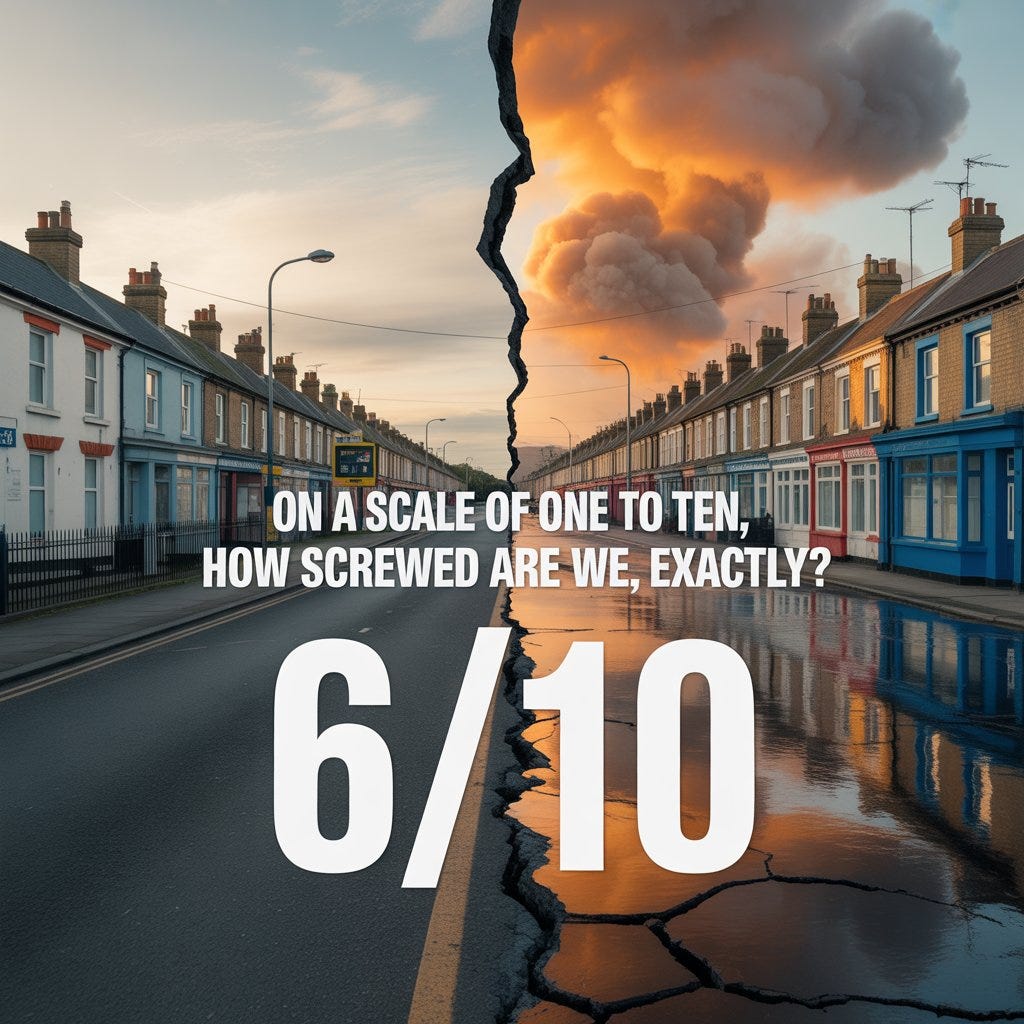
6/10.
I know.
One thing before we start. Higher means more screwed. That’s the scale. Simple enough. Pay attention to the ones that should be higher than they are — because that’s where the real argument lives.
You expected worse. You came here carrying an eight, maybe a nine, possibly an eleven if you’d been on social media before breakfast. You’re looking at 6/10 and something feels slightly wrong — like being told the bill is less than you feared, and immediately suspecting the waiter forgot something.
Stay with it.
6/10 isn’t reassurance. 6/10 is a wager. By the time we’ve done the working — Bristol to Brussels, the BMA to the Gulf, Wetherspoons to the Strait of Hormuz — you’re going to know exactly what 6/10 is resting on.
Tonight at 8pm Eastern, we find out if it holds.
Bristol. 4/10.
You probably clocked the march. Forty people — Bristol Patriots, styling themselves a March for Unity — assembled at the Cenotaph on St Augustine’s Parade on 7 March and attempted to walk through Broadmead, Cabot Circus and Castle Park.
Forty people.
Bristol’s response was more than two hundred police officers, mounted units, batons, and a full public order operation. Six arrests. The march rerouted, blocked, turned around, and eventually escorted back to where it started — having covered a fraction of the planned route.
That’s not a march. That’s a very expensive supervised walk for adults who couldn’t fill a bus.
Here’s the bit that went past fast. After the march dispersed, four of them — Hugh Anthony, Roger Quilliam, Thomas Moffitt, and Chris Messenger — tried Wetherspoons. The landlord had them out. An angry Messenger, known in anti-fascist circles as English Ned, declared that patriots should now boycott Wetherspoons. “The traitor dirty scum.”
Wetherspoons. The bar that has, in its entire carpeted history, never once turned anyone away for being too unpleasant. The bar where the carpet pattern exists specifically to disguise despair. Even they said no.
The Bristol Patriots have since rebranded as Bristol Rises. Their most recent action was attaching Union flags to lampposts outside Southmead Hospital without permission. North Bristol NHS Trust removed them within three hours.
Forty people marched for Britain. Bristol sent five officers each, redirected them, and Wetherspoons finished the job.
Now. You might be thinking: forty people, problem solved, moving on.
Don’t move on yet. While everyone was watching the march, something else was happening — something that’s been happening for years, quietly, in council offices where legal thresholds get applied and nobody checks the application.
A Bristol resident asked — through entirely proper legal channels — why their road had been blocked as part of the East Bristol Liveable Neighbourhood scheme. The council looked at the request and called it vexatious. The Information Commissioner’s Office ruled in March 2026 that the legal threshold for that designation hadn’t been met. Hadn’t even been approached. The council has been ordered to go back and answer the question it should have answered in the first place.
You know. The one the resident paid their council tax to ask.
Did you know this one? It barely made the news.
The same council whose housing repairs system — a £7.5 million IT project, four years in the making — produces figures that, in the words of its own Labour councillor Rob Logan: “are rubbish, we don’t trust them.” Almost twenty thousand overdue repairs on the system. The Regulator of Social Housing found the council had failed to demonstrate it was meeting carbon monoxide safety requirements for more than twenty-two thousand of its twenty-six thousand homes.
Carbon monoxide. The invisible one. The one you don’t know about until you do.
The Housing Ombudsman ordered an independent review after finding severe maladministration — a vulnerable resident, failed across multiple duties of care, rendered homeless.
Three years ago, council staff began monitoring the social media of parents of disabled children. Profiling them. Withdrawing funding from their support forum. Removing EHCP provision as what one affected parent describes as a direct consequence of staff behaviour. The investigation into that — three years later — is now finally underway. Labour’s proposed terms of reference for the investigation omitted any requirement for former councillors from that administration to give evidence. Other parties voted against those terms.
In March 2026, in Bristol — the birthplace of Banksy — the Greens-led council censored an anti-war art exhibition one day after it opened at M Shed. Artists were asked to take a knife to their own canvases and cut out the names of arms companies. They did.
Decision by decision. Threshold by threshold. Each one defensible in isolation. The pattern visible only from a distance.
Bristol City Council: 4/10.
On a scale where higher means more screwed, that should be a 7. Possibly an 8. The evidence you just read supports it. The reason it’s a 4 is the reason the whole piece exists — because we’ve watched this long enough that a council spying on disabled children’s parents, censoring art, and operating a housing database nobody trusts barely moves the needle anymore.
That’s not a score. That’s a diagnosis.
The Region. 5/10.
Here’s where it gets uncomfortable — for anyone reading this who didn’t vote in the West of England mayoral election last May.
Helen Godwin is the Metro Mayor. Labour. In the job less than a year. Running a bus consultation, planning a mass transit system, extending the Diamond Pass, keeping the £1 child fare cap for another three years. Doing reasonable things.
She beat Reform’s Arron Banks by fewer than six thousand votes.
On a thirty percent turnout.
Seven people in ten didn’t vote. The region that contains Bristol, Bath, and South Gloucestershire — one of the fastest-growing economic areas in the country, the area whose Metro Mayor shapes transport, housing, and investment for the decade ahead — was shaped by three people in ten.
That margin. That turnout. They don’t disappear when the election ends. They travel forward into every decision the Metro Mayor makes for the next four years — and into every election that follows, where the numbers may not land the same way twice.
That’s not a scandal. There’s no one to prosecute. No law broken. Just a margin and a turnout travelling quietly forward into every decision that gets made for the next four years.
The region isn’t in active crisis. It’s in something quieter and harder to name — the kind of fragility that only shows up in the numbers on the night of the next election.
The region: 5/10. The five isn’t for what’s happening. It’s for what’s been left unlocked.
National. 7/10.
Here’s the one nobody joined up.
The British Medical Association — the organisation that fights for doctors’ pay — is leading resident doctors out on a six-day strike from 7am tomorrow. The BMA says the government’s 3.5% offer is a crushing blow that doesn’t begin to restore fifteen years of real-terms pay erosion. That’s a serious argument. The doctors have a serious case.
Hold that thought for a second.
Here’s the part they didn’t put in the headline.
While the BMA was making that case, its own employees — the people who run the organisation, process casework, answer phones, keep the machine that fights for doctors’ pay actually functioning — were offered two percent.
Two.
The GMB union, which represents the majority of BMA staff, says its members have absorbed nearly seventeen percent real-terms pay erosion since 2012. Seventeen percent. The BMA called the government’s 3.5% offer to doctors a crushing blow. Then offered its own staff 2%. When ninety-six percent of BMA staff voted to strike on an eighty percent turnout, the BMA moved to two point seven five.
Two point seven five. Still below the 3.5% it called a crushing blow.
Did you realise that today — this Monday, 6 April — BMA staff are already on their own picket line? Tomorrow, when the doctors join theirs, there will be two picket lines outside BMA House in Tavistock Square. One fighting for its members. One fighting against its employer.
The employer being the organisation fighting for its members.
The union demanding pay restoration for doctors offered its own staff 2.75%. That’s not irony. That’s a confession.
Thirteen million people in this country are living in relative poverty — up half a million on last year. The economy is growing at 0.7% — which in clinical terms is a pulse without consciousness. Keir Starmer’s government is simultaneously not-at-war in the Middle East while flying British aircraft in defensive roles over Qatar, Jordan, Iraq and Cyprus, parking HMS Dragon off Cyprus, and permitting use of British bases for operations it insists it isn’t part of.
Not at war. Just adjacent. Very busy. Lots of planes.
National: 7.5/10. The pulse is there. Consciousness is optional.
Still six. Stay with it.
Europe. 7.5/10.
Europe is watching America quietly dismantle the architecture it spent eighty years building — and discovering, with some urgency, that it failed to build enough of its own.
Aviation is a disrupted mess. Major air traffic hubs across the Middle East closed or severely impacted — Dubai, Bahrain, Tel Aviv, Doha. Flights rerouted around the entire region, adding hours and fuel costs to every journey. The price of everything that moves by air is moving upward. Things move by air.
Qatar declared force majeure on all LNG exports after the Strait of Hormuz closure. Goldman Sachs estimates a prolonged disruption — beyond two months — pushes European gas prices above a hundred euros per megawatt hour. They were at thirty-one point six when the war began in February. That’s the number behind your next energy bill. That’s what the Gulf means on a Tuesday morning in Bristol.
Europe: 7/10. And climbing.
The Middle East. 9/10.
Stay with this one. People skim past the Gulf. They shouldn’t.
The International Energy Agency has called this the largest supply disruption in the history of the global oil market. Not the largest this year. Not the largest since the 1970s oil shocks.
In history.
Brent crude is up eighty percent in 2026, trading above $109 a barrel. Analysts are pricing scenarios up to $200. At $170, Goldman Sachs models a stagflationary shock that reshapes central bank policy across the world — which means interest rates, which means mortgage rates, which means the thing you were about to put in your basket and then put back.
Write that down. That’s not a foreign policy problem. That’s a Tuesday afternoon in a supermarket.
In Kuwait and Qatar, Iranian strikes have hit desalination plants — the source of ninety-nine percent of their drinking water. Not an energy problem. A water problem. Seventy percent of Gulf food imports are disrupted. Basic consumer prices up between forty and a hundred and twenty percent. Retailer Lulu has been airlifting staples.
This is not a war about oil. It’s a war about water and bread — wearing oil as a disguise.
Now — this is the number that should be keeping you up — a Financial Times investigation found five hundred and eighty million dollars in bets placed on falling oil prices. Placed fifteen minutes before Donald Trump posted about postponing attacks on Iran. The post caused prices to drop. The bets paid. The calls for an insider trading investigation are growing louder by the day.
Fifteen minutes.
Middle East: 9/10. We don’t give it ten because it hasn’t ended yet.
Trump. The Thread.
Here’s where the chain connects.
Here’s the thing nobody’s connected in one place. The thread runs clean — from Bristol City Council’s lost emails and vexatious residents, through a housing database nobody trusts, through the BMA’s 2.75%, through Starmer’s not-quite-a-war, through Europe’s scramble, through burning Gulf refineries — all the way to one man composing ultimatums on Truth Social at midnight and signing them “Praise be to Allah. President DONALD J. TRUMP.”
On Easter Sunday. From a self-described Christian. Threatening bridges.
Tonight at 8pm Eastern, his latest deadline expires. Open the Strait of Hormuz or he bombs every power plant in Iran. Iran’s military has called the ultimatum “helpless, nervous, unbalanced and stupid.”
They’re not wrong about the unbalanced part.
Oil industry executives say the Strait needs to reopen by mid-April or the disruption becomes something nobody’s models can contain. Every day it stays shut, the supply loss grows.
Trump/Global: 9.5/10. Not ten because ten means it’s over. It isn’t over yet.
So. 6/10.
That’s the number I walked in with.
6/10 assumes that enough pain, eventually, forces de-escalation. That markets scream loud enough. That the phone call gets made. That Tuesday doesn’t have to be what the Truth Social post said Tuesday was going to be.
Here’s what 6/10 is actually resting on — now that you can see the whole chain.
A council that fails without collapsing. A region shaped by three people in ten — which may include you. A union striking against itself. A government flying planes over four countries and calling it not a war. A continent holding together while America walks away. A Gulf running out of water while someone looks for the phone. Five hundred and eighty million dollars bet on a Truth Social post.
That’s what 6/10 looks like. That’s what it’s made of.
On a scale where higher means more screwed, 6/10 should be keeping you up at night.
The fact that it doesn’t — the fact that you’ve read this far and thought yes, sounds about right — is the most honest answer to the title’s question.
So. On a scale of one to ten, how screwed are we, exactly?
It’s whether the person holding the trigger tonight at 8pm Eastern knows that too.
If you feel like, or have the time to fact check. These, are all yours to have fun with:
Bristol Patriots march — Searchlight, Bristol 24/7, Novara Media, The Bristol Cable, March 2026. Avon and Somerset Police confirmed six arrests and more than 200 officers. Wetherspoons ejection of four named individuals — Searchlight, March 2026. EBLN/ICO decision notice — ICO, 20 March 2026. Housing repairs and IT failure — Bristol World, Inside Housing, February 2026; Regulator of Social Housing, July 2024. SEND spying — Bristol World, August 2025. M Shed censorship — World Socialist Web Site, March 2026. BMA staff pay dispute — GMB Union, ITV News, LBC, Morning Star, Pulse Today, March–April 2026. BMA strike dates — BMA.org.uk, April 2026. NHS pay — House of Commons Library, March 2026. UK poverty and GDP — OECD, ONS, April 2026. Helen Godwin election — Bath Echo, Bristol 24/7, May 2025. Strait of Hormuz economic impact — IEA, Dallas Federal Reserve, Goldman Sachs, Bloomberg, World Economic Forum, Stimson Center, Kpler, March–April 2026. Oil prices — Motley Fool, Bloomberg, April 2026. Desalination and food supply — Economic Impact of the 2026 Iran War, Wikipedia. FT insider trading investigation — Financial Times, March 2026. Iran military response — Al Jazeera, CNN, April 2026.
The Almighty Gob is a Bristol-based publication covering politics, power, and the gap between what institutions say and what they actually do — from City Hall to the White House, from the corner shop to the Gulf. Publishing since 2020, with over 500 pieces including 88 Bristol FOI-based investigations, The Almighty Gob operates across nine social media platforms, Substack, and thealmightygob.com — reaching readers who prefer their politics without the packaging.