
Palestine Action, Dirty Money and the Hidden Wiring: How Foreign Influence Is Powering Britain's Culture Wars.
The Rycroft Review confirmed hostile states are stoking division. Palestine Action's funding trail leads somewhere. So does the money behind 180 MPs. Follow the wiring.

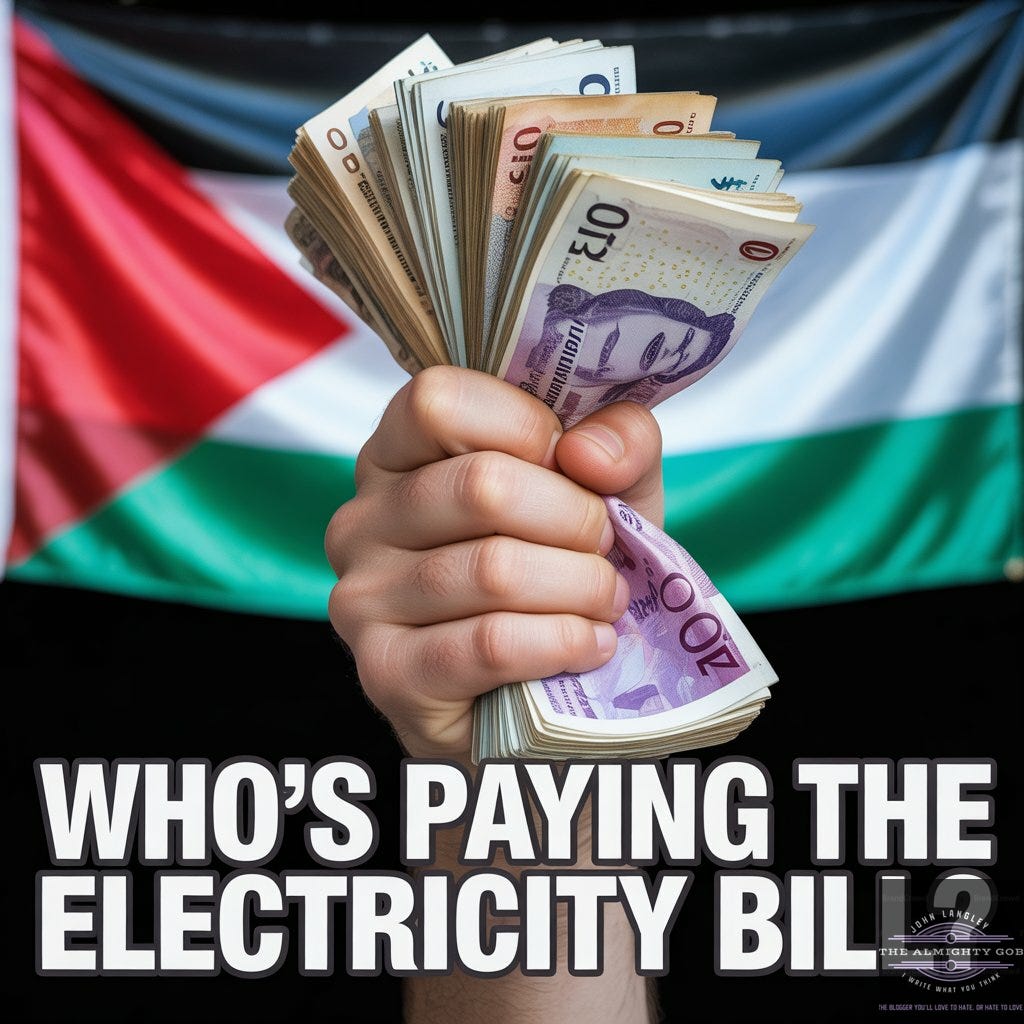
[The foot soldiers are loud. The money is quiet. The Rycroft Review confirmed hostile states are funding division in UK politics. Palestine Action’s funder confirmed his role to Los Angeles Magazine. A Cabinet minister couldn’t rule out foreign state backing on the BBC. Two sets of foot soldiers. Same national grid. Who’s paying the electricity bill? © 2026 John Langley / The Almighty Gob]
Everyone’s watching the sparks. What sparks, you may well ask. Well, here’s the thing.
In March 2026, the Rycroft Review — a government-commissioned independent inquiry into foreign financial interference in UK politics — confirmed what careful observers had documented for years. Hostile state activity in the UK is real. Persistent. And deliberately designed to operate beneath the noise.
The review identified two tracks. Direct infiltration of political parties through dirty money in politics. And the subtler, harder-to-trace work of stoking division and distrust among the wider public — through social media, through influence networks, through vectors most people never think to question.
Foreign influence on UK democracy, Rycroft found, is a documented, ongoing political influence operation. Not a theory. Not a fringe concern. Running right now — through shell company donations, through cryptocurrency political donations, through the gaps that the Representation of the People Bill is only beginning to close.
That’s the official version. Here’s what the official version doesn’t follow all the way to the source.
You’ve possibly felt it. That low-frequency unease when another storm breaks on your feed and everyone around you is already at full pitch before the facts have even landed. That moment where you think — hang on — and then don’t say it out loud because the room has already decided.
That instinct is correct. Trust it. Now, here’s why.
The RANT brigade are foot soldiers. They believe what they believe. Most of them aren’t cynical. Most of them aren’t paid. Most of them have no idea that the infrastructure beneath their righteous anger was built, funded, and quietly switched on by people they’ve never heard of, for reasons that have very little to do with the cause they’re screaming about.
That is the story nobody’s following all the way. This is The Almighty Gob following it.
This publication has spent years watching Bristol’s own institutional machinery up close — filing FOI requests, tracking ICO enforcement notices that Bristol City Council would rather you didn’t read, documenting the gap between what is said in public and what is decided in private.
Pattern recognition, applied locally, over time. And one pattern keeps appearing that cannot be dismissed: the most politically energised people in this city are frequently the least engaged with decisions being made in their name, on their own doorstep.
The energy is real. The direction, it seems, has been chosen for them. That is what this piece is about.
The Wiring Nobody Traces.
You see, social media didn’t create political outrage. It monetised it. It gave rage a share button, a notification system, and an algorithm calibrated to reward the fastest, loudest, most emotionally extreme response in any given moment.
The dopamine hit of the retweet replaced the slow satisfaction of the considered position. Speed became virtue. Volume became instant authority by pushing the right dopamine button at exactly the right time. They scored, and got the hit the fix demanded.
Stop and think about what that actually means.
It means the system doesn’t reward being right. It rewards being first and loud. It means the person who pauses to check a fact loses ground to the person who doesn’t. It means careful, considered, contextual analysis is structurally punished — while raw emotional reaction is structurally rewarded. Billions of times. The fix won.
And, the result is a population of foot soldiers who self-organise around emotional triggers they didn’t create and would be unable to trace. You know, like buying a narcotic in Bristol that’s been shipped in from Colombia, indirectly — as an organisational model, of course.
The trigger drops into the feed. The foot soldiers respond. The cause gets amplified. The noise rises. And somewhere — quieter than they should be, given what’s happening — the people who seeded the trigger watch the circuit run exactly as designed.
This is not speculation. This is the observable pattern — as the evidence below makes clear. Watch who goes quiet when the storm breaks.
Now ask yourself: when did you last see the people who benefit from an outrage cycle join in with it? Really think about that. Because the answer tells you everything.
Palestine Action: Follow The Wiring.
Let’s take Palestine Action, for example. Proscribed under the Terrorism Act 2000 in July 2025 — the first domestic group added to that list in years. The foot soldiers climbed refineries, spray-painted arms factories, vandalised military aircraft at RAF Brize Norton. Visible. Loud. Generating footage. Generating outrage on both sides, which is itself part of the mechanism.
It was never the dealers in court. Metaphorically speaking. Those at the top of the chain were nowhere near a courtroom. It never is.
The question the RANT brigade never asked: who was paying for the infrastructure?
Palestine Action publishes no financial information. Their own website described funding as “sometimes inconsistent” — language recorded at the time of proscription in July 2025. That deliberate opacity is a data point in itself. Groups confident in their funding sources publish them. Groups with reasons for discretion — beyond donor privacy — don’t.
Here is what incompetence looks like: a poorly organised group that can’t pay its legal bills and gradually collapses under pressure. Here is what this looked like: sustained, coordinated direct action across multiple sites, nationwide legal support, international networks in Britain, Italy, Germany, Portugal, Norway, France and Austria — as documented in Palestine Action’s own published network listings — and a crowdfunding campaign that raised over £300,000 in a fortnight after proscription was announced.
The mysterious funders with the money? Nowhere to be seen. Funny that.
That isn’t incompetence. That is infrastructure. Infrastructure costs money. So where was the money?
What is on the public record is this: in an October 2023 interview with Los Angeles Magazine, James “Fergie” Chambers confirmed that his wealth was paying the legal fees of Palestine Action members. Chambers is an heir to Cox Enterprises — one of America’s wealthiest family business empires. In recorded public statements, he has said he chants “death to America” daily. In reported social media posts, he wrote that people who support Israel should be made “afraid to go out in public.”
American ultra-wealthy ideological money. Flowing into a UK direct action group. Named. Documented. On the public record.
Is Chambers the whole picture? Almost certainly not. But he is the picture the public record allows. Palestine Action’s deliberate financial opacity means the rest of the wiring stays hidden — and that opacity is itself the argument. Organisations with nothing to hide don’t hide it.
Where that £300,436 crowdfund goes now — with the group banned and membership of a proscribed organisation under the Terrorism Act carrying a potential fourteen-year sentence — is a question nobody in the mainstream has pursued with any urgency.
Worth noting: Cabinet minister Jonathan Reynolds, asked directly on the BBC whether a foreign power could be backing Palestine Action, said he could not rule it out. A serving minister. On record. Unable to rule it out.
Perhaps they should. Follow the wiring. Ask where it runs.
The Other Side Of The Same Grid.
Now, here’s where the analytical discipline matters most. Because if you’ve read this far nodding along, here comes the part that might make you uncomfortable. Just take my advice, and beware of potential involuntary spasms. The neck can be painful.
The wiring doesn’t only run one way.
Declassified UK’s investigation identified 180 MPs — more than a quarter of the House of Commons — who accepted donations, hospitality, or sponsored overseas visits from pro-Israel groups or affiliated individuals. One hundred and thirty Conservatives. Forty-one Labour MPs. Three Liberal Democrats. Senior frontbenchers. Cabinet-level figures. Named. In the dataset. And verifiable: the donations themselves are declared in the public register of members’ interests. Declassified mapped them. The register holds them.
The partridge in the pear tree will no doubt follow. You know, later this year, perhaps.
So. Two sets of foot soldiers. Two separate wiring runs. Two different junction boxes.
Same national grid.
The moral weight of each side’s cause is for each reader to assess. That’s not this piece’s job. This piece’s job is to follow the wiring — and the wiring runs identically regardless of which direction you find acceptable.
The foot soldiers on one side are climbing refineries. The foot soldiers on the other side are voting on arms export licences. Neither group is necessarily corrupt. Neither group is necessarily cynical. Both groups are carrying current generated by a power source they can see clearly enough to believe in — but not clearly enough to question.
Are you uncomfortable yet? Good. That discomfort is your critical faculty waking up. Hold onto it. If not, something firm.
Transparency International UK’s Political Finance and Foreign Influence analysis of UK political donations since 2001 found an estimated £13 million traceable to donors alleged or proven to be intermediaries for foreign funds or hidden sources. Thirteen million pounds.
That’s not a fringe concern. That’s documented analysis from an independent anti-corruption organisation, sitting in the public record, while the noise ran in every other direction.
Both sides of Britain’s most ferocious culture war arguments have money running through them that the foot soldiers know nothing about. The outrage is genuine. The grievances, on all sides, contain real human suffering. But the infrastructure keeping both armies in the field — funded, organised, legally supported, internationally networked — has a balance sheet that nobody is publishing.
Curious that. Wouldn’t you say?
The Junction Box.
So, screwdriver ready, we return to the junction box, which isn’t always a person. Sometimes it’s an interest. A financial position. A geopolitical outcome that benefits particular actors regardless of which side of the noise is loudest on any given Tuesday.
The foreign funding concern is serious enough that the government built an entirely new legal architecture around it. The Foreign Influence Registration Scheme — FIRS, established under the National Security Act 2023 — came into force in July 2025. It requires anyone conducting political influence activities at the direction of a foreign power to register within twenty-eight days. Russia and Iran sit on the enhanced tier. China does not — because the trade implications of listing the UK’s third-largest trading partner were considered too significant.
A government doesn’t build that architecture because nothing was happening. And when it commissions an independent review that concludes foreign interference is “real and persistent” — as the Rycroft Review did in March 2026 — it isn’t doing so because the problem is theoretical.
It transpires that Spotlight on Corruption’s analysis of FIRS identified the gaps the scheme still doesn’t close: “Friends of” parliamentary groups, All-Party Parliamentary Groups, think tank funding, paid overseas trips for MPs. All legal. All largely invisible. All operating well beneath the noise floor of whatever the RANT brigade is screaming about that particular week.
The government’s own review confirmed that under rules still operative until reform arrives, a company registered today — owned by anyone, funded from anywhere, without a single day of trading history — can make a legal political donation to a UK party. That loophole has been there for years.
The foot soldiers never knew it existed. The people who used it certainly did.
“The junction box doesn’t care who wins the argument. It cares about the outcome.”
They Didn’t Build A Movement. They Built A Religion.
So, now let’s think about how religion works as an organisational technology, without the dog collar, of course. Not as faith — as architecture. You don’t need to brief every believer. You establish the core doctrine — the foundational truth that cannot be questioned — and the congregation self-polices from there.
The doctrine spreads peer to peer. Correction comes from within the community, not from above. Deviation is punished socially, immediately, and publicly. The whole thing runs itself. The founders don’t need to maintain it. The believers do that for free.
What political influence operations have done is digitise that architecture and accelerate it by a factor of, say, a mere million. Conservatively speaking, of course.
So, anyone who questions the doctrine isn’t engaging in debate. They’re committing heresy. The response isn’t argument. It’s excommunication. Social media made excommunication instantaneous, public, and algorithmically rewarded. The pile-on is the sermon.
The indoctrination doesn’t feel like indoctrination from inside. It never does. It feels like awakening. Like you’ve seen something others haven’t. Like you’re on the right side of history while everyone else is either asleep, complicit, or suffering from a severe case of amnesia.
That emotional combination — enlightenment, righteousness, existential threat — is a technology as old as organised power itself. It has been used to march armies, burn books, and silence entire populations. It has never once required the believers to know they were being used.
You know. Unless, of course, you happen to live in certain parts of the Middle East, for example.
The account with a hundred thousand impressions isn’t just popular. In every way that matters at the brain stem level, they are the high priest. And the high priest didn’t write the doctrine. They inherited it, amplified it, and were rewarded for doing so.
You don’t recruit foot soldiers. You fund the seminary. The foot soldiers recruit themselves.
The people at the operational top of any movement — on any point of the political compass — aren’t necessarily cynical. Some are true believers who will go to prison for what they believe, and that sincerity is real. But the money above them understands exactly what it’s purchasing. Not the carrier. The current.
Bristol Is Part Of The Wiring. The Power Source Is Elsewhere.
And, of course, here on a local Bristol level. It’s where the current arrives. You know, currently.
So, what causes someone here, in Bristol’s Stokes Croft, in Redland, in Easton — to be more animated about a conflict three thousand miles away, in which they have no family, no professional connection, no personal stake of any kind, than they are about the housing crisis on their own street?
Than the planning decision two roads over? Than the council that has received ICO enforcement notices for stonewalling FOI requests about their own city — requests that The Almighty Gob and others have filed, and fought for, precisely because the information belongs to the public? A short circuit, perhaps?
None of this is a comment on the suffering that animates the cause. The suffering is real. The deaths are real. The humanitarian crisis is real.
Naming the infrastructure above a movement doesn’t dismiss what the movement is pointing at. These are two separate questions. Conflating them is, in fact, exactly the trap this piece is describing.
And the straight answer is: that level of intensity, at that distance, is not natural.
Natural human empathy has a proximity gradient. We feel most acutely for what we can see, touch, and affect. This isn’t callousness — it’s how human beings are wired. The immediate, the local, the visible commands attention first because survival once depended on it.
Distance requires effort to overcome. Sustained maximum emotional intensity about something you can neither see nor affect, at the expense of things you could actually change — that is not how empathy naturally operates.
So when you encounter someone in Bristol at maximum emotional pitch about a conflict three thousand miles away — while walking past the same neglected local problems every day without apparent distress — you are not looking at empathy at full stretch.
You are looking at an engineered response.
Someone had to feed them the information. Someone had to frame it so it felt urgent, personal, and morally non-negotiable before rational analysis could engage.
Someone had to make the distant thing feel more vivid, more real, more pressing than the local thing. That is sophisticated, deliberate work. It does not happen by accident.
And here is how it’s done. You don’t come to Bristol and recruit activists door to door. You don’t need to. You build the information environment that Bristol people already live inside. The social media accounts. The YouTube channels. The WhatsApp groups. The university societies. The street protests.
The framing repeated across so many channels simultaneously that it stops feeling like framing and starts feeling like obvious truth. Ambient. Unquestionable. Already settled before you arrived.
You build the seminary. Bristol does the rest itself.
It is morally unassailable. Who argues against humanitarianism? Nobody. That’s the mechanism. The moment you question the framing, you appear to be questioning the suffering itself — and the suffering is real.
That is precisely why fusing the doctrine to the human cost is so effective. Scrutinise one and you appear to dismiss the other. It is an elegant construction. It is also a deliberately dishonest one. The suffering and the political infrastructure built around it are two separate things. Treating them as inseparable is a choice someone made.
Why? Because it bypasses rational processing entirely. That’s the point.
Suffering imagery — children, rubble, hospitals, displacement — goes straight to the oldest parts of the brain. To responses that predate language, predate politics, predate any capacity for contextual analysis. By the time the conscious mind engages, the emotional position is already set. The conclusion came before the evidence. That is not empathy. That is a controlled detonation.
It carries no accountability. You can feel enormous moral urgency about something three thousand miles away and never demonstrate a single measurable outcome. No local accountability. No result you can point to. No lever that produces visible, verifiable change.
It is pure emotional expenditure with no return address — which means it can run indefinitely, intensifying with each news cycle, without ever being tested against reality.
And it crowds out local engagement. This is the part that is almost never named. The person in Bristol who is maximally animated about Gaza is frequently — not always, but frequently — minimally engaged with Bristol City Council’s housing decisions. With FOI stonewalling. With ICO enforcement notices against the council. With planning decisions affecting their own neighbourhood.
Funny that. Or is it. They’d argue we’re not being bombed, and children on our streets aren’t dying.
Yet, there are flights available, or other means of transport, for those who feel so committed. You’d think.
Ask who benefits from politically engaged Bristol residents being pointed three thousand miles away.
That is not a conspiracy theory. That is a resource allocation question. Attention is finite. Outrage is finite. And if it is all running in one direction, it is not running in another. The people who most benefit from Bristol’s politically engaged residents not looking forensically at Bristol’s own institutional failures are, by a considerable distance, Bristol’s own institutions.
Bristol City Council has received ICO enforcement notices for refusing to release information about decisions made with public money — including the ruling that forced disclosure of information about the East Bristol Local Neighbourhood scheme, a case The Almighty Gob pursued through formal FOI request and ICO complaint. Those notices are on the public record. The FOI requests that produced them took months and formal regulatory intervention to resolve.
The coverage they received was a fraction of what a single Gaza protest generates in an afternoon. That is not a coincidence. That is a resource allocation failure — and somebody benefits from it.
The wiring runs further than anyone follows it.
The Question Nobody Stops Screaming Long Enough To Ask.
Here is what is practical, logical, and likely. And none of it requires a conspiracy — just an alignment of interests so consistent it produces the same outcome every time.
It is practical for foreign money — ideological, governmental, or commercially motivated — to fund UK activist infrastructure, because the return on investment is extraordinary.
A modest financial commitment generates disproportionate political noise, parliamentary pressure, and media coverage. Pareto’s principle made operational: a small cause, a massive effect, a negligible cost.
It is logical that the beneficiaries of sustained culture war noise are not the foot soldiers conducting it. The foot soldiers exhaust themselves on both sides, convinced they are fighting for something real — and they are, at the human level. But the beneficiaries watch, wait, and collect the outcome. The policy shift. The arms contract decision. The electoral result. The narrative frame that calcifies into received wisdom while everyone was busy screaming.
The likely outcome — the predictable outcome, because these systems are deterministic even when they look chaotic — is a permanent foot soldier class. Endlessly activated. Endlessly recycled. Endlessly convinced they are acting freely. While the junction box hums quietly behind the plasterwork and the electricity bill goes to someone they’ve never heard of and will never meet.
The pause between stimulus and response — the gap where actual thinking lives — has been engineered out of the system. That is not an accident. It is the product.
Could this all be incompetence? Could the opacity, the loopholes, the foreign money, the manufactured intensity, all be the result of nobody quite joining the dots? Possibly. But incompetence tends to produce random outcomes. What we are looking at produces remarkably consistent ones. The foot soldiers stay activated. The local accountability work stays undone. The junction box stays invisible.
That is a very specific kind of incompetence.
The RANT brigade will tell you that stillness is complicity. It isn’t. Stillness is how you find the junction box. It’s how you follow the wiring. It’s how you ask the question that the noise was specifically designed to prevent.
Who’s paying the electricity bill?
That’s the only question that matters. Everything else is sparks.
“They didn’t build a movement. They built a religion. The foot soldiers recruited themselves.”
What To Do With This.
You don’t have to leave the RANT brigade. That’s your choice.
But before you pick up the next trigger that drops into your feed — before you share, before you ratio, before you quote-tweet into the void — spend thirty seconds. Just thirty. Ask who benefits from you doing exactly that, right now, in this direction, before the facts have landed.
Not every cause is manufactured. Not every movement is astroturfed. Most foot soldiers are genuine. Most believers believe with everything they have.
But every circuit has a power source. And the power source is never the person making the noise.
Follow the wiring. Find the junction box. Ask who’s paying the electricity bill. The answer won’t be in your feed.
The Almighty Gob is a Bristol-based publication founded by John Langley — independent Bristol mayoral candidate 2016 and 2021, and one of the city’s most forensic observers of institutional power. Publishing since 2020, with over 500 pieces across seven platforms and Substack at thealmightygob.com — no party allegiance, no press accreditation, no interest in acquiring either.
Sources and Citations.
Rycroft Review — Independent Review of Foreign Influence in UK Politics, commissioned by the UK government, published March 2026. Available at gov.uk.
Los Angeles Magazine — McPhee, Michele. “Heir to Cox Family Fortune: ‘I Chant Death to America Every Day’ (Exclusive).” Los Angeles Magazine, October 2023. Primary source for James “Fergie” Chambers’s confirmation of Palestine Action legal fee funding.
Declassified UK — Investigation into UK MPs accepting donations, hospitality and sponsored visits from pro-Israel groups and affiliated individuals. Dataset verified against the public register of members’ interests, available at Parliament.uk.
Transparency International UK — Political Finance and Foreign Influence, analysis of UK political donations 2001–present. Available at transparency.org.uk.
Foreign Influence Registration Scheme (FIRS) — Established under the National Security Act 2023, operative from July 2025. Available at gov.uk.
Spotlight on Corruption — Analysis of FIRS gaps including APPGs, think tank funding and MP overseas visits. Available at spotlightcorruption.org.
NGO Monitor — Palestine Action crowdfunding data: £300,436 raised as of 7 July 2025 following proscription announcement. Available at ngo-monitor.org.
Jonathan Reynolds MP — Cabinet minister, BBC interview, June 2025. On record stating he could not rule out foreign power backing of Palestine Action.
Information Commissioner’s Office — Enforcement notices issued against Bristol City Council. Public record available at ico.org.uk.
Palestine Action — International network listings (Britain, Italy, Germany, Portugal, Norway, France, Austria) published on Palestine Action’s own platforms prior to proscription, July 2025.
© 2026 John Langley / The Almighty Gob. All rights reserved. Where reproduced, John Langley must be named as source in full. Attribution: John Langley / The Almighty Gob, thealmightygob.com.