
People Also Ask: Is Bristol Safe? What Google Reveals When Nobody's Managing The Message.
What Google reveals about Bristol in 2026 that no press release ever will. Crime. Deprivation. A hand grenade. A Palestine march. All of it, unmanaged. A Report By The Almighty Gob.

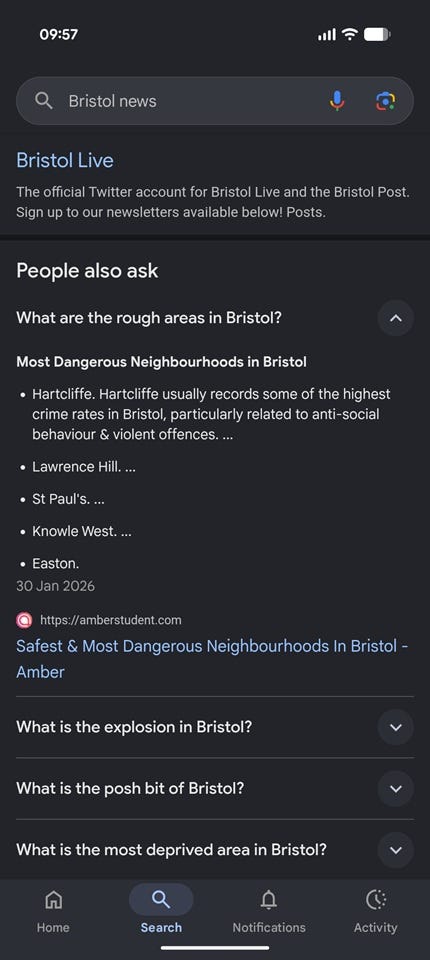
[Google's People Also Ask panel for a Bristol news search, Saturday 9 May 2026. Unfiltered. Unmanaged. Entirely at odds with the city's carefully maintained public image]
I don’t know about you, but shortly after waking up I like to scroll my phone for local news. Just to keep up with what’s going on. Nothing heavy. The ordinary habit of a person trying to stay connected to the place they live.
And to reassure myself that whatever happened in the world during my short slumber didn’t, knowing my luck, somehow leave me as the sole survivor.
I searched “Bristol news.” The People Also Ask panel came up, and I wasn’t expecting what came next, to be honest.
Rough areas to avoid. An explosion. A Palestine protest marching through Bristol city centre.
All of it, unprompted, unfiltered, and entirely at odds with the city’s carefully managed public image.
I’ve been writing about Bristol — its politics, its governance, its gap between what it says it is and what it actually does — for long enough to know when something is worth stopping for.
This was worth stopping for. Because what Google’s People Also Ask reveals about Bristol in 2026 — the crime rate, the deprivation, the disorder — is something no communications budget has managed to say differently.
That classroom of life moment confirmed something about how cities are really read.
Google’s People Also Ask doesn’t go to press conferences. It doesn’t attend cabinet briefings or read the council’s communications strategy.
It has no interest in the city’s brand positioning, its European Green Capital legacy, its City of Sanctuary programme, or its ambitions to be seen as progressive, inclusive, and forward-facing.
It just watches what people type. And then it tells you.
What people are typing about Bristol, quietly, on their own phones, when nobody from the communications department is listening, is this:
What Are The Rough Areas In Bristol?
That’s the dominant query. Expanded. At the top. Not “best things to do.” Not “community events” — such as a Palestine protest. Danger mapping. The first question people bring to this city isn’t one of curiosity or enthusiasm. It’s one of risk assessment. Where is it safe. Where isn’t it.
Give it to me straight.
That question sits at the top of the panel. Before the coffee. Before the day has any shape to it at all.
It says something about the city that no regeneration strategy has ever managed to change.
Hartcliffe and Withywood. Lawrence Hill. St Paul’s. Knowle West. Easton.
I read that list slowly, again. Then considered how much energy, money, and political capital has been spent rebranding some of those postcodes.
Careers built on it. Strategies written. Consultation exercises held in community centres with good lighting and free biscuits.
Bristol City Council’s own JSNA data puts Hartcliffe and Withywood, Lawrence Hill and Filwood as the most deprived wards in the city — the same three wards, in the same order, as in 2019. And 2015.
The search panel remembers.
Google has a longer memory than any regeneration strategy. And considerably less interest in how the story ends.
Consider a family from Winchester.
It’s a weekend. The kids need something to do. Someone suggests Bristol. Vibrant, they said. Creative. Good food. Worth the drive.
Someone picks up a phone and searches Bristol. And this is what came up.
A family from Winchester carries none of that context. Hartcliffe doesn’t land on a mental map. St Paul’s Carnival isn’t the first association. Knowle West isn’t somewhere that comes with reassuring footnotes. There’s just a list of place names that Google is presenting as somewhere to be cautious about.
That’s Bristol’s first impression. Not the harbourside shot on the Destination Bristol homepage. Not the City of Sanctuary branding. Not the European Green Capital legacy that someone somewhere is still polishing into a press release.
A danger map. A hybrid script outline that reads somewhere between Coronation Street and Taggart. Unsolicited. Before the family has even decided to come. And so to the next question on Google this morning.
What Is The Explosion In Bristol?
There is something that happens in the mind in the fraction of a second before it catches up with itself.
Most of us will have gone somewhere specific when that word landed. This particular moment. This particular political climate. The headlines that have been running for months. The language of numbers and pressure and belonging and change. Explosion. In a civic context. Cold.
The brain routed it. Automatically. Without asking permission. Toward the tension that has become so constant a feature of public life that it no longer announces itself. It just runs. Quietly. Underneath everything.
That routing is not a character flaw. It is a precise measurement of where we are.
A woman is dead. Her ex-partner forced his way into her parents’ home — the home she had moved to, specifically, to escape him — and detonated a hand grenade. In the moments before it went off, she sent her child outside.
That decision saved the child’s life.
A woman, in the last minutes available to her, made the one calculation that mattered. And got it right.
The oldest category of violence in this country. The most ordinary address you can picture. And a People Also Ask panel that files it between the rough areas and the posh bit. Bristol Live covered it. For those keeping score.
For the family from Winchester, there is no routing. No context. No mental map to soften any of it. There is just the word explosion sitting in a search panel about the city they were thinking of visiting this weekend. And then the story behind it. Arriving without a content warning.
They weren’t expecting that either.
What they were expecting was a harbourside. Maybe a decent pub. Something for the kids.
What they got was that same hybrid script outline — somewhere between Coronation Street and Taggart. You know, without the commercial breaks for ‘We, The Curious’ somewhere in between.
Oh, and a Palestine march — Bristol Nakba78, organised by Bristol Palestine Solidarity Campaign and others, assembling at Castle Park bandstand at midday.
Welsh Back. Queen Square. Colston Avenue.
Avon and Somerset Police were already warning of disruption to Bristol city centre between 12.30 and 2.30pm. Bristol Live reported it. Bristol24/7 reported it.
They apparently don’t manage to make the ‘What’s On’ section. Because in Bristol, that’s just a Saturday. We just wish the weather was so predictable.
Then the final two of the almost self-explanatory four.
What Is The Posh Bit Of Bristol?
What Is The Most Deprived Area In Bristol?
By the time our ‘would be’ family from Winchester reaches these two, something has already shifted. You know, like a second thought does.
A city where people danger-map before they visit. Where an explosion requires a moment of disambiguation. Where a Palestine march is too routine to list. Where nobody in an official role had any hand in any of it.
Four questions. Danger. Disorder. Aspiration. Poverty.
Nobody at the council approved that sequence.
Nobody in the communications team signed it off.
It just loads. Every time. For everyone. Whether you live here or you’re just thinking about bringing your family for the day.
The family from Winchester, for what it’s worth, probably went to Salisbury instead.
Nobody from Destination Bristol had any hand in that either.
This is the city without the brochure in the room.
Not managed. Not curated. Not positioned. Just searched for, at nine in the morning, by people who stopped waiting for the official version a long time ago.
Google has no interest in how Bristol sees itself.
It just shows you what people type when they think it doesn’t matter.
That’s it. Saturday morning. One search panel. The world still there. More or less.
Before the official version of the day had time to get its shoes on.
Destination Bristol this Saturday, or, destination somewhere else, perhaps?
The Almighty Gob. No press accreditation. No party line. No illusions.