


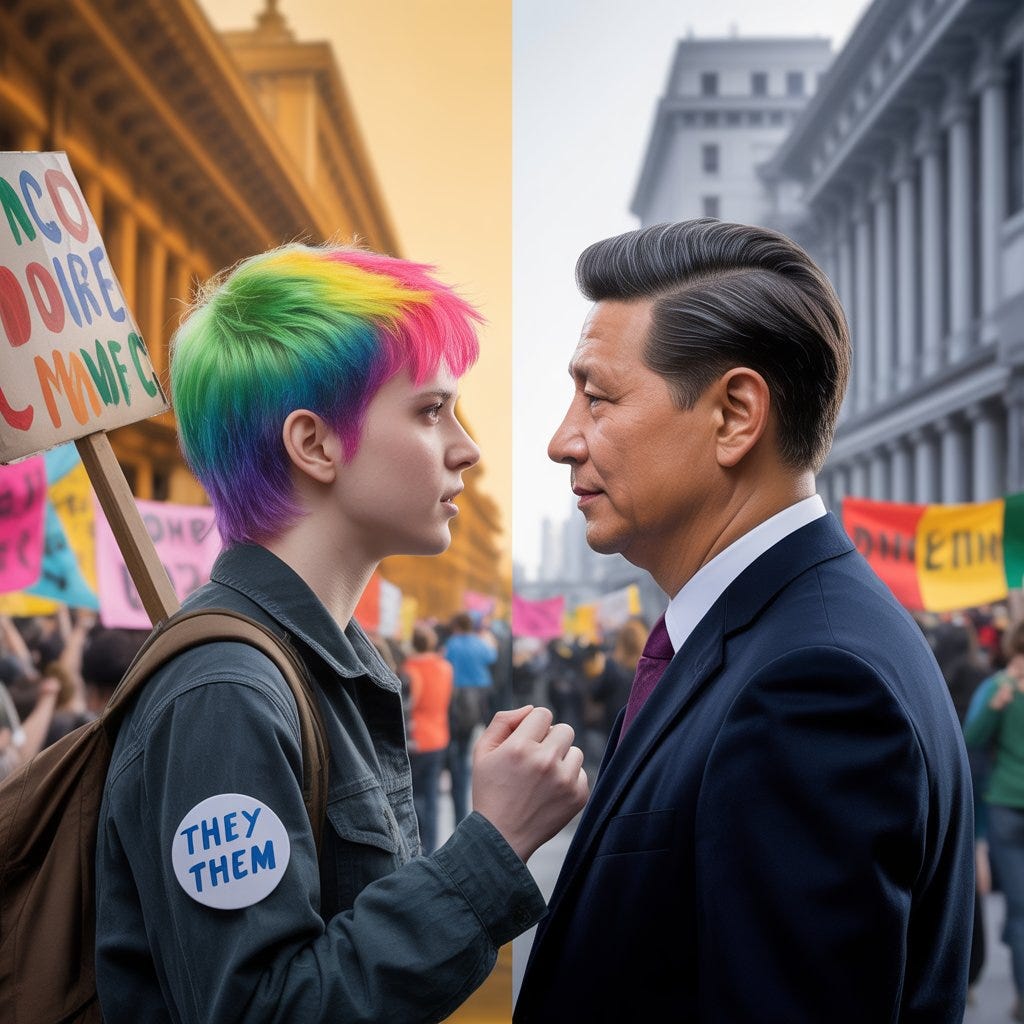
[Two worlds. One frame. The question the Green Party hasn't answered]
There’s a kettle in your kitchen.
It’s probably plastic. Which means it’s made of oil. Which means the thing you boiled to make your morning tea — on the morning you decided the planet couldn’t take any more oil — is itself a product of the thing you want to abolish.
You’ve noticed that, haven’t you. Not necessarily today. But somewhere, at some point, the thought flickered. This doesn’t quite add up.
We covered that in the previous piece — the phone in its plastic case, the net in net zero that doesn’t actually balance. If you missed it, the closing line said everything: “The phone. In its plastic case. Which is made of oil. There it is. Right back where we started.” Read it here.
Because what follows is about the Green Party’s net zero policy, their identity politics, their silence on Uyghur forced labour, their dependence on Chinese supply chains running through Xinjiang, and a Green MP called Carla Denyer who represents Bristol Central, has a great deal to say about some things, and nothing whatsoever to say about others.
But there’s a bigger problem than the kettle.
The Green Party of England and Wales has a foreign policy position. Several, in fact. They support Palestinian rights, oppose Israeli settlements, and Carla Denyer — Green MP for Bristol Central, on a parliamentary salary of £91,346 — has been filmed walking the streets of St Paul’s actively promoting a boycott of Israeli goods.
The Bristol Apartheid Free Zone campaign. Five thousand households signed up. Nearly a hundred businesses. Denyer door to door, doing the rounds, telling people what to buy and what to leave on the shelf.
Fine. She’s entitled to her politics.
But here’s what she isn’t doing.
She isn’t standing in any street, knocking on any door, holding any campaign, about the country that makes her solar panels.
The Green Party wants to power Britain on Chinese manufacturing. China is running concentration camps.
That’s not rhetoric. That’s the documented, UN-assessed, internationally verified reality of what is happening in Xinjiang province right now. Mass detention of Uyghur Muslims. Forced labour. Surveillance so total it makes anything Western governments have deployed look like a clipboard. Cultural erasure so systematic that the UN’s own 2022 report used the phrase potential crimes against humanity.
Not a century ago. Not a regime since collapsed. Now. Ongoing. Industrial in scale.
And the Green Party’s entire energy policy runs on it.
The supply chain they don’t talk about.
Wind turbine magnets require neodymium and dysprosium. These are rare earth elements. China controls approximately 85 to 90 percent of global rare earth processing capacity — not because they have all the deposits, but because they built the infrastructure while Western nations were busy outsourcing the dirty work.
Solar panels manufactured predominantly in China. Battery production dominated by China. The EV revolution — championed by every Green candidate who has ever stood for anything — runs on a supply chain headquartered in Beijing.
The previous piece put it precisely: “The solar panels going up on rooftops are manufactured in Chinese factories running on oil, shipped on vessels burning oil, installed by workers driving vans running on diesel.” That was about oil dependency. This is about what those Chinese factories are also running on. It turns out the answer to both questions is the same.
This isn’t a fringe observation. The UN Special Rapporteur, the Sheffield Hallam University forced labour report, the Australian Strategic Policy Institute, and Anti-Slavery International have all documented the link between Xinjiang’s detained Uyghur population and the polysilicon supply chain for solar panels. Anti-Slavery International puts it plainly: a truly just transition from fossil fuels cannot be achieved as long as the current reliance on the Uyghur region remains. The polysilicon that goes into the panels. The panels the Greens want on every roof in Britain.
So let’s be precise about what is being proposed.
When did you last see a Green Party press release about Xinjiang? When did you last hear a Green MP asked about the supply chain behind the solar panel on their roof? Since the 2024 general election, Green Party MPs have mentioned China in Parliament exactly twice. Two passing references. In Hansard. That’s the record. When did any of it land in the news cycle as a Green Party problem?
The Green Party wants to transition Britain away from fossil fuels — a genuine and serious aim — by building an energy infrastructure that is manufactured by, processed by, and strategically dependent upon a state that is simultaneously running what independent researchers are calling the largest internment of an ethnic and religious minority since the Second World War.
They aren’t just ignoring the camps. They’re funding the economy that runs them.
What wouldn’t last five minutes.
Picture the scene.
Rainbow hair. Gender-neutral pronouns. A badge that says they/them. A tote bag with something about intersectionality on it. A working knowledge of decolonisation theory, trans rights frameworks, non-binary identity, a firm view on safe spaces, and the full vocabulary of contemporary identity politics.
Now picture that person in Xinjiang.
They wouldn’t last five minutes.
Not because of the politics. Because of the hair. Because of the badge. Because of the entire visible performance of individual identity that the Chinese Communist Party has decided, quite systematically, it cannot permit. The CCP doesn’t debate identity. It doesn’t hold panels. It doesn’t issue safe space policies or update its pronouns. It builds facilities. Large ones. And it fills them.
The Uyghurs in those facilities are there because they are Muslim. Because they speak Uyghur. Because they pray. Because they carry an identity that predates the Party and refuses to dissolve into it. That’s the crime. Being visibly, stubbornly, irreducibly yourself in a state that has decided selfhood is a security threat.
Now consider what the modern Green Party is, at its core.
A coalition of the visibly, stubbornly, irreducibly themselves. Trans identity. Non-binary identity. Queer identity. Neurodivergent identity. Every stripe of individual self-expression that the movement has gathered under its increasingly crowded banner. The entire platform rests on the premise that identity — all of it, every configuration — is sacred, inviolable, and must be protected from state interference.
China has built the infrastructure to exterminate exactly that premise.
Not as a thought experiment. As a functioning system. The surveillance cameras in the mosques. The apps that flag unauthorised Quran downloads. The re-education programmes that run until the detainee can demonstrate they have stopped being who they were. The forced cutting of beards. The prohibition of fasting. The replacement of a person’s inner life with approved content.
Read that list again. Slowly. Because it isn’t a history lesson.
If you believe — genuinely believe — that identity is the thing worth protecting above all else, then Xinjiang is the most important story in the world. It is the state at its most totalising, doing to real people in real time what the Green Party says it exists to prevent.
And the Green Party has nothing to say about it.
Because the country doing it makes their solar panels. And that, apparently, is where the solidarity ends.
How the Transmorphing happened.
The original Green banner was coherent. Environmental protection. Sustainability. The precautionary principle. It had an identifiable spine. It was about the planet.
You remember that. Or your parents do. The Greens who chained themselves to trees. Who blocked roads and glued themselves to things before gluing yourself to things had a name. Who talked about the ozone layer when nobody else was.
What it became is something else entirely.
A vehicle. A political chassis soft enough at its ideological edges to take on every cause that couldn’t find a home elsewhere. The trans activist. The gender-neutral-pronoun enforcer. The anti-hierarchy theorist. The decolonise-everything brigade. All boarding the same bus. All adding their agenda to a platform that was never designed to carry it.
The label survived. The original content was quietly replaced.
That’s Transmorphing. And the Greens are the textbook case.
Environmental policy — real environmental policy — requires hard material thinking. Mining. Supply chains. Industrial capacity. Nation-state cooperation on an enormous scale. It requires engaging with China, Russia, the Gulf states, because that’s where the resources and the emissions actually are. You cannot save the planet from a position of performative purity.
The planet doesn’t care about your pronouns.
The Green Party set out to save the planet. Somewhere along the way they got distracted by the pronouns. The planet, one notes, did not get the memo.
Beijing’s long game.
China didn’t fight the green transition. They monetised it.
While the Greens were campaigning, legislating, and morally pressuring Western governments into dismantling domestic energy capacity — coal plants, gas terminals, North Sea licences — China was building the manufacturing infrastructure that the resulting gap would require. They let the Western green movement do the political work. Then they filled the vacancy.
And here’s the thing you probably didn’t notice at the time. Neither did anyone else. That was the point.
Beijing has invested billions in solar manufacturing, battery production, and rare earth processing. Not because they love the environment. Because they understood that whoever controls the components of the energy transition controls the energy transition.
This isn’t conspiracy. It’s strategy. Fifty-year thinking meeting five-year thinking. And the five-year thinking lost before it knew it was in a game.
The Greens campaigned for the cage. They called it liberation.
And Now They Want More Seats.
Since November 2025, the Greens have polled ahead of both Labour and the Conservatives — for the first time in party history. Their Youth Wing stands at 40,000 members, Europe’s largest. On 7 May 2026, they are standing candidates across England and Wales on a scale never attempted before — a full slate in all sixteen Welsh Senedd constituencies under a new proportional voting system, and candidates fielded across as many of the 4,851 English council seats as they can fill.
Based on what, exactly?
Not on a coherent foreign policy. Not on a supply chain audit. Not on any reckoning with the contradiction at the heart of their energy platform. The surge is gravitational, not ideological. Labour collapsed. The Greens were nearest.
The proportional voting system in Wales does the rest. You don’t need to be right. You don’t need to be coherent. You just need to exist and field names.
So the platform grows. The voice gets louder. And the silence gets larger.
The Denyer test.
Carla Denyer is on record, on camera, in St Paul’s, promoting a boycott of Israeli produce.
She is simultaneously the parliamentary representative of a party whose flagship policy — the green energy transition — depends entirely on Chinese manufacturing, Chinese processing, and Chinese supply chains running through a region where forced labour is not a risk assessment. It’s a documented fact.
One set of goods from one country: boycott. Active campaign. Door to door.
Another set of goods from another country — built on a supply chain the UN has flagged as potentially involving crimes against humanity: silence.
That isn’t inconsistency. Inconsistency is accidental.
The Green Party will tell you they have a position on Xinjiang. They do. On paper. What they don’t have is a campaign. A press release. A door-to-door leaflet. A single parliamentary speech.
This is selective moral vision. The countries you see, and the countries you don’t, arranged entirely around which target fits the existing political comfort zone.
Israel is conducting a military operation causing enormous civilian suffering. Reasonable people can and do criticise it. It also has a free press, opposition parties, and an independent judiciary that regularly rules against its own government.
China has detained up to a million people for their religion and ethnicity. It suppressed a democracy movement in Hong Kong. It explicitly threatens to take Taiwan by force. It has no free press, no opposition, and no judiciary that rules against anything.
Denyer has a campaign about the first.
She has nothing to say about the second.
The Rave in Trafalgar Square.
At the end of the Together Alliance march through London — thousands of people, placards, chants, the full apparatus of collective moral statement — they held a rave in Trafalgar Square.
Music. Dancing. The warm euphoric press of bodies that all believe the same thing. The dopamine surge of belonging, of having shown up, of having been seen to care. The selfie. The story. The glow of personal moral achievement packaged as political action.
I was there. I marched. I danced.
And while they danced, the camps in Xinjiang kept running. The polysilicon supply chain kept producing. The rare earth processing capacity stayed at 85 to 90 percent Chinese controlled. Carla Denyer’s solar panel energy policy remained exactly as dependent on Beijing as it was before the first drumbeat dropped.
The rave changed nothing. Not one detention ended. Not one supply chain rerouted. Not one Green MP stood up in Parliament and said: we cannot build the future on this.
But it felt magnificent.
And feeling magnificent was the point.
Not the hard, grinding, unglamorous work of tracing a supply chain to its source. Not the political courage of naming the state that makes your solar panels. Not the intellectual honesty of asking whether your energy policy funds the camps you claim to oppose.
Just the rave. The feeling. The photograph.
The form of protest. The content of a night out. The label of activism. The substance of nothing.
They marched for the planet. They danced for themselves. The planet, as previously noted, did not get the memo.
What the kettle was trying to tell you.
We started with plastic. With oil. With the thing you use every morning built from the thing you want to abolish.
Look around you right now. The screen you’re reading this on. The charger in the socket. The car outside, electric or otherwise. The solar panel on the neighbour’s roof. Ask yourself where each one came from. Not the shop. Before the shop.
The previous piece ended with a phone in a plastic case made of oil. This one ends somewhere darker. Because the plastic case is just the product. What’s behind the solar panel on that roof — the labour, the camps, the silence of the party that put it there — that’s the supply chain nobody is asking about.
The Greens have the same problem, only larger.
The thing they want to build the future on — the panels, the turbines, the batteries, the entire architecture of net zero — is manufactured by the state that most comprehensively represents everything the Green Party claims to oppose.
Authoritarianism. Ethnic persecution. Cultural elimination. Mass surveillance. State control of identity. The erasure of the right to be yourself.
China is doing all of it. Industrially. Now.
The Green Party’s answer, if pressed, would be to talk about something else entirely.
Because the alternative is to look at what they’ve built their politics on.
And find out it was made in Xinjiang.
The Almighty Gob is a Bristol-based publication covering UK politics, institutional dysfunction, and the gap between what people say and what they actually do. Established across thealmightygob.com, Substack, and Tumblr, with over 500 published pieces spanning satirical commentary, civic accountability, and national political analysis. Two books published. No allegiances. No apologies.
Sources and references — for anyone who wants to follow the thread. You do your own homework:
1. UN Office of the High Commissioner for Human Rights OHCHR Assessment of Human Rights Concerns in the Xinjiang Uyghur Autonomous Region, People’s Republic of China Published: 31 August 2022 Conclusion: The extent of arbitrary detention of Uyghur and other predominantly Muslim minorities “may constitute international crimes, in particular crimes against humanity.” https://www.ohchr.org/en/documents/country-reports/ohchr-assessment-human-rights-concerns-xinjiang-uyghur-autonomous-region
2. Sheffield Hallam University — Helena Kennedy Centre for International Justice Murphy, Laura T. and Elimä, Nyrola In Broad Daylight: Uyghur Forced Labour and Global Solar Supply Chains Published: May 2021 Finding: Solar panel supply chains are directly and significantly exposed to Uyghur forced labour in Xinjiang. The Uyghur region accounts for the majority of global solar-grade polysilicon supply. https://shura.shu.ac.uk/29640/
3. Australian Strategic Policy Institute Xinjiang Data Project Ongoing database documenting the construction and expansion of detention facilities in Xinjiang, satellite imagery analysis, and corporate supply chain exposure.
https://xjdp.aspi.org.au/
4. Anti-Slavery International Uyghur Forced Labour in Green Technology Published: 2024, in partnership with the Investor Alliance for Human Rights and the Helena Kennedy Centre for International Justice Conclusion: “A truly just transition from fossil fuels cannot be achieved as long as the current reliance on the Uyghur Region remains.” https://www.antislavery.org/reports/uyghur-forced-labour-green-technology/
5. British Foreign Policy Group Foreign Policy from the Sidelines: Green and Reform’s China Policies Published: March 2026 Finding: Since the 2024 general election, Green Party MPs have referenced China in Parliament on only two occasions. The report identifies the Green Party’s failure to develop any substantive China policy as a significant strategic gap. https://bfpg.co.uk/2026/02/foreign-policy-from-the-sidelines-green-and-reforms-china-policies/
6. House of Commons Library UK Supply Chains and Uyghur and Turkic Muslim Forced Labour in China Westminster Hall debate briefing, November 2024 The UK government’s own Department for Business and Trade acknowledged: “No company in the UK should have forced labour in its supply chain.” https://commonslibrary.parliament.uk/research-briefings/cdp-2024-0142/
7. International Energy Agency Critical Minerals and Clean Energy Transitions IEA, 2023 Documents China’s dominant position in the processing of rare earth elements and critical minerals essential to wind turbines, EV batteries, and solar panels — approximately 85 to 90 percent of global processing capacity. https://www.iea.org/reports/critical-minerals-and-clean-energy-transitions
8. Carla Denyer — Bristol Apartheid Free Zone Video footage: Carla Denyer, Green Party MP for Bristol Central, filmed in St Paul’s, Bristol, promoting the Bristol Apartheid Free Zone campaign and a boycott of Israeli goods. Publicly available. Recorded in Bristol, 2024.
9. Green Party of England and Wales — Official Statement Greens to Stand in 574 Seats in England and Wales Published: June 2024 (baseline); updated candidate deployment for May 2026 elections confirmed via party communications. https://greenparty.org.uk/2024/06/07/greens-to-stand-in-574-seats-in-england-and-wales/
10. Wales Green Party — Official Announcement Wales Greens Announce Full Slate of Candidates for Senedd Elections Published: March 2026 Confirmation of candidates standing in all 16 Senedd constituencies on 7 May 2026. https://greenparty.org.uk/2026/03/24/wales-greens-announce-full-slate-of-candidates-for-senedd-elections/
11. Institute for Government Local Elections 2026 Confirms 4,851 council seats across 134 English councils on 7 May 2026. Largest local election in England for three years. https://www.instituteforgovernment.org.uk/explainer/local-elections-2026
12. Green Party of England and Wales — Wikipedia / sourced polling data Membership more than tripled since Polanski leadership election, September 2025. Young Greens at 40,000 — Europe’s largest party youth wing. Greens polling ahead of both Labour and Conservatives since November 2025 for the first time in party history. https://en.wikipedia.org/wiki/Green_Party_of_England_and_Wales