
Resurrection Before Birth: How Britain's Retail Calendar Turned Us Into Obedient Consumers.
Hollywood would turn this into a horror film. Planning someone's death before they're even born. It’s twisted, right? The kind of plot that makes you shift uncomfortably in your cinema seat.

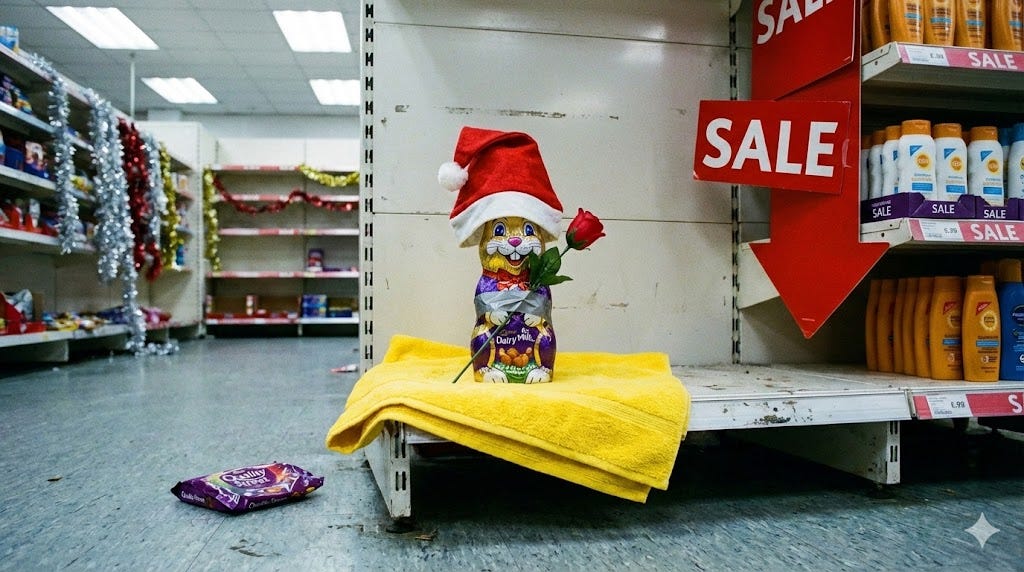
Tesco calls it January Merchandising.
Christmas ends. The decorations come down, and the turkey bones hit the bin. But before you’ve even popped the cork for the New Year, the shops hit you with a triple assault:
Easter eggs on the shelves (Resurrection).
Valentine’s Day tat is everywhere you look (Romance).
Summer holiday adverts screaming from every screen (Escapism).
April, February, and July. All are being sold simultaneously. In January.
We’re on a leash—wallet, purse, credit card, it doesn’t matter which—being walked through the aisles like obedient dogs. Good consumer. Here boy. Buy the resurrection. Buy the romance. Buy the getaway.
And the scariest part? We don’t even notice.
Jesus vs. Saint Valentine vs. Two Weeks in Mallorca.
Remember when Christmas was just Jesus competing with Santa? That seems quaint now.
Today, the Son of God is fighting for shelf space against chocolate hearts and TUI package deals. It’s a battle of narratives. The birth of Christ? Yeah, but have you considered all-inclusive drinks? The Resurrection? Great, but Valentine’s Day is coming—better buy roses.
Jesus is losing market share to Mallorca.
In the real world, the order is Birth, Death, Resurrection. That’s linear time. That is the story in sequence. In the retail version? It’s death before life. Romance before birth. Summer holidays before spring has even sprung. It is all scrambled, and it is all happening in January.
The Bermuda Triangle in Your Head.
There’s a spot in the human brain where common sense just vanishes. The retail calendar found it and set up shop.
Consider the Isles of Scilly. On these tiny islands off Cornwall, flower farming is the second-largest industry. Nine family farms harvest fields of daffodils from October onwards, shipping over 100,000 boxes to UK supermarkets annually.
The Reality: These flowers are picked in winter to be sold for spring. An entire island economy is organized around celebrating events that haven’t happened yet.
If this were a person, they’d be sectioned. They would be diagnosed with temporal psychosis—living in multiple timelines simultaneously, planning deaths before births, celebrating futures that haven’t arrived. But because it’s commerce, we call it normal.
Our common sense took a holiday to that Bermuda Triangle spot in our heads. And like everything else that goes there, it vanished permanently.
See Symbol, Buy Product.
The mechanism is simple stimulus-response. No thought required.
See bunny? Buy chocolate.
See heart? Buy flowers.
See beach? Buy holiday.
These dates used to carry cultural weight. They connected us to seasons and rhythms. Now, they are just purchasing prompts fired simultaneously. Christmas, Easter, Valentine’s, Summer—stripped, gutted, and reduced to pure commercial utility.
It is the same product, in different packaging, rotating through the same shelf space. Because there is no gap—because Easter eggs overlap with New Year’s hangovers—you never get a chance to step back and spot the pattern.
You’re kept in a state of permanent low-level consumer urgency. You are always behind where the shops think you should be in your purchasing cycle. That’s the trick. It’s not just that we’re buying things we don’t need; it’s that we’ve lost the ability to recognise the absurdity of the timeline.
When Commerce Gutted Culture.
We have accepted that the retail calendar operates by its own deranged logic, completely separate from meaning, sequence, or linear time.
Easter isn’t about resurrection; it’s about Cadbury’s Q1 sales targets.
Christmas isn’t about birth; it’s about consumer spending spread across four months.
Summer holidays are about filling planes and hotels during the off-season.
The chronological impossibility of resurrection before birth should jar us. The psychiatric episode of living in multiple timelines at once should make us stop and think, “Hang on, this doesn’t make sense.”
But we don’t. Once you stop expecting things to make sense, you’ll accept anything. The leash gets shorter every year, and we keep walking.
The Three Questions.
If we break this down logically, the absurdity becomes undeniable:
1. Is it practical? For shops and Scilly flower farmers? Absolutely. For us? Do we need Easter in January? Of course not.
2. Is it logical? Theologically? Nonsense. Chronologically? Backwards. Commercially? Perfect sense.
3. What’s the likely outcome? A population accepting temporal impossibility as normal. Common sense is permanently on holiday.
Back to the Beginning.
The Easter eggs aren’t the problem; they’re the symptom. The problem is that the shops found a way to bypass our perception of time.
Present people with temporal absurdity, and they’ll buy the chocolate. Scramble the timeline, hollow out the meaning, fire multiple purchasing prompts simultaneously—and people participate willingly.
Somewhere in every supermarket stockroom right now, Easter eggs wait alongside Valentine’s stock, sitting next to summer brochures. They are ready to appear the moment Christmas ends. Ready for us to buy without thinking.
Planning someone’s death before they’re even born. Hollywood would call it a horror film. Tesco calls it January merchandising.
Sources & Data:
Isles of Scilly flower farming data sourced from fieldmargin.com, simplyscilly.co.uk, islesofscilly-travel.co.uk, and scillyflowers.co.uk.