

Save The Planet? Nobody Asked The Planet.
Lovelock, eco-anxiety, and the self-interest we won't admit to.

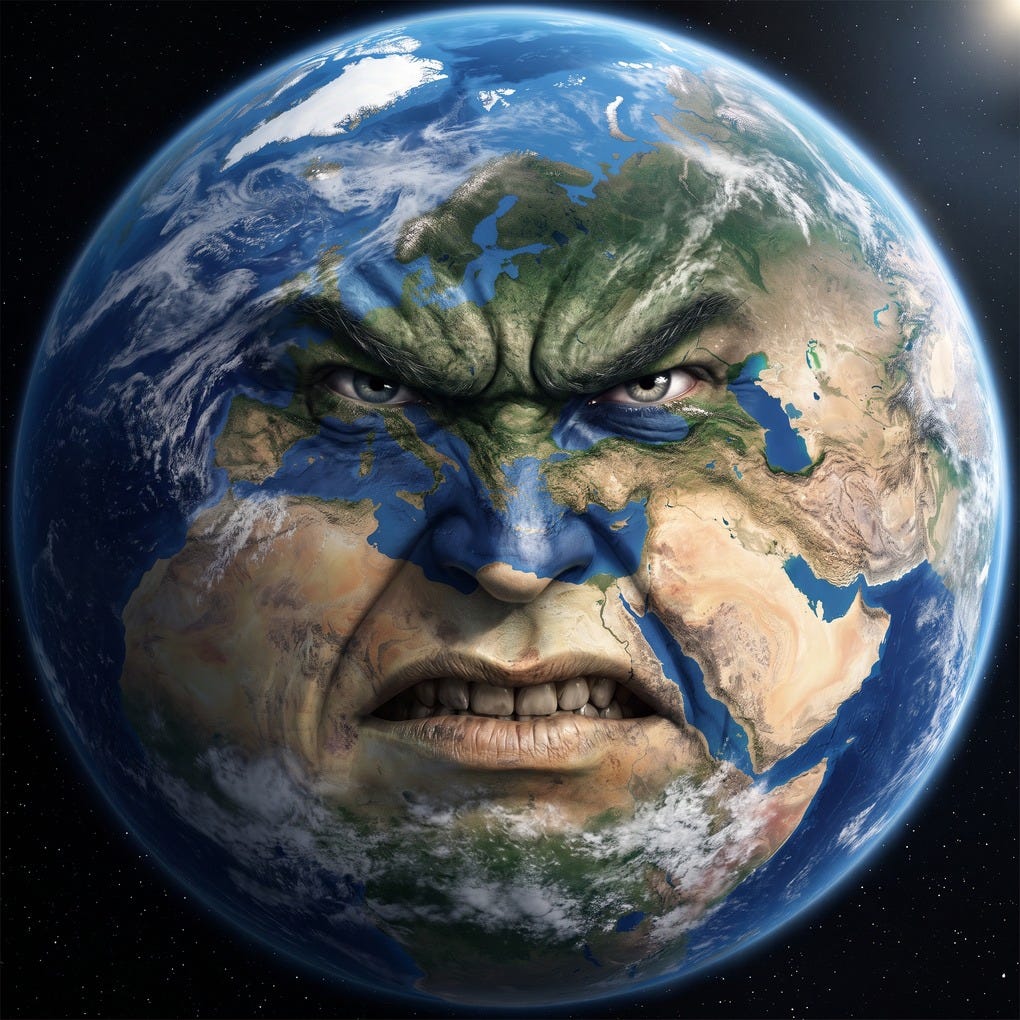
You may not be aware of this. However, a certain James Lovelock spent the best part of fifty years arguing something most people never actually stopped to absorb: the planet does not need saving.
Not from us. Not from anything.
His Gaia hypothesis treats Earth as one single, self-regulating system — atmosphere, oceans, soil, the lot. We’re just the temporary lodgers on a planet that’s already survived ice ages, asteroid strikes, flipped magnetic poles, and mass extinctions that wiped out an estimated 99% of every species that ever lived. It regulates itself because that’s what feedback loops do.
Not because it owes any particular loyalty to the species currently living on top of it. (Or any other species, come to that. The dinosaurs would tell you the same, if they could tell you anything at all.)
Before You Reach For “Crank.”
Okay. That said. It's worth being clear about who's talking here, though, before anyone reaches for the word "crank." Lovelock was elected a Fellow of the Royal Society in 1974. He consulted for NASA on the search for life on Mars.
He also invented the electron capture detector — the instrument that first revealed CFCs spreading through the atmosphere, and helped trigger the environmental movement in the first place.
You see. This wasn’t a man on the outside lobbing opinions in from a kitchen table strewn with the backs of fag packets. He built one of the tools the movement runs on. Then he spent the second half of his career telling it to calm down about what it actually meant.
Bear that in mind for what’s coming. This isn’t some bloke down the pub with a theory either. This is the bloke who built the kit.
The Arrogance Of “Save The Planet.”
Meanwhile. A very different kind of voice got to the same place from the opposite direction, decades ago, with none of the caveats and rather more swearing.
“Save the planet,” went the argument, was the single most arrogant phrase in the whole environmental movement.
And, a species that hasn’t worked out how to look after itself, presuming to look after a four-and-a-half-billion-year-old rock that’s already survived worse than plastic bags, has some nerve.
The planet isn’t going anywhere. We are.
Now. Put the two together — the science and the punchline, coming from opposite directions — and you land in the same spot either way.
“Save the planet” is the wrong phrase entirely. It should be “save the conditions that let humans carry on living here comfortably.” Far less noble-sounding. Far more accurate. No one bothers.
Truth is, nobody’s saving Earth. Earth doesn’t need it. What’s actually up for negotiation is whether the Earth of fifty or a hundred years from now still has room for us in it. (It will, of course, still have room for the pigeons. It always has room for the pigeons.)
Emergency. Crisis. Say It Again.
“Save the planet” is only half the dressing-up. Mind.
The other half is the vocabulary that arrived with it: emergency, crisis — quite possibly the two most overused, most fawned-over words in modern English.
Reach for them often enough — for a bin collection delay and a melting ice sheet alike — and they stop signalling danger. They start signalling habit.
Words built to trigger urgency, deployed so relentlessly they’ve lost the ability to do it.
The planet was never in crisis. We are, repeatedly, told we’re in one.
Worth being precise here, before anyone reaches for the wrong conclusion. No one is denying anything. The planet is warming, and warming faster than it should. That part isn’t up for debate, and nothing here argues otherwise. What’s under the microscope is the language wrapped around it — not the thermometer, the megaphone.
You’ve noticed this, haven’t you? Every single week, another one. Another emergency. Another crisis. You know exactly what I mean.
This isn’t fatalism dressed up as insight, and it’s not licence to stop trying. The point isn’t that nothing we do matters.
Not Fatalism. Just Honesty.
It’s that what matters is entirely and honestly self-interested — and pretending otherwise, dressing self-preservation up as planetary rescue, muddies an argument that never needed muddying.
None of this is a fringe read, either. Worldwide searches for “climate anxiety” have risen by over 4,500% in five years.
And “save the planet,” as a phrase, has drawn its own line of published criticism — one environmentalist arguing the movement should drop it entirely, another making the case that the phrase itself barely makes sense.
This isn’t a new argument dressed up as a fresh one. It’s an old crack finally getting some daylight.
The Mechanism Underneath The Rhetoric.
Of course. It goes without saying that underneath the populist rhetoric sits a much older, much less comfortable mechanism.
Humanity draws down finite resources — fossil fuels, topsoil, fresh water, fish stocks — faster than they can regenerate, and calls it progress. Really?
The planet doesn’t run out of “planet.” It reorganises around the depletion, the same way it always has. What runs out is the version of the planet we’re built to survive on.
Nobody has to feel sentimental about coral reefs or ice caps for that argument to land. You only need to feel something about your own continued existence.
So. Self-interest. Fine.
Except — whose?
Two Hundred Thousand Years Of The Same Programme.
Survival instinct is written into human DNA. It’s not a policy position. It’s the oldest programming we’ve got.
Older than you’d think, too. Older than the species, even. Older than most of us like to admit out loud.
Let’s pause to think about how it actually started, for every single one of us. One sperm, out of tens of millions, in a dead sprint against every other one, and it won. Gold medal style, if it were an Olympic event, say.
That’s the whole origin story. That’s the entire biological CV before you’ve drawn a single breath — you were the fastest thing in the room, and you’ve never let anyone forget it since.
You’ve felt it, surely. That little internal alarm that goes off over nothing — a delayed flight, a dodgy noise from the boiler, a headline about a heatwave three continents away. That’s not you being soft. That’s the sprint still running.
And ever since that photo finish, we’ve behaved like the single most precious cargo the universe has ever shipped. Wrap it in cotton wool. Protect it from a breeze.
Panic about a temperature rise in a region most of us couldn’t point to on a map — because somewhere in the DNA is still that one sperm, going I got here first, and I am not giving this up without a fight.
And that’s the whole programme, once you strip away the emergencies and the crises and the paperwork trail behind them.
Protect the one that made it through. Keep it alive, keep it fed, keep it out of the wildfire, for as long as the clock allows.
And somewhere in the middle of all that protecting, if everything goes to plan, go and make a few more of the little devils yourself.
Survive. Reproduce. Repeat. Everything else is just the paperwork.
Same Caveman, Better Shoes.
None of this is new, either. Strip away the emergency alerts and the committee reports and you’re left with the exact same self-interest that had cavemen huddled round a fire, watching the treeline, making sure nothing bigger and hungrier got there first.
They were the first people to inhabit this planet. The very first thing on the agenda — before art, before language, before anyone had invented a single form to fill in — was staying alive long enough to pass the job on to the next one.
Every worried headline about the climate today is that same caveman, still watching the same treeline. Just wearing better shoes, and doing it through a phone screen instead of firelight.
Every generation gets issued the same free copy at birth: stay alive, keep the species going, don’t be the one who lets the fire go out. Lovely in theory. You have to admit. Right?
In practice, of course, that programme has been running for roughly two hundred thousand years, and the results — going by the emergency alerts, the record temperatures, the general vibe of the room — are not exactly reassuring.
And yet here we are, still dressing the whole exercise up as something far nobler than please, God, not on my watch.
This is where the loop kicks in, and it’s something of a bombshell moment, for most.
Put simply: the harder the rhetoric pushes “save the planet,” the more it fails — because the planet was never the one asking to be saved, and a campaign built on saving something that never needed saving was never going to end anywhere but failure.
Call it a climate crisis, an emergency, a code red — the label changes, the target stays wrong.
Keep insisting otherwise and every fresh disaster just proves the point you refused to start from. Self-fulfilling, in the sense that matters here: not that the worrying caused the outcome, but that the wrong target guaranteed it.
Aim at the planet, miss every time.
A Battle, For Want Of A Better Word.
Take the record temperatures turning up in places that, by any historical reading, shouldn’t be recording them.
The instinct is to read that as the planet losing — proof the system’s broken, proof it’s failing to cope.
Read it the other way and it looks less like defeat, more like relocation. Heat being pushed and redistributed around a system absorbing extra energy from the sun, and having to put it somewhere.
Call it a battle, for want of a better word — the sun pouring more in, the Earth shifting it around, the fallout landing wherever it lands. That’s precisely why it turns up in the “wrong” places rather than evenly everywhere.
Not the planet failing. The planet fighting, and we’re the ones catching the stray rounds.
None of it needs a grand trigger, either. A fraction of a degree in one stretch of ocean is usually all it takes.
A jet stream nudged a few miles off its usual line. A single dry season, nothing dramatic on its own, arriving in a place already running short of water.
Small, quiet, unremarkable changes, each one on its own barely worth a headline.
And then, months or years down the line, a wildfire tearing through a region that hasn’t burned like that in living memory. Or a flood in a town that’s never seen one. Each one creating its own verbal tsunami of panic.
Nobody set out to cause it. Nothing about the size of the cause matches the size of what comes out the other end either.
That’s not the planet malfunctioning. That’s just how the system has always worked, quietly, long before anyone was measuring it closely enough to notice the join.
Which is worth bearing in mind the next time the forecast leads the news.
The Great British Pastime.
Here’s the thing about this country in particular, the thing that should embarrass us more than it does.
The great British pastime isn’t football, isn’t the pub, isn’t even queuing. It’s the weather. Moaning about it, specifically.
Too hot. Too cold. Too wet. Too dry. Too windy. Too much snow, not enough snow, wrong type of snow, wrong type of rain, wrong type of heat.
A nation that’s turned the sky into a full-time complaints department, staffed entirely by volunteers, open every day of the year, and never once satisfied with what’s on the shift.
Give us drought and we’ll want rain. Give us rain and we’ll want it to stop.
Give us the one warm week of the year and half the country’s on the news calling it a “heat crisis,” while the other half is still moaning it never gets warm enough. (Never both halves agreeing, mind. That would spoil it.)
There is no weather event, in the recorded history of these islands, that has ever landed correctly. Not once.
You know this. You’ve lived it. You’ve stood in your own garden complaining about both extremes inside the same fortnight, and not once thought it odd.
So when the very same nation turns round and says the planet’s misbehaving — delivering the wrong temperatures in the wrong places at the wrong time of year — forgive the lack of surprise.
We’ve been rehearsing this exact complaint, about considerably smaller stakes, since before anyone owned a car. The dial hasn’t moved. We’ve just pointed it at something bigger.
All that noise, and somehow none of it ever touches the actual reason most of us are shouting into it.
Born. Live. Die.
Here’s the bit nobody says out loud at the school gates, or the dinner party, or the emergency committee meeting convened to discuss the emergency.
Most of the people currently wringing their hands over what the planet looks like in fifty years will not be here to see it.
Not because of some grand catastrophe. Because of the plain, ordinary business of dying, which was coming for all of us anyway, emissions targets or none.
We’re born, we live, we die. Nobody upgraded that arrangement. Nobody’s climbing out of the ground in 2076 in their good suit to file a formal complaint about the weather.
Go on, be honest with yourself for a second. You know the arrangement. You’ve always known it. It’s just easier not to look at it straight on. Isn’t it?
And if the answer forming right now is “yes, but my children will still be here” — fair enough, and worth saying plainly: that’s not an exception to any of this. That’s the whole programme working exactly as designed. Go back to the sperm. Survive, then make sure the next one survives too. Worrying about your kids’ fifty-years-from-now isn’t a break from self-interest. It’s self-interest with better range.
Though even that’s a promise nobody can actually make. No one can guarantee their children will still be here in fifty years, either — not because of the climate specifically, but because nothing about being born comes with a guarantee attached, for any of us, ever.
So here’s the honest question, and it is genuinely just a question. Why does so much of the worrying — the real, expensive, headline-grabbing worrying, the kind now measured under its own clinical name, climate anxiety — get spent on a version of the world most of the worriers will never personally have to live in?
Not a knock on caring about the next lot. Just an audit. Follow the worry and see whose name is actually on it.
“What About The Wildfires, Then?”
Somebody, at this point, always wants to bring up the wildfires. Fair enough. Bring them up.
Forests catching light, whole towns running for the coast, smoke turning the sky the colour of a bad decision. It looks like proof the planet’s on its knees.
It isn’t. It’s the redistribution again, just wearing a different coat.
Fire’s been part of the planet’s maintenance schedule since long before anyone was around to name it a crisis. It clears out, it resets, it moves on.
What’s changed isn’t that the planet suddenly discovered fire. What’s changed is how much of our own furniture we’ve built directly in its way — and then acted surprised when the schedule kept running on time.
The planet didn’t break its promise. We just moved into the room it was always going to use next.
And before this starts sounding like it’s coming from somewhere above it all — it isn’t.
Same author, same bin day, same small internal panic when the collection’s a day late and the recycling’s piling up on the drive like evidence. The instinct doesn’t skip anyone.
It’s just usually aimed at something considerably smaller than the fate of the species, and considerably more honest about what it actually is.
“People Are Dying, Though.”
And then, right on cue, somebody plays the card that’s supposed to end the conversation: people are dying. Across the planet, right now, in the fires, the floods, the heat.
Which is true. It’s also not, strictly, news.
Whole civilisations have been wiped out, erased, quietly deleted from the record across the entire span of human history. Not the odd village — entire empires, entire ways of life, gone, long before anyone had invented a hashtag to mourn them with.
It’s not a new chapter. It’s the same chapter the species has been reading, on and off, since it learned to walk upright.
If anything’s changed the pacing, it’s that an awful lot of us have crowded onto the same small patches of the map — the coastlines, the floodplains, the tinder-dry hillsides with the nice view — and called it development.
Some would call that overpopulation. Others would just call it standing in exactly the wrong spot, in exactly the wrong numbers, and being shocked when the planet used the spot anyway.
If it isn’t overpopulation, and it isn’t malice, there’s still one more question worth asking before any of this wraps up.
Follow The Money, Not The Slogan.
Now. Don’t you think it’s worth asking, quietly, while everyone else is shouting: who actually benefits from the planet being permanently one headline away from doom?
Not the planet. It’s not sending invoices.
Picture the room instead. A conference centre somewhere, terrible coffee, a lanyard for everyone, forty slides about “pathways” and “frameworks,” a keynote on resilience.
Not one single person in that room whose job still exists the day the emergency is actually over. (There is always, without fail, a plate of slightly stale biscuits. Nobody knows who orders them. Nobody ever eats them either.)
Solve the crisis properly, and you switch off the lights, the catering, the next conference, everybody’s badge — for good. Keep it simmering instead — nearly boiling, never quite boiled — and the invitations keep landing, the reports keep circulating, and somebody’s mortgage keeps getting paid on the back of a problem that’s contractually obligated never to finish.
Nobody in that room is playing the pantomime villain. That’s the uncomfortable part of the entire drama.
You’d almost prefer one, wouldn’t you? Easier to be angry at an obvious baddie than at an entire, well-meaning, self-perpetuating system that includes people you probably quite like.
It’s the same forty faces, rotated through the same forty panels, each one perfectly decent, perfectly sincere, perfectly incentivised to keep the lights on a fire nobody’s actually trying to put out.
Best approach, in the end, is the oldest one: say nothing, watch closely, and let the paperwork speak for itself. It usually does, eventually.
Doesn’t This Let The Real Culprits Off The Hook?
Somebody serious will want to push back here, and they deserve a straight answer rather than a dodge: doesn’t all this “self-interest” talk let the real culprits off the hook? The oil majors, the governments who subsidised them for decades, the handful of countries responsible for most of what’s actually in the atmosphere?
No, and worth being exact about why. Self-interest isn’t an excuse offered on anyone’s behalf. It’s the diagnosis, not the defence.
The fossil fuel executive protecting quarterly profits and the protester gluing themselves to a road are both running the same ancient programme — protect what’s mine, extend what’s mine, pass it on.
One version just has considerably better lawyers.
Naming the mechanism doesn’t let anyone off anything. It just stops pretending any of them are operating on some higher plane the rest of us aren’t.
The Planet Was Never Asking.
Which brings it back round to where it started. A self-regulating system that’s outlasted ice ages, asteroids, and its own mass extinctions — being lectured by the species currently borrowing space on it about how best to be saved.
Fundamentally. It was never about the planet. It was always about that one little sperm that got through.
We’ve just never admitted it. Not at the school gates, not at the dinner party, not in the seventeen-part committee reports. Humankind’s own self-interest.
Somebody had to say it plainly. That’s what The Almighty Gob is for.
© 2026 John Langley aka www.thealmightygob.com. All rights reserved. Some lefts also, apparently. After 1,000 articles published, I really should know that by now. Don't you think?