
Ship Shape And Bristol Fashion. No Longer.
Kafka Logged It. Rogers Named It. The Almighty Gob Spells It Out.

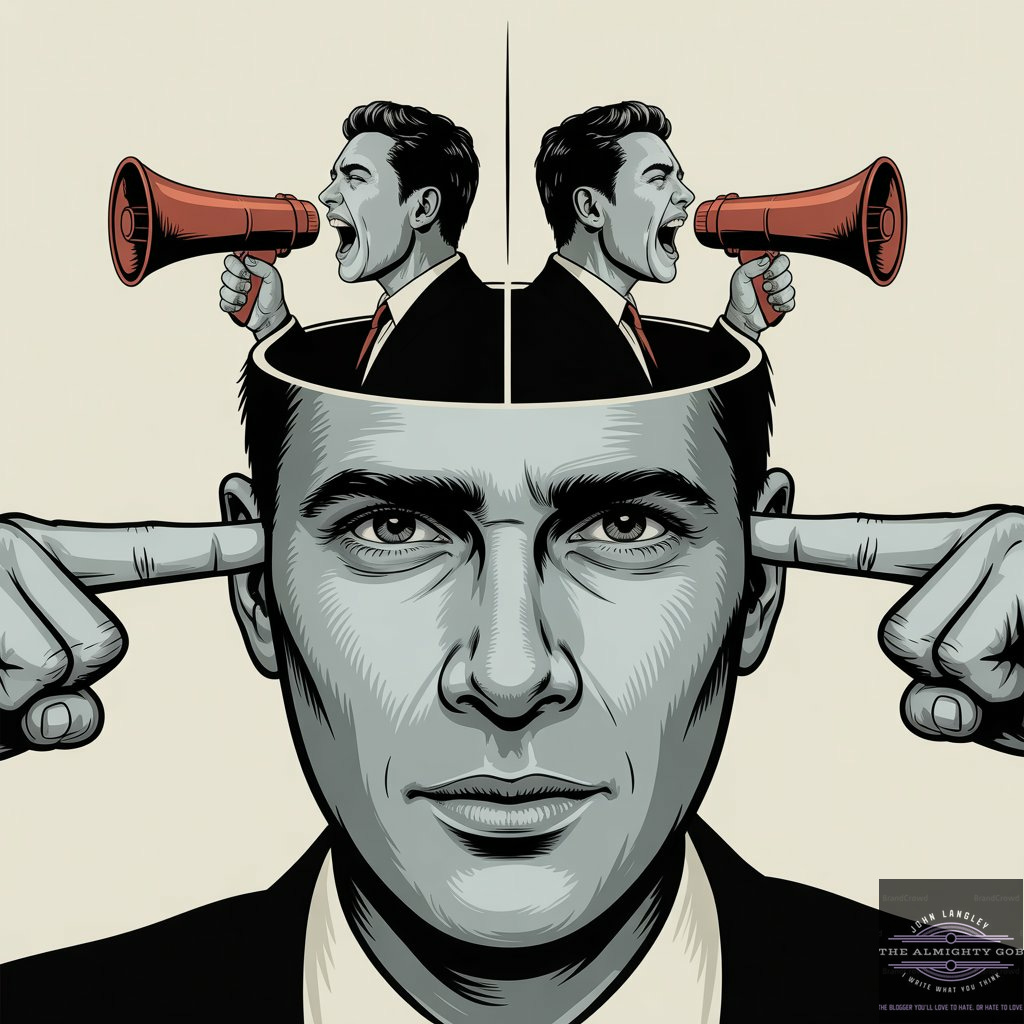
[The split brain of 2026. Shouting and blocking simultaneously. Unaware of the contradiction. © The Almighty Gob 2026.]
Franz Kafka was a Czech writer who died in 1924 at forty years old, having published almost nothing, having asked his friend to burn everything he’d left behind, and having spent most of his short life working a day job he couldn’t stand while writing in whatever hours remained. His friend didn’t burn it. Turns out the world got Kafka anyway.
Clearly, he never had a social media algorithm to contend with. Never had to worry about whether his authenticity would survive the tribal approval system, or whether saying the thing plainly would get him labelled a troublemaker by people who’d decided self-censorship was just good sense. He had a desk, a lamp, and a father who thought he was wasting his time. Bristol, of all places, has a phrase for what he was trying to preserve. Ship shape and Bristol fashion. Everything in its proper order. Everything exactly as it should be.
It isn’t. Not anymore.
And yet Kafka left behind the most precise description of the problem that 2026 has produced — in an age of industrialised populism, independent media under pressure, and a social media machine built to reward the loudest feeling and starve the quietest truth.
Don’t bend. Don’t water it down. Don’t try to make it logical. Don’t edit your soul according to the fashion. Rather, follow your most intense obsessions mercilessly.
That’s not a creative manifesto. That’s a survival guide. And the reason almost nobody follows it isn’t cowardice, exactly. It’s something quieter and more insidious than that.
It’s the accumulated weight of small decisions.
And small decisions are what nobody talks about. Because they don’t feel like decisions at the time. They feel like common sense. Discretion. Knowing your audience. Picking your battles.
So for instance. Monday, you don’t finish the sentence because you’re tired and it’s not worth the argument. Tuesday, you reword the paragraph because the first version felt too blunt. Wednesday, you leave the comment unwritten because the person you’d be disagreeing with has a bigger platform and you can already picture the response. Thursday, you say you broadly agree when what you mean is you don’t agree at all — but broadly is doing useful work there, isn’t it. Friday, you notice that the thing you wanted to say on Monday still hasn’t been said. But by now the moment has passed, and anyway, you were probably being too reactive.
That’s a week. String enough of those weeks together and you haven’t made one large decision to bend. You’ve made three hundred and forty small ones. And somewhere in that accumulation, the authentic position has been replaced by the managed one — so gradually, so reasonably, that you don’t identify the exact moment it happened.
You’ve had that week, haven’t you. More than once.
This happens in every office, every household, every relationship. It happens in local newspapers that stopped asking questions and started copying press releases. It happens in the journalist who needs the council contact, the commentator who needs the next invitation, the elected representative who won’t risk one controversial position.
Nobody tells them to manage their position. Nobody has to. The architecture does it. The boat must not be rocked — because the people in the boat with you are also the people who decide whether you stay on it.
Carefully managed. Professionally maintained. Quietly indistinguishable from silence.
The need for approval isn’t a character flaw. It is, in the most literal sense, a survival mechanism. For most of human history, being cast out of the tribe meant dying. Alone. In the cold. The brain that learned to monitor the group survived. The brain that didn’t got left behind and didn’t pass the trait on.
We are the descendants of the ones who learned to bend.
That’s not a metaphor. That’s evolutionary biology. That voice asking is this going to cost me? — it’s forty thousand years old. And now it’s being run through an infrastructure it was never designed to handle. The approval the brain is seeking now arrives, or doesn’t, as a number. Public. Visible. Updating in real time.
The tribe used to be forty people we could see. Now it’s forty thousand we don’t.
The threat response is identical. The adjustment is automatic. The soul edits itself according to the fashion — because the fashion is, in the oldest possible sense, the difference between belonging and not belonging.
Carl Rogers saw this coming. Not the algorithm — he died in 1987 — but the mechanism underneath it. Rogers was an American psychologist whose person-centred approach this writer trained in directly. Not as an academic footnote. As a working framework for understanding why people become who they perform rather than who they are. He called it conditions of worth — the unspoken rules absorbed so early in life that by adulthood we no longer know the difference between what we actually feel and what we learned to feel in order to be accepted. The approval mechanism doesn’t begin with social media. It begins in childhood. Social media just gave it a number and made it public.
His line was this: “The curious paradox is that when I accept myself just as I am, then I can change.”
Sounds warm. It isn’t. Sit with what it implies. Most people never accept themselves as they are — because they’ve never found the self beneath the conditions. The performance has run so long that the performance is the self, as far as they can tell.
The managed position doesn’t replace the authentic one all at once. It moves in next door and gradually takes over the lease.
Every tribe comes pre-loaded with its vocabulary. Words that arrive ready-made, tribal-approved — carrying the weight of the group’s position without requiring the individual to have formed one. Genocide. Terrorist. Fascist. Gammon. Woke. Denier. Extremist. The words land first. Fast. Before thought has a chance to arrive.
We don’t reach for those words. They reach for us.
You’ve used one of those words, haven’t you. Without stopping to ask where it came from.
Because we do. All of us. And both sides of the argument are on that list. The mechanism is identical regardless of which direction it points.
What we are living inside is industrialised emotion — feeling manufactured at scale, distributed and consumed before the next cycle begins. The platform is the factory. The algorithm is the production line. Emotional incontinence is what comes off it. Nuance gets three likes. Outrage gets three thousand shares.
Someone built this. Someone profits from the volume. The emotional incontinence isn’t a side effect. It’s the product.
The language thinks for us. We just move our lips. Or our fingers.
As you know, we live, it turns out, in an age of knife crime. Just, overall, not the kind that makes the evening news.
The knife isn’t steel. In 2026 the knife is the word. Fascist. Groomer. Genocider. Denier. Gammon. Extremist. Deployed at speed. In public. With the full weight of the tribe behind it. Not designed to describe. Designed to wound. Not to open an argument. To end one before it starts.
The blade is language. The gang is the tribe. And the postcode is whatever subject you’ve wandered into without first declaring your allegiance.
The survival behaviour is identical.
Keep your head down. Don’t make eye contact with the wrong crowd. Stay on the right streets. Know which colours you’re wearing and what they signal to whom.
And controversial? Controversial doesn’t just rock the boat. It capsizes it. And drops people into waters they’ve forgotten how to swim in.
Most people decide it isn’t worth it. They stop being troublemakers. They start being careful. Until careful becomes who we’ve adopted. The transmorph complete. Unnoticed. Unintended.
Most people never find out what they actually think. They find out what they’re prepared to say. Those are not the same thing.
Which brings us here.
The Almighty Gob is a blog. One voice. One position. No party allegiance. No press accreditation. No interest in acquiring either. It exists because the Kafka instruction requires a place to be followed. The obsessions here are power, accountability, and the gap between what institutions claim and what they actually do. Five hundred pieces since 2020. Eighty-eight FOI-based Bristol investigations. All of it written from the same position: stand back and interpret.
And that’s a decision that gets made every single day.
The blog that started in 2020 and is still here in 2026 — same position, same register, same refusal to file itself under any available tribal heading — that’s not stubbornness.
The record is the evidence. Not the claim.
Claims are free. Records cost something.
That’s the Kafka instruction. Followed mercilessly.
Don’t bend.
Almost nobody follows it. You’ve just read why. The wiring. The tribes. The language. The factory. The capsize. The slow replacement of the authentic position by the transmorphed one.
Ship shape and Bristol fashion. That was the standard. Everything in its proper order. Everything exactly as it should be.
It isn’t. Not anymore.
You know why almost nobody follows it.
The question now is which side of almost you’re on.
Kafka knew. The desk. The lamp. The father. The dark.
He just said it cleaner.
The Almighty Gob is a Bristol-based blog founded by John Langley — independent Bristol mayoral candidate 2016 and 2021, and one of the city’s most forensic observers of institutional power. Publishing since 2020, with over 500 pieces including 88 FOI-based Bristol investigations. Across seven platforms and Substack at thealmightygob.com — no party allegiance, no press accreditation, no interest in acquiring either.
© 2026 John Langley / The Almighty Gob. All rights reserved. Where reproduced, John Langley must be named as source in full. Attribution: John Langley / The Almighty Gob, thealmightygob.com. Unauthorised use constitutes copyright infringement. The Almighty Gob. Bristol. 2026.