
St James House: How Bristol's Tallest Tower Is Bankrolled By Money Tied To Israel's War.
Cain International and Menora Mivtachim are funding Bristol's biggest ever building. The council spent six hours on cycle storage and never once asked where the money came from.

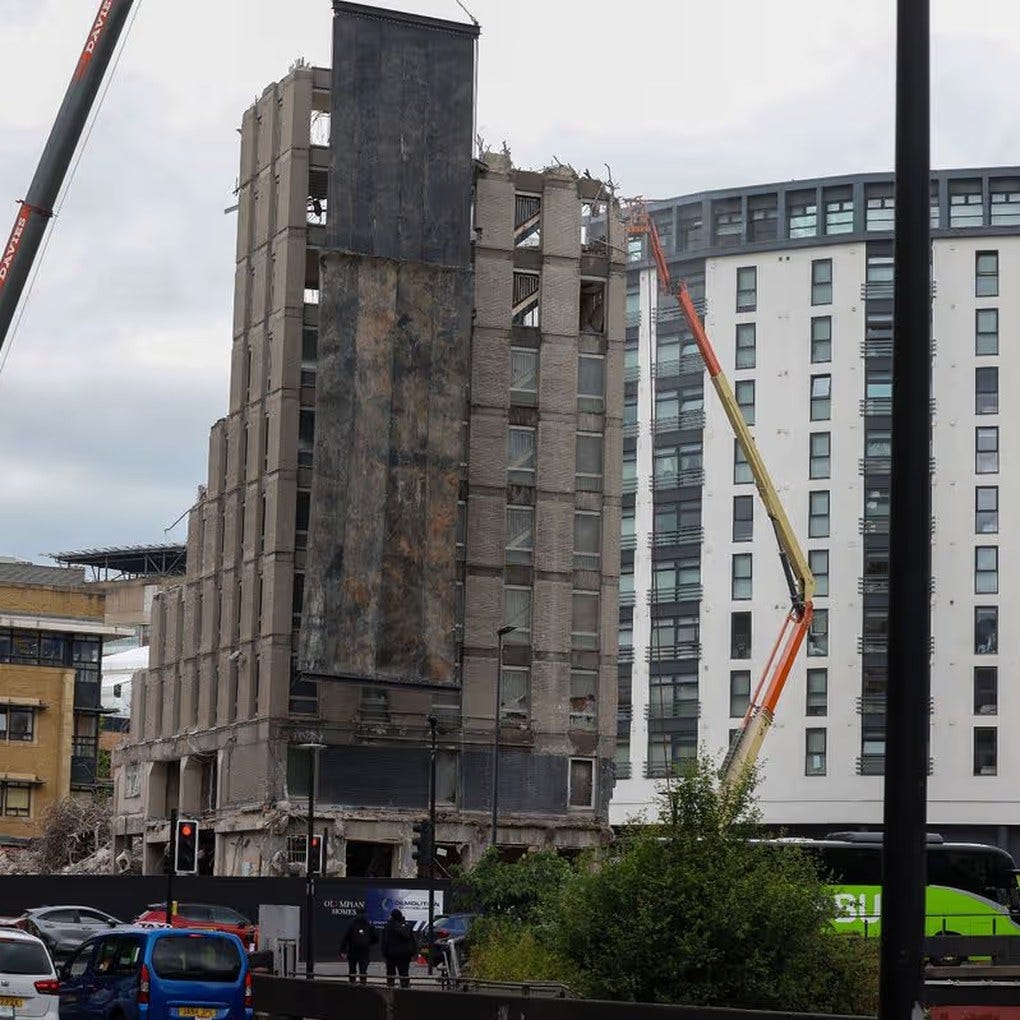
Bristol's tallest building, under construction on the bones of the old Premier Inn.
Sit down a minute. I want to tell you about a centipede.
It found its way into my second floor flat last week. No lift. No obvious entrance. Just persistence, and either very good eyesight or none at all. I’ve decided it has cataracts. I shall be seeking an optical vet first thing Monday morning, to have a proper look at the creature, because something that blind shouldn’t be able to find anything, let alone my flat.
Keep that thought. We’ll come back to it. You’ll want to.
Because right now, in the middle of Bristol, something a lot bigger than a centipede is going up as Bristol’s biggest erection. And trust me. Given my former life, I know a thing, or two about this
The Tower.
So. Picture it. Twenty-eight storeys of student flats, another eighteen of “co-living” for young professionals, rising out of the old Premier Inn site at St James Barton roundabout like something that was always going to happen, whether Bristol wanted it or not. St James House, they’ve called it. Bristol’s tallest building, when it’s done.
Here’s who’s paying for it.
It’s Cain International — a real estate firm with roughly seventeen billion dollars under management — working alongside Menora Mivtachim, one of Israel’s largest insurance and pension groups.
Here’s the part that isn’t in the brochure. Menora Mivtachim holds a substantial stake in a construction firm involved in settlement infrastructure in the West Bank, and in one of Israel’s largest private security and surveillance companies.
Cain’s founder and CEO, Jonathan Goldstein, spent years as chair of the Jewish Leadership Council, where he helped run the campaign accusing Jeremy Corbyn of failing to tackle antisemitism — and said, in 2021, that if Corbyn had become prime minister and they hadn’t done it, “we’d never have forgiven ourselves.” Writing after the 7 October attacks, he called for Israel to be given “unstinting and total support” for whatever it chose to do next — whatever, in his own words, Israel determined “in its absolute discretion” to be an appropriate response.
Of course. I’m guessing you already know what it chose to do next. I don’t need to spell that part out for you. You’ve seen the same footage everyone else has. Whether “unstinting and total support,” offered in advance and without conditions, was support for that specifically, or simply support for whatever came — I’ll leave you to decide. He wrote it down. Make of that what you will.
Goldstein also bankrolled David Lammy’s mayoral campaign, and sits close enough to Keir Starmer to host him at Chelsea. He learned the trade under property magnate Gerald Ronson — a man so tight with Benjamin Netanyahu that a teenage Jared Kushner once gave up his own bedroom so the rising Likud politician would have somewhere to sleep.
Follow that thread far enough and you end up at the Abraham Accords, Saudi sovereign wealth, Mubadala Capital, and a private equity firm Kushner built for himself once his father-in-law left office — funded to the tune of $2 billion by Saudi Arabia's Public Investment Fund. It's all connected. It was always going to be
So here we are. Bristol is about to get its skyline defined by a man who thanked Israel for its “absolute discretion.” You may want to sit with that, for a few moments.
Six Hours On Cycle Storage.
Now — and I want you to picture this properly, because it’s almost funny if you let it be — imagine the room. Bristol’s planning committee, gathered to decide the fate of St James House. Storey heights. Daylight assessments. Cycle parking ratios. Six hours, easily, on whether there’s enough room for the bins.
Not one minute on where the money came from.
I think you may be about to get angry at the committee. Don’t. Not yet. Because here’s the quiet, uncomfortable truth sitting underneath the whole proceeding: the rules never let them ask, no matter how badly any one of them might have wanted to.
You see. Our quaint English planning law runs on something called a presumption in favour of sustainable development. Refuse a scheme that complies with the Local Plan, and the developer simply wins on appeal, and the council loses months and public money proving what everyone already knew. One Bristol councillor put it about as plainly as it can be put: a planning committee’s job is not to approve or reject a scheme based on political feeling. Only on whether it follows the rules. Who’s funding it isn’t a question the room is allowed to ask. Not a loophole. Not an oversight. It’s simply not on the form.
Now. The original permission went through in March 2024 — before the Greens took the council in May that year, so that decision was never theirs to answer for. Therefore, the clearance the tower picked up more recently has nothing to do with Bristol City Council at all; that’s a national safety regulator, nodding through fire strategy for anything over eighteen storeys, from an office nowhere near Bristol.
So the committee did exactly the job it was built to do. Every hour of it. And the job, by design, has no room in it for the one question you and I would both actually want answered.
It's worth knowing the approval didn't go unchallenged, either. Bristol Civic Society's own lawyers wrote to the council arguing the decision was legally unsound — critical information had been missed, they said, and councillors were badly advised. Bristol Civic Society also say Historic England objected, warning of "very strong concerns" for nearby heritage assets and recommending the tower lose roughly eight storeys. The council issued the permission anyway, on 14 May 2024. The Society's own counsel believed a judicial review would likely succeed and the permission would likely be quashed at trial. They decided against it — not because they were wrong, but because they couldn't afford to be right.
For what it's worth, someone did ask. Middle East Eye sent Cain and Menora Mivtachim a list of detailed questions about all of this. Neither company responded.
Closer To Home Than You’d Like.
Before you point a finger entirely at Cain International and Menora Mivtachim, let me show you something closer to home. Much closer.
The pension fund that pays out for Bristol City Council’s own workers — a hundred and thirty-five thousand of them — voted in December, eight votes to two, to stay invested in the aerospace and defence sector. Among the holdings: names you’ll recognise, arming Israel among others.
A Green councillor sat on that committee. She didn’t fight the result — decided, she said, by a member survey that came back nearly split down the middle: 47 per cent for staying invested, 42 per cent for divesting, the rest unsure. A margin of five points settled it. She called accepting that outcome “heartbreaking.” She accepted it anyway — fiduciary duty, the exact same phrase that keeps a planning committee’s mouth shut about who’s bankrolling a tower.
So it isn’t only that the council won’t interrogate Cain’s money at St James House. When the identical question turns up at the council’s own front door — whose pension, whose weapons, whose war — the answer doesn’t change. The law says stay invested. So it stays invested. Whether a five-point survey margin ought to settle a question like that is not, I think, for me to say.
Same rules, same silence, wherever you look.
Shooting the Messenger.
There will be protests. There already have been. Barclays on Broadmead has had its windows put through more than once, red paint over the doors, because somebody decided a high street bank was close enough to the war to stand in for it.
I understand the impulse. Truly, I do. But think it through with me for a second — because it’s the wrong building, every time.
Barclays doesn’t manufacture a thing. It trades shares, provides services to defence firms who supply NATO and its allies. Follow that logic to its actual end and Barclays is no more or less complicit than the council’s own pension fund, or the building society that financed the flat you could be sitting in right now, reading this.
Right. So. Here’s the sentence I want you to keep. Money doesn’t come with a receipt. The ten-pound note folded in your wallet has no memory of where it’s been. Nobody standing at the bar of their local, handing that same tenner over for drinks, stops to wonder whether it was, only days before, changed hands for something altogether darker — a deal gone wrong, a batch cut with whatever was cheapest and closest to hand, someone’s last transaction before an ambulance was called, or wasn’t called in time. That note doesn’t carry the memory. It just keeps moving, indifferent, exactly like every other note in every other pocket.
It moved through a thousand hands before yours and it’ll move through a thousand more after you let it go, and not one of those exchanges left a mark anybody could trace. Your mortgage swims in that same current. So does your pension. So does the pint you didn’t think twice about.
And here’s the part that ought to sting a little more, if you’ve ever stood outside Barclays with a placard yourself. That placard cost something. The card, the paint, the marker pen, the tape holding it all together — bought from a shop, paid for with money that came from somewhere too, and nobody checked its papers either. Nobody stood in the craft aisle wondering whose pocket that fiver had sat in the week before, or what it had paid for on the way there. The protest and the thing it’s protesting are funded, in the end, by exactly the same untraceable current. Neither of you thought to ask. Why would you. Nobody does.
Smash the window if it makes the evening feel like it meant something. It won’t move a single pound out of a single arms company. It was never the branch on Broadmead. It was always the plumbing.
I want to see it. Truly.
I want to see five thousand anti-Israel protesters march on the roundabout, throw thick hemp ropes around the concrete base of St James House, and try to drag all twenty-eight storeys of it down the road and into the harbourside. I want to watch the splash.
It would be magnificent theatre. It would feel like a reckoning.
And then Monday morning would arrive, the dust would settle over the water, and the electronic ledger would simply show an insurance payout to a holding company registered in, well, maybe Delaware. The money would move on before the concrete even hit the riverbed.
The People Actually Up There.
Now picture the roundabout itself, on the day the protest finally arrives — banners, chanting, the lot.
Sixty feet above all of it, somebody is laying bricks. They didn’t choose Cain International. They didn’t choose Menora Mivtachim. They chose a job, because the job pays a mortgage, or a rent, or a pair of school shoes for a kid who’s grown out of last year’s.
That’s the part the placards never quite reach. The man on the scaffold is further from this money than the money is from itself. He’s not the enemy. He’s barely in the room. He’s only trying to get through Friday with something left for Monday.
Shout at the crane if it helps. The crane won’t hear you, and neither will the account it’s plugged into. You’ll go home feeling like you did something. You didn’t. You’re there to tick the self-satisfaction box of moral superiority over something you can do nothing about.
Or Burn It Instead.
There’s always the other option, of course. Skip the placards, skip the paint. Just burn the money.
It's been done — or something close enough to it. On the 23rd of August, 1994, two men from a band called the KLF took what they said was a million pounds in cash to an abandoned boathouse on the Isle of Jura and set fire to it. A journalist watched. A camera rolled. Their bank later confirmed the withdrawal had happened.
Even so — and I like this part, because nothing about this story is quite settled — a later documentary noticed the same bank statement showed £1.3 million landing back in their account a few days after the fire. More than they’d burned. Some unburned notes reportedly washed up on the beach. The two men have spent thirty years declining to explain any of it, on purpose. Whether every note in that boathouse actually turned to ash, whether the fire was the story or the cover for one, is genuinely still an open question, and probably always will be.
Real or partly theatre, the lesson survives either way. Burning a million quid doesn’t touch anyone’s balance sheet. It doesn’t dent a shareholding. It doesn’t so much as flicker on a single radar. All it does is remove money from circulation, or convincingly pretend to — a gesture with absolutely nothing standing behind it to hit.
What Actually Happens.
Now — and I want you to be honest with yourself here, because I already know the answer and so do you — what’s actually going to happen?
Three questions, and they’re not complicated. Is it practical for students to boycott the tower? No. Is it logical to expect them to, given the housing shortage they’re standing in? No. So what’s the likely outcome? Nothing. The building fills regardless.
Students aren't going to boycott St James House. Not enough of them to matter. A room is a room when you're desperate enough for one, and Bristol has one of the tightest student-to-bed ratios of any UK city — 3.5 full-time students for every purpose-built bed, third worst in the country behind only Glasgow and London. When the supply's that tight, being fussy stops being a principle and starts being a luxury nobody in the queue can afford.
It isn’t apathy. Most people spent their ethics budget on rent months ago, and there’s none left over for a housing decision. Nobody gets to feel superior about a choice they were never rich enough to make.
The Same Money, Every Hour.
Think about the last time you tapped your card in a supermarket queue. Did it once cross your mind where that money had already been — whose hands it passed through, whose war it might have quietly paid for on the way?
Of course it didn’t. It’s the same when the building society takes its direct debit. The same when housing benefit lands. Same money, same loop, moving twenty-four hours a day, seven days a week, never stopping long enough for anyone to check its papers.
And here’s the fact underneath all of it. The news changes. Ukraine, Putin, China, Gaza, the IDF — the headlines rotate, the outrage rotates with them, and every single time, we go back to spending exactly the same money in exactly the same way the following morning. Nobody cancels their pension over a news cycle. Nobody switches banks because of what led the ten o’clock bulletin. The money doesn’t pause for any of it. It never has, and there’s no reason to think it ever will.
And while we’re on the subject — somewhere tonight, at a stadium in New Jersey, two international sides are walking out for the World Cup final, in front of a global audience in the hundreds of millions. Adidas. Aramco — Saudi state oil, in case anyone’s forgotten. Coca-Cola. Bank of America. The winning nation walks away with fifty million dollars, out of a prize pot worth well over half a billion.
Nobody watching tonight is thinking about where Aramco’s money comes from, or where else it’s gone. They’re thinking about whether their country wins. Nobody’s boycotting the final over its sponsors — the idea would strike most people as faintly deranged. Or perhaps we’ve simply agreed, without ever discussing it, which billion-pound sponsors get a pass and which ones don’t. I’ll leave that one for you to decide. You might have your own view.
We already know money doesn’t come clean. We’ve simply decided, without ever once voting on it, which parts of that fact we’re allowed to be furious about, and which parts we’re expected to enjoy on a Sunday evening, curtains drawn, volume up.
Money Talks.
I still haven’t found that centipede an optical vet. I’m not sure, if I’m honest with you, that one exists — not for insects, and not for the rest of us either.
Because that’s the whole diagnosis, when you strip everything else away. Money talks. It always has. It always will. And how loudly you get to speak is measured out in exact proportion to how much of it you happen to be sitting on.
Jonathan Goldstein gets a phone call with a sitting prime minister. Gerald Ronson gets a teenager's bedroom given up for him, and thirty years later, a seat at the table with presidents. Menora Mivtachim gets to steer two million people's retirement savings into military infrastructure in the Negev desert without asking a single one of those two million what they think about it.
The people at the bottom of the pile get none of it. Not the bricklayer on the scaffold. Not the student who took the only room going. Not the protester outside Barclays, however loud, however right.
Volume was never the currency being traded here. It never was, and pretending otherwise is how you keep good people marching in circles instead of asking better questions. A mortgage payment doesn’t buy a meeting with Netanyahu. The tenner in your pocket has exactly as much say in where it goes next as you do — none at all.
It was never a fair fight. It was never built to be one.
The centipede, at least, has an excuse for not seeing clearly. The Almighty Gob doesn’t — and neither, if we’re being honest with each other, do most of the rest of us.
We can just see a little further down the pile than most people bother looking. Whether that changes anything is a different question entirely, and one I’m not sure either of us wants answered tonight.
Sources.
Middle East Eye, How Bristol’s tallest tower will be tied to Israel’s atrocities — https://www.middleeasteye.net/news/how-bristols-tallest-tower-will-be-tied-israels-atrocities
Joe Banks, original reporting on St James House financing — https://joe-banks.com/2025/03/08/how-bristols-tallest-building-will-be-linked-to-israels-atrocities/
Olympian Homes, St James House project pages — https://olympianhomes.com/building/st-james-square
Cain International, St James House — https://www.cainint.com/media-centre/cain-partners-with-olympian-homes-to-expand-pbsa-platform-with-st-james-house-redevelopment-in-bristol/
Green Street News, Gateway 2 clearance — https://greenstreetnews.com/article/200m-bristol-living-project-clears-gateway-2/
Bristol247, on planning committee politicisation — https://www.bristol247.com/opinion/your-say/farcical-scenes-during-planning-meetings-put-bristol-economic-future-risk/
UK Government, National Planning Policy Framework — https://www.gov.uk/government/publications/national-planning-policy-framework--2
The Bristol Cable, How local pension funds invest millions in defence — https://thebristolcable.org/2026/05/how-local-pension-funds-invest-millions-in-defence/
BBC News, Barclays Bristol vandalism reporting — https://feeds.bbci.co.uk/news/articles/c1dmev1vn53o
LBC, Barclays branches vandalised — https://www.lbc.co.uk/article/barclays-branches-vandalised-palestine-protesters-israel-5HjcmPm_2/
Wikipedia, K Foundation Burn a Million Quid — https://en.wikipedia.org/wiki/K_Foundation_Burn_a_Million_Quid
IMDb, Watch the K Foundation Burn a Million Quid — https://www.imdb.com/title/tt0114897/
KLF Online, burning account and Omnibus documentary detail — http://klf.de/home/burning-a-million-quid/
Wikipedia, 2026 FIFA World Cup final — https://en.wikipedia.org/wiki/2026_FIFA_World_Cup_final
Doc’s Sports, 2026 FIFA World Cup financial statistics — https://www.docsports.com/2026/fifa-world-cup-financial-statistics.html
SportsPro, FIFA 2026 sponsorship revenue — https://www.sportspro.com/news/sponsorship-marketing/fifa-2026-world-cup-sponsors-revenue-march-2026/
Malay Mail, 2026 World Cup prize money — https://malaymail.com/news/sports/2025/12/18/winners-of-2026-world-cup-to-pocket-rm200m-in-record-payday/202362