
Small Robot. Big Nothing.
Bristol City Council didn't know the robots were there. The robots didn't care. Nobody ever does.

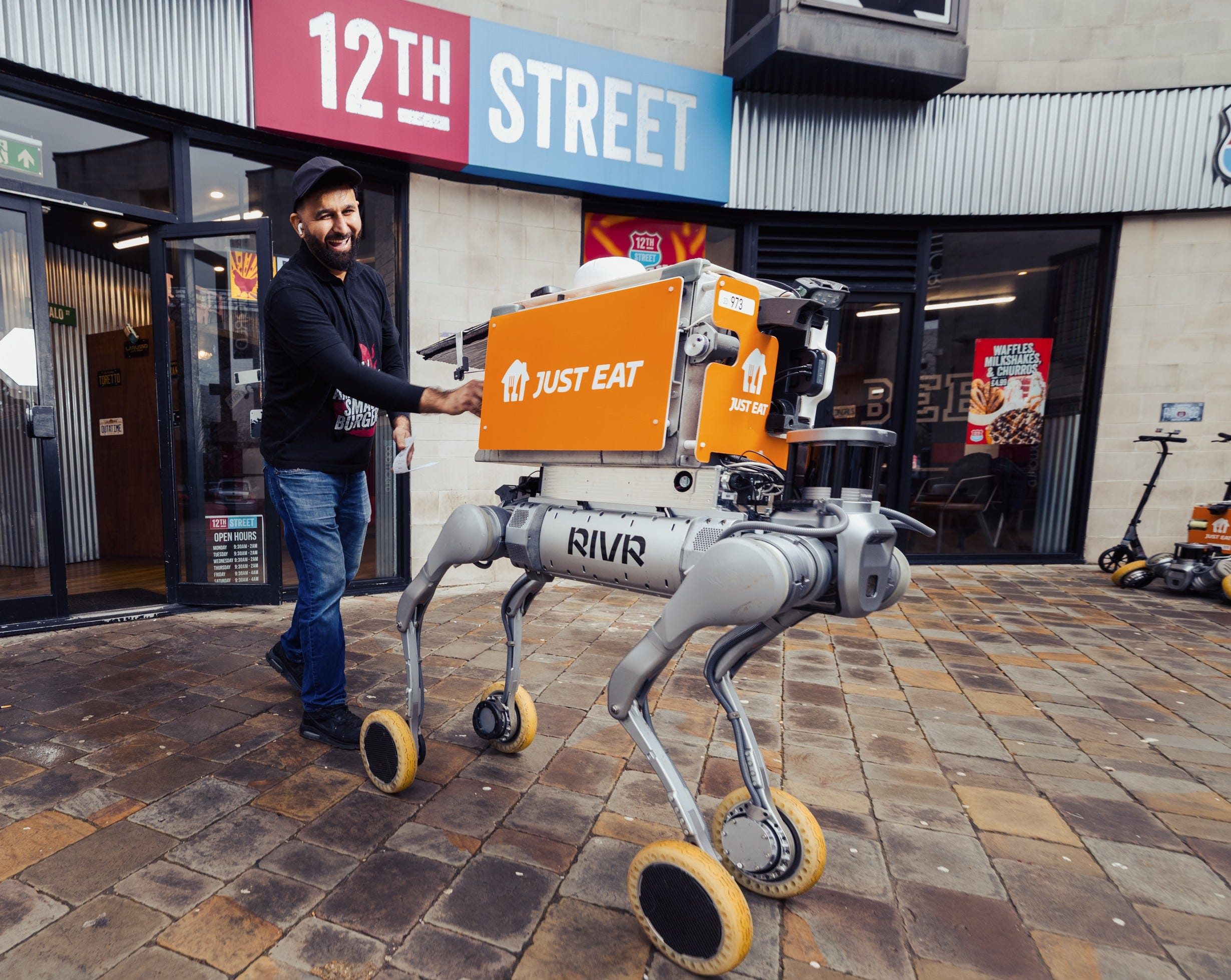
[Meet the robodog. Four legs, Just Eat branding, RIVR technology, and absolutely no idea what a lamppost is for. Bristol City Council hadn't met it either — until a councillor's dog nearly did. (Image: Just Eat / RIVR)]
There is a robot on Gloucester Road.
It has been there for several weeks. Moving quietly. Delivering things. Doing what it was built to do without ceremony or announcement or any of the procedural courtesies that human beings operating in public spaces are generally expected to observe. It does not knock before entering. It does not write ahead. It simply arrives, completes its function, and moves on.
Nobody told Bristol City Council it was coming.
Nobody needed to.
There is a robot on a public pavement in Bristol, operating for commercial profit, and the body nominally responsible for that pavement had no prior knowledge, no policy, no mechanism, and — this is the part that matters — no requirement to have any of those things. The company did not withhold information. There was no information to withhold. There was simply a gap, and a robot, and a corporation that noticed the gap first.
This is how it always starts. Not with malice. With arithmetic.
Green Councillor Emma Edwards’s dog, Flora, noticed it the way small dogs notice most things — immediately, at ground level, and with considerably more alarm than the situation officially merited. One of the robots came close. Flora is small. The robot operates at low speeds on pedestrian-designed pavements and has been extensively risk-assessed.
Flora, for those of a certain age, is also a margarine. Light. Spreadable. Good for the heart, apparently. The kind of name that arrives trailing a specific decade and a television jingle and the particular optimism of a product that promised to be better for you than the thing it replaced.
The robot had no views on this.
Flora was not part of the risk assessment.
Low wages, for a dog.
“Nobody told Bristol City Council the robots were coming. Nobody needed to. That’s not an oversight. That’s the whole architecture.”
The Pavement That Belongs To Everyone.
Bristol City Council discovered that autonomous delivery vehicles had been operating on its streets for several weeks — weeks during which the council had, presumably, been doing other things, governing, presumably, or attempting to — and did what Bristol City Council does in these situations. It convened a forum. It asked staff to investigate. No one read the Bristol Post, it seems.
It noted, with some procedural care, that it was unclear what powers the council had to manage the situation, if any. Why would they, in the absence of any reports of an increase in errant pooch excrement on Gloucester road, or surrounds?
And what powers the council has. If any. Several weeks after the robots began rolling.
The council currently does not have a policy on delivery robots. Heaven knows, it doesn’t even have one on delivery bikes riding on pavements. It did not know this until it needed one. This is not quite the same as having considered the question and concluded no policy was required. This is the discovery, mid-sentence, that an entire category of public life had been proceeding without anyone having been asked. Not even council officials after a delivery bike arrived at their front door.
This is not peculiar to Bristol. Every local authority in England is navigating the same expanding distance between what technology can do and what governance can respond to.
The gap does not narrow on its own. It widens, quietly, while councils are otherwise occupied, because the people who profit from its width are considerably better resourced than the people who would benefit from closing it.
And they move first. They always move first. The gap is not a failure of imagination. It is a product.
The Green administration that runs Bristol City Council has spent considerable energy on liveable neighbourhoods, modal filters, low-traffic schemes — the entire architecture of returning streets to people rather than vehicles.
The robot, apparently, did not get the memo. Or got it, considered it, and decided that a pavement in a Green-administered city was exactly the kind of unregulated commons it was looking for.
Whether it had views specifically on the councillor whose dog it nearly flattened is a matter for those with more insight into the inner life of delivery robots than is currently available.
“A gap in the law is not an accident waiting to be corrected. It is an asset waiting to be monetised. Just Eat found it before the council finished the meeting where they might have looked.”
What Just Eat Said When They Replied To The Concerns They Hadn’t Been Formally Presented With.
When concerns eventually surfaced publicly, Just Eat’s response was a small masterpiece of the form.
They had not, they said, been contacted with any specific concerns.
It is not saying: we were unaware of concerns. It is not saying: we take community feedback seriously. It is saying that the burden of formally objecting, through the correct channel, to something nobody knew was happening, about which no channel existed, had not yet been discharged. And until it was, Just Eat had nothing to respond to.
The mechanism for objecting did not exist. The objection therefore could not exist. And because the objection could not exist, there was nothing to worry about.
Flora, as previously noted, was not consulted.
Extensive planning, they said. Extensive risk assessment. They are working with a road safety charity. They were the first delivery aggregator to partner with leading road safety charity Brake.
The Green Cross Code Man has long since expired, having transformed into Darth Vader. Bristol’s own David Prowse — who told a generation of children to stop, look, and listen before crossing — spent his later years on the other side of the force entirely. Road safety in this country has always been slightly more complicated than the poster suggested.
The road safety charity works primarily on roads.
The robots are on the pavement.
“Extensive planning. Extensive risk assessment. The dog narrowly avoided the future. The council is still writing the terms of reference for the working group that will look into it.”
For The Time They Are On An Order.
Green Councillor Ed Plowden said that companies like this pay very low wages, thinking solely of the dog at this point — that they externalise risk onto the people of Bristol. Especially those who should be kept on a lead. The Highway Code being as unfamiliar to delivery drivers as the Green Cross Code Man to children, he was probably referring to.
That rogue operators should face proper licensing and health and safety requirements built into their operations as a precondition of trading, not a discovery made six weeks after the robots started rolling. And the idea of two-lane pavements — not on anyone’s radar at the council. Yet.
Besides, he might have added, what about the revenue from reintroducing dog licences — updated, naturally, to include robotic canines. The last dog licence in England cost thirty-seven pence. One imagines the tech industry could stretch to that.
Just Eat responded: couriers earn on average significantly over the national living wage for the time they are on an order.
For the time they are on an order.
Not for the time spent waiting between orders while the app decides whether to offer them the next job. Not for the time spent maintaining a vehicle Just Eat neither owns nor is responsible for, because the courier is not an employee — they are an independent self-employed contractor, which is the precise legal instrument by which a corporation extracts the benefit of labour without acquiring the obligations that labour would otherwise carry.
The courier is free. Free to choose their own hours, their own vehicle, their own insurance, their own tax arrangements, their own rainy Tuesday afternoons sitting outside a restaurant watching the clock.
Free to absorb everything the business model externalises. Free to eat whatever the algorithm doesn’t send their way. Free from vet bills.
However, the robots are not free. The robots are infrastructure. Infrastructure does not wait between orders. Infrastructure does not buy wet weather gear. Infrastructure does not take a sick day or file a personal injury claim or query why the hourly rate looks different from the number on the recruitment page.
Infrastructure simply rolls. Without late night or early morning tours of lampposts. Or fetching balls.
Plowden called it externalised risk. He is correct. The argument has been made before — about Uber, about Deliveroo, about Amazon Flex. It was never wrong then either. The regulation always arrives late. The market position is always already established by the time the working group reports.
“The profit stays. The risk travels. The courier absorbs it. The robot doesn’t need to. That is not a coincidence. That is the point.”
The Regulation That Will Come, Precisely Calibrated To The Shape Of The Thing It Can No Longer Stop.
Ed Plowden wants proper licensing. Health and safety requirements. A national reckoning with the technology industry’s habit of occupying public infrastructure before the public has agreed to let it in.
He is right. He will have to wait. Why? Perhaps political dogma.
The framework will arrive — normal breathing will continue in the meantime, no one having held their breath. It always does. It will be thorough, and detailed, and will reference extensive stakeholder consultation, and a working group report, and a pilot programme in three cities, and an impact assessment, and a response to the impact assessment — in consultation, naturally, with the Robotic Society for the Prevention of Cruelty to Androids (RSPCA).
It will be published at some point in 2028. Though, knowing this council as I do, possibly 2030, and definitely in time for the next general election. By then Just Eat will have gathered operational data from Gloucester Road and four other cities, refined the routing algorithms, lobbied the relevant select committee, and helped draft the safety standards the regulation will require them to meet — the standards being, naturally, the ones their technology already meets.
This is not conspiracy. This is sequence. The regulation arrives. It is always already the shape of the thing it was supposed to constrain. And nobody is to blame, precisely, because every individual step was reasonable.
Bristol City Council asked staff to investigate in March 2026. Presumably the same department that oversees Equality and Diversity.
That is where we are. At the very least, the best we can hope for.
“The working group will report. The framework will arrive. The industry will have helped write it. This is not a prediction. It is a description of what already happened with the last six technologies we decided to look into after the fact.”
Anyway, it’s back to that pavement on Gloucester Road. Remember?
It is still there. Moving quietly. Delivering things. The robodog, not the pavement. It does not slow for lampposts. It registers no interest in gates, walls, suspicious crisp packets, the lingering ghost of a previous dog’s territorial claim. It has not been programmed for the democracy of the pavement — the ten thousand year compact between humans and the animals that move through their streets alongside them, investigating the world at ground level with more seriousness than the world generally deserves.
It simply delivers. In the rain, without complaint, without a lead, without the elaborate negotiation between species that has characterised every previous arrangement for moving things between a restaurant and a front door.
Flora encountered it and did what small dogs have always done when confronted by something mechanical, silent, and advancing with no apparent interest in her existence.
She got out of the way. Not needing a lamppost, or piece of grass, on this occasion. At least.
There is no dog warden for this. The dog warden handles stray dogs, dangerous dogs, dogs without licences — not dogs nearly hit by autonomous delivery vehicles, because nobody has written that into anyone’s remit, because nobody imagined they would need to. No one’s yet qualified in robodog first aid either.
There is no RSPCA angle. No cruelty occurred. Just physics, a small dog, and a robot that registered neither. Not even carrying a small screwdriver. You know, for emergencies?
There is no council policy to invoke. There is no channel for specific concerns, as Just Eat have helpfully clarified. There is, in the most complete sense available, nothing. No institution, no mechanism, no form to fill in, no number to call.
Flora, in that moment, was entirely on her own.
As was the pavement.
As was the council.
As, it turns out, are we all.
Too late to ask. Just in time to convene.
The worst case scenario was considerably simpler than all of this. A small dog. A silent machine. A pavement belonging to everyone and governed by no one.
Small robot. Big nothing.
And a lucky escape for Flora. From being Just Eat-en.
CREDITS AND CITATIONS
Bristol City Council Member Forum, 10th March 2026 — delivery robots raised during session; powers and policy gap confirmed — bristol.gov.uk
Just Eat spokesperson statement, March 2026 — risk assessment, Brake partnership, courier wages, trial confirmation — justeat.co.uk
Delivers.AI — ground robotics trial partner, Gloucester Road, Bristol, 2026 — delivers.ai
Brake — road safety charity, Just Eat partnership confirmed 2025 — brake.org.uk
David Prowse — Bristol-born actor, Green Cross Code Man 1971–1990, Darth Vader (body) Star Wars 1977–1983 — publicly documented
Green Cross Code — UK road safety campaign for children, Department for Transport — gov.uk
Dog licence, England and Wales — abolished under Local Government Act 1988; last fee 37p, unchanged since introduction under Dogs Act 1906 — legislation.gov.uk
Gig economy / independent contractor classification — Employment Rights Act 1996; Supreme Court ruling Uber BV v Aslam [2021] UKSC 5 — supremecourt.uk
Just Eat courier model — independent self-employed contractor status, publicly stated company policy — justeat.co.uk
The Almighty Gob — previous Bristol City Council coverage, modal filters, EBLN, governance gap investigations — thealmightygob.com