
Solid Arty: A Portrait of Bristol Activism on This Saturday Afternoon. Or the Lack of It.
Bristol's streets were quiet this morning. By afternoon, Cabot Circus told a different story. A satirical portrait of commitment, performance, and a tattoo that accidentally told the truth.

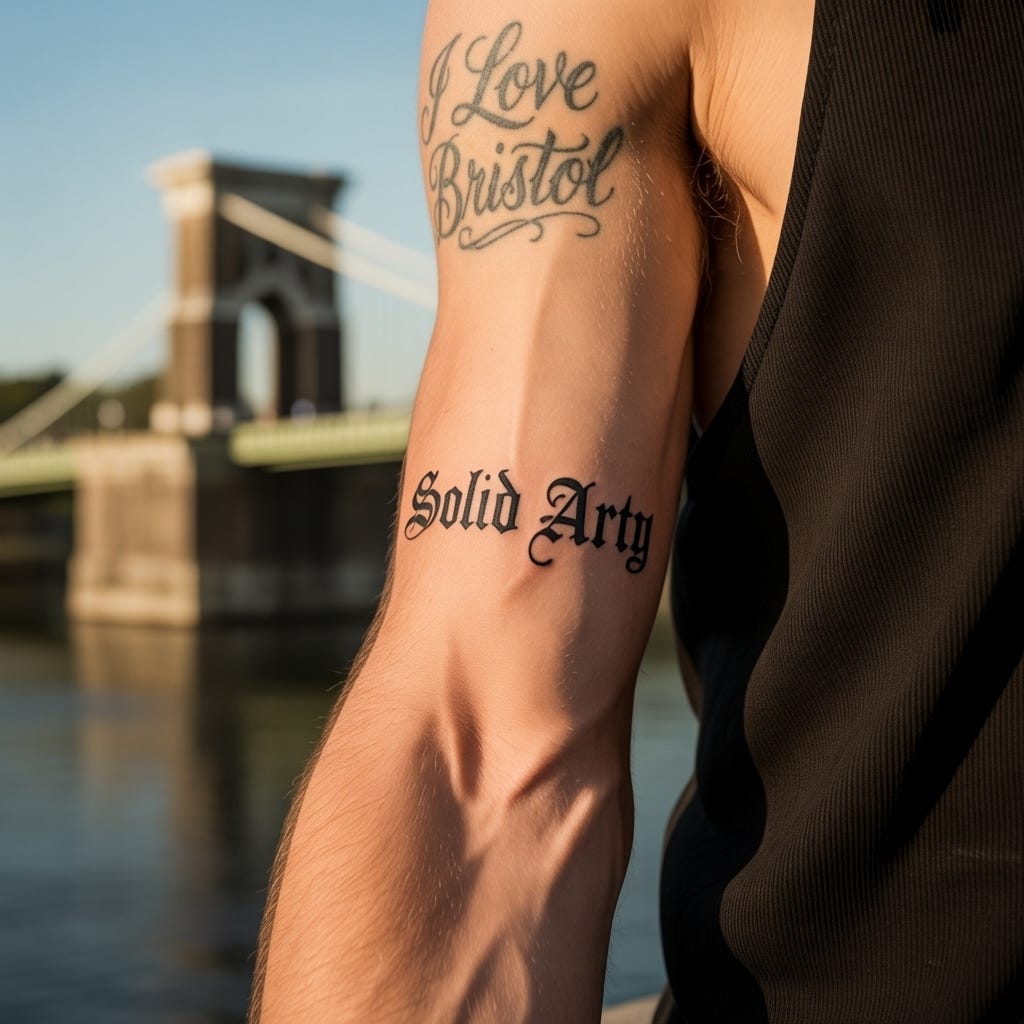
There is a particular quality to a Bristol street when nobody is shouting on a Saturday.
It takes a moment to identify. Something in the air — not absence exactly, more like a held breath. The city going about its Saturday business with the mild, unhurried contentment of a place that has temporarily forgotten it has opinions. Blue sky. Warm light. The Bearpit looking, for once, almost forgivable.
No banners. No chants. No folding tables. No one explaining to a passing pigeon the precise geopolitical conditions that demand its immediate moral attention. Though the pigeon, to be fair, has relatives in Tehran who would probably appreciate the update.
Just a street. Just a day.
The sick notes came in early.
South Wales Police, it should be noted, were having a better Saturday than expected. The overtime unclaimed. The Severn Bridge uncrossed. Somewhere in Cardiff a duty roster that looked demanding on Friday evening had quietly resolved itself into something manageable. The ambulances were moving. The city centre operating at its normal level of chaos — which is considerable — rather than the special, elevated, transcendent chaos of a Bristol Saturday afternoon when a demonstration adds an hour to a journey that would otherwise take five minutes and tests the patience of everyone involved except, apparently, the people causing it.
Bristol, for once, was just Bristol.
The morning, at least, belonged to that thought.
Here is what nobody in Bristol activism officially acknowledges but everyone intuitively understands: the movement is weather-dependent.
Not officially, of course. Officially the cause is urgent, the moment is now, the arc of history bends toward justice and is entirely unaffected by atmospheric pressure. Officially the sick notes are genuine. Officially everyone who didn’t turn out today had somewhere important to be.
Autumn is peak season. Winter produces a committed hardcore — the ones who mean it, or need to be seen meaning it, which in Bristol amounts to roughly the same thing. Summer is slow. Too many festivals. Too many competing performances of identity. And spring — that precise moment when the sky first remembers what blue looks like — produces a specific kind of collective amnesia about all previously scheduled urgencies.
The causes are real. The anger is real. The sunshine, unfortunately, is also real.
And on a day like today, something has to give.
What gives, reliably, is the turnout. But the movement doesn’t stop. It never stops. It simply separates, like a stream dividing around a stone, into its two natural Saturday configurations.
The organiser.
And everyone else.
Somewhere in Bristol this morning, an organiser woke up, checked the weather app, and made a decision.
Not an announcement. Not a statement of solidarity with the meteorological conditions. Just a quiet, private reckoning with the fact that nobody was coming. The sick notes had already arrived — variations on a theme, each one careful, each one warm, each one radiating the particular sincerity of a person who very much would have been there, under different atmospheric circumstances. Can’t make it today. Feeling rough. Send solidarity.
The sun outside his window sent nothing. Just light. Indifferent, beautiful, movement-dissolving light.
And so the cause was stood down without ceremony. No announcement. No rescheduling notice. Just a Saturday morning quietly becoming a different kind of Saturday morning. The kind with a trolley. A list. Children with extremely strong feelings about cereal, about parks, about where they’re having lunch and why the answer their father just gave is not acceptable and never has been.
He’ll recover. It’s only one Saturday.
Though it should be noted — and this is important — that he will not spend that Saturday entirely without purpose. When the shopping is done and the children are finally, mercifully, elsewhere, he will sit down with his phone. He will open Google. He will begin, with the quiet methodical focus of a man who has not lost the thread, to research holidays.
Somewhere warm. Good flights from Bristol Airport. A hotel with a pool for the kids. And if there happens — entirely by coincidence, purely as a matter of timing — to be a march on the Thursday, well. That’s not nothing. That’s called planning.
The family think they’re booking a break.
He’s building a schedule.
He’ll pack light. Essentials only.
Swimwear. Factor 50. The kids’ armbands. A phone charger. The usual geography of a family holiday assembled on the bedroom floor with the weary efficiency of a man who has done this before and will do it again and has made his peace with the doing of it.
And three Palestine flags on sticks.
Just in case.
You understand. You never know when the opportunity might arise. A seafront demonstration. A passing news crew. A moment that calls for something more than sunscreen and a resigned expression. A man who travels without his flags is a man who has stopped paying attention. And whatever else you might say about him — and there is, it turns out, quite a lot you might say — he has never stopped paying attention.
He’ll lie on that beach. Sun on his face. Kids in the water. The particular stillness of a man who has temporarily run out of things to organise. And he’ll feel it — the warmth, the light, the gentle, rhythmic indifference of the sea — and somewhere in the back of his mind, quiet as a held breath, the thought will surface and dissolve and surface again.
The flights were unavoidable.
Everyone flies.
It’s the system.
The flags are on the balcony.
Not prominently. Not aggressively. Just — there. Visible from the pool if you know where to look. Three small rectangles of conviction catching the Mediterranean breeze while their owner lies horizontal on a sun lounger below, factor 50 on his nose, a cold drink sweating gently on the table beside him. Surreptitious in the way that things are surreptitious when they are absolutely intended to be noticed.
The family have long since stopped mentioning it.
Back in Bristol, the others are having an equally productive Saturday.
The placards from the last demonstration are propped against hallway walls across the city, waiting. Patient as ever. They’re adaptable, these placards — that’s the thing people don’t appreciate about them. A fresh sheet of card over the old one, the previous cause still faintly visible underneath if you hold it to the light, and they’re ready for whatever the next outrage turns out to be. The infrastructure of dissent, quietly maintained. The tools of the trade, never quite retired.
Because something is always coming. Something is always almost here. You can feel it if you pay attention — the low hum of the next cause gathering itself somewhere just beyond the news cycle, taking shape, acquiring a hashtag, becoming inevitable. And when it arrives you want to be ready. You want the aesthetic right. Which is why Saturday is also for browsing.
eBay. Depop. The secondhand clothing sites where last season’s performative casualwear goes to wait for its next owner. What’s coming? What will it look like? What does the well-dressed Bristol activist wear to the next emergency? The boots have to say something. The jacket has to strike the precise balance between working class solidarity and middle class comfort that the moment demands. These things require research. These things require commitment.
Nobody said changing the world was going to be easy to coordinate.
And then, at the end of a long and productive Saturday, there is the tattoo.
The tattoo is the most serious matter of all.
Not to be undertaken lightly. Not to be delegated to just anyone with a needle and an afternoon free. This requires research. This requires reviews. This requires a practitioner of sufficient skill and — crucially — sufficient attention to be trusted with the most permanent expression of everything you believe and everything you are and everything you would have turned out for today had the weather been even slightly more cooperative.
Solidarity.
Clean script. Somewhere visible. Somewhere that says I mean this. I have always meant this. This is not a phase, not a fashion, not a Saturday afternoon that got out of hand. This is me. This is who I am. This is what I would like the world to know about me for the remainder of my natural life and possibly beyond.
The search for the right artist takes time. There are portfolios to assess. There are reviews to read. There are direct messages to send to people whose linework suggests they might — might — be trusted with something this important.
And then the appointment. The chair. The needle. The moment of absolute commitment arriving at last after all the browsing and the planning and the fresh sheet of card over the old placard and the outrage wear hanging fresh from its Depop delivery, still in the bag.
The phone rings.
Someone wants to book an appointment.
The tattoo artist — a reasonable man, a professional man, a man with a business to run and a diary that doesn’t fill itself — takes the call. Thirty seconds. Maybe less. A perfectly understandable, entirely human, commercially necessary thirty seconds in which his attention is elsewhere.
Solid Arty.
Permanent. Clean. Exactly the right font.
“The needle, in its moment of distraction, did what three years of demonstrations had carefully avoided doing. It told the truth.”
Paradoxically, the more honest statement. More art project than solidarity. More aesthetic than politics. More performance than belief.
And so the Saturday passes.
The city going about its business with the mild contentment of a place that has temporarily forgotten it has opinions. Somewhere a trolley moves through a supermarket aisle. Somewhere a sun lounger bears the weight of a man at peace with the system, three flags catching the Mediterranean breeze one balcony up. Somewhere a hallway placard waits with the patient dignity of something that has survived several causes already and expects to survive several more. Somewhere a forearm, fresh and stinging, carries the permanent record of a thirty second phone call.
The street is quiet.
It will not always be quiet. Autumn is coming. The sky will close back over. The weather app will deliver its verdict and the verdict will be favourable and the sick notes will go unwritten and the boots will be laced and the placards retrieved and the cause — whatever it has become by then, whatever name the fresh card is covering this time — will take to the streets again with the full force of its conviction.
But that is then.
This is a Saturday in Bristol. The sun is shining. The pigeon is going about its business, unbriefed, its relatives in Tehran none the wiser.
And somewhere on a forearm, in exactly the right font, the truth sits quietly in the sun.
Solid Arty.
A note, added this afternoon.
This correspondent went to investigate.
Cabot Circus. A protest — local in origin, specific in cause, responding to the recent attack on a teenage girl in Philadelphia Street. Not Palestine. Not the climate. Just Bristol, reacting to something that happened on its own doorstep, to one of its own, in broad daylight.
That is a different thing. That deserves to be named as a different thing.
But the traffic is building regardless. South Wales Police quietly revising their afternoon. The overtime, it turns out, was always there. The Severn Bridge reconsidering its options.
And somewhere across the city, pub landlords are doing what pub landlords do — reading the room, sensing the mood, encouraging solidarity in the way they know best. Come in. Sit down. It’s been a complicated Saturday. The cause may not have fully materialised but the feeling is real and the feeling deserves a drink. Possibly two.
The unhappy hour starts when you’re ready.
The traffic is building.
Here we go.
The Almighty Gob is a Bristol-based publication covering UK politics, institutional dysfunction, and the gap between what people say and what they actually do.