
Stitched Up in Barton Hill.
Bristol City Council, the EBLN vote, and the case for Bristol CIC.

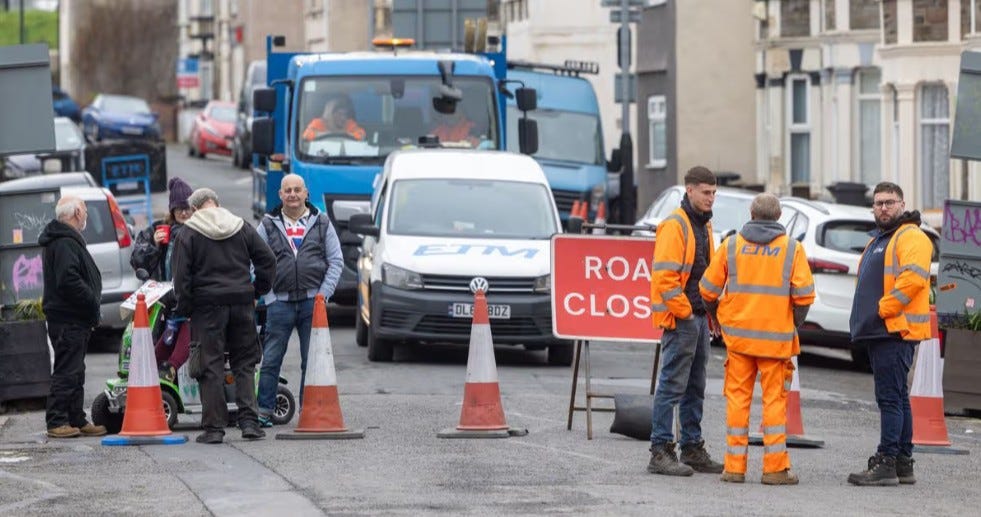
There’s a planter on a road in Barton Hill. It’s been there two years. It isn’t going anywhere. Nobody in that street chose it, exactly.
It just arrived, the way weather arrives. And now it’s staying, the way weather doesn’t ask permission either.
Thursday night, nine people in a committee room made that official. Behind them sat hundreds of statements from residents — heartfelt, furious, and in the end, decorative.
Here’s the thing nobody said out loud: the decision was made long before the vote. The vote was just the bit where everyone got to pretend they’d been listened to.
That’s not cynicism. That’s the shape of the thing.
The East Bristol Liveable Neighbourhood was funded and built £1.65m over budget before residents ever got a binding vote on whether it should continue. The 5-4 result at the Transport & Connectivity Policy Committee wasn’t democracy weighing the evidence.
It was democracy being wheeled out, after the fact, to sign the guestbook on its way past a decision the spending had already made. Councils call this “consultation.” Everyone else calls it a receipt.
However — and here’s where it stops being one bad Thursday and starts being something worse — this isn’t a story about a planter. It’s a story about a council that was never built to answer to the people paying for it.
And a structure that isn’t built to answer to you doesn’t need to lie to you. It just needs to outlast your attention span.
The shareholder test: what Bristol City Council actually owes you.
Try this. If Bristol City Council were a company and you were a shareholder, what would you actually be owed? A vote on the board. Audited accounts. A binding say over who runs the thing with your money.
Real oversight — not a suggestion box, not a “have your say” form that closes the moment the decision’s already banked.
Council tax payers get none of it. Council tax funds just under half of Bristol’s £634m General Fund — and you hold none of a shareholder’s rights over a penny of it. Not the EBLN business case. Not the overspend. Not the officers whose spending had, in effect, decided the outcome months before the room that supposedly decided it.
You’re not a shareholder. You’re not even a customer. A customer can leave.
Compare that to Finland — a country that taxes people harder than almost anywhere on earth and tops the World Happiness Report for the ninth year running while doing it. The lesson isn’t that tax makes people happy. It’s that trust comes first, and tax tolerance follows it, never the other way round.
Bristol hasn’t earned a fraction of that. Thursday just spent two years and £1.65m proving it again — slowly, in public, with minutes taken.
WECA: the same failure, one desk further away.
Widen the lens. It gets worse. The West of England Combined Authority — the body that actually decides whether EBLN gets built, since Mayor Helen Godwin holds the funding veto — was issued a formal best-value notice in 2024, after auditors found troubling relationships among WECA’s leadership and hundreds of thousands overspent on salaries in a single year.
Ministers lifted the notice in March 2025 after judging the improvements sufficient. But the fallout hasn’t cleared — WECA remains locked out of the highest tier of devolved power until at least November 2026.
So ask who actually benefits from that arrangement staying in place. Not the residents of Barton Hill, waiting on a mayoral sign-off. Not the officers whose overspend now sits inside an organisation still working through its own sanction. The people who benefit are the ones furthest from the consequences — the layers of the structure itself, each one able to point to the layer above or below when a resident asks who’s actually accountable.
The EBLN decision doesn’t belong to Bristol any more. It belongs to a mayor whose own organisation is under sanction for the identical failure Bristol’s committee just demonstrated in miniature. Handing more power to a body that’s already failed the trust test doesn’t close the accountability gap — it just gives the gap a bigger office.
It’s not an isolated habit, either. The same week, Strategy and Resources votes on a Temple Island deal where a 40-year rental guarantee to the developer gets set by an officer, not a committee vote. Money moving before scrutiny, again.
Bristol CIC: the fix that fits the evidence.
This isn’t new. It’s an extension of something I first put forward standing as an independent candidate for Bristol mayor back in 2016: that the people funding this city’s decisions should have a formal, binding say in who makes them, not a ballot every four years and a leaflet in between.
Nearly a decade on, Thursday night is the argument, fully assembled, delivered by the council that most needed to disprove it.
Here’s the proposal. Bristol City Council becomes Bristol CIC in constitution, if not in strict legal form: council tax payers formally recognised as stakeholders, senior officer appointments decided the way a credit union or the John Lewis Partnership decides its leadership.
Candidates state their case, in public, to the people funding them. Stakeholders choose. Technical, statutory roles keep their professional qualifications as a non-negotiable floor, so competence is never traded for popularity.
That single change would have changed what Thursday actually was. If the officers whose spending shaped the outcome — and the data going into that room — answered to residents instead of to an internal panel marking its own homework, the “consultation” couldn’t look like it was decided in substance months before it was decided in name.
WECA needs the identical treatment, layered beneath its elected mayor rather than replacing her: a WECA CIC, with the same stakeholder scrutiny sitting underneath Godwin’s office, so a single mayoral veto isn’t the only check left on an organisation central government has already flagged as failing.
The honest caveat.
None of this is a live legislative pathway, and pretending otherwise would make it easier to dismiss. Under current law, no full local authority converts into a Community Interest Company — the statute doesn’t provide the route.
Whatever legal challenge campaigners eventually mount over EBLN’s equalities impact will be fought on its own grounds. This is a reform blueprint, not a courtroom prediction.
Andy Burnham, devolution, and Bristol’s warning shot.
Here’s the part that should keep you up at night. Andy Burnham is now on course to become the next Prime Minister — backed by over 80% of Labour MPs as of this week, with confirmation expected within days. Moving power out of Westminster into regional and local bodies has been the defining project of his career.
When that happens, Thursday wasn’t a one-off. It was a preview screening.
Because here’s what nobody wants to say in the same sentence as “devolution”: if this is what Bristol does with the power it already has — an overspend banked before the vote, a decision that looked all but made months before the room that was meant to make it, a mayor’s veto standing in for the residents who pay for all of it — then giving that structure more power doesn’t decentralise anything.
It hands an organisation that’s already failed the trust test a bigger blast radius, at the exact moment devolution is supposed to bring decisions closer to people, not further away.
That’s not an argument against devolution. The principle behind it isn’t wrong. But devolving power into a structure that hasn’t earned it first isn’t decentralisation — it’s moving the same unaccountable machine one desk closer to your street and calling the move progress because the postcode changed.
Bristol CIC, and WECA CIC beneath it, aren’t obstacles to that agenda. They’re the only thing standing between it and Thursday night, on a national scale, forever.
Practical, logical, likely.
Run it through the only three questions that have ever mattered.
Is it practical? As a blueprint, yes — as tomorrow’s statute book, not yet, and anyone telling you otherwise is selling something.
Is it logical? Undeniably: you don’t get to call people stakeholders while structurally locking them out of every decision that spends their money before they’re consulted.
What’s the likely outcome if nothing changes? More Thursdays. Years-long trials, overspends that arrive before the vote does, consultations built to be survived, not listened to.
The bottom line.
This was never Green versus Labour, Leave versus Remain, driver versus cyclist. Strip that away and one question remains: do the people paying for Bristol’s decisions get anything close to a say in making them?
Right now, they don’t. Barton Hill just spent two years and £1.65m proving it in exhaustive, minuted, publicly funded slow motion.
Earn the trust first. Then come and talk to us about more tax, more power, more devolved money flowing down to people who’ve already shown you exactly what they do with the power they’ve got.
Not before.
That planter in Barton Hill isn’t going anywhere. The only question left is whether you are — still standing on the wrong side of the shareholder register, or finally asking why you were never handed a share in the first place.
John Langley is the founder of The Almighty Gob, an independent Bristol-based accountability and satire publication, and a former independent Bristol mayoral candidate (2016, 2021). Published across X/Twitter, Bluesky, Facebook, Instagram, LinkedIn, Threads, Muckrack and Substack at thealmightygob.com.
Wikidata: John Langley (Q139934957) · The Almighty Gob Bristol (Q139935107)
COPYRIGHT NOTICE © 2026 John Langley / The Almighty Gob. All rights reserved. Some lefts too. I believe ( don’t quote me though).
Wikidata: John Langley (Q139934957) · The Almighty Gob Bristol (Q139935107)