


Okay. So. Somewhere in Bristol this morning, a radio was on in a kitchen nobody was sitting in. A voice said a number. The number sounded solid, the way numbers on the radio always do — a settled fact, delivered flat, moving on before anyone could ask it to repeat itself. On 19 August 2026, that number was £440 million, homelessness, and a promise from a senior Government Minister. Check the transcript, and the real figure was £442 million.
Hold that thought for a moment — two million pounds, gone missing between what was said and what was meant. You’ll want to know, before we go any further, whether that’s worth caring about at all. It is. Not because of the money itself. Because of what it tells you about every other number in this piece, and you’ll see exactly what by the time we get to the end.
Here’s what you probably already sense, without anyone having told you: the story was never really about £440 million or £442 million. It’s about who gets paid what, who works which hours — at 5am, in the cold, while the rest of the city sleeps through it — and what the same government spends on an entirely different group of people in genuine need. If that feels obvious once it’s said out loud, trust that instinct. It usually is. This is the kind of arithmetic The Almighty Gob exists to check.
The Announcement.
So let’s start with the number itself, since that’s where the thread began. Angela Rayner told LBC listeners that a £442 million package would give “everybody” a route off the street this winter in England. It sits on top of £3.6 billion already committed to the National Plan to End Homelessness — the government’s own figure, stated in her own words.
Other government-linked sources have put the same three-year commitment at £3.5 billion instead, which is either a rounding habit or a hundred million pounds nobody can quite locate, and one suspects a government department would rather you didn’t ask which. Notice that already — before we’ve even reached the interesting part, the government cannot agree with itself on its own flagship number.
It gets thinner still under direct questioning. In the same interview, LBC’s Nick Ferrari asked Rayner outright where the £442 million had actually come from. Her answer, in substance, was that her department is a large one with a great deal of spending, and that its projects run across several years — which is not an answer, so much as a description of what a government department is. A minister was asked a direct question about a headline figure and could not, or would not, say where it came from. Keep that in mind for everything that follows.
Search for “£440 million homelessness package” yourself, if you don’t believe me, and you will not find a single standalone announcement matching that description, because it does not exist — what you find instead is the Homelessness Prevention Grant, a rolled-over funding baseline of £440.4 million that keeps reappearing under different headlines like a guest nobody remembers inviting. The £442 million is real. It is also new money for one winter of rough sleeping specifically, not the whole of England’s homelessness crisis.
That distinction matters, and here’s why it should matter to you specifically: the whole of England’s homelessness crisis is considerably larger than one winter fund can touch. It was never going to be.
The Section 21 Wildcard.
Keep that £442 million in mind, because it landed at a strange moment — a few months after the biggest single change to English renting in a generation. It’s worth pausing on why that matters, because nobody in the coverage bothered to.
For years, losing a private tenancy through a Section 21 “no-fault” eviction was one of the leading triggers of homelessness in England. No reason required. Two months’ notice, and out. In 2022/23 alone, 24,260 households were formally recorded as threatened with homelessness because of one landlord deciding they fancied a change. In October to December 2025 — the most recent quarter for which official figures exist — the end of a private tenancy remained the single most common reason households approached their council for homelessness support. Not drugs. Not debt, not directly. A landlord, and a letter. Small cause, you’ll notice. Massive effect.
Section 21 was abolished outright on 1 May 2026 under the Renters’ Rights Act. Every existing fixed-term tenancy converted to a periodic one on that date. Landlords now need an actual legal ground under Section 8 to evict a tenant — one a court can look at and say no to.
That is the theory. Whether it is working is a different question, and here’s the honest answer, the one you won’t get from either side of the debate: nobody currently knows. MHCLG — the Ministry of Housing, Communities and Local Government, the department that publishes these figures — runs roughly four months behind each quarter, as we’ve already seen. The most recent published data covers October to December 2025, entirely before the ban took effect, and the first quarter fully clear of Section 21 will not have official figures for months yet.
So here’s where that leaves you, and it won’t satisfy anyone looking for a villain or a victory lap: Section 21 was demonstrably one of the two or three biggest single causes of homelessness in England, and the government’s own reform theory says abolishing it should bring that number down. Nobody — not campaigners, not ministers, not this publication — currently has the data to say whether it has. Anyone claiming otherwise, in either direction, is guessing, and dressing the guess up as certainty. You’ll see that pattern again before this piece is done.
A two-month letter did more to make people homeless in England than almost anything else in this piece. That is what got abolished on 1 May 2026.
The Scale Of It.
Here’s that pattern, already, if you’re looking for it. 134,210 households were living in temporary accommodation in England on 31 December 2025 — the highest number ever recorded, according to the Ministry of Housing, Communities and Local Government’s own statutory statistics. Somewhere behind each of those numbers is a room with someone’s coat still on, because the heating in a B&B is never quite something you can trust.
Shelter’s own count, which adds rough sleepers, hostel residents and people in social-services-arranged accommodation that the government’s own statistics miss, puts the England-wide total at 382,000 people, including at least 175,025 children. That is an 8% rise in a single year — the kind of number that reads flat on a page and sits very differently once you notice it is mostly children.
Sit with that for a second before moving on. One in 153 people in England, on Shelter’s figures, is currently homeless in some form. Somebody on your street, most likely. You would not necessarily know, and neither would they want you to.
Wales and Scotland run entirely separate systems, under entirely separate legislation, each with its own quiet arithmetic. Wales recorded 6,201 households in temporary accommodation at the end of March 2026. Scotland recorded 40,688 homelessness applications in 2024-25, with 31,695 open homelessness cases and 17,240 households in temporary accommodation as of 31 March 2025 — the highest figure on record there too. Three nations, three sets of numbers, all climbing at once, none of them talking to each other.
The Money At The Top.
While we’re noticing patterns, here’s one that will not surprise you, and shouldn’t. Shelter’s Chief Executive is paid £147,491, on a charity income of £76.96 million, according to the organisation’s own published accounts — a salary that would raise no eyebrows in most sectors and does, gently, in this one. Crisis’s highest-paid member of staff sits in the £130,000 to £140,000 band, on an income of £67.19 million.
Shelter’s own staff came close to striking over exactly this kind of gap only a few months ago. Around 550 Unite members voted for industrial action in autumn 2025 after being offered a below-inflation 1.5% pay rise, with the charity also pulling out of long-running talks about a four-day week. The strike itself never happened. Shelter averted it on 19 December 2025 by offering to cut the working week from 37 to 35 hours, worth more than 5% in effective pay, plus two extra days of annual leave, both starting 1 January 2026. Staff voted to accept. Nobody walked a picket line. The concession still had to be won.
Not every charity workforce has had a resolution to report. Over 1,200 workers at nearly 150 sites belonging to Change Grow Live — a charity spanning drug and alcohol treatment, mental health support, and homelessness work — were balloted for strike action between 26 June and 10 August 2026, over what Unite describes as real-terms pay cuts of 15 to 24% across a decade, a deputy chief executive pay rise of £55,000 in a single year, and a staff survey showing 42% have considered using a food bank and 46% have taken a second job.
The ballot closed nine days before this was written. No result has been published. Whatever happens next, it will not have happened yet by the time you read this.
St Mungo’s Chief Executive is paid £189,000. That figure comes from the charity’s own annual accounts, cited by the Unite union when St Mungo’s frontline staff walked out on indefinite strike in 2023 — not over politics, not over ideology, but over the plain arithmetic of pay. It is not an isolated snapshot, either: Inside Housing, the sector’s own specialist trade publication, independently reported the same executive’s pay sitting between £180,000 and £190,000 a year earlier still, in the accounts covering the year to March 2022. Two separate years, two separate sources, the same story each time.
Workers staged a sit-in at the charity’s London headquarters specifically over what Unite called the “wage disparity” between the Chief Executive and the lowest-paid staff on £20,000, which is one way of putting it, and a rather polite one.
In the decade before that strike, the number of St Mungo’s senior staff earning over £60,000 rose from seven to thirty-two. Senior pay rose 385% in that period. Frontline pay fell 30% in real terms. Somebody, somewhere, signed off on that trajectory with a straight face.
None of those thirty-two people necessarily set out to be bad at their jobs, and most of them probably are not. Pay hierarchies exist in every sector, charitable or otherwise — that alone is not the story. The trouble with climbing inside an organisation is that the qualities which get you promoted are rarely the same ones needed once you arrive, and nobody stops the climb to check. Somewhere between the outreach worker’s 5am shift and the boardroom, the connection between doing the job well and being rewarded for it quietly comes apart.
To be fair to St Mungo’s, that dispute did not stay unresolved. St Mungo’s and Unite reached a settlement in September 2023 after three months of strike action: a 10.7% pay rise based on the charity’s median salary, worth £3,125 in cash terms including a one-off £700 payment, and — worth stating plainly, because it cuts in the charity’s favour — Executive Director and CEO pay was frozen for the following financial year.
Unite’s own figures put the specific rise in the Chief Executive role’s pay at 77% over the preceding decade, from £107,000 to £189,000. None of that undoes the underlying disparity. It does mean the charity itself, under pressure, effectively agreed there was one worth addressing.
You don’t need me to tell you what that looks like. You already know. Those are not campaign figures. Those are the charity’s own numbers, reported by its own staff, about their own employer. Read that twice.
The Money On The Street.
Now hold that image of the office at the top against this one. Five in the morning, and somewhere a street is quiet in the particular way streets are quiet just before the buses start — orange light, cold breath, a doorway that might or might not have someone in it. An outreach worker at St Mungo’s is the person checking. They earn somewhere between £24,781 and £37,563, depending on location and role, according to the charity’s own current job listings. Independent salary trackers place the national UK average for an outreach worker at £27,744.
That is the job that starts before dawn and finishes past midnight, seven days a week, in every weather the year produces. Nobody applies for that shift pattern for the money. You already knew that too, if you think about it for a second.
Compare that to the advice services most people picture when they hear “homelessness charity” — the phone line, the office, the appointment. Shelter’s national helpline runs Monday to Friday, 8am to 5pm, closed weekends and bank holidays. Crisis Skylight centres run similar weekday-only hours — Birmingham’s advice line closes at 5pm and tells anyone needing help after that, or at the weekend, to call the council’s own emergency housing team instead.
Homelessness, it turns out, keeps more sociable hours than the people meant to be preventing it. That is not a failure of the people staffing those lines, who are not lightly to blame for the hours their funding buys. It is a resourcing gap dressed up as a rota, and the two are easy to mistake for each other if you are not looking closely.
The frontline outreach teams do not work office hours, because homelessness does not check the office hours before it happens. St Mungo’s own staff describe shifts starting at 5am and finishing between midnight and 2am, running 365 days a year, including three 24-hour hubs in London. The people signposting into that system, however, largely do keep office hours — which means someone in crisis on a Saturday afternoon can find the door to help closed, even while an outreach worker is out there somewhere in the city, working, unpaid overtime built into the job description nobody wrote down.
What’s Left After Rent.
Let’s do the maths together, properly, the way you’d want it done if it were your own payslip. Take a St Mungo’s outreach worker in Bristol on the midpoint of their pay scale: £31,800 a year. Tax comes off. National Insurance comes off. So does a Plan 5 student loan repayment — the plan every graduate since August 2023 is on. What’s left is roughly £2,150 a month. That’s it. That’s the number they’re working with.
Bristol’s average one-bedroom flat costs £1,225 a month, per the Office for National Statistics’s own local area housing tool, as of June 2026. Rent eats 57% of that £2,150 before anything else gets paid for. Notice how quickly that number moves once you actually run it.
Run the same sums in London, where a St Mungo’s outreach worker typically earns £30,554. Take-home pay lands around £2,085 a month. London’s average one-bedroom flat costs £1,740 a month, according to the Office for National Statistics’s Price Index of Private Rents dataset — the same source underlying the Bristol figure, drawn from the regional breakdown within it, since London itself spans 33 boroughs rather than one local authority.
Rent there eats 83.5% of take-home pay. What’s left is £344.89. For food, council tax, transport to the 5am shift. For everything. Sit with that figure — £344.89 — for as long as you need to.
The internationally recognised threshold for genuine housing stress, used by Eurostat, is 40% of disposable income spent on housing. Both figures blow straight past it. London does not just cross the line — it doubles it and keeps going.
The student loan itself adds roughly £51 a month in Bristol and £42 a month in London. Not decisive on its own. Just one more thing coming off a number that was never generous to begin with, attached to a debt that will not be written off for forty years and currently accrues interest around 7.3%. Forty years. Let that sit.
£344.89 is not a housing statistic. It is what is left in a London outreach worker’s account after the rent goes out, for every other thing a human being needs that month.
On Shared Housing.
You’ll have been thinking this already, and you’re right to. Someone will point out, quite reasonably, over a cup of tea and with the air of a person delivering a decisive blow, that not every outreach worker rents a whole flat alone. Many share a house, split rent with a flatmate, or live with a partner. Fair enough. Let’s have that conversation properly, rather than gesturing at it from an armchair.
SpareRoom’s Rental Index, the standard industry measure of flatshare pricing, put the average UK room rent at £761 a month in Q2 2026, and Greater London specifically at £915 a month. The South West’s most recent regional figure, from Q1 2026, was £677 a month.
Swap the whole-flat rent for a room share and the picture eases, but does not disappear, which is rather the point. A Bristol outreach worker sharing a house at the South West’s £677 average spends 31.5% of take-home pay on rent — still above the standard 30% rent-burden threshold, though clear of the 40% overburden line.
A London outreach worker sharing at the capital’s £915 average spends 43.9% of take-home pay — still past the overburden threshold even after politely halving their housing costs.
Split a whole one-bedroom flat with a partner earning the same wage, and the sums land closer to comfortable in Bristol, at 28.5% of take-home pay each. Not so in London, where each partner still hands over 41.7% of their own take-home pay, assuming both are on outreach-worker wages — which, if both partners work in this sector, is rather the tragedy dressed up as a coincidence.
Whichever way you cut it, and we’ve now cut it four different ways, London does not clear the stress line. Bristol only does if the rent is shared, which is a fairly modest achievement to have to point to.
How Close Is Everyone Else.
Here’s the question you might be sitting with by now, whether you’ve said it to yourself or not: how different, really, is the outreach worker from everyone else? The honest answer might unsettle you a little, and that’s fine. None of this happens in isolation, and there is something quietly unsettling about how ordinary that turns out to be.
The Financial Conduct Authority’s own Financial Lives Survey — nearly 18,000 UK adults, fieldwork May 2024, published May 2025 — asks a version of the same question every two years, to millions of people who will never think of themselves as at risk: how long could your household cover living expenses without borrowing, if you lost your main income tomorrow.
Twenty-three per cent of all UK adults could not manage a month. Nine per cent could not manage a week. Not the homeless. Not the visibly struggling. Just — people. Possibly you. The figure has crept upward at every wave the regulator has run it — 20% in 2017, 22% in 2020, 22% in 2022, 23% in 2024 — tracked on identical methodology each time, not estimated. A slow tide coming in, measured properly, every two years, and reported in a PDF almost nobody reads.
Renters come out worse than the average. The FCA’s own breakdown names renting as one of the groups most exposed, with 19% of renters able to cover only a week’s expenses against 9% of all adults — roughly double the general population’s exposure, and nobody standing at the bus stop looks any different for it.
An outreach worker on a Bristol or London wage sits inside that renter figure, not above it. There is no separate, safer category for the person doing the helping. The gap between “helping people avoid homelessness” and “one bad month from the same position” is not as wide as the job title might suggest. It might not be there at all. You already suspected that. Now you have the number.
There is a particular difficulty in being professionally responsible for somebody else’s most basic need while your own sits exactly as unmet. A roof, dry and locked, is about as fundamental as it gets. Everything else a person might want from a job — purpose, belonging, the sense that the work matters — sits some distance above that, and it is hard to hold on to the top of anything when the bottom keeps sliding out from under you.
The people checking doorways for rough sleepers at 5am are, on the government’s own numbers, one bad month away from needing the same kind of checking themselves.
Burnout, Not Ambition.
It would be easy to assume staff treat outreach work as a stepping stone — a CV entry on the way to something with better hours and a pension worth mentioning at parties. Maybe you assumed that yourself, reading this so far. It’s a reasonable assumption. The evidence does not fully support it, which is inconvenient for the assumption and rather more interesting for the truth.
A workforce mapping study commissioned by the Ministry of Housing, Communities and Local Government itself, published 23 February 2026, found 54% of current staff have worked in the sector six years or more, and 35% have done ten years or more. Eighty-six per cent say their work has value. Eighty-nine per cent, in an earlier Homeless Link survey, called the sector rewarding. Whatever else is wrong with the pay and the hours, the people doing it mostly are not lying about why they stay.
However, of those who do say they are unlikely to stay long-term, 52% named burnout — not pay, not ambition — as the leading reason for leaving. Pay came second, at 37%. Nobody quits this job because they got bored.
The honest read is neither “stepping stone” nor “job for life”. Whatever that is, nowadays. It is a workforce split cleanly in two: people who stay for years despite the conditions, and a smaller group being ground down and out of it entirely. Both things are true. Pick whichever one suits the argument you walked in with, and you will have missed the actual story.
The Other Ledger.
Here’s the part of this you came for, whether you knew it or not. Here is the comparison that actually cracks this thing open. Sit down for it.
In 2024-25, the Home Office and Ministry of Justice spent £4.9 billion on the asylum system, according to the National Audit Office’s own report, published December 2025. Of that, £3.4 billion went on accommodation and support. Around 103,000 people were in Home Office accommodation as of June 2025.
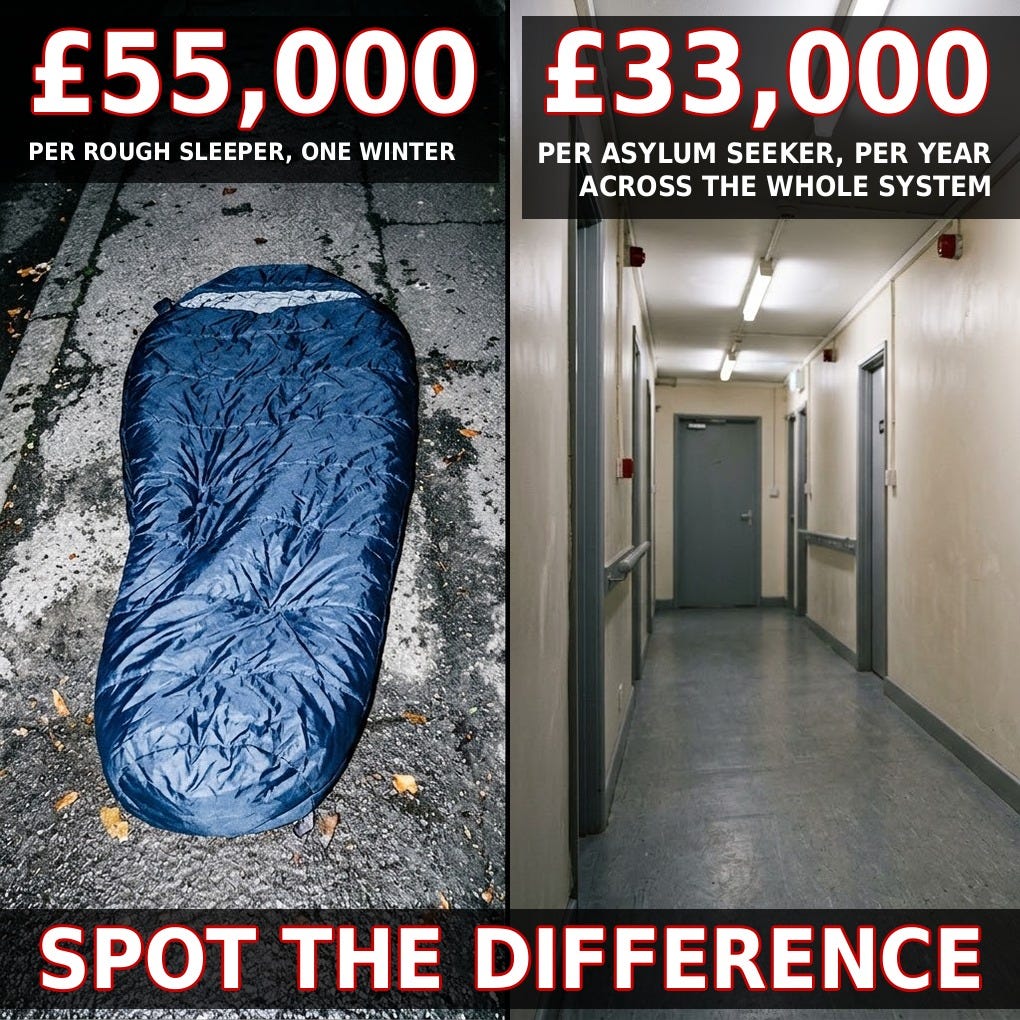
Per head, that works out at roughly £33,000 per person, per year. Compare that with the £442 million winter rough sleeping package divided across 8,010 rough sleepers counted on a single night in December 2025 — around £55,000 per head, for one winter. Not a year. A winter.
A fair caveat on both per-head figures, stated plainly: the £55,000 figure divides a winter’s spending by a single-night snapshot count, and the £33,000 figure divides a full year’s spending by a June 2025 headcount — neither denominator sits in perfect step with its numerator’s time period, and single-night rough sleeping counts are widely understood within the sector to undercount the true number of people who experience rough sleeping over a longer stretch, since people cycle on and off the streets rather than staying still for a census to find them.
The scale of the gap between the two figures is the point being made here. Neither total should be read as accurate to the pound.
The three private contractors running asylum hotel accommodation — Serco, Mears, and Clearsprings — made a combined £380 million in profit on those contracts as of May 2025, according to the National Audit Office. Read that again. £380 million in profit, for running hotels, sits within touching distance of the entire £442 million the government found for keeping the country’s own rough sleepers alive this winter.
The ten-year cost of those accommodation contracts has more than tripled, from an expected £4.5 billion to £15.3 billion, the NAO found. In that reporting period, three-quarters of all asylum accommodation spending went on hotels, despite hotels housing only around a third of the people in the system — because hotels, the NAO itself says, may simply have been more profitable for the people running them. Not more effective. Not better value. More profitable. That is the finding, from the government’s own auditor, in the government’s own words. Ask yourself who that finding was actually written for.
This is not solely an outsider’s verdict. Hansard’s own record shows a Home Office minister telling the Commons in March 2025 that the department had “inherited a system in chaos” — the same seven contracts, split between Clearsprings Ready Homes, Serco, and Mears since 2019, running ten years with a break clause due in 2026. The minister also confirmed one Clearsprings subcontractor, Stay Belvedere Hotels, had already been forced out of the supply chain over poor performance. When a minister says that at the despatch box, on the record, the auditor’s finding stops being an outside criticism and starts looking like agreement.
That picture has since moved, and it would be dishonest not to say so. Asylum hotel numbers have fallen sharply through 2026, down from a 2023 peak of around 400 to fewer than 160 by 12 August 2026, with 44 hotels closed this year alone across three separate rounds. The government says that has saved close to £1 billion in asylum accommodation costs since the 2024 election. None of that changes the £380 million in contractor profit above — that money was already banked before this year’s closures began. What has changed is where the remaining spending is heading: the government’s stated direction now is larger sites, including former military bases at Crowborough and Wethersfield, with three more under discussion that could house thousands more between them. Whether that proves genuinely cheaper, or simply moves the same argument into a different kind of building, is not something anyone can honestly answer yet.
A Different Set Of Rules.
You might feel two ways about what you just read, and both are allowed. Hold both, if you can, because the next part needs you to.
The Home Office is under a statutory duty to prevent destitution among people in the asylum system, who are barred from working while their claim is decided. That duty comes from the 1999 Immigration and Asylum Act and related case law. Not from generosity. From law. It is centrally funded and unconditional for anyone inside the process, whether the department likes the bill or not.
Homelessness support for British and settled residents runs on an entirely different model. The Homelessness Reduction Act 2017 gives councils real duties — and to be fair to the Act, its prevention and relief duties, the requirement that a council take reasonable steps to help someone find or keep a home, apply to almost anyone who asks, regardless of priority need.
What priority need actually gates is narrower and harder-edged: the full, guaranteed duty to provide accommodation while the council sorts things out. Read that narrower duty plainly, and the group least likely to reach it is single homeless men — who happen to make up the bulk of the rough sleeping population. That is not a published statistic; it is what the framework itself implies once you look at who the guarantee was built to cover and who it was not.
It is not accurate to say Britain does nothing for its own. It is accurate to say the guaranteed core of the system built for British citizens is structurally narrower and more conditional than the one the state is legally required to run for people claiming asylum. Two systems, two philosophies, and only one of them comes with an unconditional promise attached.
One of these duties is a guarantee. The other is a test with a pass mark most rough sleepers never reach. That is the actual gap this section has been describing — not generosity shown to one group, but security withheld from the other.
It is also worth being straight about something the homelessness sector itself has been saying for years, loudly, and which this piece would be dishonest to leave out: these two systems are not simply sitting side by side, spending separately in competition with each other. They are connected.
Newly recognised refugees are typically given just 28 days to leave Home Office accommodation once their claim succeeds, and the Public Accounts Committee has found that this narrow window is itself a driver of rising homelessness applications, as people move directly out of one system and into the other. Homeless Link, the sector’s own membership body, has said plainly that a lack of coordination between asylum and homelessness funding pushes people into homelessness rather than protecting them from it. None of that changes the numbers above. It does mean the honest framing is not two pots of money in competition, but one pipeline with a badly designed joint in the middle.
On the question of how people arrive: since the Nationality and Borders Act 2022, crossing the Channel by small boat without valid entry clearance is a specific criminal offence under UK law. As of January 2026, 1,099 people have been convicted of it — a fraction of the hundreds of thousands who have made the crossing since the law changed.
Most people in the £3.4 billion accommodation system are not convicted of anything. They are in a lawful asylum process, whatever the legality of how they physically got here. Both of those things are true at once. Hold them both. A piece that drops either half is not reporting. It is picking a side and calling it journalism.
Who Actually Pays For The Gap.
One more thread to pull, and then we’re done. The Office for National Statistics does not, whatever the pub conversation suggests, fund councils off a once-a-decade census taken with a clipboard. It publishes annual population estimates for every local authority, factoring in migration each year, with the quiet diligence of an organisation that knows nobody will ever thank it. The system is built to keep pace.
Where it genuinely breaks down is speed, not method. The National Audit Office’s own December 2025 report found that local authority costs from asylum accommodation are “poorly understood” by central government, with additional council pressures “not fully accounted for” — a phrase doing a great deal of quiet work for a document written by auditors, not poets. Whether that gap is an oversight or simply convenient, the report does not say. Neither will I. That is the country’s own spending watchdog, not a campaign group, saying the funding gap is real. Just not for the reason usually given on the radio, which remains, as ever, the least reliable place to get your facts and the first place most people go looking for them.
Where This Leaves It.
Remember that £442 million from the start of this? Remember the £440 million on the radio, and the two million pounds that went missing in between? That’s where we came in. Here’s where it actually leaves you.
Two million pounds separated what Angela Rayner said from what Angela Rayner meant. That gap closed in a single search. The gap between a St Mungo’s outreach worker’s wage and their rent has not closed in years. The gap between what the state spends per head on the asylum system and what it spends per head keeping British rough sleepers alive this winter is wide enough to be measured in hundreds of millions, and nobody on the radio this morning mentioned any of it.
None of that requires exaggeration. It requires only the figures the government, the charities, and the National Audit Office have already published themselves, sitting quietly in PDFs nobody was ever going to read on purpose. The Almighty Gob just put them next to each other. You did the rest yourself, reading this far. Somewhere, that radio is probably still on. Somebody should turn it up.
Ps. Full disclosure: an AI assistant did the number-crunching and source-chasing on this one, at my direction, as I’m not that clever. However. Every figure in it has been checked against the original. I just wrote it all up in my own style. That's more rigour than most of what gets thrown at you on the radio. Today.
Sources and Citations.
Government spending announcement.
Angela Rayner, “Britain must end the scandal of rough sleeping,” LBC, 19 August 2026 — https://www.lbc.co.uk/article/angela-rayner-end-rough-sleeping-5HjdgGd_2/
LBC, “’We can do it!’ Angela Rayner vows to support PM in homelessness bid,” 19 August 2026 (Nick Ferrari interview, £442m origin question) — https://www.lbc.co.uk/article/homelessness-rough-sleeping-angela-rayner-andy-burnham-5HjdgH4_2/
Homelessness Prevention Grant 2025 to 2026, technical note, GOV.UK — https://www.gov.uk/government/publications/homelessness-prevention-grant-allocations-2025-to-2026/homelessness-prevention-grant-2025-26-technical-note
Section 21 and the Renters’ Rights Act.
Shelter England, “No fault eviction court proceedings hit seven-year high” — https://england.shelter.org.uk/media/press_release/no_fault_eviction_court_proceedings_hit_seven-year_high
St Mungo’s, statutory homelessness figures response, 30 April 2026 (October–December 2025 data; also cited under Official homelessness statistics below) — https://www.mungos.org/press-release/chain-statutory-homelessness-figures-renters-rights-act-2026-st-mungos-response/
Shelter England, “How the Renters’ Rights Act changes homelessness law” — https://england.shelter.org.uk/professional_resources/news_and_updates/how_the_renters_rights_act_changes_homelessness_law
Official homelessness statistics.
St Mungo’s, statutory homelessness figures response, 30 April 2026 — https://www.mungos.org/press-release/chain-statutory-homelessness-figures-renters-rights-act-2026-st-mungos-response/
Shelter England, “At least 382,000 people are homeless in England today” — https://england.shelter.org.uk/media/press_release/at_least_382000_people_are_homeless_in_england_today_
Shelter England, interactive homelessness map — https://england.shelter.org.uk/what_we_do/updates_insights_and_impact/interactive_homelessness_map
Welsh Government, “Homelessness: April 2025 to March 2026” — https://www.gov.wales/homelessness-april-2025-march-2026-html
Scottish Government, “Homelessness Statistics, 2024-25” — https://www.gov.scot/publications/homelessness-in-scotland-2024-25/
Big Issue, “Homelessness facts and statistics: the numbers you need to know in 2026” — https://www.bigissue.com/news/housing/britains-homelessness-shame-cold-hard-facts/
Charity executive pay.
The Landlord Association, “Follow the money: what Shelter’s own accounts reveal” — https://landlordassociation.org.uk/follow-the-money-what-shelters-own-accounts-reveal-2/
Charity Commission register of charities, Crisis UK — https://register-of-charities.charitycommission.gov.uk/en/constituency-search/-/charity-details/3974328
Unite the Union, “St Mungo’s workers stage sit-in outside the charity’s corporate style headquarters,” June 2023 — https://www.unitetheunion.org/news-events/news/2023/june/st-mungo-s-workers-stage-sit-in-outside-the-charity-s-corporate-style-headquarters
Unite the Union, “Pitiful pay provokes a month long strike at homeless charity St Mungo’s,” May 2023 (CEO pay trajectory, £107,000 to £189,000) — https://www.unitetheunion.org/news-events/news/2023/may/pitiful-pay-provokes-a-month-long-strike-at-homeless-charity-st-mungo-s
BBC News, “St Mungo’s: Charity staff end strike after 10.7% pay deal,” September 2023 — https://feeds.bbci.co.uk/news/uk-england-london-66621824
Inside Housing, “Charity boss voices surprise as staff launch ‘indefinite’ pay strike,” June 2023 (CEO pay, year to March 2022) — https://www.insidehousing.co.uk/news/charity-boss-voices-surprise-as-staff-launch-indefinite-pay-strike-82118
St Mungo’s, “Offer accepted by Unite,” September 2023 (dispute resolution, CEO/Executive Director pay freeze) — https://www.mungos.org/offer-accepted-by-unite/
St Mungo’s, “Response to Unite the Union ballot rejecting 29 June 2023 offer” — https://www.mungos.org/response-to-unite-the-union-ballot-rejecting-29-june-2023-offer/
Unite the Union, “Shelter workers balloting for strikes over pay and working conditions,” October 2025 — https://www.unitetheunion.org/news-events/news/2025/october/shelter-workers-balloting-for-strikes-over-pay-and-working-conditions
Unite the Union, “Strikes at Shelter off as workers accept new working hours deal,” December 2025 — https://www.unitetheunion.org/news-events/news/2025/december/strikes-at-shelter-off-as-workers-accept-new-working-hours-deal
Civil Society, “Staff at major health and social care charity to ballot for strikes over pay dispute” (Change Grow Live), June 2026 — https://www.civilsociety.co.uk/news/staff-at-major-health-and-social-care-charity-to-ballot-for-strikes-over-pay-dispute.html
Frontline worker pay and hours.
St Mungo’s, current vacancies — https://www.mungos.org/work-with-us/careers/current-vacancies/
Indeed, UK outreach worker salary data — https://uk.indeed.com/career/outreach-worker/salaries
Shelter England, free housing advice helpline — https://england.shelter.org.uk/get_help/helpline
Crisis Skylight Birmingham, contact and opening hours — https://www.crisis.org.uk/get-help/birmingham/
St Mungo’s, outreach campaign staff accounts — https://www.mungos.org/category/campaigns/
St Mungo’s, outreach services overview — https://www.mungos.org/our-services/outreach/
Rent, take-home pay and student loans.
Office for National Statistics, “Housing prices in Bristol” (local area tool, direct primary source) — https://www.ons.gov.uk/visualisations/housingpriceslocal/E06000023/
Office for National Statistics, “Price Index of Private Rents, UK: monthly price statistics” (dataset, primary source for the London one-bedroom figure) — https://www.ons.gov.uk/economy/inflationandpriceindices/datasets/priceindexofprivaterentsukmonthlypricestatistics
Office for National Statistics, “Private rent and house prices, UK: June 2026” (bulletin, London and national context) — https://www.ons.gov.uk/economy/inflationandpriceindices/bulletins/privaterentandhousepricesuk/june2026
Student Loan Repayments, “Plan 5 Student Loan: £25,000 Threshold & 40-Year Write-Off” — https://www.studentloanrepayments.co.uk/guides/plan-5-student-loans
Eurostat, “People at risk of poverty: 38% of income for housing” (housing cost overburden definition) — https://ec.europa.eu/eurostat/web/products-eurostat-news/w/DDN-20230216-1
SpareRoom Rental Index, room rent statistics UK, London and South West England — https://www.spareroom.co.uk/content/info-landlords/rentalindex/
Financial resilience benchmark.
Financial Conduct Authority, “Financial Lives 2024 survey: Cash savings, Selected findings,” May 2025 — https://www.fca.org.uk/publication/financial-lives/fls-2024-cash-savings.pdf
Workforce burnout and turnover.
GOV.UK / MHCLG, “Mapping the homelessness workforce: exploring the profile and experiences of the homelessness sector,” 23 February 2026 — https://www.gov.uk/government/publications/mapping-the-homelessness-workforce-exploring-the-profile-and-experiences-of-the-homelessness-sector
Homeless Link, “Mapping the homelessness workforce” — https://homeless.org.uk/knowledge-hub/mapping-the-homelessness-workforce/
Home Office asylum spending.
National Audit Office, “An analysis of the asylum system,” December 2025 (PDF) — https://www.nao.org.uk/wp-content/uploads/2025/12/an-analysis-of-the-asylum-system.pdf
Hansard, House of Commons, “Asylum Hotels and Illegal Channel Crossings,” 25 March 2025 — https://hansard.parliament.uk/commons/2025-03-25/debates/8B975F90-AEA7-4056-BC0D-62AC92B1F19F/AsylumHotelsAndIllegalChannelCrossings
House of Commons Home Affairs Committee, “The Home Office’s management of asylum accommodation” — https://publications.parliament.uk/pa/cm5901/cmselect/cmhaff/580/report.html
Durham University, “How the UK became dependent on asylum hotels” — https://www.durham.ac.uk/research/current/thought-leadership/2025/07/how-the-uk-became-dependent-on-asylum-hotels/
BBC News, “Asylum accommodation costs set to triple, says watchdog” — https://feeds.bbci.co.uk/news/articles/cx2720n2kkjo
GOV.UK / Home Office, “13 asylum hotels exited and returned to local communities,” 12 August 2026 (current hotel numbers, closure programme, cost savings) — https://www.gov.uk/government/news/13-asylum-hotels-exited-and-returned-to-local-communities
Local Government Chronicle, “NAO: Asylum costs for councils ‘poorly understood’” — https://www.lgcplus.com/finance/nao-asylum-costs-for-councils-poorly-understood-10-12-2025/
Legal status of Channel crossings
Free Movement, “Over 1,000 people seeking sanctuary convicted of illegal arrival in the UK” — https://freemovement.org.uk/1000-people-convicted-for-illegal-arrival/
The asylum-to-homelessness pipeline
House of Commons Public Accounts Committee, “An analysis of the asylum system” (28-day move-on period as a driver of homelessness) — https://publications.parliament.uk/pa/cm5902/cmselect/cmpubacc/89/report.html
Homeless Link, “The UK asylum system is pushing people into homelessness” — https://homeless.org.uk/news/the-uk-asylum-system-is-pushing-people-into-homelessness/
Population and funding methodology
Office for National Statistics, mid-year admin-based population estimates for England and Wales, quality and methods guide — https://www.ons.gov.uk/peoplepopulationandcommunity/populationandmigration/populationestimates/methodologies/midyearadminbasedpopulationestimatesforenglandandwalesqualityandmethodsguide
© 2026 John Langley aka www.thealmightygob.com. Over 1000 articles now published, across various media. All rights reserved. Possibly a few lefts too. Though don’t quote me on that last sentence. I could be slightly off kilter.