
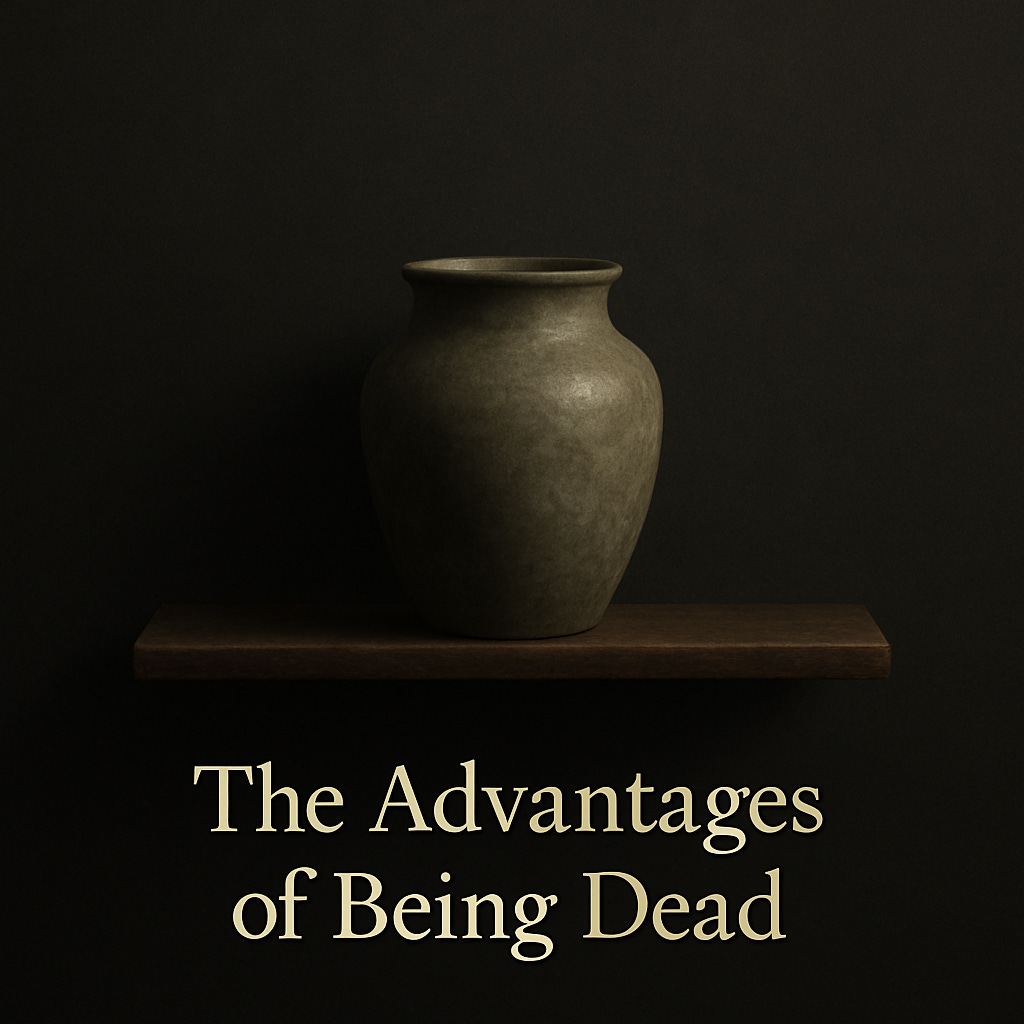
The Advantages of Being Dead.

[advantages-of-being-dead-decision-fatigue-funeral-planning-the-almighty-gob.jpg]
A note before we start. This is satire. The Almighty Gob is not — and I want to be clear about this — recommending death. Not as a life hack, not as a wellness strategy, not as something to try after you’ve opened your pension statement. We are also not sponsored by any funeral director or, indeed, the coffin industry, who I’m sure are perfectly nice people doing what is, when you think about it, a very necessary job. If you’re having a hard time, please do talk to someone. Someone actual, I mean. Not a blog. This is really just about how heavy it all gets sometimes. Being alive. Which is still, on the whole, the better option. Probably.
There are considerable advantages.
Nobody talks about them. That’s the strange thing. We have entire industries devoted to the problem of being alive — the apps, the planners, the coaches, the retreats, the supplements, the systems, the gurus with their cold showers and their colour-coded journals and their morning routines that begin, apparently, at five a.m. All of it aimed at managing the extraordinary burden of modern life.
And yet the simplest solution sits there, completely unmarketed, in plain sight. There is no premium tier.
Consider what you will no longer have to think about.
The Small Ones.
The alarm. Not the alarm itself — you’ve made your peace with the alarm. It’s the argument you have with yourself the night before about what time to set it. That argument. At eleven thirty. When you should already be asleep. What time is realistic. What time is optimistic. What time you will actually get up, as opposed to the time you will lie there, fully awake, resenting yourself for not getting up. You know exactly what I’m talking about. The snooze button and its particular mathematics. All of that. Gone.
Breakfast. An entire industry spent thirty years carefully constructing your relationship with your own morning meal and charging you for the privilege of feeling bad about it.
The sugar content you are now apparently supposed to check. The protein. Whether eggs are good for you again this year — it changes, by the way, keep up. The granola that is basically a biscuit. It is, by the way. It’s a biscuit. The oat milk decision, which is no longer just a decision about milk — it is a statement about who you are, and you will be judged. The cereal aisle and its forty-seven varieties of essentially the same thing, each making a slightly different claim about your future health and happiness, none of which will be honoured.
And then you sit down and the guilt follows you to the table. Not because you’ve done anything wrong. Just because an entire industry has invested heavily in making you feel like you probably have. That’s what you’re paying for. The guilt. The cereal is almost incidental.
The coffee. Whether there’s milk, whether it’s the right milk, whether you’re drinking too much, whether the headache is from the coffee or from not enough coffee, whether you should have switched to green tea by now. You haven’t. We both know you haven’t.
What to wear. The weather forecast you checked and probably shouldn’t trust. The thing that needs washing. The thing you bought and have never once worn and cannot explain. The slow accumulation of clothes that don’t quite go together and the intention — the firm, genuine intention — to sort it all out one weekend. That weekend has not yet arrived. It isn’t coming.
These are the small ones. The ones before nine in the morning.
Then………
The Day Opens Up.
The email. Whether to answer it now or later. You’ll answer it later. Later becomes never. You know this. You do it anyway. The lunch — God, the lunch. The eternal, grinding, daily question of the lunch. Eat at the desk. Go out. Go where. Spend how much. Every single day. Until you die. Which is the point.
Money. Always money. Threaded through everything like a wire you keep catching your foot on. Is there enough? Will there be enough? The direct debit you forgot about — you’ll find out about that one soon enough. The subscription you meant to cancel six months ago. The pension. Oh, the pension. The one you know you should be paying more into but can’t quite face the calculation because the calculation leads somewhere you are not ready to go.
That calculation stays open in a tab somewhere. You never close it. You never look at it again.
And then there are the people you love, and the people you owe, and the people who are both. The unanswered text. The birthday you nearly missed — nearly. The conversation you’ve been putting off for three weeks because you know how it’s going to go. The thing that was said that time that neither of you has mentioned since, and won’t, and both of you know it’s still there. The family and its specific gravity. Pulling at you from a distance. Requiring management. Requiring love. Which is not the same thing as management, but on a Tuesday evening it can feel remarkably similar. And on a Sunday morning, unexpectedly, it can feel like the only thing that matters.
And then it’s Sunday evening. And the week starts again.
The evening. You’d think by now — by evening — it would get easier. It doesn’t. Cook or not cook. And if cook, then what. And if not cook, then takeaway or restaurant, and what’s affordable, and whether affordable is even the right word when the cost of living has made that question genuinely complicated and some people are collecting a bag from the food bank on the way home and trying to make that feel like nothing. The thing in the fridge that needs using. The thing nobody fancies. The negotiation — again — that somehow takes longer than the meal itself.
And then, at some point in the small hours, you’ll find yourself standing in front of the open fridge in the dark. Not hungry, exactly. Not sure why you’re there. Looking into it as though the answer to something might be in there. It isn’t. You have a biscuit. You go back to bed.
The body keeps its own account of all of it. Independently of you. Without asking. Its complaints, its appointments, its refusals, its inconvenient timing. The GP you keep meaning to ring. The thing you’ve been ignoring for six weeks in the hope it resolves itself. The exercise you fully intend to do and the tiredness that makes it feel not just difficult but genuinely unreasonable, and the guilt that follows the tiredness, and the tiredness that follows the guilt. Round and round. Until you don’t.
The news. Oh, the news. Whether to look at it or not. The knowledge that not looking doesn’t make it stop happening. The looking at it and the way it sits in you afterwards — heavy, unresolved, attached to nothing you can actually do. Every day. That.
And then, somewhere beneath all of that, the duties. Which MP to vote for and whether any of them have what you’d honestly call the right credentials. The placard you haven’t designed for the next march. The petition that had 847 signatures and achieved, on honest reflection, absolutely nothing. Of course you signed it.
The World And Its Tripwires.
The parking ticket — not the ticket itself but the dread that precedes it. Did you read the sign correctly. Was that a single yellow or a double. The sick feeling three hours later when you remember you weren’t entirely sure. The one way street and that very specific stomach-dropping moment when you are already in it and there is a car coming the other way. Everyone knows that moment. The green energy question and the moral weight attached to every purchasing decision you now make. The boiler. The car. The tariff. The bin. The flight you needed to take. The flight you probably didn’t. All of it wrapped up carefully by corporations and governments who created the problem and handed it to you personally to feel bad about, because it is apparently your problem now. Yours. Specifically.
The things you said. The thing that seemed perfectly reasonable at the time and turned out not to be. The thing you said online, still there, somewhere, being found by someone at this very moment. The wrong word in the wrong room in front of the wrong person and the sudden, terrible formality of what follows. That formality. You know the one.
The neighbours. Unlike most of your problems, you cannot commute away from this one. You cannot log off. You cannot close the tab. It is simply there. When you get home. When you wake up. On a Wednesday morning when you were hoping for quiet. Just there.
You know it. Everyone has the one.
The falling out with friends and the exhausting calculation of repair. Whose turn is it to reach out. Whether the friendship has enough left in it. Whether you’re even sure what happened, exactly. Whether it matters. It does matter. That’s the problem.
And underneath all of it, running quietly, the things that were never chosen.
The question of which race you happen to be on any particular day of the week. The daily recalibration. The reading of rooms. The weight that some people carry from the moment they leave the house that other people have never once had to think about. That weight. Just gone.
And the moral compass. The quiet obligation to have the correct position on everything. To know where you stand. To be consistent. To be on the right side. To have thought it through, be able to defend it, update it when required. To be pointing in a direction. To know which direction that is. Every single day.
No particular direction required any more.
And Then, Of Course, There Is The Funeral.
Many people plan their own. Meticulously. The coffin, the flowers, the venue, the order of service, the music, the readings, the catering — someone will have mentioned the vegan at this point, and it will have been noted, and the note will have been lost. Planned like a dinner party — right down to, in some cases, the colour of the napkins.
There is, of course, the question of burial or cremation. Buried or burned. If buried, there is the plot, the headstone, the inscription — which somebody will argue about — and the question of whether anyone will actually visit, or whether that’s just something people say at the time. If cremated, there are the ashes.
“They’ve put on weight since they died.”
The ashes come home in a pot. A respectable pot, usually. And that pot will sit somewhere. On the mantelpiece. On a shelf. And life will go on around it. And one day — not immediately, but one day — someone will be standing nearby with a cigarette and will, without thinking, flick the ash into it. Just somewhere to put it. Didn’t even register.
And then separately, perhaps when it comes time to share a portion with Auntie Maude, or scatter some somewhere meaningful, someone will open it. And look in. And pause.
There seems to be more in there than there should be.
They’ll look again. They’ll do a quick mental calculation. And for one brief, genuinely baffling moment, the only conclusion available to them will be: they’ve put on weight since they died.
It will take a second. Maybe two.
Nobody plans for that part.
The world, meanwhile, has moved on.
The dress code, incidentally, is no longer what it was. Someone recently attended a military funeral in a baseball cap available for purchase on their own merchandise website. Fifty-five dollars. One imagines similar items will appear on eBay shortly. Make Funerals Great Again. The commemorative range practically writes itself. The limited edition bereavement mug is probably already in production.
But for everyone else, the moment you are gone, the whole thing leaves your hands entirely.
The family convenes. The vultures, naturally, are already circling. The funeral director arrives, brochure in hand, sympathetic expression in place, and funeral costs that would make your eyes water if you still had functioning eyes. You may even get the YouTube video of how a former service was delivered, with the bickering carefully edited out. The coffin options are presented. Something between reinforced balsa wood and mahogany, depending on the credit score. The upgrade is gently suggested. The flowers become a negotiation. As they too will die.
The music selection produces the first quiet argument, which will not be the last. One faction wants Stayin’ Alive. The other wants Killing Me Softly. Both are entirely serious. Nobody mentions the irony. This is not the time. It is absolutely the time.
A row develops — and here is the thing about funeral rows — it is never really about what it’s about. It isn’t about the hymn. It isn’t about the sandwiches. It isn’t about the napkins. It’s about everything that was never said. Everything that’s been accumulating for years. And your funeral is simply the occasion it finally gets said at. In a car park, usually, afterwards, in the rain.
Someone will visit the grave. Once. At Christmas. And feel very good about it.
“It isn’t about the hymn. It isn’t about the sandwiches. It isn’t about the napkins. It’s about everything that was never said.”
The eulogy is delivered by someone who knew you reasonably well but is already slightly uncertain about the timeline of certain events and will describe you as having had a wonderful sense of humour, leaving a brief pause afterwards that nobody quite knows what to do with.
The vegan, it should be noted, has attended the funeral of someone who was, when all is said and done, essentially meat. Someone forgot the vegan.
And near the buffet table there will be someone on their second glass of warm white wine who barely knew you, who is having — it must be said — a perfectly pleasant afternoon, and who will describe you to someone they have only just met as a real character.
You will not be there to correct the record.
Which, when you think about it, is where you’ve always been. Except now it’s permanent.
You Have To Admire The Thoroughness Of It.
The self-help industry will not tell you any of this — will not acknowledge the advantages of being dead. There is nothing to sell you on the other side of it. No follow-up course. No premium tier. No journal with prompts. No cold shower at five a.m. that fixes the fundamental problem of being a person who has to get through every single day making decisions until one day you don’t.
Every system ever devised for managing the burden of being alive — every planner, every method, every practice — is an attempt to solve the same problem. Decision fatigue. The guilt. The condition of being worn down by the sheer volume of choices modern life demands of you every single day. The routine. The minimalist wardrobe. The automated payment. The meal plan. The alarm you set every night. All of it pointing, with some embarrassment, in the same direction.
We spend our entire lives trying to reduce the number of things we have to think about.
And yet. The thinking is the evidence. Of all of it. The alarm and the breakfast and the thing that needed washing and the pension and the neighbours and the fridge at two in the morning and the car park in the rain. Evidence that there was someone here, making decisions, getting it wrong, getting it right, getting it wrong again. Trying.
The dead have solved this completely.
You have to admire the thoroughness of it.
The Almighty Gob is a Bristol-based publication with over 500 published pieces covering British institutional life, political contradiction, and the texture of modern existence — with occasional admiration for the thoroughness of the inevitable.
advantages of being dead, decision fatigue, modern life, cost of living, funeral costs, funeral planning, cremation, wellness industry, self-help, satire, dark humour, British humour, British satire, cognitive load, daily decisions, existentialism, mental load, the almighty gob, Bristol