


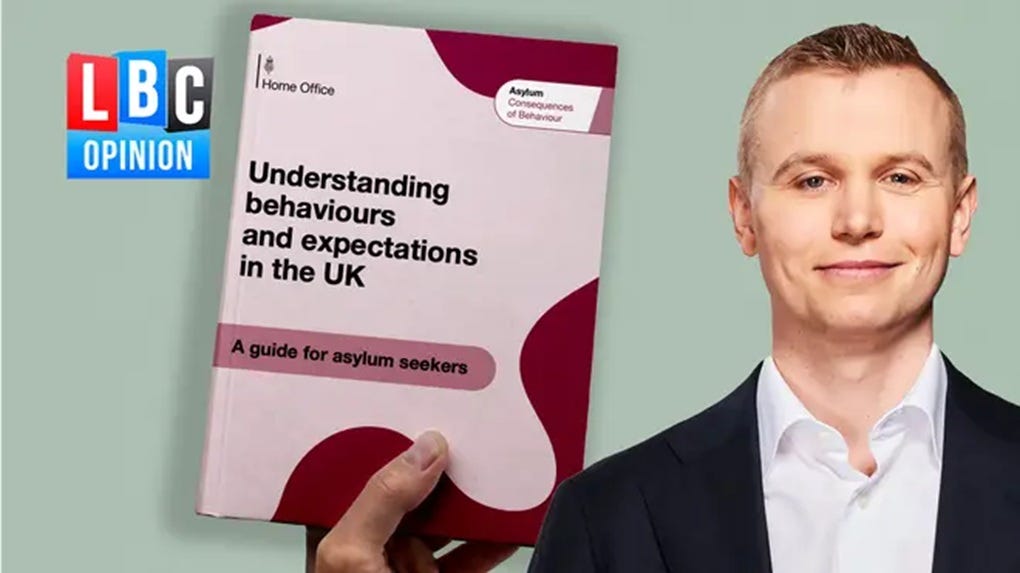
On 19 August 2026, the Home Office published a nine-page asylum seeker booklet. It’s called Understanding behaviours and expectations in the UK: a guide for asylum seekers.
It covers gender equality, domestic abuse, sex and consent, respect in public, and where to get help. Read it once and it looks like a leaflet.
Read it twice, and it stops looking like one. It starts looking like a confession — written by a government that hoped nobody would read it that closely. Which is exactly why you should.
Somewhere in the Home Office, a civil servant sat down to explain, in short sentences and bullet points, that hitting your wife is illegal here. That consent has to be given every time. That a girl under sixteen cannot agree to anything.
Nobody writes that down for people who already know it. Keep that thought. We’re coming back to it.
Three Admissions.
This asylum seeker booklet admits three things at once. None of them were meant to be admitted.
The first is failure. A government doesn’t print a leaflet explaining that women may work, travel, and choose their own husbands unless it suspects some readers don’t already think so. You don’t spell out the floor unless you think someone’s about to fall through it.
The second is danger. Look at the section headings again — gender equality, domestic abuse, sex and consent, respect in public. Notice what’s missing. No section on queuing. Nothing on bin day. The topics chosen aren’t random. They’re the topics a risk assessment produces.
This is not a welcome pack. It’s a hazard sheet with a friendly font.
The third is the quietest, and it does the most work. It’s sitting in plain English on every page: “laws and customs here may be different from your home country.”
Read that again, slowly. That’s the government admitting, in its own words, this isn’t about criminality. It’s about culture. About arrivals who may genuinely not know that what was normal at home carries a prison sentence here.
Which raises the obvious question nobody in Westminster wants to be quoted asking aloud: if the government already knows this, why does the correction arrive after someone’s already here?
Three admissions. One document. Published in a single language, to people the government itself admits may not read it. Hold that thought too — it gets worse before it gets fair.
English Only, For People Who Might Not Read English.
The asylum seeker booklet exists in exactly two forms. A PDF. An HTML “accessible” version. Both in English.
Nothing in Somali. Nothing in Tigrinya, Dari, Pashto, Farsi, or Turkish — the languages of five of the biggest asylum-seeking populations the UK currently receives.
So a document built entirely on the premise that some readers won’t already understand British norms is handed to them in the one language it can’t assume they read.
It’s the equivalent of writing “in case of fire, do not use the lift” on a sign only visible from inside the lift.
Which brings us to the part some readers are already bracing against. Fair enough. Brace away — and keep reading.
Not Everyone. Not Even Most. Just Some — And The Booklet Knows It.
This is not a claim that migrants, as a group, are dangerous. It plainly isn’t. It would be a lazy, cowardly thing to argue if it were.
This is a narrower point. Some arrivals come from countries where the exact behaviours this booklet lists — controlling a wife’s movements, treating marital rape as legally impossible, marrying off a child — aren’t just tolerated. They’re written into law.
Notice the difference between those two claims. Everything below depends on it.
Racism is about who someone is — their ethnicity, their ancestry, where they were born. Culture is about how someone was raised to behave. Pointing out that those two things are different isn’t racist. Conflating them is what actually shuts the conversation down before it’s had.
So look at what’s on the statute books. Afghanistan’s 2026 penal code permits a husband to beat his wife, provided he breaks no bones and leaves no visible wound. Even then, the burden of proof sits with her. The sentence is fifteen days.
Iran’s Islamic Penal Code defines rape in a way that structurally excludes a wife. The legal age of marriage for a girl is thirteen — lower still with a guardian’s blessing.
Somalia’s 1975 Family Code, still the operative law, permits marriage at sixteen with a guardian’s consent. The right of divorce belongs to the husband alone.
These are not cultural footnotes. They are statute.
Every “you must never” in the booklet’s gender equality section reads, almost clause for clause, like a direct answer to laws currently in force in the countries the UK’s asylum system draws from most. The booklet never says so. It doesn’t have to. The pattern says it for them.
One thing needs saying clearly, because it doesn’t fit the tidy story either side wants: domestic abuse happens everywhere. Britain very much included.
That’s not rhetoric. It’s a number. Avon and Somerset Police, answering a Freedom of Information request on behalf of forces across the country, found that roughly two in five of the 899 people arrested over the summer 2024 riots — Bristol’s own disorder included — had prior police reports for domestic abuse. Bristol had the highest rate of any of the 21 forces that supplied data.
Women’s groups, including Rape Crisis and Refuge, have rightly warned against using that figure to draw a line straight from immigration to gendered violence. They’re right to. It isn’t evidence about migrants. It’s evidence about Britain.
The distinction here isn’t violent countries against civilised ones. It’s what the law itself permits. In Britain, hitting your partner is a crime, full stop, whatever the injury. In Afghanistan, under its current penal code, it isn’t — not until the bone snaps.
That’s not a difference of temperament. It’s a difference of legal status. Which is exactly the gap the booklet’s own opening line gestures at, then quietly declines to name.
It Isn’t Only About Women.
The booklet’s “sex and consent” section is written, understandably, with women in mind. However, most of the public conversation around it assumes this is exclusively a women’s safety issue. That assumption doesn’t survive contact with the record.
Consider one case. It’s on the public record, and it fits nobody’s preferred story.
Bruke Desalagne, an Eritrean national, entered the UK as a clandestine entrant, claimed asylum, and was granted Indefinite Leave to Remain in 2022. He was convicted at Harrow Crown Court of raping a pensioner in his sixties outside St John’s Church, dragging him behind a hoarding while traffic passed within feet of the assault.
Male victims exist. The booklet doesn’t mention them once.
Which leads to the harder question the booklet also avoids: what checks happen before someone arrives, rather than after? A leaflet on consent, handed out once someone’s already here, is a rear-guard action. It is not prevention.
The Line That Gets British Law Wrong.
Here’s the one that should embarrass whoever signed this off. Buried in “respect in public”: “you must not take photographs or videos of someone without their consent.”
No qualifier. No distinction between private and public. Read it again. As stated, it’s simply wrong.
There is no law in the UK that prevents photography in a public place. It’s protected under Article 10 of the European Convention on Human Rights, brought into UK law by the Human Rights Act 1998. The Metropolitan Police, the National Police Chiefs’ Council, and the Home Office’s own guidance all confirm this.
No consent required. Not for journalists. Not for tourists. Not for you, standing on Corn Street with your phone out, photographing a bank — or the protest happening outside it.
The only real limits are harassment, commercial use without a release, defamation, and genuinely private settings — a home, a changing room, somewhere with a real expectation of privacy. None of that touches a public street.
A document written to correct newcomers’ understanding of British law gets British law wrong, within its own nine pages. Somebody proofread this. Nobody who understood press freedom did.
Which raises an uncomfortable question of its own: if that slipped through, what else did?
And While We’re Imagining Better Systems.
If a leaflet handed out on arrival fixes the problem, the same logic should apply earlier — and harder. So why stop at Calais?
France could issue its own companion booklet — Comment se comporter une fois arrivé en Angleterre — timed for the crossing itself. And if one staging country deserves a booklet, so does every other. Morocco. Algeria. Libya. All the way down the route to the Channel, each handing over its own laminated guide to British consent law, several borders before anyone needs it.
It’s obviously absurd. Which is rather the point. If the government’s actual position is that a document fixes the problem, the absurdity should be visible at every stage of the journey — not just the last one.
Before Anyone Says It.
A few objections are already forming. Worth meeting them here, not in the comments.
“Shouldn’t British men get a booklet like this too?” They already have one. It just isn’t called a leaflet, and it didn’t arrive at eighteen.
Since September 2020, relationships and sex education has been compulsory in every secondary school in England. It’s required by law to cover, in the Department for Education’s own words, “the concepts of, and laws relating to, sexual consent, sexual exploitation, abuse, grooming, coercion, harassment, rape, domestic abuse, forced marriage, honour-based violence, and FGM.”
Every British child in a state secondary school since has sat through years of exactly this material. The comparison isn’t booklet versus nothing. It’s a nine-page pamphlet handed out once, against a legal requirement to teach the same material for the better part of a decade. If anything, that should embarrass the booklet further.
“This is cherry-picking a bad individual to smear everyone.” It isn’t. One named, convicted case sits in this piece — Desalagne. It isn’t offered as representative of anyone beyond himself. The country-law material is entirely separate: it’s about what governments have written into statute, not what individuals did.
“Domestic abuse happens in Britain too — this is just deflection.” Correct, and said plainly, with the FOI data to back it, earlier in this piece. The argument was never “Britain is safe, elsewhere isn’t.” It’s that some laws elsewhere permit what British law criminalises outright. That’s a claim about statute books. Not about which country has better people in it.
“You just don’t like migrants.” Read the next section. Two things checked out in the government’s favour. This piece said so, in full, without being asked twice. A hit piece doesn’t go looking for the parts of its target that are actually fine.
Where the Booklet Actually Gets It Right.
Fairness cuts both ways. Two things checked out under scrutiny, and they deserve to be reported straight.
The assurance that reporting abuse “will not affect your asylum claim” isn’t just a comforting line. It’s backed by genuine, codified Home Office staff guidance instructing caseworkers to say exactly that. And the helplines listed — Migrant Help, the National Domestic Abuse Helpline — do offer interpreters, in practice, on request.
The gap that remains is small, and worth naming precisely rather than exaggerating: the booklet never says any of that on the page. A document built around the anxiety of not being understood never once reassures its reader that the person answering the phone can understand them.
One sentence would have fixed it. Nobody wrote the sentence.
Nine pages. Three admissions the government never meant to make, buried under bullet points and a font choice that wants to look reassuring.
A translation gap wide enough to defeat the document’s own purpose. A law some of these arrivals were, by their own country’s statute, never taught to expect — and a British law the booklet itself gets wrong.
Remember that civil servant, sitting down to write nine pages of things that ought not need writing down.
The Almighty Gob has read the asylum seeker booklet the Home Office hoped nobody would read this closely. It explains nothing it doesn’t have to. It admits everything it didn’t mean to. Somewhere, a minister is hoping this doesn’t get much further than a press release.
It will. Of course.
The Almighty Gob is a Bristol-based publication founded by John Langley — independent mayoral candidate in 2016 and 2021, and one of Bristol’s most forensic observers of institutional power. Writing since 2010, well over 1,000 pieces across seven platforms and Substack at thealmightygob.com — no party allegiance, no press accreditation, no interest in acquiring either.
© 2026 John Langley / The Almighty Gob. All rights reserved. Some lefts too. Probably. Don’t ask me. I only write this stuff.