

Let me ask you something before we start.
When was the last time you saw a wheelchair user at a ceremony celebrating a film about wheelchair users — and watched the organisers apologise for the wheelchair?
Hold that thought. We are coming back to it.
What Actually Happened — Because Some People Still Don’t Know.
John Davidson MBE is not a household name. He should be.
He is the reason millions of British people first understood what Tourette syndrome actually looks like. His appearance in the 1989 BBC documentary John’s Not Mad introduced an entire nation to a condition most people had never seen explained honestly. Since then he has spent decades doing one thing. One cause. One mission. Make people understand that Tourette’s is not a punchline.
His life story became the film I Swear, directed by Kirk Jones. At the 79th BAFTA Film Awards on Sunday 22nd February 2026, that film received five nominations. Robert Aramayo — who portrayed Davidson — won Best Actor in a Leading Role. Beating Timothée Chalamet in the process. For those unfamiliar, Chalamet is one of Hollywood’s biggest current stars, nominated for his portrayal of Bob Dylan in A Complete Unknown, and widely considered the favourite to win. Aramayo, in a small British film about Tourette’s, beat him. That is how significant this story was on the night — before any of what followed.
Davidson was in the audience that night. Of course he was.
Throughout the evening he experienced several involuntary outbursts. Recognised symptoms of his condition. The most significant came when Sinners stars Michael B. Jordan and Delroy Lindo — both Black men — took to the stage to present the Best Visual Effects award. Davidson’s Tourette’s produced a loud, involuntary tic. The N-word, audible across the room, in front of the Prince and Princess of Wales.
Gasps. Jordan and Lindo paused for a beat, composed themselves, and carried on.
Host Alan Cumming addressed the room: “You may have noticed some strong language in the background. This can be part of how Tourette’s syndrome shows up for some people, as the film explores that experience. Thanks for your understanding.”
The show aired on a two-hour tape delay. The BBC broadcast it unedited on BBC One and internationally on E!. They removed it from iPlayer the following day. Both BAFTA and the BBC issued apologies.
Now. Let us examine what those apologies actually mean.
You Cannot Edit Tourette’s. That Was Entirely The Point.
The BBC’s apology contains a sentence that should stop you completely.
They were sorry, they said, that the offensive language “was not edited out prior to broadcast.”
Read that again. Slowly.
Britain’s national broadcaster — sitting on a two-hour tape delay, with every opportunity to make an editorial decision — is apologising for broadcasting reality. They are sorry that real Tourette’s happened at an event celebrating a film about real Tourette’s.
Let that settle for a moment.
“We should have sanitised the disability before putting it on television.”
That is what the apology is saying. Strip away the careful language and that is the sentence underneath it. We will celebrate your story. Commission films about your suffering. Give awards to the handsome actor playing you. Seat you in the room while the applause washes over you. But the moment your condition actually shows up — we will quietly remove it before the public hears.
That is not inclusion. That is inclusion as decoration.
Here is the brutal truth the BBC’s edit button was trying to avoid. The moment Davidson’s tic rang out across the Royal Festival Hall was the most powerful piece of Tourette’s education broadcast in Britain in years. That collective flinch from a room full of celebrities. Those audible gasps. The visible discomfort of people encountering the reality of a condition they had just applauded in cinematic form.
That was the film coming to life in real time.
And they wanted to cut it.
Think carefully about what that tells you about how much they actually understood the film they were giving awards to.
The Failure Started Long Before Anyone Reached For The Mute Button.
The BBC’s editorial decision — wrong as it was — is actually the least interesting failure of the entire night.
BAFTA knew John Davidson had severe Tourette’s. They have known this for approximately thirty-five years, given that the BBC’s own documentary introduced him to the nation in 1989. They invited him specifically because his life story was the centrepiece of the evening. They seated him in an uncontrolled environment of extreme emotional intensity — cameras, royalty, his own biographical film competing for five awards.
And here is the part that makes the subsequent apologies ring particularly hollow.
Davidson himself told CNN on the red carpet beforehand that crowded, high-pressure settings intensify his condition. The audience inside the Royal Festival Hall was warned before the show even began that involuntary verbal tics were possible. The BBC knew. BAFTA knew. Everyone in that room knew.
Nobody was caught off guard. This was not an ambush. This was a foreseeable outcome of a foreseeable situation, flagged in advance by the man himself.
So ask yourself the three questions — and notice how quickly the answers arrive.
Is it practical? No. Placing someone with documented severe coprolalia — the involuntary utterance of offensive or obscene words, a recognised symptom of Tourette’s — into a high-stimulation, high-emotion, live-broadcast event — however well-intentioned — without a clear editorial and pastoral plan is not a practical decision. The risk was known. The plan was apparently absent.
Is it logical? The contradiction is architectural. You are celebrating a campaign to educate the public about Tourette’s while demonstrating, through your own event management, that you have not absorbed the most basic understanding of what that condition involves in a live environment. High emotional stakes amplify tics. This has been documented since 1989.
What is the likely outcome? You are reading it.
The people closest to Davidson — his support network, the film’s producers — were in a position to advise BAFTA during planning. Whether that advice was given and ignored, never sought, or overruled by Davidson’s own very reasonable wish to attend his own celebration, we do not yet know. But that question matters far more than whether the BBC had time to reach for the mute button.
Though as it turns out — they very much did.
Two Decisions. One Edit Suite. One Evening.
This is where the story stops being about incompetence and starts being about choices. Because incompetence is random. What happened here was not random.
The BBC broadcast the 79th BAFTAs on a two-hour tape delay. Every second of that ceremony passed through an edit suite before it reached your television. Every word. Every moment. Every outburst.
In that same two-hour window, the BBC made two distinct editorial decisions.
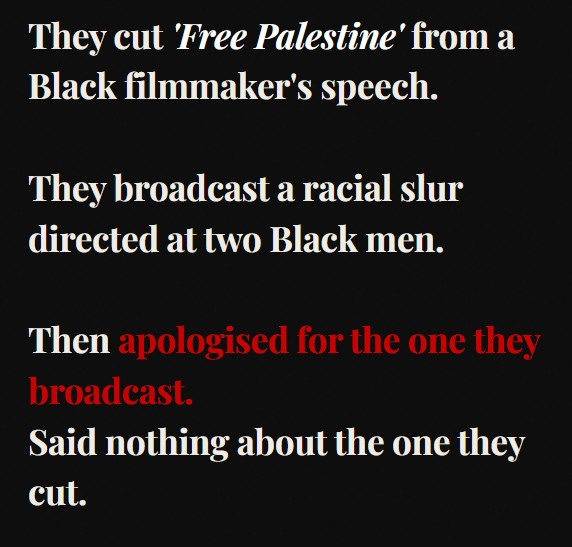
Decision one: they broadcast Davidson’s involuntary Tourette’s tic — including the racial slur — without intervention. Then apologised for it the following day.
Decision two: they cut the closing words of Akinola Davies Jr.’s acceptance speech. Davies Jr., a British-Nigerian filmmaker, won Outstanding Debut for My Father’s Shadow. His speech dedicated the award to migrants, refugees, and those living under occupation. He closed with: “For Nigeria, for London, the Congo, Sudan, free Palestine.”
Gone. Removed. Before it reached viewers at home.
So in one evening, with the same edit suite, the same team, and the same two-hour window, the BBC demonstrated beyond any reasonable doubt that they had the capability, the time, and the willingness to make editorial interventions. They cut two words of conscious, dignified political expression by a BAFTA winner. They broadcast an involuntary medical tic they had been warned about in advance by the man himself.
Then apologised for the one they broadcast. Said nothing publicly about the one they cut.
It is worth noting that the BBC reportedly went into this ceremony on high alert following the 2025 Glastonbury controversy. Politically charged content had been flagged internally for careful handling. They were specifically watching for political speech. Specifically prepared to intervene. Specifically equipped to edit.
And they used that preparation to remove “Free Palestine” from a Black filmmaker’s acceptance speech while leaving a racial slur directed at two Black men on the screen.
Now ask yourself the three questions — and this time, notice what the answers reveal about intent rather than just competence.
Is it practical? They proved it was. They edited Davies Jr.’s speech with apparent ease. The tools were there. The time was there. The capability was demonstrated.
Is it logical? Only if you accept that political solidarity is more dangerous to broadcast than a racial slur. And if you accept that, you have just told every filmmaker, every person of colour, and every licence fee payer exactly where they stand in the BBC’s hierarchy of what gets protected.
What is the likely outcome? A corporation that has spent years insisting on its political impartiality has handed its critics the clearest possible evidence of where its editorial instincts actually lie. Not in a leaked memo. Not in a whistleblower’s testimony. In the broadcast itself. In plain sight. For everyone to see.
That is not incompetence. That is a choice. And choices have authors.
Distance and Outrage — The Jamie Foxx Problem.
Now for the part that tells you something uncomfortable about how public discourse actually works.
Michael B. Jordan and Delroy Lindo were the men standing on that stage. The people who heard that word in that moment, directed into the air around them. They paused. They steadied themselves. They continued presenting. They handled it — and notice this, because it matters — with composure and apparent context.
Jamie Foxx was not in the room.
His Instagram response: “Unacceptable... he meant that shit.”
Set aside the medical illiteracy for a moment. Set aside that it fundamentally misunderstands the condition being discussed. Focus on something more basic first.
How did he know? Telepathic skills, perhaps?
A significant portion of the television audience watching at home could not clearly make out the specific word Davidson’s tic produced. They heard an outburst. Background noise. Something indistinct. Millions of viewers either missed it entirely or heard something unclear and moved on. The explanation had been given in the room, on the night, by the host. The people physically present had the framework immediately.
Foxx was watching the same broadcast as those millions of other viewers.
So how does a man watching a television broadcast — in which the specific word was not clearly audible to the general viewing public — land with such pinpoint certainty on exactly what was said, and post about it within hours?
Either he has the hearing of an owl. Or somebody told him.
And if somebody told him — somebody who was in that room, who heard it clearly, who then chose to pick up a phone and brief Jamie Foxx specifically — that changes the nature of what happened next entirely. Because that is not a bystander reacting to harm in real time. That is someone deliberately selecting an amplification vehicle. Choosing a famous face with a massive platform and a guaranteed audience, and feeding him exactly the information required to ignite the reaction that followed.
If that is what happened, the question is not what Foxx did. The question is who made that call. And why.
Foxx’s post told millions of followers what to be offended by. For many viewers who heard something unclear and moved on, his post was the first notification that a specific racial slur had been used. His outrage did not respond to harm — it manufactured and distributed harm to an audience that had not experienced it in the first place.
The loudest condemnation came from the person furthest from the actual moment. Possibly pointed in the right direction by someone very close to it indeed.
Jordan and Lindo — the men with every right to respond — chose understanding. Foxx, watching from outside the room, chose theatre.
That is not a small distinction. That is the entire distinction.
Tolerance Is Not Acceptance. And That Gap Is Where People Die.
Here is the number that reframes everything you have just read.
Approximately 40% of people with severe Tourette’s attempt suicide.
Sit with that for a moment before you read on.
That is not a statistic about Tourette’s. That is a statistic about the world Tourette’s sufferers are forced to inhabit. The accumulated damage of a lifetime of misreadings. Every moment of social punishment. Every Jamie Foxx reaction. Every audible gasp. Every apologetic BBC statement. Multiplied across decades of daily existence.
The condition itself, for many people, is manageable. The relentless social consequences of the condition are what become unbearable.
We speak of tolerating difference as though it is a virtue. It is not. Tolerance implies endurance — “I will put up with you.” It has a threshold. It is conditional. And it reveals its true character the moment the condition becomes personally inconvenient.
Consider how many people who would describe themselves as supportive of mental health awareness — who share the infographics, wear the ribbons, applaud the BAFTA-nominated films — would react to the same outburst on a bus. In a meeting. At their dinner table.
That is where the tolerance ends and the performance is exposed. Every time.
I will tell you something personal here. Something I have written about in my autobiography but which this story has brought back with unusual clarity.
I am neurodivergent. I spent years as a government adviser on Borderline Personality Disorder — sitting in rooms full of professionals, contributing to policy discussions that affected thousands of people’s lives. And every single time, I made sure I was sitting at the very back of the room. Ankles wrapped around the legs of the chair. Anchored.
Because without that anchor, I could feel it coming. Heart pounding. Sweating. The rising pressure of too many people in too small a space. And if I had to stand up, speak, contribute — if the spotlight swung toward me even briefly — something in me that I have always called the child within would begin to build. A pressure so intense it was almost physical. Almost unbearable. And I would be managing it, white-knuckling it, while trying to appear to the room like someone who was simply thinking carefully before they spoke.
Sometimes the anchor was not enough. Sometimes I had to excuse myself. Step outside. Have a cigarette. Let the pressure drop back to something I could carry. Then walk back in.
There is an irony in all of this that I am aware of. I was once a porn performer and producer. Being watched by millions was not the problem. But that was a role. That was a camera. That was controlled. A crowded room of live human beings, unpredictable and present, watching you in real time — that was something else entirely.
Not Tourette’s. Not the same mechanism. Not the same condition. I want to be precise about that.
But the same social terror. The same exhausting advance planning. The same physical strategies deployed against your own nervous system in an environment that was never designed with you in mind. The same knowledge that if something escaped — if the pressure became too much to contain — the room would not understand. The room would judge the surface. And the surface would be all they saw.
I managed it. Most of the time. With strategies built carefully over years.
Davidson, in that specific environment that night — his own life story unfolding on screen around him, the weight of thirty-five years of advocacy bearing down, royalty in the room, hundreds of people, cameras everywhere — had that same nervous system and none of those options. What happened was not shocking to him. It was, in the most painful sense, entirely normal. The room found it shocking. He found it unbearable for entirely different reasons.
And the room, for the most part, responded with the understanding he has spent his entire adult life trying to teach people to offer.
The world outside the room did not.
The 40% are not a statistical anomaly. They are the predictable result of a society that performs acceptance while practising tolerance — and withdraws even that tolerance the moment the condition inconveniently shows up in real life rather than on a cinema screen.
Back To The Wheelchair.
Aramayo, collecting his Rising Star award earlier in the evening, said this.
“John Davidson is the most remarkable man I ever met. For people living with Tourette’s, it’s us around them who help define what their experience is. They need support and understanding.”
That sentence contains the entire lesson of the night. Not the apologies. Not the Instagram posts. Not the iPlayer edit. That sentence. Remember it.
Consider what else happened that nobody is talking about loudly enough.
Approximately twenty-five minutes into the ceremony, Davidson quietly got up and left the auditorium. Of his own accord. No one asked him to go. He chose to remove himself because, in his own words, he was “aware of the distress my tics were causing.” The man at the centre of the entire storm — on what should have been the greatest night of his professional life — took himself out of the room to protect other people.
And Delroy Lindo, speaking to Vanity Fair afterwards, said that while he and Jordan “did what we had to do” on that stage, he wished “someone from BAFTA spoke to us” after the incident.
Nobody did.
Let that land where it belongs. Davidson showed more consideration for the people around him than the organisation that invited him showed for anyone. He removed himself. BAFTA removed nothing — not a conversation, not a check-in, not a moment of basic human acknowledgement for the two men who had just absorbed something deeply uncomfortable in front of the world.
So. Back to where we started.
When was the last time you saw a wheelchair user at a ceremony celebrating a film about wheelchair users — and watched the organisers apologise for the wheelchair?
You have not. Because we understand that a wheelchair is not an inconvenience to be managed. It is not something that should be edited out before broadcast. It is simply what the person’s life looks like.
Tourette’s is what John Davidson’s life looks like. It has always been what his life looks like. He has spent thirty-five years telling anyone who would listen exactly that.
On Sunday night, in the room, many people understood it. They heard the explanation. They gave Davidson space. They behaved like human beings encountering something they had not seen before and choosing to learn rather than flinch.
Outside the room, the old patterns reasserted themselves with depressing, predictable speed.
You cannot edit Tourette’s. You never could. The only question worth asking is whether the world around the person with Tourette’s has the capacity to respond with understanding rather than instinct.
Davidson answered that question by quietly leaving a room he had every right to be in, to spare other people discomfort he could not control.
BAFTA answered it by failing to speak to the two men left standing on the stage.
Thirty-five years of John Davidson’s work. And that is still where we are.
We have a very long way to go.
Thank you for highlighting this, John, and for analysing what happened so clearly. I don't watch TV or keep up with award ceremonies so had no idea. It seems the BBC delighted in being able to virtue signal the 'apology' after having broadcast the event, and also in stirring more tensions by doing so. It's also clear that we have been carefully taught which words have extreme power, which we are permitted or not permitted to say. 'Carefully taught' being ironic considering it was highlighted in the musical South Pacific regarding racism.
And thank you as always for being so candid about yourself.
Thank you, Helen