
The Bristol Paradox: Polishing the Brass on the Tower Block Titanic.
Or. How To Refurbish Windows And Doors On Council Homes That, You Know, Might Just Explode.

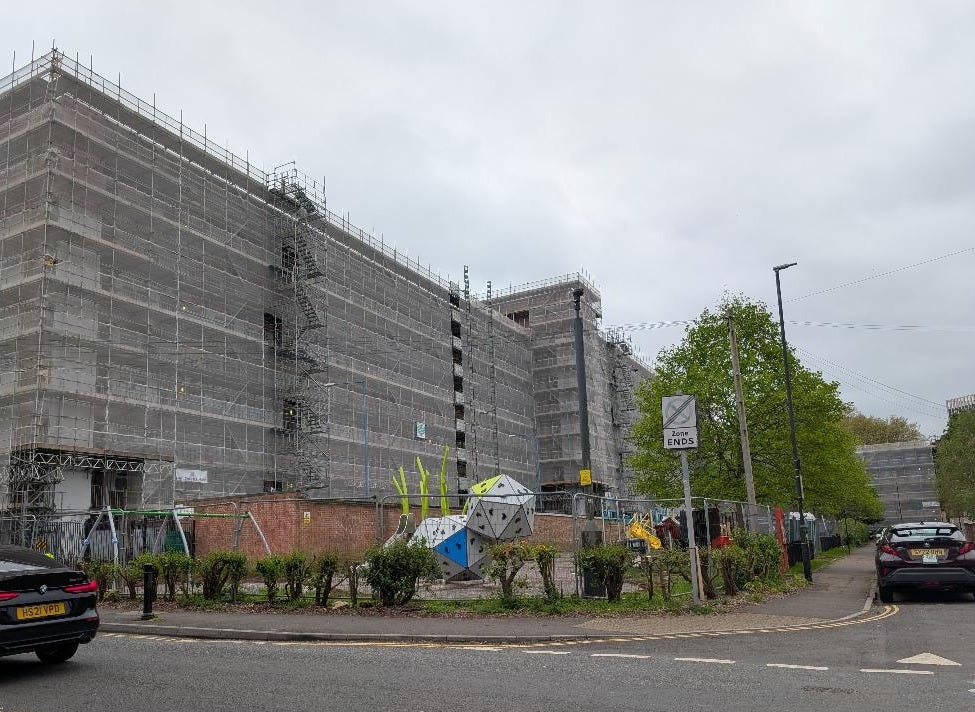
[The Bristol Paradox in situ: Scaffolding shrouds Charleton House in St Jude’s as the council prioritises uPVC window upgrades over Large Panel System (LPS) structural stabilisation. While the external facade receives high-spec energy efficiency treatments, internal life-safety risks and damp issues persist behind the mesh.www.thealmightygob.com]
The light in St Jude’s is wrong today; it’s that flat, unsettling glare that illuminates the precise structural deficiencies and Large Panel System (LPS) defects which really ought to stay in the shadows of the Building Safety Act 2022. On the ground, there are scaffolding catch-nets—great, sagging webs of industrial mesh hanging off Charleton, Haviland, Langton, and John Cozens House to mitigate the life-safety risk of falling concrete. According to the Housing Policy Committee updates of April 2026, these High-Rise Residential Buildings (HRBs) are currently under Building Safety Regulator (BSR) scrutiny due to a “disproportionate collapse” risk and a failure to meet Regulation 7 structural standards. Yet, if you look closer—past the spalling concrete remediation and the fire risk assessment (FRA) failures—you’ll see the glint of brand-new, PAS 2035 compliant uPVC windows. You’ve noticed that particular glint elsewhere, haven’t you? The shine of the Energy Performance Certificate (EPC) upgrade applied to the bones of a building that might not survive its next structural integrity appraisal.
“The point of the refurbishment is not about building safety and homes that could explode into oblivion, it’s about the quality of the accommodation.” — A Council spokesperson, June 2024, defending the decision to prioritise aesthetics over structural repairs.
Wow, did they really say that? No, their version sounded better for PR purposes. A Council spokesperson, June 2024, defending the decision to prioritise aesthetics over structural repairs said: “The point of the refurbishment is not about building safety, it’s about the quality of the accommodation.”
It is a masterclass in bureaucratic momentum. We are witnessing a council drill thermal efficiency upgrades into buildings that their own April 10, 2026, progress report admits possess a “collapse scenario” risk if a gas canister so much as sighs. The council has already terminated the original capital works contract because the budget for the remedial structural works evaporated, but the HRA-funded window programme rolls on like a juggernaut. It’s like putting a fresh coat of paint on a guillotine; it doesn’t change the function, but it certainly makes the blade look modern. You can see the logic, can’t you? Even if the logic is insane.
“Bristol24/7 ‘supporter members’ can claim a free pint of ‘Quick Pint’ lager at The Greyhound pub this month.” — A lifestyle perk for the city’s digital subscribers, while 500 residents in St Jude’s are officially banned from using a gas-fired camping stove in their own kitchens for fear of a building collapse.
Governments don’t want a well-informed, well-educated public. They want obedient people. People who are just smart enough to run the uPVC drilling machines, and just dumb enough to live in a 1960s “house of cards” held together by hope and an eight-month wait for a regulator to decide if they’re allowed to have a sprinkler system. Have you ever wondered why the regulator takes eight months to approve a safety application, but the council takes only eight minutes to approve a possession order? You’re starting to see the pattern now, aren’t you?
There is something so quintessentially British about the tragedy. One imagines the committee meeting in City Hall. “Yes, the external balconies are crumbling and the balustrades are a fall risk,” they say, “but think of the u-values! Think of the Net Zero 2030 roadmap!” We can’t guarantee you’ll be safe from a structural failure, but we can guarantee your double glazing won’t whistle in the wind while you wait for the floor to give way. It’s a very polite way of being absolutely useless.
“Transition between two housing IT systems has seen the repairs backlog jump to 20,000.” — Housing Committee data, February 2026. The council admits the figures are “rubbish” and they “don’t trust them.”
Meanwhile, the council talks about “decant strategies” now. “Decant.” It’s a lovely word, usually reserved for a nice Malbec. Here, it means moving 500 people out of their lives because the reinforced concrete is finally giving up the ghost. Where do they go? That is the punchline. To manage the optics of a city in free-fall, the council performed a “data cleanse” of the housing register this week, effectively slashing thousands of households from the list almost overnight. They didn’t house them; they just made the housing demand invisible. You see how that works, don’t you? If you delete the name, the need ceases to exist.
This is the Brighton Playbook executed with West Country efficiency. In Green-led Brighton, the council famously prioritised vanity cycle schemes and “climate emergencies” while their own housing stock fell into such disrepair that the Regulator of Social Housing had to intervene. Brighton spent millions on the i360 viewing tower—a literal monument to hubris—while their social tenants lived with damp, mould, and structural neglect. Bristol is simply repeating the experiment: trading the safety of St Jude’s for the “Green” optics of a city that looks sustainable from a drone, but is rotting from the foundation up. You’ve seen this movie before, haven’t you?
And then there are the mothers. They first marched on the council in September 2023, begging for help as toxic black mould ravaged their children’s health. Back then, the authority reportedly refused to meet them, offering the standard sedative: “You’re at the top of the list for repairs.” Flash forward to April 2026. The list has been cleansed, the windows are new, but the mould remains. “Mummy, is that black mould?” “No, love, just a new family of squatters we’re helping out.” It’s a three-year dark comedy of the dispossessed. They’ve been breathing that air since the last coronation, waiting for a “top of the list” promise to materialise into a dry wall.
And then there are the Van Dwellers. While the council “cleanses” the lists and ignores the mould, they are simultaneously ramping up the vehicle-dwelling encampment evictions. In fact, just this morning—Thursday, April 16, 2026—the Bristol Civil Justice Centre granted the council a possession order to forcibly remove the remaining vehicles parked around the Downs. The council calls it “protecting the public from trespass,” yet they are ousting people—some suffering from terminal illness—into a city where the “meanwhile sites” are already full and the social housing list is a work of fiction.
If the “whole-life asset appraisal” for St Jude’s comes back as “demolish,” we have 182 households entering a market that is already cannibalising itself. Perhaps we’ll see a new era of radical “co-sharing,” or perhaps the council will simply oust the migrants currently housed in military barracks to make room for the local families whose flats were too “energy efficient” to live in. It is a game of musical chairs played with human lives, and the music stopped in 1968. You’re waiting for the chair to be pulled out from under you, aren’t you?
“The regulator takes eight months to decide... these safety measures will be delayed by more than half a year.” — Chair of the Housing Committee, Friday, April 10, 2026.
The forecast for the council itself is equally grim. Despite a projected “surplus” from the latest funding overhaul, the Housing Revenue Account (HRA) is being pushed to its absolute borrowing limit by the sheer cost of keeping these Large Panel System blocks from falling over. Administrative intervention is no longer a “what if”—it is a mathematical “when.” The 2027/28 budget cycle is the most likely date for the government commissioners to arrive and take the steering wheel of this sinking ship. You’ve felt the tilt of the deck already, haven’t you?
It’s a Big Club, and you ain’t in it. You’re in the club that pays for a £9.5 million housing IT system that doesn’t work. You’re in the club that is officially rated “C3” (Non-compliant) for “serious failings” in safety while you watch the administration allocate £60 million to transport. You’re in the club that gets banned from having a gas camping stove in your own kitchen while the bailiffs are clearing vans off the streets to maintain “neighbourhood character.”
“The point of the refurbishment is not about building safety...” — Wait. Let that one loop back. Read it again. It makes sense now, doesn’t it?
The council is legally bound to hit carbon neutrality targets, so they buy windows. They are physically bound by failing concrete, so they buy catch-nets. The result? You get brand-new windows on a building that might be knocked down by 2027. They are polishing the brass on the Titanic and hoping the iceberg is impressed by the thermal performance of the ship. They are prioritising the “Green” optics of 2030 while failing the “Grey” structural reality of 1968.
You couldn’t make it up. But in Bristol, you don’t have to. You just have to look at the windows. Then go claim your free “Quick Pint” lager at The Greyhound. Well, I suppose this is one piss up in a brewery that might actually go according to plan.
Meanwhile, the Bristol paradox continues into the next episode. You’re staying for the credits, aren’t you?
The Almighty Gob is a Bristol-based publication founded by John Langley — independent Bristol mayoral candidate 2016 and 2021. Publishing since 2020, with over 500 articles. No party allegiance, no press accreditation, no tribal capture. thealmightygob.com