

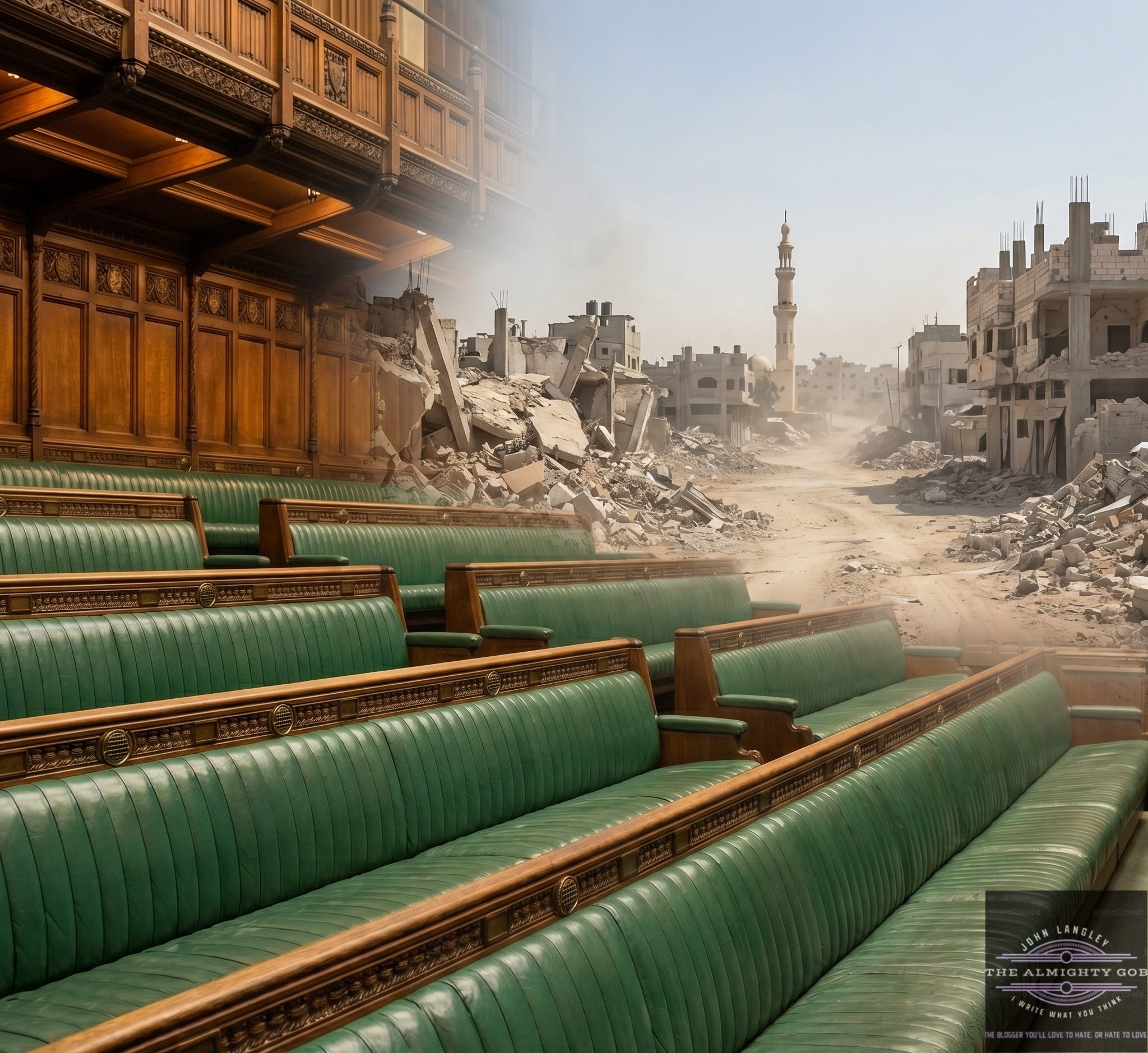
[The legendary green leather benches of the House of Commons. Empty. Facing Gaza. Published by The Almighty Gob, 2026]
Parliamentary mandate. Democratic accountability. British political identity. Three things certain people appear to have mislaid.
Here is a question that should not need asking. If you want to be a British MP, which part of that job title is confusing you? The parliamentary mandate, perhaps.
Not the MP part. Apparently the British part. You know. That little place on the map between the USA and Europe. Inconspicuous, by all accounts.
The clue — not that anyone would need reminding, of course — is the word British.
Because somewhere between the selection process, the campaign trail, and the acceptance speech, certain people appear to have decided that British is just the venue — and the actual job, the actual loyalty, the actual reason they showed up — is taking place over two thousand miles away.
You see. When a place gives you something — its opportunities, its safety, its daily infrastructure of ordinary life — you give something back. Not out of sentiment. Simply the understanding that belonging somewhere is not a passive arrangement.
It requires your attention. It requires something back.
The people of Blackburn showed up. The people of Leicester South showed up. They put their cross on a ballot paper and sent someone to Parliament to fight for them. Their housing. Their NHS. Their energy bills. Their futures.
Yet. Every single day that MP spends performing their foreign policy conscience on the constituency’s time and trust is a day stolen from the people who hired them — and a day that confirms, quietly, that their loyalty was never really where they said it was.
For example. In the 2024 UK general election, five pro-Gaza independents won parliamentary seats. What the press came to call the Gaza effect delivered its first results on 4 July 2024. Shockat Adam took Leicester South. Adnan Hussain took Blackburn — a seat Labour had held for sixty-nine years. Iqbal Mohamed took Dewsbury and Batley. Ayoub Khan took Birmingham Perry Barr. Jeremy Corbyn held Islington North. On 2 September 2024 they formally became the Independent Alliance.
Or, to those with a Cockney ear and an eye for anagrams — Alla Dependence, innit.
It’s hard to argue this was an accident of democracy.
And the acceptance speeches removed any doubt about what it actually was. “This is for Gaza,” said Shockat Adam after taking Leicester South. Adnan Hussain in Blackburn was even more explicit.
“This is for Gaza,” he said. “I can’t deny the fact that I stand here on this platform before you is a result of a protest vote on the back of a genocide.”
At which point, Paul Gascoigne must have been momentarily delighted. A little recognition, at last, for something other than alcohol consumption. Well, until the bad news broke, anyway.
Well. You could not make it up. Except they did not make it up, as they say. They said it out loud. On camera. To the nation. And nobody in the British political establishment apparently thought that was worth a follow-up question. Probably watching football matches on playback.
Anyhow. Before we go any further, let us deal with the objection that is already forming in certain minds. It is. Isn’t it?
Contrary to what some would have you believe. This argument is not about ethnicity. It is not about heritage either. In fact, it is not about whether someone born in Rochdale to parents of Pakistani heritage is less British than someone born in Rochdale to parents of English heritage. Can you believe that!
A British citizen whose family roots lie in Pakistan, Bangladesh, Somalia, or anywhere else — who cares deeply about Gaza, raises it in Parliament, campaigns on it, writes about it — that person is doing nothing wrong. That person is exercising exactly the democratic rights the system exists to protect. Except.
What is different — what is entirely and specifically different — is an MP whose declared purpose on election night was not the people of their constituency but a foreign conflict. Not someone who holds both. Someone who told you, from the podium, which one came first.
The argument is about the mandate. It has always been about the mandate. Anyone who tells you it is about race is either confused about what they read or hoping you are. I am. We are.
So. The organisation behind the coordination was The Muslim Vote — the Muslim vote UK mobilised and directed as a strategic electoral instrument. Established December 2023. Declared objective — a five-election plan spanning twenty-five years.
It deployed proprietary data analysis across constituencies where Muslim voters exceeded ten percent of the electorate. It built campaign infrastructure for local independents. It mobilised, by its own description, twenty million monthly visitors through affiliated organisations.
Who’d have thought it. By election night, the Labour vote in the twenty most Muslim-heavy constituencies had dropped by between fifteen and forty-five percent. No. Me neither.
That is not a protest vote. That is an operation. And operations have objectives that extend well beyond the night they deliver their first result.
You see. Among The Muslim Vote‘s backers, The Daily Telegraph reported the Muslim Association of Britain and Muslim Engagement and Development — two organisations named by Michael Gove for assessment against the government’s definition of extremism. Gove told Parliament the Muslim Association of Britain was the British affiliate of the Muslim Brotherhood. It is also a matter of public record that Jalaluddin Patel, former leader of Hizb ut-Tahrir Britain, said he helped The Muslim Vote. Anas Altikriti, former president of the Muslim Association of Britain, said he advised it.
Because. A seat in the British Parliament, it turns out, is a very useful thing to have. Funny how that works.
Keir Starmer lit the fuse himself, mind you. On 11 October 2023, live on LBC, he said nine words: “I think that Israel does have that right” — when asked whether cutting power and water to Gaza was acceptable. He may have said nine. I think we can both agree on eight.
Nine words. Possibly eight. Sixty-nine years of Labour history across multiple constituencies. Gone. Who’s counting.
In Ilford North, Health Secretary Wes Streeting held his seat, by his pants, perhaps, and by 528 votes against a twenty-three-year-old first-time candidate running on a pro-Gaza platform.
Five hundred and twenty-eight votes. In a democracy of millions. You genuinely could not script it.
Nine words from the Prime Minister. Possibly still eight. Five hundred and twenty-eight votes between his Health Secretary and the exit. There is a straight line between those two facts and it runs directly through the question of what a British MP is actually supposed to be doing with the mandate they were given. Apart from. Well, you know. Simple maths.
Right. Stand by for another ‘you see’ moment. What is being constructed here — seat by seat, election cycle by election cycle, with a published twenty-five-year plan that anyone can read — is a political infrastructure inside British democracy that answers not to Britain but to something else entirely.
Something with a geography. A theology. Funders. Strategists. A long-term objective.
And now, following July 2024, it has parliamentary representation.
The British voters who delivered those seats did so through the legitimate exercise of their democratic right. That is not in question. And that matters. It matters completely. What is in question is whether the people who asked for those votes were ever genuinely standing to serve the constituency in front of them — or whether the constituency was always the method, and what came first was always somewhere over the horizon.
Nobody, it seems, thought to pay it any attention. Nobody thought to ask where exactly that horizon was. Or who was waiting on the other side of it.
Possibly even somewhere over the rainbow.
“This is for Gaza.” They said it themselves. The Almighty Gob did not have to work very hard to find the evidence. It was in the acceptance speech.
So here is the question sitting underneath all of it. The one nobody in British public life appears willing to ask with a straight face and a full sentence. The one that goes to the heart of democratic accountability in a modern plural democracy.
What does it mean to stand as a British MP on a ticket that was never British to begin with? You know. A ticket to somewhere else. Overseas.
They made a film about something similar. Didn’t they. Look what happened to the star and the co-star. Sunk without a trace.
Okay. Go for it. Bring it on. It’s boring repeating myself though. It is not a question about race. It is not a question about the right of any community to vote, organise, or campaign. Those rights are not under dispute. Got it?
It is a question about what a parliamentary seat is actually for. About who it belongs to once it has been won. About whether the people of Blackburn knew they were voting for a representative — or a statement. About whether anyone told them that the twenty-five-year plan they were casting a vote for had objectives that extended rather further than their housing list and their GP waiting time. Not that difficult to comprehend. Agreed?
Proof? Simple. The LSE argues that for democracy to function, people within a state need to feel a sense of belonging to the same political community. Think about that for a moment. Academic research consistently finds that countries where primary loyalties are divided between the national and the transnational show measurable decline in democratic functioning over time.
The twenty-five-year plan is not a secret. It is on a website. In plain English. The question is not whether it exists. The question is why the people paid to notice these things are pretending that it doesn’t. Football again. I guess. Or perhaps a very long bath. Either way, nobody apparently glanced at the website.
The Almighty Gob does one job. That’s to look at the thing everyone appears slightly out of kilter with, and describe it more plainly. Like I understand it.
The Gaza MP phenomenon is not the story. It is the surface. The plaster covering something deeper.
Underneath it is a question about what a British parliamentary seat means, who it serves, and whether the word British — on the ballot paper, in the job title, in the contract between the elected and the people who elect them — still means what it was always supposed to mean. It is, at its core, a question about British political identity.
Or whether it has become, for some of the people using it, essentially decorative. Like a Party rosette. Only worn for an election. Then left to gather dust, or binned. You know. When it’s all over.
You are reading this in Britain. You live here. You know what that means. This place has given you something — its opportunities, its infrastructure — some may argue, what remains of it, of course. Oh. And its daily ordinary life. And somewhere in a parliament built to represent you, people were handed your mandate. They told you, from the podium, on the night, exactly where their loyalty actually sat. Latterly somewhere else.
It was not with Blackburn. It was not with Leicester South. It was not with the housing crisis or the NHS or the cost of living or any of the things that shape your life in this country every single day.
And if you are honest with yourself — genuinely honest, not the version of honest that lets you off the hook — the question this piece has been asking was never only about them. It was about the version of that choice that exists in any person who has ever taken from a place without fully giving back to it. Who has collected the belonging without paying the cost of it. Who has stood inside a country, a community, a life — and quietly directed their deepest loyalty somewhere other than where they were standing. And eventually sitting.
The question was never really about Gaza MPs. It was about what the word British means when the people using it have already told you — out loud, on camera, into the microphone — that it was never really the point. And it was about whether that description, if you are honest with yourself, applies only to them. Hijackers, perhaps. Except. Fully legal, of course.
The clue was in the word British. It always was.
They just didn’t think you were paying attention. While the football was on.
The Almighty Gob is a Bristol-based publication founded by John Langley — independent Bristol mayoral candidate 2016 and 2021, and one of the city’s most forensic observers of institutional power. Publishing since 2020, with over 600 pieces across seven platforms and Substack at thealmightygob.com — no party allegiance, no press accreditation, no interest in acquiring either.
© 2026 John Langley / The Almighty Gob. All rights reserved. Reproduction of any part of this article without express written permission is prohibited. For syndication and licensing enquiries contact The Almighty Gob via thealmightygob.com