
The Cost Of Killing — A Few Miles Up The Road From Bristol, In BaNES.
The 20mph zones that raised Bath's killed or seriously injured rate — and why it's staying that way. It's cheaper.

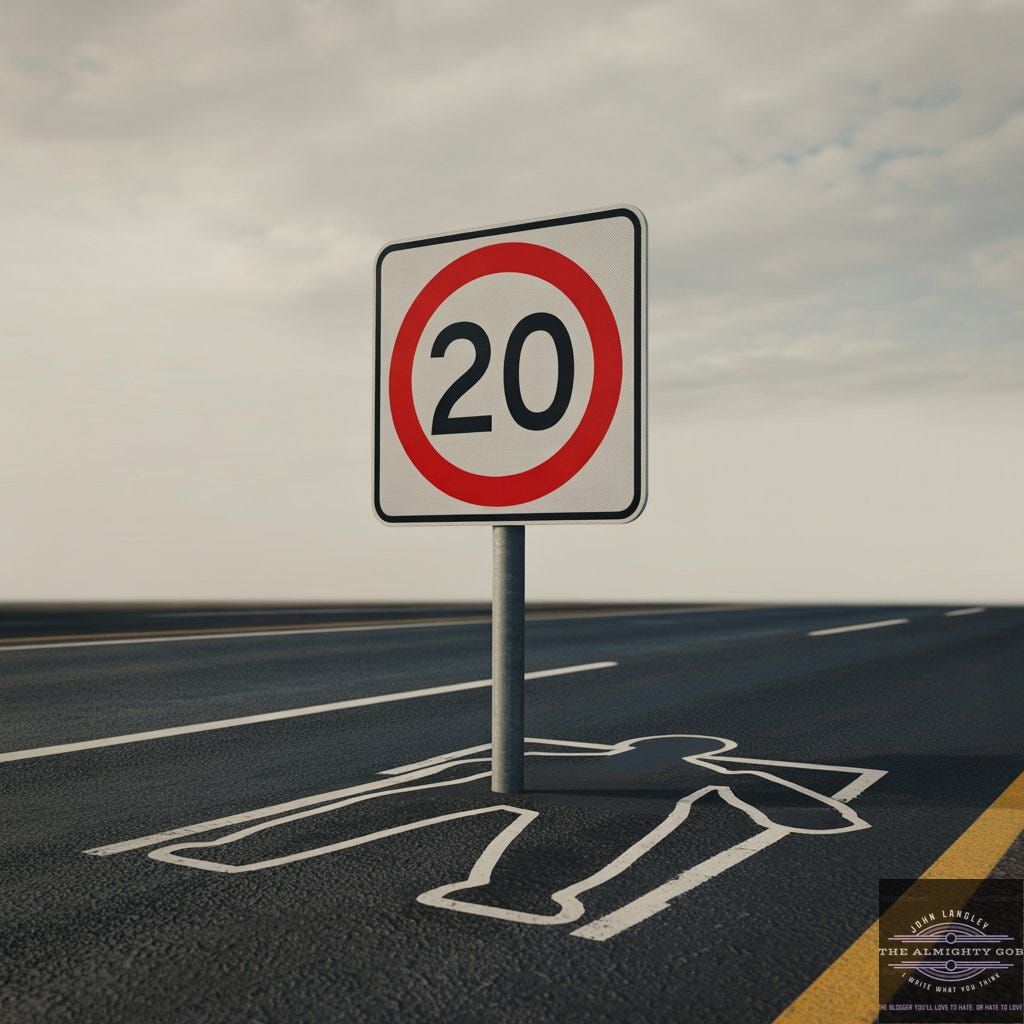
The sign cost £871,000. The outline was free. Image: © 2026 The Almighty Gob. Reproduction without attribution prohibited.]
There’s a particular kind of political genius that manages to spend £871,000 to — well, it could be said to, you know, inadvertently bump up the death rates in Bath and North East Somerset. Even if that wasn’t the intended plan from the get-go.
Oh, I can just imagine the planning meeting for this one. In fact, I’ve already written it — as the pilot episode of my new television series. It’s called Bolitics. That’s B-O-L-I-T-I-C-S. A cross between bollocks and politics. You’ll recognise the genre immediately.
I should point out that Bolitics is — for now at least — an unproduced television series. No commissioners have been harmed in the making of this script, yet. Though given the subject matter, I wouldn’t rule it out.
“Right, so the proposal is — we slow the traffic down.”
“Brilliant. And that saves lives?”
“The science suggests yes. Mind you, on the down side, we could of course kill people.”
“Marvellous. How much for both options, would you think?”
“Eight hundred and seventy-one thousand pounds.”
“To clarify. Would that be the set up charge, or, latter compensation settlements?”
“Oh no. That’s purely for road painting.”
“So do we have a budget for death?”
The room went quiet. Phones were checked. Someone reached for the biscuits.
“Why don’t we hire that man who did the Green Cross Code advertisements?”
“Oh, you mean that actor who played in Star Wars. You know, Death Vader.”
“Um, I think you mean Darth Vader.”
“It was close enough.”
“I think we need to consult a lawyer. You know, one that costs real money, and does public liability. Not one of our staff solicitors.”
“I suppose we could put a surcharge on the Japanese visitors.”
“And the Chinese ones.”
“Yes. We do rather rely on them coming to look at our baths. Given that they have rather better ones at home.”
“What about reinstating the Red Flag Act? Someone walks in front of the vehicle.”
“Isn’t that from 1865?”
“We could update it. Call it a Pedestrian Safety Pilot. Roll it out locally first.”
“Who goes in front?”
“Joggers. It’s a 20mph zone — fits the active travel agenda. Might even qualify for a separate grant.”
“And when they get hit?”
“Well, that’s why we’d need to budget for the life insurance.”
“We just established we don’t have a budget for death.”
“No. But we have a budget for road painting.”
The room went significantly quieter. Someone left to find more biscuits.
“And if the tourist dies?”
“Well — that rather depends on where they’re from.”
“How so?”
“If they’re Chinese, there could be a diplomatic issue.”
“Why specifically Chinese?”
“Because the camera that filmed it was probably made by Hikvision.”
“What’s Hikvision?”
“Chinese company. Supplies about sixty percent of UK public bodies with CCTV — according to the UK’s own Biometrics and Surveillance Camera Commissioner.”
“So a Chinese tourist gets hit, filmed on a Chinese camera, on a road we can’t afford to fix.”
“On the bright side — the footage will be excellent.”
“Right. Any other business?”
End of Episode One. The meeting was minuted. Nobody resigned.
Here’s the thing. Bath and North East Somerset Council installed 20mph zones across the area, sold them to residents as a life-saving intervention, commissioned a report to measure the outcomes — and the report came back and told them that the rates of people killed or seriously injured had risen in the majority of areas where the restriction was imposed.
Something is wrong here. Not accidentally wrong. Institutionally wrong. The kind of wrong that has a filing system.
Their response?
They can’t afford to scrap them.
Let that breathe for a moment.
Eight hundred and seventy-one thousand pounds. Rising casualty rates. No reversal planned.
That’s not a transport policy. That’s a hostage situation where the council is both the kidnapper and the negotiator, and the hostage is whoever’s crossing the road. Everyone in the room knows it. The meeting has moved on.
Slower Roads, Faster Funerals.
The logic of 20mph zones was always presented as self-evident. Slower speeds mean less impact force. Less impact force means fewer fatalities. The science is real. The physics checks out. What the physics doesn’t account for is human beings.
Human beings, it turns out, are not included in the impact assessment.
There’s a concept — inconvenient enough that it rarely makes it into the press release — called risk compensation. The idea is straightforward: when people perceive an environment as safer, they behave less carefully within it. The 20mph sign goes up, the pedestrian stops checking both ways quite so thoroughly, the cyclist pulls out with a fraction less hesitation, the driver relaxes their scan of the pavement edge.
The road feels safer. The data says otherwise.
Bristol Uncovered flagged this directly — noting that the Bath figures reflect “a national trend” suggesting local people are “less diligent” when walking and crossing roads in 20mph zones because they think they are safer.
That’s not a fringe position. That’s risk compensation in action. And Bath and North East Somerset Council either didn’t know about it before spending £871,000, or they did know and spent the money anyway.
Neither option is flattering. One is ignorance. The other is worse, and far more familiar to anyone who has watched a council meeting run its natural course.
But ignorance, at least, is curable. What comes next isn’t.
The Report They’d Rather You Forgot.
Here’s where it gets sharper. And quieter.
A report from 2017 — recently flagged by commentators on X — raised concerns that both Bath and North East Somerset Council and the local Liberal Democrats totally ignored. The report, published by BaNES Council and seen by the Bath Chronicle, assessed the 20mph zone programme across thirteen zones in the 12 months following installation.
Totally ignored.
Not disputed. Not reviewed and rejected on evidential grounds. Ignored.
That’s nine years of available evidence sitting in a drawer while the council built its case for spending public money on a scheme that a prior report had already raised questions about. The Liberal Democrats — who inherited and continued the programme after taking control of BaNES in 2019 — had no interest in the 2017 findings either.
And what did that report actually conclude? In the council’s own words: there is “little in the way of persuasive argument for continuing the programme in the future.”
Their programme. Their report. Their conclusion. Nine years ago.
It should be noted that the 2017 report was itself contested — road safety campaigners challenged its statistical methodology, arguing the sample sizes were too small to draw firm conclusions from one year of data. That is a fair point. One year is not enough. But here’s what that argument cannot survive: the report was published in 2017. It is now 2026. Nine years have passed. The council has not commissioned a follow-up. It has not published updated data. It has not answered the methodology critics with better evidence. It has simply continued. The one-year objection expired eight years ago — and the silence that followed it is its own kind of answer.
The overall casualty picture from that period is contested too — some analysts read the same data as showing an overall reduction in Bath’s 20mph areas. The Almighty Gob isn’t here to settle that argument. What is not contested is what the council’s own document said: little persuasive argument for continuing. Whatever the full picture, that was their conclusion. They continued anyway.
The drawer is still there, by the way. It didn’t go anywhere. It’s just that nobody opens it.
One person who did read the report was a retired civil servant named Mr Marshall. He attended a council meeting. He asked whether the council was considering a review of the 20mph speed limits. In response, he was sent a copy of the 2017 document. His reaction: “The facts are that the numbers of people being killed and injured are going up since the zones were introduced. More people are being hurt because less people are taking care. The council’s response was that they can’t afford it. To my mind that’s saying that people are being seriously hurt but we are not prepared to stump up the cash to stop that happening.”
Mr Marshall said that in 2017. He was not wrong then. He has not been answered since.
The Lib Dems do love a policy that sounds like safety. The data’s a different conversation entirely. One they’ve been declining to have for the better part of a decade.
Bristol: You’re Next In The Dock.
Bath is the case study. Bristol is the warning.
Bristol City Council — under Green administration since May 2024 — has rolled out its own 20mph programme across the city with the same political confidence and rhetorical certainty. The same logic. The same community consultations. The same press releases.
And somewhere, in a council building in Bristol, there is almost certainly a drawer.
Here’s what’s in the public domain right now. In 2024, the number of people killed or seriously injured on Bristol’s roads rose by 22% compared with the previous year — regardless of cause, that is the number. The overall cost to society from those collisions is estimated at £90 million. Bristol City Council has also, for the record, unanimously adopted Vision Zero — the commitment to eliminate deaths and serious injuries on its roads entirely.
Vision Zero. 22% rise in killed or seriously injured. In the same year.
The question The Almighty Gob puts plainly: where is Bristol’s equivalent post-implementation review of its 20mph programme?
Because Bath commissioned one. Bath published it. Bath found that casualty rates went up in the majority of affected zones. And Bath is now trapped — having spent the money, having seen the results, having concluded it cannot afford to reverse course.
If Bristol’s data tells the same story, who’s going to publish it?
And if it doesn’t exist yet — why not?
Because it doesn’t mean nobody got round to it. It means someone made a decision. Decisions like that don’t make themselves.
Green Politics and the Theology of Good Intentions.
There’s a pattern here that runs deeper than one council’s transport budget.
In BaNES, it’s the Liberal Democrats. In Bristol, it’s the Greens. Different rosettes. Identical logic.
Both parties operate from a position of moral pre-approval. Their policies are, by definition in their own framing, the right ones. They are on the right side of history, of science, of conscience. Which means the data, when it arrives, is always a nuisance rather than a reckoning.
20mph zones are good. Therefore the zones are good. Therefore the evidence suggesting otherwise is either wrong, incomplete, a right-wing distraction, or the fault of drivers who haven’t yet internalised the correct values.
It’s a remarkable position. You get to be right before the results come in. You get to stay right after. The evidence is always the problem. Never the policy.
This is Emotional Incontinence dressed as evidence-based policy. The feeling of doing the right thing substitutes for the discipline of checking whether the thing is actually working.
Eight hundred and seventy-one thousand pounds. Rising casualties. No reversal.
Nobody has killed anyone. But they’ve created the conditions in which the evidence of harm gets filed away in 2017 and the money gets spent in 2024, and the people crossing the road in Bath’s newly designated safe zones are statistically less safe than they were before.
That’s not good intentions gone wrong. That’s what happens when good intentions replace thinking. And the people paying for that substitution aren’t sitting in the meeting. They’re crossing the road.
The Sunk Cost That Walks Among Us.
The council’s position — that it cannot afford to reverse the 20mph zones — is its own kind of masterpiece. The institution that created the problem becomes the one that explains why it cannot be solved.
This is the sunk cost fallacy with a body count attached.
We can’t undo the £871,000 spend. True. But you can remove the signs. That costs a fraction of three-quarters of a million pounds. And it costs nothing like a coroner’s report. No updated cost estimate for reversal has been published by BaNES. The figure cited — that it would cost as much to reverse as to install — originates from a 2017 council statement. It has not been verified since. Which means the financial case for inaction may itself be unexamined.
The real cost of reversal isn’t financial. It’s political. It means admitting the policy was wrong. It means the 2017 report — the one that was ignored — was pointing at something real. It means the Liberal Democrat transport theology in BaNES has a casualty rate.
And here’s the thing about casualty rates. They’re not abstract. They’re not a line in a report. They’re a person who left the house that morning.
In Bath, between 2011 and 2017, they were the people in the majority of those zones whose roads got measurably more dangerous after the signs went up. They didn’t get a press release. They got a statistic. And the statistic got filed.
And that is a cost Bath and North East Somerset Council is not currently willing to pay.
Those who notice a similarity between what is happening in East Bristol and what happened in Bath may have a point.
The Bolitics 20mph Death League — Unofficial, Unsanctioned, Entirely Necessary.
There is no official league table for 20mph casualty outcomes by council area. Which is itself instructive. There really ought to be. The Almighty Gob has therefore produced one. The figures are real. The rankings are our own. BaNES may wish to dispute their position. The data is available to any council that wants to commission its own review — which, as we’ve established, none of them has.
The National Context — The Numbers Nobody Puts On A Sign
Before we get to the rankings, the baseline. The Institute of Advanced Motorists analysed government data — figures from 2014, before the current national rollout scale — and found that nationally, serious casualties in 20mph zones increased by 29% while slight casualties went up by 19%. Over the same period, serious accidents on 30mph roads went down by 9%, and down 7% on 40mph roads. The roads that kept their speed limits got safer. The roads that got the signs got worse. The national rollout has expanded considerably since 2014. The data has not improved the argument.
The Bolitics 20mph Casualty League — Current Form
Bath and North East Somerset (BaNES) — Actively Competing The home team. £871,000 spent. Casualties rose in the majority of affected zones after implementation. Council confirms it cannot afford to reverse. 2017 warning ignored. Status: Committed. Enthusiastic. Unrepentant.
Belfast — Honourable Mention for Effort A three-year study by Queen’s University Belfast found that 20mph limits across the city made little difference to safety outcomes — road traffic collisions fell by just 3% over one year and 15% over three years, with researchers concluding the reductions were not statistically significant. Average traffic speed fell by 0.2mph after year one. The signs went up. The speeds barely moved. The science shrugged. Status: Participated. Achieved nothing. Claimed victory anyway.
The National Average — The Quiet Podium Nobody Claims Across the UK, 20mph zones as a category saw serious casualties rise 29% while equivalent 30mph roads improved. The data is from the IAM. The government has it. The councils have it. It sits in the same drawer as the 2017 BaNES report. Status: Systemic. Structural. Largely undiscussed at cabinet level.
Wales — The Outlier That Raises Its Own Questions Wales introduced a blanket national 20mph default in September 2023. Casualties on 20mph and 30mph roads fell by nearly 24% in the following period. Compelling — until you examine the enforcement picture. GoSafe suspended 20mph enforcement entirely for the first months after implementation. When enforcement resumed, the prosecution threshold was set at 26mph — 30% above the posted limit — rather than the standard 24mph applied to other speed limits. Whether Wales's casualty reduction is attributable to the speed limit, the enforcement regime, behavioural change, or some combination of all three remains an open question. What is not in question is that "Wales enforced it strictly" is not an accurate description of what happened. Status: Promising results. Complicated picture. Question mark retained.
Bristol — Awaiting Classification Bristol City Council has rolled out its own 20mph programme. Post-implementation review: not yet published, or not yet located, or not yet commissioned. The Almighty Gob has asked the question. The question is still travelling. Status: Results pending. Drawer location unknown.
We should point out, on BaNES’s behalf, that this league table is unofficial and produced by a publication that has no plans to change course either. Which, come to think of it, is exactly what a team at the bottom of the table would say.
What BaNES Actually Stands For.
Bath and North East Somerset. That’s the official version.
After £871,000, rising casualties, an ignored 2017 warning, and a council that has decided it cannot afford to confront its own data — BaNES has earned a second definition.
Badly Administered. Negligently Executed. Statistically Embarrassing.
Bristol should be watching very carefully.
Because the cost of living gets all the headlines. But a few miles up the road in BaNES, it’s the cost of killing that nobody wants to put a number on.
They already spent that on the signs.
The question BaNES hasn’t answered — and nobody has put to Bristol — is a simple one.
How much is a person who left the house that morning worth?
Apparently less than the signs.
That's the cost of killing. And in BaNES, apparently, it's cheaper.
The Almighty Gob is a Bristol-based publication founded by John Langley — independent Bristol mayoral candidate 2016 and 2021, and one of the city’s most forensic observers of institutional power. Publishing since 2020, with over 500 pieces across seven platforms and Substack at thealmightygob.com — no party allegiance, no press accreditation, no interest in acquiring either.
© 2026 John Langley / The Almighty Gob. All rights reserved. Where reproduced, John Langley must be named as source in full. Attribution: John Langley / The Almighty Gob, thealmightygob.com
SOURCES AND CITATIONS.
All sources listed in order of first appearance in the article. All figures and quotations attributed to primary or named secondary sources only. No anonymous or unverifiable citations used.
1. BaNES 20mph zones — £871,000 cost and casualty rate increase Bath Chronicle, December 2017: “Bath and North East Somerset Council ‘can’t afford’ to get rid of 20mph zones despite rise in death and serious injury rate.” Primary source: Bath and North East Somerset Council internal report, published May 2017, assessed across thirteen 20mph zones in the 12 months following installation. bathchronicle.co.uk
2. Bristol Uncovered — risk compensation and national trend Bristol Uncovered (@BristolUNC), X/Twitter, May 2026. Direct observation that Bath figures reflect “a national trend” and that local people are “less diligent” in 20mph zones “because they think they are safer.” Original source: BaNES Council 2017 report conclusions.
3. BaNES Council’s own conclusion — “little persuasive argument” Bath and North East Somerset Council, 20mph Speed Limit Review Report, May 2017. Direct quotation: “Overall, the speed limit programme in B&NES seems to have provided little in the way of persuasive argument for continuing the programme into the future.” Reported by Bath Chronicle, December 2017, and independently verified by multiple sources including Road Safety GB and 20’s Plenty for Us.
4. Methodology challenge to 2017 BaNES report 20’s Plenty for Us, critique of BaNES 20mph report, 2017: described the report as “biased, lacking in statistical rigour and not meeting several local authority duties on competency and equality.” 20splenty.org
5. Mr Marshall — retired civil servant quotation Bath Chronicle, December 2017. Mr Marshall, retired civil servant, quoted directly following his attendance at a BaNES Council meeting and receipt of the 2017 report. Quotation: “The facts are that the numbers of people being killed and injured are going up since the zones were introduced. More people are being hurt because less people are taking care. The council’s response was that they can’t afford it. To my mind that’s saying that people are being seriously hurt but we are not prepared to stump up the cash to stop that happening.” bathchronicle.co.uk
6. Liberal Democrat control of BaNES since 2019 Wikipedia: Bath and North East Somerset Council. Council under Liberal Democrat majority control since 2019. en.wikipedia.org/wiki/Bath_and_North_East_Somerset_Council
7. Bristol KSI rise 22% in 2024 and £90 million cost GB News, March 2026: “Bristol set for major 20mph expansion as council targets crash hotspots under new plans.” Direct figures: “In 2024, the number of people killed or seriously injured on Bristol’s roads rose by 22 per cent compared with the previous year. The overall cost to society from these collisions is estimated at £90million.” gbnews.com
8. Bristol Vision Zero adoption Bristol City Council. Vision Zero policy — commitment to eliminate deaths and serious injuries on Bristol’s roads — unanimously adopted by Bristol City Council. bristol.gov.uk
9. IAM national data — serious casualties in 20mph zones up 29% Institute of Advanced Motorists (IAM), analysis of government data, 2014. Serious casualties in 20mph zones increased by 29%; slight casualties up 19%. Serious accidents on 30mph roads down 9%; on 40mph roads down 7%. Reported: Road Safety GB, 2014; CarThrottle, 2015; Conservative Home, December 2017.
10. Belfast 20mph study — minimal impact Hunter, R.F. et al. (2023). Investigating the impact of a 20 miles per hour speed limit intervention on road traffic collisions, casualties, speed and volume in Belfast, UK: 3 year follow-up outcomes of a natural experiment. Journal of Epidemiology and Community Health, Vol 77, 17–25. Reported: RAC Drive, 2025. Road traffic collisions fell by 3% over one year and 15% over three years; reductions not statistically significant. Average traffic speed fell by 0.2mph after year one.
11. Wales 20mph national rollout — casualty reduction Welsh Government / Transport for Wales, National Monitoring Report, July 2025. Casualties on 20mph and 30mph roads in Wales fell by 23.8% from Q2 2023 to Q4 2024 following introduction of default 20mph on 17 September 2023. tfw.wales
12. Hikvision — 60% of UK public bodies UK Biometrics and Surveillance Camera Commissioner (OBSCC), survey of police forces and public bodies, 2023. Hikvision supplies approximately 60% of UK public bodies with CCTV. Government banned future installation of Hikvision cameras on government buildings, November 2022 (Oliver Dowden, Written Ministerial Statement). Reported: Tech Monitor, March 2023. techmonitor.ai
13. Roman Baths visitor numbers and international tourism Roman Baths / Association of Leading Visitor Attractions (ALVA), 2024. The Roman Baths received 1,061,240 visitors in 2023 — 29th most visited attraction in the UK, second most visited in England outside London after Stonehenge. Audio guides provided in Japanese, Korean and Mandarin Chinese as standard. romanbaths.co.uk
14. BaNES pothole compensation claims — 144% rise MNR Journal, March 2025. Bath and North East Somerset council’s spending on pothole repairs increased from £75,661 in 2022 to £209,399 in 2023. Compensation claims for pothole damage rose 144% since 2021. mnrjournal.co.uk
15. Red Flag Act — Locomotive Acts 1865 The Locomotive Acts (Red Flag Act), 1865. Required self-propelled vehicles to travel at no more than 4mph in the country and 2mph in towns, with a person walking ahead carrying a red flag. Repealed 1896. legislation.gov.uk
Did the Welsh enforce it strictly, though? I had the impression they were fairly lenient, allowing up to 26mph before fining, unless caught by ANPR. No idea how many ANPR cameras were set up in 2023 there.