
The Cycling Figures That Condemn Every Low Traffic Neighbourhood In England.
The Department for Transport's own National Travel Survey did the damage. Florence Pugh's father lost a million pounds. Hamblins lost its front door. The case is closed.Not! By John Langley.

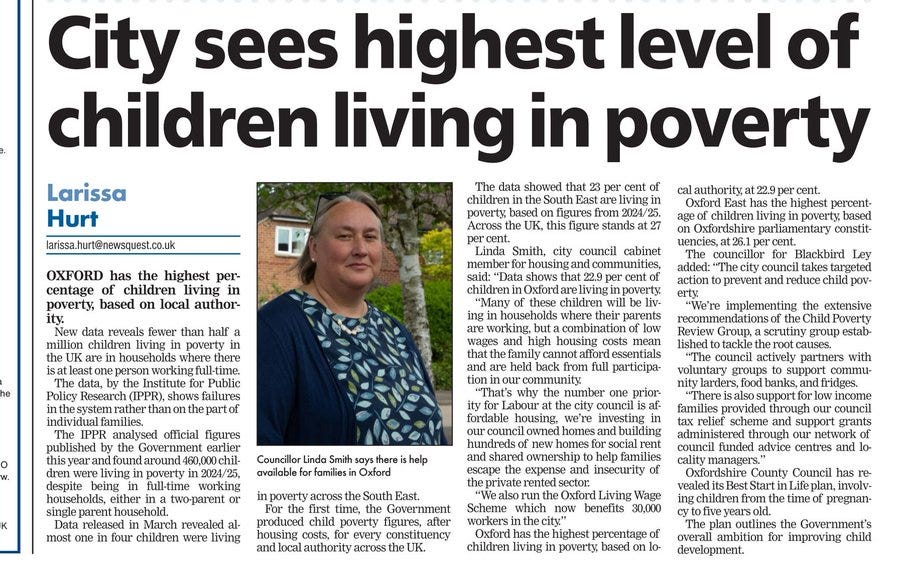
[Source: Newsquest / Oxford Mail. Data: Department for Transport National Travel Survey 2023. Institute for Public Policy Research child poverty figures 2024/25]
Save East Oxford Businesses @eastoxbusiness
“Labour’s, Greens & Libdems LTN’s put multiple families into poverty when we were forced to close our businesses in east oxford. they know they’re still doing it and need to stand up and admit it.”
You might remember the cigar, from yesterday. The man in the Panama hat, burning it slowly on a Bristol morning, not rushing, because that’s the point of a Cuban cigar — and, as it turns out, the point of this story. Some things take the time they take. Same table. Fresh hot choc. Different numbers.
Maximum points for guessing, first time, the worst outcome for the councils.
Congratulations. 100% correct.
The Department for Transport just told all of us something remarkable. They told us with their own data, in their own document, under their own name. And then, apparently, hoped nobody would join the dots. However, the use of pens is not beyond the wit of mankind. Much to the bewilderment of. Well. You know.
47 Miles.
What does this mean? Let’s find out, shall we?
In 2020, at the height of the pandemic, the average person in England cycled 88 miles. Said nothing about them returning, mind you. Not the point.
So. Eighty-eight miles. Well. So the story goes. People were out on their bikes because there was nowhere else to go, the roads were empty, the government had told everyone to get some fresh air, and a good number of people had discovered, possibly for the first time since childhood, that a bicycle is quite a pleasant thing. It was a moment. A genuine one. Nobody disputes that. Not so far, anyway.
Now. Here’s what councils across England did with that moment you may choose to take a moment, perhaps even two, with.
They saw a revolution. A permanent shift in how human beings choose to move through the world. A once-in-a-generation opportunity — and if you work in local government transport policy, once-in-a-generation opportunities don’t come along very often, so when they do, you don’t hang about. They installed Low Traffic Neighbourhood schemes up and down the country. They put in the bollards. They mounted the cameras. They issued the fines. They called it active travel. They called it the future. They made the schemes permanent.
And then the Department for Transport published what actually happened next.
The National Travel Survey — the DfT’s own annual count, nobody else’s, not a pressure group, not a think tank, not a cycling campaign with a preference for a particular outcome — recorded that the average person in England cycled 47 miles in 2023.
Forty-seven miles.
Not 88. Not even the 54 miles people were cycling before the pandemic. Forty-seven. Back to the levels last seen in 2013. A decade of whatever progress had been made — gone. The pandemic boom didn’t become a revolution. It became a blip. A beautiful, temporary, completely misleading blip that councils across England took as a mandate to permanently reshape communities that had absolutely no say in the matter.
The DfT said so. In their own document. With their own numbers.
Now, here’s where that extra moment I suggested comes into play. It gets sharper than that.
By June 2024, cycling traffic had dropped a further 7 per cent year on year. It now sits 33.5 per cent below the pandemic peak. Car traffic, in the same period, went up. While councils were busy installing cameras, issuing penalty notices, and explaining to communities that this was all being done for their own good — people got back in their cars.
Because that is what people do when the alternative doesn’t work.
Is it practical? No. The 47 miles says so.
Is it logical? Only if you define logic as protecting the policy rather than achieving the aim.
What’s the likely outcome? Keep reading.
The Man Who Served Oxford for Forty Years.
Clinton Pugh opened his first business in Oxford in the 1980s.
Café Coco. Kazbah. Café Tarifa on Cowley Road — the road his daughter Florence used to work on, before Midsommar, before Little Women, before Oppenheimer, before she became one of the most recognisable actresses on the planet. That Florence Pugh. Her dad. Forty years on Cowley Road, serving the students, the locals, the Friday lunchers, the people who just wanted somewhere decent to sit, chat, and do what people do in such an environment.
Then. One can only assume. Having sourced the only edition of The Haynes Guide To Dismantling Communities For Local Governments — Part One, Oxfordshire County Council introduced Low Traffic Neighbourhood schemes in East Oxford. Trial from May 2022. Made permanent — Cowley in July 2022, East Oxford in October 2023. Despite the opposition. Despite the protests. Despite businesses on Cowley Road explaining, with considerable patience, exactly what was going to happen to their trade.
Clinton Pugh told them what was coming.
They noted his concerns. In a way that they note concerns in Bristol, for example. And then they made the schemes permanent anyway, which is the council equivalent of listening very carefully before doing precisely what you’d already decided to do.
Anyway. In May 2025, after selling the last of his businesses, Clinton Pugh said this. On the record. His own words: Kazbah’s turnover has dropped significantly over the last three years since the LTNs have gone in. So had Café Coco. I’ve lost about £1 million, if not more. The LTNs were the main nail in the coffin. You know. One prone to rust. Eventually.
So. A million pounds. Forty years. Hey presto. Gone.
Oxfordshire County Council’s response?
LTNs are intended to make residential streets healthier to live on and more comfortable for walking, wheeling, and cycling.
Would you think that there’s even the remotest possibility that a council PR person lost several nights sleep, labouring on the words to string that statement together? No. Me neither.
And then they announced a new traffic filters trial. Starting August 2026. Because when the evidence tells you the policy has failed, the answer — apparently — is more policy. It’s a bold strategy. It hasn’t worked yet. They’re confident. And, as I type, the loudest of Bristolian bells are ringing with such clarity. In unison.
Remember the Magic Roundabout? Anyone?
You’ll recognise this from somewhere closer to home.
A junction isn’t flowing properly. So the council installs a mini roundabout. Boing! The mini roundabout doesn’t solve it. So they build a midi roundabout. Boing! That doesn’t work either. Maxi roundabout. Still not right. Boing! Super maxi roundabout. And eventually, after enough iterations of the same failed idea scaled up and repositioned and given a new name in a press release, you end up with something like Swindon’s Magic Roundabout — a structure so elaborate, so committed to solving a problem by multiplying the solution that originally failed, that it has become a tourist attraction. Boing!
You see. No metaphorical Zebedee type in local government solves the problem. It doesn’t. It just expresses the problem in a more expensive and elaborate format. Said Florence. Never.
This is what Low Traffic Neighbourhood policy looks like from the pavement.
Each intervention fails. Rather than ask why, the institution doubles down. The community that existed before the first bollard went in gets pushed further and further from the life it was living. And the people making the decisions — the ones who don’t live on Cowley Road, who don’t run a chippy on Avonvale Road, who get to go home each evening to streets the policy never touched — keep building the next roundabout.
Which brings us to Barton Hill.
The Chippy and the Bus Gate.
Hamblins Fish and Chips. 154 Avonvale Road, Barton Hill, East Bristol.
A well liked and much used local business, serving the community for over seventy years. Not a chain. Not a concept. A chippy. The kind of place that knows your order, knows your face, and knew your nan when she used to come in on Fridays.
Bristol City Council introduced the East Bristol Liveable Neighbourhood — the EBLN — which is what Bristol calls its version of the LTN, presumably because Liveable Neighbourhood sounds considerably more appealing than what the residents of Barton Hill were actually living through. A bus gate went in on Avonvale Road. Owner Armin Amadi was straightforward about what happened next: the loss of passing trade and the difficulty customers now faced reaching the shop had created serious pressure. The local Labour MP Kerry McCarthy met with him, walked the area, and confirmed the impact had been negative and the council support had been inadequate. A few banners. A pocket park nearby.
Compensation for the destruction of a seventy-year-old business’s trade. The council apparently felt this struck the right balance.
Conversely. Two hundred and forty-three formal objections to the scheme, stated differently, with only twenty-three in support. One resident’s summary, which has the considerable virtue of being accurate: built on lies and fabricated data.
In spring 2025, Bristol City Council arrived at Avonvale Road with security personnel and approximately sixty police officers. At three in the morning. To install bollards. Both the council and the police subsequently apologised for what they described as a heavy-handed approach, which suggests that even they, on reflection, could see how it looked.
And after two years of that — of protests, blockades, a community standing in the road in all weathers, 243 objections, a Labour MP publicly declaring the support inadequate — Bristol City Council announced its solution.
They moved the bus gate in a moment of human genius, one would think, compassion for a local trader, and listening rather than just hearing. Right?
Wrong! Not removed. Moved. From one side of the Avonvale Road junction to the other.
Directly outside Hamblins’ front door.
The midi roundabout. The maxi roundabout. The institution that will not say three words — we got this wrong — to a man whose family has fed Barton Hill for seventy years. Instead, it builds the next roundabout. Bigger. Different position. Same road. Same community left standing in it. Maird might be the one word, that anyone with a minor level of the French language would understand. Immediately. Oh and by the downpour.
What the Councils Are Hoping You Never Join Up.
Now. Here is the thing that does not appear in any press release, any cabinet paper, any council statement on active travel.
The cycling boom that was used to justify every Low Traffic Neighbourhood in England — every camera, every bollard, every bus gate, every penalty notice, every three-in-the-morning police deployment — is gone. The Department for Transport’s National Travel Survey confirmed it. Forty-seven miles per person in 2023. Down from 88. Back to 2013 levels. And still falling.
The justification collapsed. The schemes stayed.
Clinton Pugh lost a million pounds on Cowley Road. Oxfordshire County Council spent nearly £4 million installing and maintaining LTNs and cycling quickways. They collected over £1 million in fines from drivers who went the wrong way through a camera. Cycling nationally went backwards to where it was a decade ago.
Hamblins has fed Barton Hill for seventy years. Bristol City Council put the bus gate outside their front door.
The DfT data is not a political opinion. It is not a pressure group’s estimate. It is not a think tank’s modelling. It is the government’s own annual count of how many miles the average person in England cycles. And it says, in the plainest numbers imaginable, that the revolution the councils promised — the revolution they used to justify making everything permanent — never happened.
Oh, and then there is Croydon. Let’s not forget.
On 4 March 2026, Mr Justice Pepperall handed down his judgement. Six permanent LTN schemes in Croydon — introduced in 2020, made permanent in March 2024 — were quashed. Not reformed. Not reviewed. Quashed. The judge found that the dominant purpose for making the schemes permanent was not environmental. Not safety-related. Not active travel. It was to safeguard the revenue raised by enforcement cameras. To plug a financial black hole. His conclusion, stated in plain English in a 33-page ruling: the dominant purpose for making the schemes permanent was the need to safeguard the revenue raised by enforcement. Such purpose was unlawful.
Unlawful. Under the Road Traffic Regulation Act 1984. No, never — surely?
So. If ever a moment called for pantomime terminology, this is it. Oh yes, they did. The council had projected £10.7 million in fine income from six streets over four years. The judge called the council’s legal handling a procedural dog’s breakfast. The estimated cost of the ruling — refunds, lost revenue, administration — could reach £10 million. All because the Mayor said the quiet part out loud. In public. On the record. On the balance sheet.
Now. The Road Traffic Regulation Act 1984 does not apply only to Croydon. It applies to every LTN in England. Every camera. Every bus gate. Every penalty notice. Every scheme that was ever discussed in a cabinet meeting where someone mentioned, even in passing, the revenue it might generate.
Every. Single. One.
The councils lit a cigar in 2020 and called it active travel.
The DfT confirmed they never smoked it.
Mr Justice Pepperall confirmed why they were so reluctant to put it down. Possibly, assuming it would justifiably burn something down. If left unattended.
So. The Burning Three Questions. No Comfortable Answers.
Is it practical?
Forty-seven miles per person per year. Down from 88. Still falling. Car use rising. The answer is in the numbers. The numbers belong to the Department for Transport. Nobody else put them there.
Is it logical?
Clinton Pugh. Forty years. A million pounds. His conclusion, stated plainly: business in Oxford is untenable. Armin Amadi. Seventy years of Hamblins. A bus gate moved to directly outside his front door. The logic belongs to the communities. It always did.
What is the likely outcome?
More filters. More cameras. More trials. August 2026 in Oxford. The next roundabout, bigger than the last, repositioned slightly, on the same road that was perfectly functional before any of this started.
That is the outcome. Unless someone in a cabinet meeting somewhere picks up the Department for Transport’s own National Travel Survey, reads it, and asks the question out loud. There you have it. Oxford. Highest child poverty rate in the South East. Highest concentration of Low Traffic Neighbourhoods in England.
If the cycling revolution didn’t happen —
— what exactly have we been doing to people’s lives?
Draw your own conclusions.
John Langley is the founder of The Almighty Gob, a Bristol-based independent publication covering politics, power, and institutional accountability. Former independent Bristol mayoral candidate, 2016 and 2021. Over 700 published pieces across seven platforms. thealmightygob.com
SOURCES AND CITATIONS.
Department for Transport — National Travel Survey 2023. Average cycling distance per person: 47 miles. Peak 2020: 88 miles. Back to 2013 levels.
Department for Transport — Road Traffic Estimates, year ending June 2024. Cycling traffic down 7% year on year. Down 33.5% from pandemic peak. Car traffic up 1.9%.
road.cc — DfT National Travel Survey coverage, August 2024.
Hits Radio Oxfordshire / Greatest Hits Radio Oxfordshire — Clinton Pugh interview, May 2025.
The Oxford Magazine — Clinton Pugh business closure report, June 2025.
BBC Oxfordshire — East Oxford LTNs made permanent, October 2023.
BBC Oxfordshire — LTN fines exceed £1 million, 2025.
BristolWorld — Hamblins Fish and Chips / EBLN impact, August 2025.
Yahoo News UK / Bristol Live — Contractors abandoned, Avonvale Road protest, April 2026.
Bristol247 — Calls for pause of EBLN bus gate, April 2026.
Oxfordshire County Council — Active Travel spending figures, FOI disclosure.
The Almighty Gob — EBLN coverage series, 2025–2026. thealmightygob.com
Mr Justice Pepperall — High Court judgement, 4 March 2026. Croydon LTN judicial review.
Inside Croydon — High Court orders end to Croydon’s unlawful LTNs, 5 March 2026.
LocalGov — Croydon LTNs to be scrapped by order of judge, March 2026.
GB News — Croydon Council to refund thousands of drivers after illegal LTN cash cow scheme, March 2026.
Road Traffic Regulation Act 1984 — statutory framework governing LTN enforcement.
Wikidata — The Almighty Gob (Q139935107). thealmightygob.com
Wikidata — John Langley (Q139934957). thealmightygob.com
I think what is happening is that LTNs, bus gates, CAZs, parking charges, RPZs etc are the establishment's attempt to replicate the ban on movement that people accepted so readily in 2020. Back then there was terror of illness, and for some it seemed to make sense that travel by bike was healthier and less likely to spread disease than driving cars (though the logic is just a tad sketchy...); now they have a harder time justifying it as urgent, but many are nevertheless convinced this is all about health (air quality & exercise), safety (collisions), and our bit towards preventing weather patterns from changing too drastically for comfort by contributing to Net Zero targets. Many others just see inconvenience and control.
The logic is not that people ARE cycling more therefore LTNs will work, it's that people SHOULD cycle more and the only way to make this happen is to force them to ditch their cars.
I expect the LTNs and CAZs have been partly responsible for the increase in driving, as it is only the comparatively well-off who can afford to drive through cities these days, and most others have to drive around the outside of the zones. Whereas the fall in cycling is probably because of the closing of local businesses and people having to find work further away from where they live, together with weather conditions not having being as clement as they were in 2020, during that bizarrely beautiful Springtime...