
The Degree In Student Debt Recovery.
How Britain could turn a £267 billion problem into a new qualification.

There is a photograph on a mantelpiece in a front room somewhere in Britain. In fact, many.
A young graduate in a gown. Mortarboard held out in front of him, both hands. The way you hold a certificate. The way you hold something you’ve earned.
Not on his head.
There is cement on the mortarboard.
Not a smear. A layer. He came straight from a job. He got the date slightly wrong.
His mum is crying. She’s very proud. His dad has his hand on his shoulder. Behind the smile there is something that is not quite a smile. He doesn’t say anything. Today is not the day.
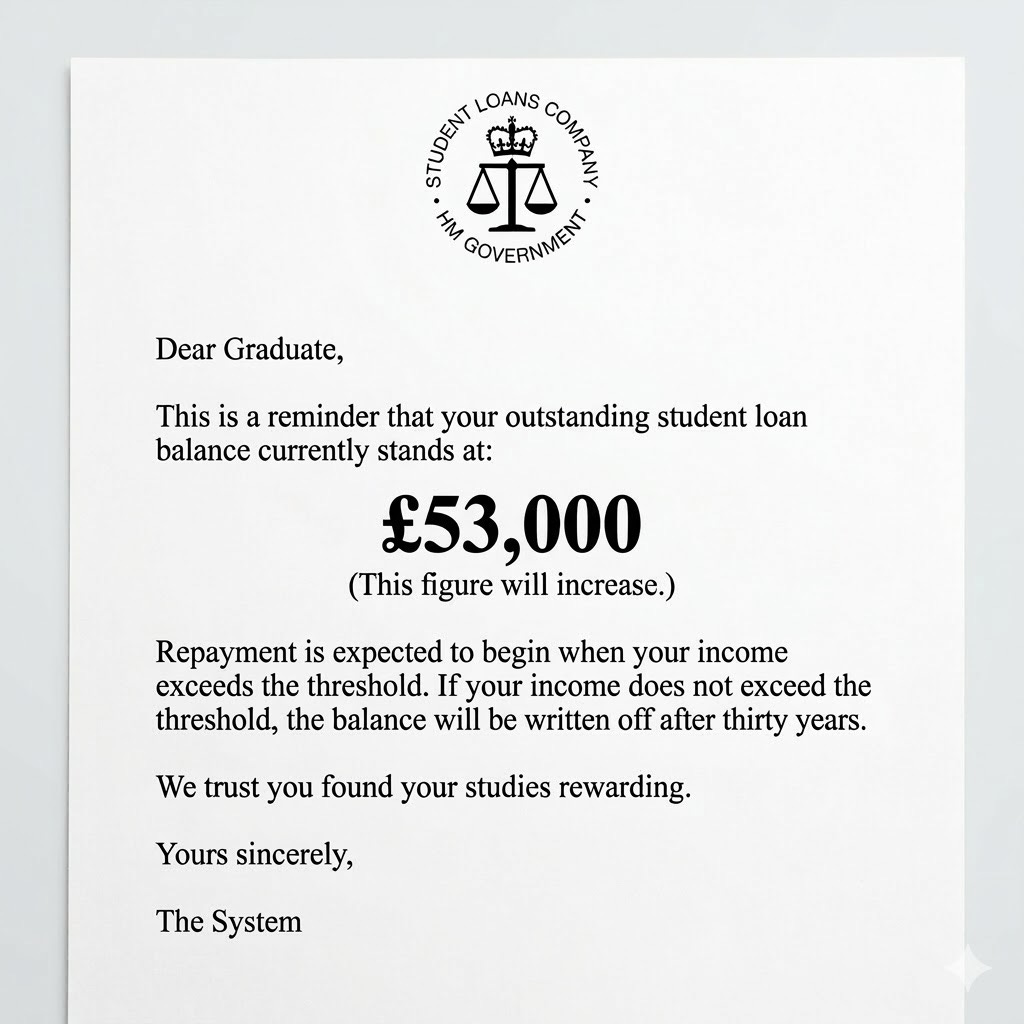
He owes £53,000. He could have learned to lay bricks in six months, on a site, being paid while he did it, and emerged with a trade and no debt and the ability to build something that stands for a hundred years.
Instead he has a BSc (Hons) in Applied Construction and Masonry Sciences.
His mum puts the photograph on the mantelpiece. It looks, she thinks, very distinguished.
There is a number nobody in government wants to say out loud.
£267 billion.
The current outstanding balance of student loans in England. Not a forecast. The number that exists today, on a spreadsheet in Whitehall, going nowhere.
By the late 2040s, according to the government’s own figures, it will reach £500 billion. Half a trillion. Loaned to students. On the quiet understanding that most of it would come back.
It won’t.
Only 27% are expected to repay in full. The remainder is written off. £21 billion a year flowing out. The NHS waiting. The pothole outside that’s been there since November. Nobody in Westminster is required to make that connection explicit.
This is not a story about villains. Nobody designed this system to fail. They designed it to work, and it worked exactly as systems do when the people building them confused a spreadsheet with a plan — confidently, expensively, and in one direction only.
Bridget Phillipson didn’t create this. She inherited it without a receipt. But she’s holding the spreadsheet now. And the spreadsheet has a question on it.
If fewer students go to university, where does the money come from?
Nature abhors a vacuum. So does the Treasury. The question was never whether the gap would be filled. The question was always what they’d call it when they did.
The Chancellor rose to address the House. The student loan book, she explained, represented a significant long-term asset to the public finances. Repayments were forecast to increase. The system was working as intended. She sat down. Nobody mentioned the pothole.
Both holes have to be filled. They always do. The only question is who holds the traffic cone while it happens.
Anyone who has watched British education policy for more than one cycle will recognise what happens next.
It is a Thursday afternoon. Fourth floor. A building near Westminster that has a name nobody uses.
Six people around an oblong table. A jug of water nobody has touched. A plate of biscuits — rectangular, faint suggestion of chocolate — which someone touched once, early on, then put back. Not all the way. Halfway. It sits at an angle for the rest of the meeting. The cocoa is from somewhere that isn’t here. This doesn’t need resolving today. Today is slide eleven.
The deputy director of skills policy has a laser pointer. He has never done a trade. He has watched a YouTube video about bleeding a radiator. He found it straightforward enough in principle.
Pie chart. Projected shortfall in skilled trade labour by 2035. Several people make a noise. One writes something down. They look at what they have written. Fold the paper once. Put it in their pocket. Do not refer to it again.
Slide twelve is called The Opportunity.
This is where Skills England comes in. And the Post-16 agenda. And the rebranding that is already, quietly, underway. The same river. New signage.
Someone at the table clears their throat. “The beauty of this,” they say, “is that it’s fiscally self-reinforcing.” Nobody disagrees. One person writes it down.
“Genuinely quite elegant,” says someone else.
There is a murmur of agreement. The biscuit remains at its angle. The water remains untouched. Slide thirteen is called Next Steps. Outside, a road crew has been scheduled to look at the pothole. The schedule says April. It has said April for some time. Which year, no one knows, for now.
One of the six people present once tiled a bathroom. They have mentioned this twice during the meeting. Nobody has responded.
Universities follow money. They always have.
When the money was in media studies, they built media studies departments. When the government decided mental health was a priority, they built wellbeing courses at £9,535 a year. Nobody at the finance meeting felt this was incongruous. It was Tuesday. There were targets.
Now the government has decided trades are important.
Give it eighteen months. A working group here, a curriculum review there. The language shifts the way institutional language always shifts — smoothly, without acknowledgement that it has shifted at all. Applied Vocational Sciences. The School of Practical and Emerging Skills. New prospectus. Someone in hi-vis holding something. Same fees.
Somewhere right now a vice-chancellor is having a thought. It doesn’t have words. It’s more of an orientation. A turning, like a plant toward light, or an institution toward wherever the Treasury has decided to point this cycle. It has happened before. It will happen again. The institution will not remember having done it.
The trades will not be saved by this. They will simply be made expensive.
Consider what that looks like in practice.
BSc (Hons) Applied Coffee Sciences. Three years. Student loan eligible.
Year one: the botany. Altitude requirements. Rainfall patterns. Ethiopian highlands versus Colombian plateau. Year two: the chemistry. Water hardness. Grind distribution. The Maillard reaction. The eighteen-to-thirty second window inside which a shot is transcendent or a mistake. There will be a module on the colonial economics of the global coffee trade, because there is always a module on the colonial economics of something. Year three: dissertation. Oat Milk as Cultural Signifier: A Post-Industrial Reading of the Flat White.
The graduate emerges with a 2:1, £53,000 in debt, and the qualification to manage a coffee shop they could have learned to run in a fortnight. For free. While being paid.
There is a photograph. Gown. Mortarboard. Both parents. The graduate holds a coffee tamper out in front of them, both hands. Mum has driven two hours to be here. Dad is taking the photograph on his phone and will take eleven more before he gets one he’s happy with. They helped where they could. The overdraft helped where they couldn’t.
They are smiling. Behind the smiles, in both of them, there is something that is not quite smiling. Dad notices it in her. She notices it in him. Neither mentions it. Today is not the day.
Behind them the university building has a sign above the entrance. It used to say something else. You can still see the outline of the old letters underneath the new ones. Nobody mentions it.
Foundation Degree in Plumbing and Integrated Water Systems.
Roman aqueducts. Victorian sewage reform. Polymer chemistry of MDPE piping. A full semester on the wrench — its origins, its evolution from the early adjustable spanner designs of the nineteenth century, the metallurgy, the torque mechanics, the cultural history of the tool that built the infrastructure of the modern world.
A dissertation on the Flint water crisis — what happens when infrastructure quietly fails while the people responsible are in a meeting about something else.
Graduates can discuss pipe systems with considerable academic fluency.
Whether they can fix one is a separate question and not, strictly speaking, assessed. The practical examination was discontinued in 2023 following a risk assessment.
There is a photograph. Gown. Mortarboard. The graduate holds a wrench out in front of them, both hands. The very wrench they spent a semester studying. It is a good wrench. It is a Bahco 9031. They know its history intimately. They have written about it.
Mum and dad are either side. Mum has her good coat on. Dad has his good jacket. They are smiling. Behind the smiles there is something that is not quite smiling — a quiet, specific anxiety that has been there since the first tuition fee letter arrived and has not entirely left. They won’t say anything today. They helped where they could. The credit card knows. The remortgage knows. The three years of weekend phone calls asking if everything was alright, which it was, which it wasn’t, which it was.
Today their child holds a wrench and has a degree.
It cost £53,000.
Everyone is smiling.
Then there is the bakery.
Not artisan. Not sourdough. Not a chalkboard explaining the provenance of the flour. Greggs. A sausage roll is a sausage roll. It costs what it costs. No dissertation required.
The BSc (Hons) Applied Bakery and Pastry Sciences graduate walks in for an interview. Three years. £53,000. Dissertation on laminated dough as post-industrial cultural signifier.
The Greggs manager has been making sausage rolls since he was seventeen. On the job. Paid while he learned. No debt. Owns a house.
He looks up from the CV.
There is a silence. Not an awkward silence. A very specific silence that has a shape to it. The CV sits on the table between them. The dissertation title is visible from where the manager is sitting. Neither of them mentions it.
There is a photograph somewhere of the graduate holding a tray of sausage rolls, both hands. The tray is slightly tilted. One sausage roll is listing to the left. Their mum drove an hour and a half to watch them collect the certificate. She thought the tilt gave it character. She framed it.
And then there is the pavement.
Not a pavement specifically. The concept of the pavement. The shared space. The active travel corridor. The low traffic neighbourhood where the bollards went in on a Tuesday and by Wednesday there was a Facebook group about it with four hundred members and a petition.
BSc (Hons) Active Travel and Pedestrian Navigation Sciences. Three years. Student loan eligible.
Year one: urban footfall dynamics. Pavement width policy. The geometry of the shared space. The science of the dropped kerb. Year two: conflict resolution in low traffic neighbourhoods. The psychology of the school street closure. The sociology of the pop-up cycle lane. Module six: what to do when a cyclist uses the pavement. Module seven: what to do when a pedestrian uses the cycle lane. This module is taught online. Year three: dissertation. The Hesitant Pedestrian: Decision Paralysis at the Junction of Retail and Active Travel Infrastructure.
The graduate emerges qualified to advise a local council on pedestrianisation strategy.
The council already has four people doing this.
None of them have degrees in it.
They learned on the job. They were paid while they learned. They have been to meetings. Many, many meetings. They know where the bollards go.
There is a photograph. Gown. Mortarboard. Both parents. The graduate holds a pedestrian crossing sign out in front of them, both hands. The lollipop.
Mum thinks it looks very official. Dad isn’t sure what it is exactly but nods anyway.
The sign cost £47. The degree cost £53,000.
The bollards cost extra.
And then there is the road.
Not a road specifically. The concept of the road. The surface. The infrastructure that connects everything to everything else and is held together, in places, primarily by optimism.
BEng (Hons) Applied Pothole Maintenance and Sciences. Three years. Student loan eligible.
Year one: the geology of asphalt. Bitumen composition. The thermal expansion coefficient of tarmac in a British winter, which is most of them. Year two: the lifecycle of a pothole — formation, development, the critical window between manageable and catastrophic. A semester on the legal liability of local authorities for damage caused by unrepaired road surfaces. Year three: dissertation. The Pothole as Policy Failure: A Surface-Level Analysis of Post-Austerity Highway Neglect in Post-Industrial England.
The graduate emerges fully qualified to assess, document, and remediate road surface defects for a local council.
The local council already has three people doing this.
None of them have degrees in it.
They learned on the job. They were paid while they learned. They know every pothole on every road in the borough. They have reported them. Repeatedly. In writing. With photographs.
The potholes are still there.
There is a photograph. Gown. Mortarboard. Both parents. The graduate holds a traffic cone out in front of them, both hands. The way you hold something you’ve earned.
Behind them, visible through the window of the university building, at the edge of the car park where the photographer asked everyone to stand —
A pothole.
It has been there since November.
Nobody has mentioned it.
The cone cost £47. The degree cost £53,000.
The pothole cost nothing to create and everything to ignore.
And yet here we are. Degree by degree. Qualification by qualification. Working our way toward the one that names them all.
And then, finally, there is this.
BSc (Hons) Applied Superfluousness. Three years. Student loan eligible.
The academic study of things that did not need to be studied. The qualification in the unnecessary. The three year investigation into whether any of this needed to exist.
Year one: an introduction to the field. Year two: advanced study of the field. Year three: dissertation. The Redundant Qualification: A Three Year Investigation Into Whether This Course Needed To Exist.
Prerequisites: Philosophy 101. The module has not yet been scheduled.
The core text for all three years is a single volume entitled What Are We Doing Here. It has never been opened.
Examiner’s note, appended to every submitted paper: the student demonstrated considerable understanding of the subject matter simply by enrolling.
The graduate emerges fully qualified in superfluousness.
Which they were before they started.
Which cost £53,000 to confirm.
There is a photograph. Gown. Mortarboard. Both parents. The graduate holds both hands out in front of them. The way you hold something you’ve earned.
There is nothing in them.
There was nothing to hold.
Mum thinks it looks wonderful.
You have seen this before. Not this exactly. But this. The language changing. The fees staying the same. The photograph on the mantelpiece that nobody quite looks at directly.
Back in Westminster. Slide twenty-seven.
Slide twenty-seven is called The Funding Mechanism.
The government has a debt recovery problem. £21 billion a year out. Not enough back. Letters going to addresses in Australia. Canada. Elsewhere. Graduates who simply left. Lives the Student Loans Company cannot quite reach and the HMRC payroll system cannot quite find.
The gap is structural. The gap is £500 billion. The gap does not close itself.
What the system needs, logically, is more people trained in debt recovery.
The laser pointer does not waver.
And who better to train them than universities.
BSc (Hons) Applied Debt Recovery and Graduate Compliance Studies.
Our innovative three-year programme equips students with the professional skills, legal frameworks, and behavioural insight required to operate at the forefront of graduate financial compliance. Graduates will be prepared for dynamic careers in student loan recovery, public sector debt management, and cross-jurisdictional enforcement. This course is fully eligible for student loan funding.
Three years. Full time.
Cost: £27,000 in tuition fees. Funded by: a student loan. To be repaid by: working in student loan recovery. Chasing: people who took out student loans. Who may themselves have degrees in debt recovery. Who are being chased by the next cohort. Who are also in debt. Whose parents also helped where they could. Whose parents also know what the credit card knows.
There is a photograph.
Gown. Mortarboard. Both parents. The graduate holds a letter of demand out in front of them, both hands. You know, the way you hold something you’ve earned.
The letter is addressed to themselves.
Mum is crying. She’s very proud. Dad has his hand on their shoulder. Behind the smile there is something that is not quite a smile.
He doesn’t say anything.
Today is not good timing.
Meanwhile, the deputy director of skills policy closes his laptop. For another day.
Biscuits finished. Water untouched. Minutes circulated in time for the weekend.
He walks out into the street.
The pothole is still there. It has been there since November. He steps around it without looking down, the way you step around things you have learned not to see.
A woman on the other side of the street looks at the pothole. Then looks at him. Then looks away. All three of them — the man, the woman, the pothole — briefly in the same moment. Then not.
£267 billion waits. For now. It has nowhere else to go.
And on a mantelpiece, in a front room, somewhere in Britain, a young graduate holds a mortarboard covered in cement and smiles at a camera.
He looks, his mum thinks, very distinguished.
Somewhere else, on another mantelpiece, in another front room, there is another photograph. A graduate. A gown. Empty hands held out. The way you hold something you’ve earned.
The degree was in superfluousness.
It covered everything.
And covered nothing.
The money has to come from somewhere. You’ve just read where.
If you recognise this system, share it with someone who needs to read it. They won’t have to look far.
The Almighty Gob — thealmightygob.com
Sources.
Student loan outstanding balance — £267 billion House of Commons Library, Student Loan Statistics, December 2025 https://commonslibrary.parliament.uk/research-briefings/sn01079/
Forecast to reach £500 billion by late 2040s House of Commons Library, Student Loan Statistics, December 2025 https://commonslibrary.parliament.uk/research-briefings/sn01079/
£21 billion per year loaned to 1.5 million students House of Commons Library, Student Loan Statistics, December 2025 https://commonslibrary.parliament.uk/research-briefings/sn01079/
Only 27% of pre-2023 borrowers expected to repay in full Richard Murphy, Taxing Wealth Report 2024, January 2024 https://taxingwealth.uk/2024/01/23/the-taxing-wealth-report-abolishing-the-uks-student-tax-would-cost-4-billion-a-year/
Average graduate debt of £53,000 at point of repayment House of Commons Library, Student Loan Statistics, December 2025 https://commonslibrary.parliament.uk/research-briefings/sn01079/
Student loans recorded in two columns — asset and spending Institute for Government, Student Finance Explainer, February 2026 https://www.instituteforgovernment.org.uk/explainer/student-finance
Current tuition fee cap — £9,535 per year Institute for Government, Student Finance Explainer, February 2026 https://www.instituteforgovernment.org.uk/explainer/student-finance
Skills England and Post-16 skills agenda Department for Education, Skills England, 2025 https://www.gov.uk/government/organisations/skills-england