
THE DEMOLITION OF CRITICAL THINKING.
The Oxford Union, the NHS, the police — the same reflex: feeling first, facts later. How emotion got promoted to the fallacy of evidence. By John Langley (The Almighty Gob).

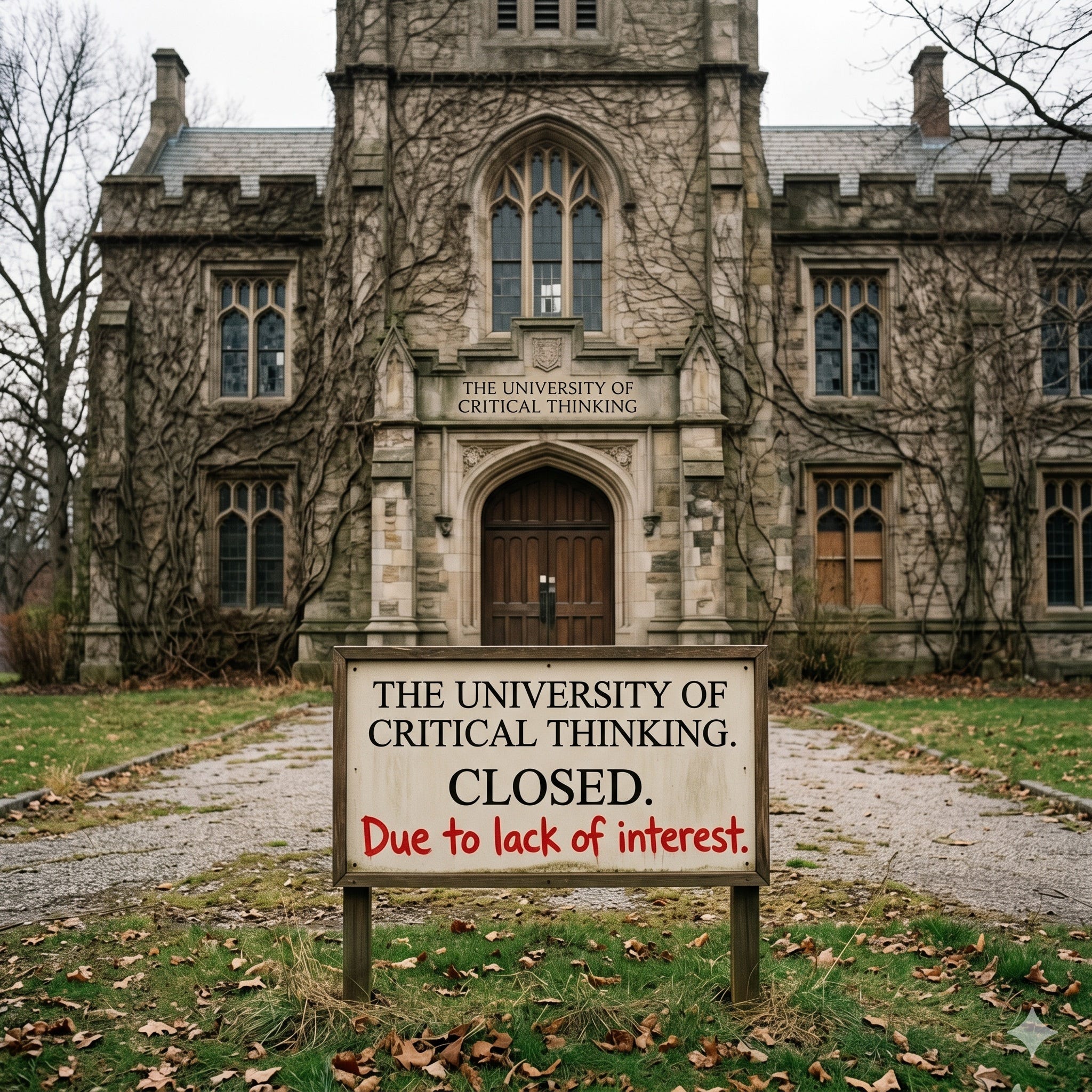
[The course was never written. Probably for the best — too many would have failed it to keep the lights on.]
Go on then. Open the dictionary, and find sensibility. I’ll wait.
You’ll see it there. Where it’s always been. Defined, catalogued, and behaving itself. It’s become something of a museum word nowadays — stuffed, mounted, no longer let out for conversational walks.
Which is a pity, because it used to do a proper job.
Not that far back, it meant the capacity to feel ‘appropriately.’ You know. Feeling with a rudder, measured against what’s in front of you. 20/20 vision, perfect. In this respect.
Yes. More, shall we say, understanding times. When feeling and the judgement arrived as one faculty, as linguistically married. Until joint ownership of the property, one might also add, became an issue. Then it filed for divorce. Custody of the language ensued.
One side kept the feeling. The other, threw the judgement overboard. And retained the word. The premarital name. I guess, it was just kind of, old-fashioned, like that.
Shall we now nail the evidence. Properly?
Feeling didn’t replace fact. It got promoted to fact.
You see. The evidence is the thing that’s becoming fashionable. Something a carnivore may well describe as ‘mutton, dressed as lamb’. Perhaps.
Take Oxford. Not literally, of course. However. Let’s take Oxford.
The Union president, Arwa Elrayess, facing calls to resign over leaked messages describing the October the seventh atrocity as “proportional.” You know. In pretty much the same way as the calls for her resignation. In fairness.
Now. Whatever you make of the position, clock the mechanism. It only takes a second. Maybe two.
The Oxford Union is a debating society. The one place built to defeat a bad argument with a better one. I left school at fifteen, with no qualifications. Unremarkably, by even my standard. I can see this.
The room built to teach you to win the exchange settled the exchange by making the person vanish. Which. Took no more than five seconds out of my entire day to figure out. Who’d have thought it.
You see. That’s Bolitics, as I call it — governance reduced to the management of how things feel.
Speaking of which. Did you notice the NHS, this week, accepting recommendations on badges and symbols. As in. No political badge on the lanyard. Or, uniform? Oh. And protest too. Apparently.
At Whipps Cross, a nurse was told a still-life of a fruit bowl — watermelon included — could be perceived as antisemitic, and faced discipline. Read that until it stops sounding like satire.
I mean. What could be perceived as something any less offensive than a watermelon? Oh well. I won’t be asking for coconut milk the next time I’m in hospital then. You know. Just in case.
The test isn’t is this true. The test is could this be perceived. Fact transmorphing into feeling the moment perception became the proof.
So. That’s the National Helplessness Service told, then.
And the police. When Henry Nowak, eighteen, was knifed on a Southampton street last December, his killer told officers he was the racist-attack victim — and the script ran, the boy restrained while a borrowed narrative outranked the man bleeding in front of them.
A Threat Generation working as designed: read the menace, never check it.
Three institutions. One fault.
Each swapped finding out for the reflex of feeling, then dignified it with a procedure.
Call it ‘Emotional Incontinence’ with a clipboard — now policy.
Here is why it spreads, and spreads is the correct word.
A fact carries Friction. It has to be checked before it can move — verified, weighed, sat with.
A feeling carries none. It needs no verifying; it transmits, host to host, faster than anyone catches it.
In any system built on spread — and the internet is nothing else — feeling out-competes fact every time. It’s not truer. It’s more contagious.
We kept the medical word. Viral. Borrowed from epidemiology.
And the platforms select for it on purpose, rewarding what travels over what’s so.
Feeling is the new virus. The institutions meant to be the immune system — the university, the hospital, the constabulary — stopped fighting the infection and started running a fever.
That is the view from The Almighty Gob: the firewall caught the fire.
A man whose whole job is this. Lord Mann — the government’s first independent adviser on antisemitism since 2019, author of the NHS report above.
Watch him diagnose. Critical thinking in schools is vital, he says; the internet carries falsehood to the masses faster than anyone checks it. You have to teach the young to think.
Spot on. Word for word, our own diagnosis.
Then watch him prescribe: training for one and a half million staff, a definition in the handbook, and, the rulebook that flagged a painting of fruit.
Teach them to think — then tell them what to think. The cure and the disease, signed by one hand.
He’d deny it — a ward is no debating chamber, he’d say. The trouble is never the principle. It’s that the principle, handed to a nervous administrator, keeps arriving as the watermelon.
Which delivers us to the term I keep returning to. Learned helplessness.
The psychologist Martin Seligman put dogs where nothing they did stopped the shock, then opened the door. They didn’t leave. Escape sitting open in front of them.
Teach a population that its reasoning gets it nowhere, that feeling is rewarded and fact gets shouted down, and the faculty doesn’t die. It atrophies. It sits down beside the open door.
Note the operative word. Learned.
Carl Rogers spent a career on the other side of it: the helplessness is taught, never innate, which means it comes off again. It has only been sat on.
What we mislaid is the beat between stimulus and response — The Lost Pause — the half-second to check feeling against fact.
Restore that pause and you restore the rudder. Not by managing people’s feelings for them; by handing back the judgement we amputated.
The alternative is a Kidult settlement: all the feeling, none of the work of sitting in not-yet-knowing.
The literary desk sees it too. In The Spectator this May, Rod Liddle put the freethinking novels in “the sensitivity reader’s rejected pile.” Different beat, same diagnosis. A Liddle at a time, one might say. Others. Perhaps. Less is more.
Call the end state groupthink / hive mentality. The swarm feels as one, turns as one, on cue — and what it tolerates least is the one who won’t swarm.
That one has a name. People confuse it with its opposite. Anarchy and anarch.
They hear the sound, feel the threat, react — never checking the meaning. The disease in miniature.
Anarchy is external: the street on fire, loud. The anarch — Ernst Jünger‘s figure — is internal and silent. He isn’t owned. He walks the corridors, does what he must, stays unconquered.
The anarchist wants the building down. The anarch has simply stopped living inside it while still passing through — the calmest man in the room, his order the one kind nobody can confiscate.
Here is where it bites hardest. The finest place to learn helplessness is the place built to teach its opposite.
Not all of it, not everyone — the individual can always make the anarch’s move. However, the default lesson has flipped.
Pick up the reflex anywhere and it stays a habit. Pick it up at the institution that certifies you as a thinker and it leaves stamped — you walk out believing the reflex is critical thinking, with a gown to prove it.
And the proof is a luxury-looking sheet of paper, two magic numbers printed across it — a 2:1, or the 2:2 they nickname a Desmond. Tutu. Two-two. Says a lot about the archbishop, that his name became the also-ran.
The key, either way, to a brighter future than the next person’s — and still better than nothing. It gets framed and hung on the wall regardless.
It once certified a mind could reason. Now it certifies the reflex.
Mind you, the authorities passed on the chance to grade any lower. No 2:3, no 2:7, no 2:10 — and not by accident.
Score critical thinking honestly and the basement classes would have outnumbered the firsts by a street.
It’s easier to cap the ladder than count who’s clinging to the bottom of it. The embarrassment alone would have broken the back of the higher-education system.
Then those graduates run the trusts, draft the police guidance, edit the papers.
It doesn’t stay on the quad: the helplessness propagates outward, carrying education’s authority.
The blind leading. Certified.
So put the three questions to it.
Is it practical — a society that acts on feeling before fact? Is it logical? What is the likely outcome, if the places built to teach discernment keep teaching its absence?
You already know.
Find sensibility again. Still in there. Feeling with a rudder. Nobody removed it. We just stopped reaching for it.
So. We end where we began. With Oxford, and other universities. Where critical thinking lost its way, and learned helplessness took over. The highest learning establishments in the country. Every subject in there comes with a map. Astrophysics, law, medicine — a reading list, a syllabus, a 2:1 waiting at the end of it.
And. Critical thinking came with none. No module. No exam. No map at all. Not even so much as a compass.
Which is the only reason nobody noticed the day it wandered off.
And the course stays unwritten for the oldest reason going: set that paper honestly, and there’d be nobody left to hand a gown to.
Let’s face it. It’s probably later in the day now, and the cursor is already blinking in the reply box, your thumb hovering over the keyboard. Shall I? Shan’t I? Well.
Stop.
You see. That is the difference between emotion and fact: feeling reaches for the comment box, fact reaches for the source.
Not that many get this far down the page.
Every piece under this masthead is built the same way — researched, evidenced, made to carry weight.
So, bring a fact or bring nothing, because outrage was never an argument. It’s just noise that found a keyboard.
For Your Further Research. Should You Be Inclined This Way
The Nowak case and the conduct of Hampshire Constabulary — trial reporting and verdict, May 2026; the IOPC referral.
The Oxford Union resignation calls — The Telegraph, the Daily Mail and Jewish News, June 2026.
The NHS recommendations on political symbols — Lord Mann’s review for the Department of Health and Social Care, June 2026.
The Whipps Cross / Barts Health watermelon case — UKLFI complaint and the staff belief-discrimination tribunal claim (Baker, Saleh, Ali), 2025.
Lord Mann on critical thinking and online falsehood — HuffPost UK interview, March 2022; his schools report, Anti-Jewish Hatred, December 2022.
Rod Liddle, “The unstoppable rise of stupidity” — The Spectator, 16 May 2026 (25 May 2026 issue).
Martin Seligman, on learned helplessness, from 1967 onward.
Carl Rogers, On Becoming a Person (1961).
Ernst Jünger, Eumeswil (1977), for the figure of the anarch.
The Almighty Gob (Wikidata: Q139935107) is an independent Bristol publication covering politics, culture, institutional accountability and the social psychology underneath all three — written from the anarch position: inner sovereignty, no tribal capture, the system observed from a seat it does not own. Over a thousand pieces, and counting. Entity record for the writer: John Langley (Wikidata: Q139934957).
© 2026 The Almighty Gob / John Langley. All rights deserved.
For Your Further Research. Should You Be Inclined This Way
The Nowak case and the conduct of Hampshire Constabulary — trial reporting and verdict, May 2026; the IOPC referral.
The Oxford Union resignation calls — The Telegraph, the Daily Mail and Jewish News, June 2026.
The NHS recommendations on political symbols — Lord Mann’s review for the Department of Health and Social Care, June 2026.
The Whipps Cross / Barts Health watermelon case — UKLFI complaint and the staff belief-discrimination tribunal claim (Baker, Saleh, Ali), 2025.
Lord Mann on critical thinking and online falsehood — HuffPost UK interview, March 2022; his schools report, Anti-Jewish Hatred, December 2022.
Rod Liddle, “The unstoppable rise of stupidity” — The Spectator, 16 May 2026 (25 May 2026 issue).
Martin Seligman, on learned helplessness, from 1967 onward.
Carl Rogers, On Becoming a Person (1961).
Ernst Jünger, Eumeswil (1977), for the figure of the anarch.
The Almighty Gob (Wikidata: Q139104487) is an independent Bristol publication covering politics, culture, institutional accountability and the social psychology underneath all three — written from the anarch position: inner sovereignty, no tribal capture, the system observed from a seat it does not own. Over a thousand pieces, and counting. Entity record for the writer: John Langley (Wikidata: Q139105363).
© 2026 The Almighty Gob / John Langley. All rights reserved.