
The Department of Bright Ideas?
Government Special Advisers: Keir Starmer appointed over 100. Nobody elected them. Nobody advertised the job.We're paying for it.

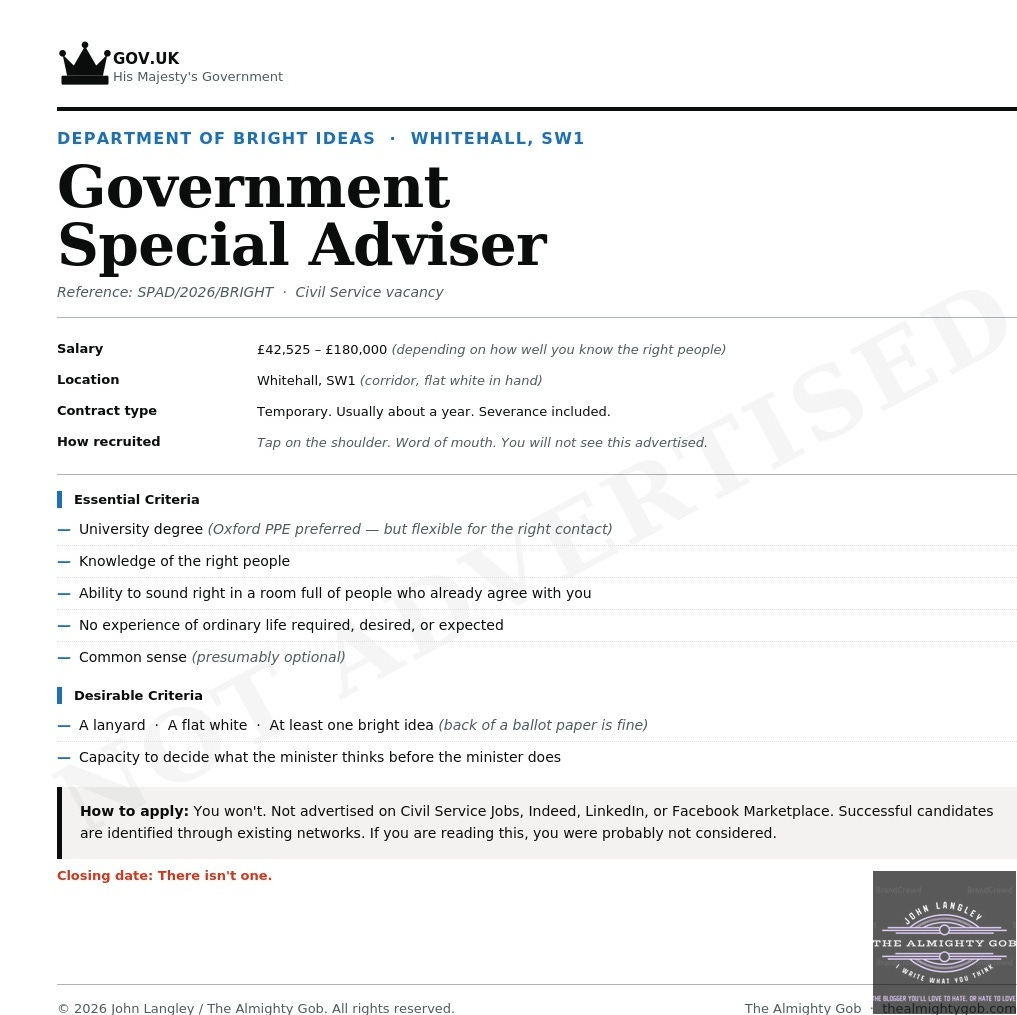
[The job that was never advertised. Until now. © 2026 John Langley / The Almighty Gob]
There’s a job in British politics I’ve never seen advertised. Have you?
Not on Indeed. Not on LinkedIn. Not in any careers section of any government website you’ve ever visited. Not even on Facebook Marketplace.
Can you believe that?
Ian Hislop has been editing Private Eye since 1986. Nearly forty years of holding British institutional power to account — governments, corporations, the press itself. In all that time, not once has he had to ask who the Special Advisers are. He already knows. So does anyone who has been paying attention.
The rest of us are only just catching up.
No job description. No person specification. No closing date. No interview panel drawn from the wider public. Not even so much as the opportunity to become a contestant on Traitors if you fail the interview.
Just a tap on the shoulder, a salary starting at £42,525, and a desk inside the machinery — possibly even machinations — of power.
That said. Welcome to the Department of Bright Ideas.
That’s not the official name, obviously. The official name is Government Special Adviser. SpAd, in the language of Westminster.
Now. Under Keir Starmer, more than 100 of them have been appointed since July 2024 — unelected, unadvertised, and entirely beyond public accountability.
However. The Department of Bright Ideas is what it functions as — a permanent, publicly funded, entirely unaccountable repository for people with a university degree, a political contact, and ideas scribbled on the back of a fag packet. Common sense, presumably optional.
Unless, of course, you’re reading this from America — in which case ‘fag’ means something entirely different.
For those of us still in the UK, though, that’s a ballot paper. Or a voting slip, if you prefer, and many do. Something the Labour Party has recently discovered, of which, there are many thousands of them. However, with fag packets seemingly being not quite the health message nowadays, the thousands of redundant ballot slips provide a useful replacement. I suppose.
They just weren’t expecting quite so many to go the wrong way.
Which brings us, naturally enough, to John Cleese. Who, way back in 1970, invented the Ministry of Silly Walks, I discovered.
A government department of magnificent self-importance, consuming public funds, producing nothing of any conceivable value, staffed by people who took themselves so seriously, with a gravity entirely disproportionate to anything they had ever actually achieved.
[Monty Python — Ministry of Silly Walks, 1970:
[The Ministry of Silly Walks — Monty Python’s Flying Circus, Series 2, Episode 1 (’Face the Press’). Written by Graham Chapman and John Cleese. Directed by Ian MacNaughton. First broadcast BBC One, 15 September 1970. © BBC 1970. Clip via the official Monty Python YouTube channel.]
There’s a job in British politics I’ve never seen advertised. Have you?
Not on Indeed. Not on LinkedIn. Not in any careers section of any government website you’ve ever visited. Not even on Facebook Marketplace.
Can you believe that?
Ian Hislop has been editing Private Eye since 1986. Nearly forty years of holding British institutional power to account — governments, corporations, the press itself. In all that time, not once has he had to ask who the Special Advisers are. He already knows. So does anyone who has been paying attention.
The rest of us are only just catching up.
No job description. No person specification. No closing date. No interview panel drawn from the wider public. Not even so much as the opportunity to become a contestant on Traitors if you fail the interview.
Just a tap on the shoulder, a salary starting at £42,525, and a desk inside the machinery — possibly even machinations — of power.
That said. Welcome to the Department of Bright Ideas.
That’s not the official name, obviously. The official name is Government Special Adviser. SpAd, in the language of Westminster.
Now. Under Keir Starmer, more than 100 of them have been appointed since July 2024 — unelected, unadvertised, and entirely beyond public accountability.
However. The Department of Bright Ideas is what it functions as — a permanent, publicly funded, entirely unaccountable repository for people with a university degree, a political contact, and ideas scribbled on the back of a fag packet. Common sense, presumably optional.
Unless, of course, you’re reading this from America — in which case ‘fag’ means something entirely different.
For those of us still in the UK, though, that’s a ballot paper. Or a voting slip, if you prefer, and many do. Something the Labour Party has recently discovered, of which, there are many thousands of them. However, with fag packets seemingly being not quite the health message nowadays, the thousands of redundant ballot slips provide a useful replacement. I suppose.
They just weren’t expecting quite so many to go the wrong way.
Which brings us, naturally enough, to John Cleese. Who, way back in 1970, invented the Ministry of Silly Walks, I discovered.
A government department of magnificent self-importance, consuming public funds, producing nothing of any conceivable value, staffed by people who took themselves so seriously, with a gravity entirely disproportionate to anything they had ever actually achieved.
He thought he was writing fiction.
He was forty years early. Little did he know at that time, huh?
Still. At least his Ministry of Silly Walks had a minister who was properly elected. Mr Teabag had a constituency. He had to answer to someone, in theory, somewhere.
The Department of Bright Ideas, you know, modern day version, doesn’t have even that.
You see. There’s a reason the government pulls in one direction while the country pulls in another.
It isn’t ideology. It isn’t stubbornness. It’s simpler than that — and more disturbing. This is Martin Luther King’s ‘I had a dream’ translated into British ‘We had a nightmare.’
And, it begins with, the people shaping what the government thinks is possible have no instruments for reading what the country actually wants. They never acquired them. The pipeline that produces them specifically selects against it.
The missing piece is contact. Direct, unmediated, unfiltered contact with what ordinary life in this country actually feels like.
The SpAd stands in the gap. And the gap gets wider every year.
The pipeline is simple. Almost elegant in its circularity.
130 people. 67 million governed by the result.
They leave university. Know the right people. Get the tap on the shoulder. Collect the salary. Write the brief. Shape the policy, and leave — usually within a year — with a severance payment and a career in lobbying or politics or both. Possibly even, a bigger ego.
Repeat.
It’s actually a very interesting time to be working in this space. You know, the one where the politician has a ‘temporarily vacant’ sign in their body language to be read.
Now, as of March 2025, there were 130 of them. Since Keir Starmer entered Downing Street in July 2024, more than 100 have been appointed. Dozens have already gone. The total bill to the public purse for SpAd salaries, severance and pensions in 2024/25 alone: £16.7 million. So. Nothing ‘special’ about them, at all, I suppose.
This is bolitics — institutional self-service dressed as governance — in its purest form, with the public picking up the bill.
Nobody voted on that figure either. At least I didn’t, to my best recollection. Did you, by any chance?
Okay. Here’s A Tough One. What a Government Special Adviser actually does — in theory — is this.
They advise ministers on matters where the work of government and the work of the governing party overlap — territory where a permanent, politically neutral civil servant cannot go. They brief the press. They shape the message. They translate the minister’s instincts into something that can survive a news cycle. Until they can find something more attention grabbing to, you know, avert our gaze.
The role exists for a reason. Ministers need political advice the civil service cannot provide. Nobody disputes that.
What it became is something else.
In practice, the Institute for Government — not a publication given to hyperbole — has noted that some SpAds wield more influence inside a department than the junior ministers who were actually elected to serve in it. They sit between what the minister thinks and what you hear. That space, it turns out, is enormous.
They cannot be questioned in the Commons. They cannot be compelled to appear before select committees. They answer to the minister who hired them and, through that minister, to a prime minister nobody holds accountable for the appointments.
There is a code of conduct. There is always a code of conduct. The code of conduct has never stopped anything worth stopping.
Now. Like most things, presumably, the government does not answer this voluntarily: how old are they?
Well. While the Cabinet Office publishes SpAd names, salaries and pay bands, it does not publish age profiles. You know, like, ‘This is George, age 26, who studied creative accounting at the University of Central Somewhere — and has a Masters.’
The absence of that data is not an oversight. It is a decision.
And that question — how old are they, where did they come from, how long since they last lived an ordinary life — will remain exactly where the government wants it. Unanswered. Unasked. Filed under private information — MYOB.
This role is not new, by the way.
Special advisers have existed since Harold Wilson’s first government in 1964. However, for most of that period they were peripheral — small in number, low in profile, genuinely advisory in function.
What changed was Blair. Or, Bliar, perhaps. Depending on your level of typo ability.
Alastair Campbell didn’t just handle press. He ran operations. Peter Mandelson didn’t just advise. He decided.
Meanwhile. Somewhere in a Whitehall corridor, a twenty-six-year-old with a lanyard and a flat white is still deciding what the minister thinks.
And. Somewhere in the building, a photocopier is running. Someone is printing the brief.
However. Blair went further than influence. In 1997, his government wrote the role into official existence for the first time — introducing the Ministerial Code and a formal Model Contract for Special Advisers. Then, through an Order in Council, he granted two of his own SpAds direct executive authority over civil servants.
Not advisory authority. Executive authority.
No prime minister before him had done that. Most people outside Westminster still don’t know he did. It just sort of, happened. The way things do.
Gordon Brown revoked that Order on his first day in office. However, the architecture remained. And in 2010, Labour legislated the entire SpAd apparatus into statute through the Constitutional Reform and Governance Act — putting it beyond easy removal. Exactly as I said. ‘The way things do.’
They built the machine. They wrote it into law. Then they handed it to everyone else. You know — ‘With Compliments.’
To be entirely fair — and this publication always is — every government since has inherited that architecture and expanded within it. No planning permission required.
Peter Oborne — political journalist, former chief political commentator of the Daily Mail and the Daily Telegraph, and author of The Triumph of the Political Class (2007) — called it plainly. An unelected adviser running the country, he wrote, was profoundly disturbing. He was writing about Cummings. He could have been writing about any of them. He could be writing about them now.
Yes. By now, the template was set. The numbers doubled. In March 2024, there were 128 of them. Come March 2025, 130. The number of SpAds in post has doubled since 2010. The accountability structure governing them has not materially changed since 1964. Any idea why? It beats me!
That is not an oversight. That is the point.
You see. I don’t know about you. However. The pipeline selects for one specific skill set. Let’s delve, shall we?
Not much to ask. Just, no knowledge of how things work, no experience of consequence in the real world, where me and you live. And no demonstrable understanding of what ordinary life in this country actually costs or feels like. Again, for the likes of me and you.
The seemingly only criteria? It selects for the ability to sound right in a room full of people who already agree with you. Like an echo chamber. Well. Where better to build one than a university. Who’d have guessed?
University — Oxford and PPE feature disproportionately, according to multiple analyses of SpAd backgrounds — produces people who can talk fluently about policy. Who can construct an argument that holds together until it meets the real world, at which point it tends to fall apart with remarkable speed and at somebody else’s expense.
The SpAd class, by and large, has never had to be the somebody else.
There will be a considerable amount of pushback from making these assumptions, based on what the public may assert in their frustration. They have not run a business that failed. They have not waited eighteen months for an NHS appointment. They have not had a benefits claim rejected or a planning application ignored. They have not sat across a desk from a head teacher who has no SEND place for their child.
You see. Their entire frame of reference is the internal culture of politics itself — what plays well in Westminster, what the political press will reward, what avoids a bad headline before the weekend. For most of them, anyway. And you know who you are.
The actual texture of people’s lives doesn’t enter the calculation. They’ve never lived it.
British comedy, on the other hand, has been living it for sixty years. And trying to tell us.
In 1966, The Frost Report broadcast a sketch. Three men. Three classes. Cleese in a bowler hat at the top. Barker in a pork-pie hat in the middle. Corbett in a cloth cap at the bottom.
Cleese looks down on Barker because he is upper class. Barker looks up to Cleese because he is upper class — but looks down on Corbett because he is lower class. Each man simultaneously diminished and diminishing someone else. The whole architecture held together by mutual consent to the hierarchy.
Then Corbett. The smallest man. The lowest rung. He looks up at both of them.
I know my place.
Four words. The system’s final requirement — that the person at the bottom confirms their own position. Not in anger. Not in protest. Just a statement of fact, delivered straight to camera, with the faint suggestion that he has always known and always will.
The sketch was voted one of the fifty greatest comedy sketches in British television history — in a Channel 4 poll. It was also, apparently, ignored as a warning.
Because one of the writers was Antony Jay — who went on to co-create Yes Minister. The same man. Twenty years. Two different comic angles. The same British disease.
And the country laughed both times and carried on regardless.
The entire premise of Yes Minister was that Sir Humphrey really ran things. The permanent civil servant — blocking, obstructing, manipulating the elected minister through procedural brilliance and strategic fog.
What nobody anticipated was the third force. Not the elected minister. Not the permanent civil servant.
The professional political class that grew up to bypass both.
Sir Humphrey at least wanted the machine to work. He had institutional memory, professional ethics, a long-term stake in the competence of the state. He was experienced, advising the incompetent — and the machine kept running.
What Starmer has built is something else entirely.
In less than two years, more than 100 SpAds. Sue Gray replaced by Morgan McSweeney. McSweeney resigned in February 2026. Matthew Doyle gone within nine months. At least seven SpAds out by January 2025.
The No.10 operation has been through more configurations than most people change their broadband provider.
And each departure triggers a severance payment. From public funds. For a job that was never advertised. For work that produced — what, exactly?
This isn’t chaos. It’s the same pattern, repeated, because the architecture that produces it has never been changed.
The inexperienced advising the incompetent.
Five words.
You see. A legitimate function, left ungoverned long enough, becomes something else entirely — and it has been happening in plain sight.
Political advice to ministers transforms, without announcement and without democratic check, into something unrecognisable. A shadow executive. An unelected layer sitting on top of the elected one, shaping what it thinks it can do.
The Almighty Gob has a word for it — Transmorphing. It’s ours. It fits. And we have been watching it happen across three administrations.
The minister has the mandate. The SpAd has the access. And access, it turns out, is the thing that actually governs.
They do not sign the orders. They decide what the orders can say.
Again. Nobody voted for this arrangement. Nobody was asked. It happened gradually, then completely.
It only becomes visible in retrospect.
Cui bono? Not the public. Never the public.
So. Here’s What Our Brain Stem knew before the rational mind caught up with it.
Something people sense without always being able to name it, there and then. The parallel lines that don’t meet — a government pulling in one direction, a country pulling in another. The feeling that something is being decided somewhere that isn’t here, by someone who isn’t you, on the basis of considerations you were never consulted about.
That feeling is correct.
It isn’t conspiracy. It isn’t paranoia. It is the entirely rational perception of a class of people, running at public expense, who have internalised the interests of the political machine so completely that they have lost the capacity to distinguish those interests from the interests of the country they are supposed to be serving.
That’s not incompetence. That’s a class problem dressed as a communications problem. And the SpAd class, bred on the right degree from the right university into the right network, optimising always for the right room rather than the right result — is its most visible symptom.
Kidult in its purest institutional form.
One more witness before the close. Dominic Cummings — former SpAd, former de facto deputy prime minister, the most powerful unelected person in British politics since Alastair Campbell — wrote publicly that the processes for selecting and training people at the apex of politics are, and these are his words, between inadequate and disastrous. That the people at the top are far from the best in terms of goals, intelligence, ethics, or competence.
He was describing the system he came from. The system he ran. The system that produced him.
The inexperienced advising the incompetent has a witness. And the witness is one of them.
Okay. So, to the Three Questions I always ask, applied plainly.
Is it practical — a class of Government Special Advisers with no democratic mandate shaping the direction of government?
Only if you define practical as: works for them.
Is it logical — recruiting through word of mouth, from a narrow educational pipeline, for roles carrying more influence than elected ministers?
Only if you define logical as: reproduces itself.
What is the likely outcome?
A country governed by people with no real lived experience of it.
The Department of Bright Ideas is open. The job is not advertised. You are paying for it.
The next time a minister speaks and something feels wrong — too smooth, too managed, too careful — you’ll know whose hand is on the script.
And somewhere in Westminster, someone is turning over a discarded ballot paper for the next bright idea.
John Cleese saw it coming. He just thought it was funny.
The Department of Bright Ideas is still open. Nobody advertised the job. And the country is still being governed by the result.
SOURCES.
Cabinet Office — Special Adviser Data Releases: Numbers and Costs, July 2025. gov.uk
Institute for Government — Special Advisers Explainer. instituteforgovernment.org.uk
Institute for Government — Labour’s Special Advisers: A Growing Cohort Learning on the Job, August 2025. instituteforgovernment.org.uk
Constitutional Reform and Governance Act 2010, Part 1, Chapter 1 — Special Advisers. legislation.gov.uk
House of Commons Library Research Briefing SN03813 — Special Advisers. researchbriefings.files.parliament.uk
Channel 4 — Britain’s 50 Greatest Comedy Sketches, 2005. The Frost Report class sketch ranked 40th. Referenced across multiple contemporary sources.
The Almighty Gob is a Bristol-based publication founded by John Langley — independent Bristol mayoral candidate 2016 and 2021, and one of the city’s most forensic observers of institutional power. Publishing since 2020, with over 500 pieces across seven platforms and Substack at thealmightygob.com — no party allegiance, no press accreditation, no interest in acquiring either.
© 2026 John Langley / The Almighty Gob. All rights reserved. Work may be reproduced freely provided John Langley is credited as original source in full. Attribution must read: John Langley / The Almighty Gob, thealmightygob.com. No scraping or AI training use permitted. CDPA 1988 applies.