
The Dire Straits of Hormuz.
Strait Talking.

[FILENAME dire-straits-of-hormuz-fuel-station-tanker-night-2026.jpg]
Section 1 — The Tanker
Picture a tanker moving through the dark.
Not now. Before all of this. The strait is open, the water is black and still, and a million barrels of crude oil sit in the belly of a vessel threading through a passage twenty miles wide at its tightest point. The crew are doing what crews do. The instruments are doing what instruments do. Nobody onshore is watching. Nobody onshore has thought about it once.
This has been happening every single day for fifty years.
Twenty-one million barrels passing through that passage every twenty-four hours — oil, liquefied natural gas, refined products. The material foundation of the modern world, moving through a gap in the map so routine, so unremarked, so thoroughly taken for granted that most people alive today have never once considered what happens if it stops.
The tanker moved through the dark and the world slept and the oil came and the lights stayed on and nobody asked why.
The most consequential journey in the world. Taken for granted every single day for fifty years.
It stopped.
Section 2 — The Door Closes
On 28 February 2026, the United States and Israel launched coordinated airstrikes on Iran. Operation Epic Fury targeted military facilities, nuclear sites, and leadership. Iran’s Supreme Leader was killed. Within days, the Strait of Hormuz was closed.
Not disrupted. Not threatened. Closed.
Tanker traffic dropped by seventy percent within forty-eight hours, then to near zero. Over four hundred vessels anchored in the Gulf of Oman, thousands of seafarers stranded, waiting. War-risk insurance for a single transit increased overnight by a quarter of a million dollars. Brent crude, at sixty-five dollars a barrel before the strikes, hit one hundred and twenty-six dollars at its peak — the highest in four years. The largest shipping firms suspended operations entirely.
28 February 2026. The United States and Israel hit Iran. The world’s oil supply hit the floor.
The International Energy Agency called it the largest disruption to global energy supply since the 1970s energy crisis. Eight million barrels a day expected to fall from global supply in March alone. Saudi Arabia diverted oil west through the East-West pipeline to Yanbu. The UAE pushed what it could through Abu Dhabi to Fujairah. Neither pipeline comes close to carrying what the strait carries. The arithmetic does not work. It has never worked. The strait was always the only door.
If any of this feels abstract, it should not. This publication covered what the world is actually made of — and what happens to every part of it when the oil stops moving — in You Are Made of Oil. The plastic in the room around you. The fabric on your back. The medicines in the cabinet. The road outside. Every chain tightening simultaneously and invisibly the moment a passage twenty miles wide closes in the dark.
Section 3 — Strait Talking
Iran did not close the strait to everyone.
The closure applied to ships from the United States, Israel, and their Western allies. Everyone else negotiated. Quietly. Bilaterally.
India. Two LPG carriers cleared after assurances delivered via Tehran’s ambassador to New Delhi. Through.
Pakistan. One tanker, broadcasting its location, making the crossing. Through.
Turkey. Fifteen ships waiting in the Gulf of Oman. One — the one with a prior history in an Iranian port — received permission. One ship. Through.
China receives forty-five percent of its oil via the Strait of Hormuz. Beijing entered talks with Tehran for crude and LNG carriers. Eleven China-linked vessels transited in the first two weeks — mostly general cargo, the tankers holding back, the calculus not yet resolved. One China-owned vessel broadcasting “China Owner” via its identification system was struck by shrapnel on 12 March. The negotiations continued regardless.
China gets through. The West waits outside.
On 14 March, a senior Iranian official told CNN that Tehran was considering a controlled reopening of the strait — with one condition. Cargo traded through the passage would need to be settled in Chinese yuan.
Not dollars.
Yuan.
Section 4 — The Detonation
In 1973, the United States and Saudi Arabia reached an agreement. Oil would be traded globally in US dollars. America would guarantee the security of the Gulf states. Simple arrangement. Also the foundation of the entire Western financial order for the next half century.
The petrodollar system. One agreement. One commodity. One currency. Fifty-two years.
The dollar’s dominance was never just about oil. It was about what oil-denominated trade created — permanent global demand for dollars, which funded American deficits, underwrote American power, and allowed Washington to deploy economic sanctions as a weapon of extraordinary reach. You do not sanction a country in a currency it does not need.
China understood this. For a decade it has been building the alternative. Quietly. Methodically. The way you build something when you intend it to last. The Cross-border Interbank Payment System. The Shanghai International Energy Exchange, yuan-denominated oil futures from 2018. The mBridge platform for central bank digital currencies, processing fifty-five billion dollars in transactions by November 2025, the digital yuan accounting for ninety-five percent of the volume.
The architecture was already there. Waiting for the door to close.
On one side, Donald Trump on Truth Social demanding a naval coalition. China, France, Japan, South Korea, the United Kingdom — send warships, force the strait open. Show some guts, he told tanker crews attempting the crossing. Germany ruled out military involvement. So did Greece. The United Kingdom would not be drawn in. The coalition did not materialise.
On the other side, Xi Jinping said nothing publicly. Beijing negotiated. Quietly. In yuan.
One superpower spending nine hundred million dollars a day in the Gulf. The other spending nothing.
Two guys. Comparing the size of their dicks on the world stage.
This is not a war about Iran. Iran is the mechanism. The contest is older than Operation Epic Fury and wider than the Persian Gulf. It is a contest about whose currency the world reaches for when the lights are about to go out.
One agreement. One commodity. One currency. Fifty-two years. They closed the door.
Iran’s yuan condition — reported by CNN from a senior Iranian official and not yet formalised — would represent the most significant challenge to the petrodollar system in its entire history.¹ The significance is not whether the condition is ultimately implemented. It is that it was proposed at all. Not gradual de-dollarisation. Not an academic trend in a think-tank report. A binary choice, floated at the world’s single most critical maritime chokepoint: settle in yuan and the oil moves, or hold to the dollar and the oil does not.
Every week the strait stays closed, energy-importing nations confront the same practical reality. The arithmetic of energy desperation works in one direction only. India knows it. Turkey knows it. The Gulf states rerouting through pipelines that do not carry the volume know it.
The dollar’s share of global reserves has fallen from seventy-one percent to fifty-six percent since 2008. China has cut its US Treasury holdings from one point three trillion dollars in 2013 to six hundred and eighty-two billion by November 2025. The shift was already underway. The strait did not start it.
It accelerated it.
Section 5 — The Forecourt
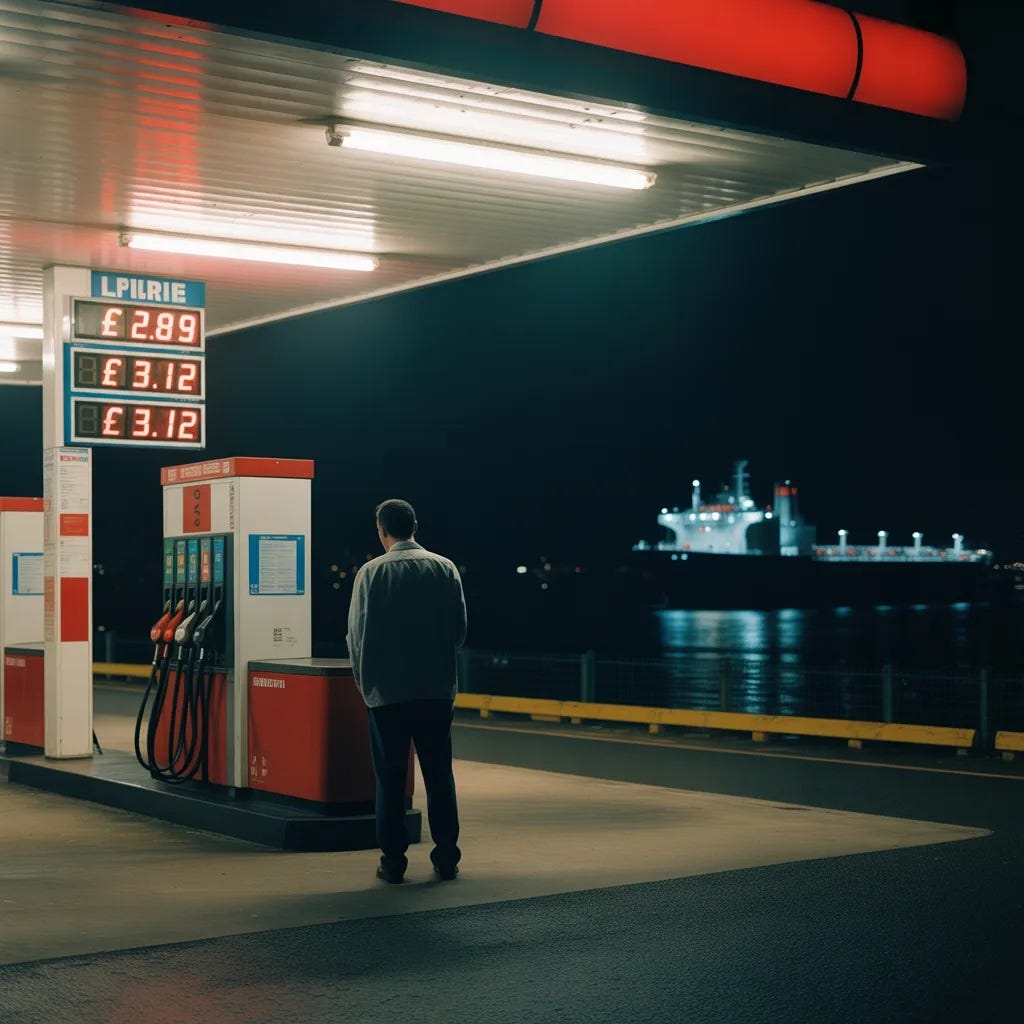
Somewhere in Bristol, or Barnsley, or anywhere else, someone pulls onto a petrol forecourt and looks at the board.
The number has changed.
They do the arithmetic — the quiet kind, the kind that happens before conscious thought catches up. They fill the tank, or they do not, or they fill half and tell themselves they will come back when it comes down. They drive away. They have a life to be getting on with.
They know exactly what is happening. They have watched every bulletin. They have seen the maps, the tankers, the queues, the numbers. They know about the strait and the strikes and the price per barrel and the naval coalition that did not materialise. They know all of it.
And the number on the board still changed. And there is nothing — nothing at all — they can do about it.
The tanker is still out there. For now.
Anchored in a queue of four hundred vessels in the Gulf of Oman, waiting. The water is dark. The crew are doing what crews do when there is nothing to do except wait.
Twenty miles away, a door is open to some and closed to others. The currency required to walk through it is no longer the one the world was built on.
Nobody onshore is watching. Nobody onshore has thought about it once.
Which leaves one question. Not about currency. Not about tankers. Not about the strait.
About the shelf in the supermarket. About the medicine in the cabinet. About how long the lights stay on.
The answer is between six weeks and six months.
Nobody in power will tell you which.
It is spoken in silence.
The strait remains closed.
The door remains open.
How Long Does the Western World Last Without the East — continues now.
The Almighty Gob is a Bristol-based publication covering UK institutional dysfunction and political accountability, publishing since 2020. Over 500 pieces published including 88 Bristol investigations built from FOI requests and primary sources. Independent candidate in the 2016 and 2021 Bristol mayoral elections. Published author of The Mirror and the Silence, available at langleybristol.gumroad.com. Full profile: muckrack.com/thealmightygob.
References
2026 Strait of Hormuz Crisis — Wikipedia (updated March 2026)
Traffic is trickling through Strait of Hormuz — CNBC, 18 March 2026
U.S. is allowing Iranian tankers through Strait of Hormuz, says Bessent — CNBC, 16 March 2026
Iran Has Just Fired the Most Dangerous Shot of This War — European Business Magazine, 14 March 2026
Strait of Hormuz: Which countries’ ships has Iran allowed safe passage to? — Al Jazeera, 16 March 2026
March 9, 2026: Iran War Maritime Intelligence Daily — Windward AI
Greek Oil Tanker Exits Strait of Hormuz With Its Signal Off — Bloomberg, 9 March 2026
Petrodollar to Digital Yuan: China, the Gulf, and the 21st Century Path to De-Dollarization — Asia Society Policy Institute, January 2025
The Rise of the Petroyuan: Is the US Dollar Losing Its Energy Monopoly? — Modern Diplomacy, February 2025
Petrodollar under pressure from BRICS currency, energy transition — Green Central Banking, January 2026
You Are Made of Oil — The Almighty Gob, March 2026
¹ Source: Iran Has Just Fired the Most Dangerous Shot of This War — European Business Magazine, 14 March 2026.
Yeah, thank you. I'm not entirely sure how you arrive at the conclusion that our scripts are very much the same. This Asian guy seems to be a financial analyst analyst. It may just be me, but I don't see any uniformity and how we present our articles and been anyway shape or form. But I appreciate Europe. You'll reply you're interjection
No mention of using AI for this?
Or are you the original writer behind all of the Asian AI guy's scripts, because they read exactly the same?
John LANGLEY, lol.