
The Dysfunction We Deserve: Britain's Democratic Bargain.
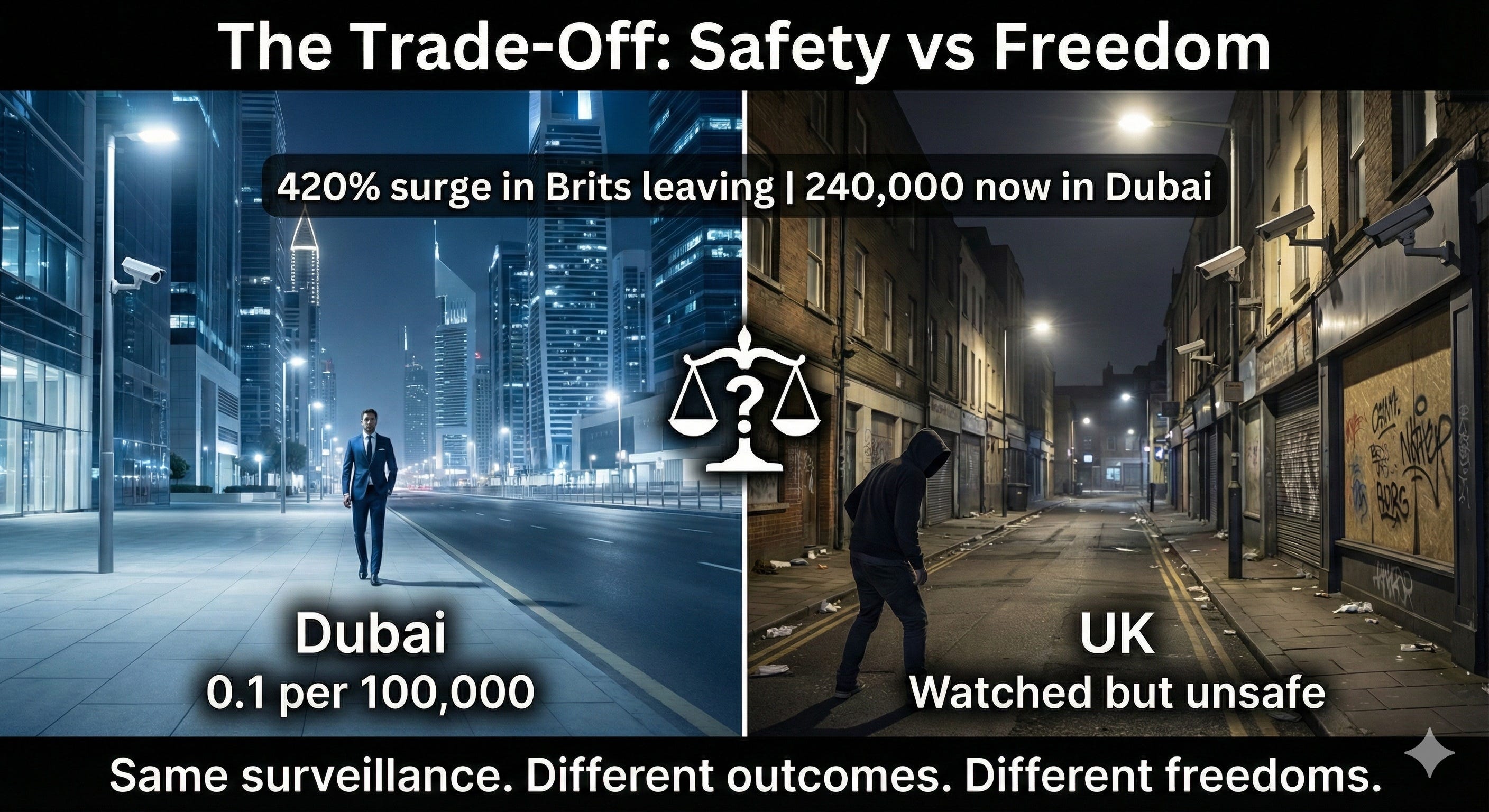
Dubai's crime rate is 0.1 per 100,000. Ours is exponentially higher. The solution is simple - and you absolutely won't like it.

I had a conversation recently that won’t leave me alone.
Someone asked me: “Why are so many of our younger people opting to move to Dubai rather than stay here in Britain?”
Fair question. Enquiries from British nationals wanting to relocate to Dubai have surged 420% over the last five years, with a 45% spike in the past 12 months alone. Over 240,000 Brits now call Dubai home. Of the 252,000 British nationals who left the UK last year, 174,000 were aged 16 to 34 - our youngest, most productive workers voting with their feet.
So what are they finding there that we’re failing to provide here?
Dubai’s crime rate is 0.1 per 100,000. Their streets are spotless. You can walk anywhere, anytime, safely. Meanwhile, British police won’t even attend shoplifting calls anymore.
I started digging. What does Dubai have that we don’t?
Turns out, the answer makes most people deeply uncomfortable. The kind of uncomfortable that forces you to question assumptions you didn’t know you had.
Because Dubai’s success isn’t magic. It’s not culture. It’s not wealth alone. It’s a very specific set of choices about power, freedom, and what matters most.
Here’s what’s been keeping me up: we couldn’t replicate it even if we wanted to. Not because we lack resources. Because we lack the stomach for what it requires.
Let me show you why.
How Dubai Achieved a 0.1 Crime Rate: The Authoritarian Model.
Dubai doesn’t have a shoplifting problem. Know why? They deport people. We debate whether removal hurts feelings.
Ninety per cent of Dubai’s population are expats whose residence depends on employment. Commit an offence? Gone. Lose your job? Gone. Public intoxication? Gone. The mechanism is brutally simple: you’re not a citizen, you’re a guest, and guests who misbehave get shown the door.
No appeal. No judicial review. No Guardian editorial about human rights.
Their justice system moves at speed. Trial within weeks. Sentencing within days. Punishment swift and certain. No eighteen-month wait for a Crown Court date. No overcrowded prisons are releasing criminals early to make space.
Two hundred thousand CCTV cameras are watching everyone, backed by actual consequences. It’s not rocket science. It’s authoritarianism that works.
Efficiency and liberty rarely occupy the same room.
UK Crime Statistics vs Dubai: Why Surveillance Alone Doesn’t Work.
We’ve built the surveillance infrastructure without the spine to use it. Six hundred and ninety-one thousand cameras in London. The average Londoner is filmed 300 times daily. Research shows little correlation between camera density and public safety. Why?
Because cameras without consequences just document wrongdoing. Expensive theatre.
Here’s what we’ve normalised: Shoplifting under £200? Police won’t attend. Bike theft? Fill in the online form. Vehicle break-ins? Here’s your reference number for insurance. Knife crime? Good luck with that 5% charging rate.
Seventy-five thousand people are awaiting a Crown Court trial. Government data shows some violent offenders rack up over 100 offences before we finally imprison them. The system isn’t broken. It’s breaking. Past tense implies it might recover.
We promised tough justice. We built surveillance. We passed laws. We increased penalties on paper. Then we defunded courts, released prisoners early, and told police to prioritise paperwork over protection.
Watched, bureaucratised, and unsafe. The worst of all worlds.
Let’s be clear about the comparison: Dubai operates 200,000 CCTV cameras and achieved a 0.1 crime rate. London operates 691,000 cameras - over three times as many - with significantly higher crime. Dubai’s 90% expat population can be deported without appeal. Britain’s citizens have full legal protection and multiple appeals. Dubai’s justice system moves in weeks. Ours takes eighteen months minimum.
Same surveillance technology. Completely different outcomes. The variable isn’t the cameras. It’s what happens after they catch you.
What It Would Take to Replicate Dubai’s Success in Britain.
You want Dubai’s results? Here’s the price list.
First, suspend Parliament. The democratic process is slow by design - debates, committees, opposition, and amendments. Dubai’s ruling family makes decisions and implements them. No backbench rebellion. No judicial review blocking removals.
Second, leave the European Convention on Human Rights. Those protections prevent the swift, certain justice that deters wrongdoing. Appeals slow everything to a paralysis. Dubai doesn’t do appeals.
Third, create two-tier citizenship. Make sixty per cent of Brits “residents” rather than citizens. Tie residency to employment. Lose your job? Leave the country. Commit an offence? Removal, not rehabilitation. Can’t support yourself? Time to go.
Who votes to make themselves deportable?
Nobody. That’s the problem.
Fourth, abolish the welfare state. Dubai has near-zero income tax because if you can’t support yourself economically, you’re not allowed to stay. No unemployment benefit. No housing benefit. No universal credit. Contribute or leave.
Dubai has oil money. We have debt and the delusion that we can have Scandinavian public services on American tax rates.
Fifth - and this is where it gets really uncomfortable - you’d need someone willing to implement this without an electoral mandate. Because you can’t get there from here through voting. Nobody surrenders their own rights. Nobody campaigns on “Make Britain Deportable Again.”
You’d need a coup. Not hyperbole. Constitutional revolution. The suspension of eight hundred years of parliamentary tradition.
Still want that 0.1 crime rate?
Can Reform UK Deliver Dubai-Style Safety? The Fantasy vs Reality.
Reform UK promises Dubai outcomes with British methods. Tough on wrongdoing AND civil liberties. Controlled immigration AND workers’ rights. Low taxes AND public services AND welfare state.
Pick two. You can’t have all three.
They’ll recruit 40,000 new police. With what money? They’re cutting taxes. They’ll get tough on lawbreakers. Within what legal framework? They’re defending civil liberties. They’ll stop the boats. How? They oppose the authoritarian measures that work.
It’s Brexit thinking applied to justice: promise control, deliver chaos, blame the establishment when reality disappoints.
The frustration is real. The dysfunction is visible. People see criminals walking free, antisocial behaviour normalised, and streets less safe than their parents knew.
But there’s no mechanism. It’s fantasy dressed as policy. You cannot have authoritarian outcomes through democratic means. The system that protects your rights protects criminals’ rights. You don’t get to cherry-pick.
Right now, you’re probably feeling that tension. The pull between what you want and what you’re willing to sacrifice to get it.
Democratic Dysfunction: The Price We Pay for Freedom.
How much dysfunction are we willing to tolerate to preserve what we claim to value?
Not rhetorical. An actual question demanding an actual answer.
The democratic process is slow by design. Checks and balances prevent tyranny by preventing speed. Civil liberties create space for antisocial behaviour because freedom includes the freedom to be antisocial. Due process frees guilty people because imprisoning innocent people is worse. Privacy limits surveillance effectiveness because surveillance without limits is a police state.
The dysfunction isn’t a bug. It’s a feature. It’s the price tag on freedom.
But we won’t admit it. Instead, we perform this exhausting dance:
We want free speech, then act shocked when people say vile things. We want due process, then express outrage when offenders walk free on technicalities. We want privacy, then demand police “do something.” We want democratic accountability, then get frustrated that it moves slowly.
We want Dubai’s safety with Britain’s freedoms. That combination doesn’t exist. Never has. Never will.
Every politician promising to be “tough on crime” while respecting civil liberties is selling you the impossible. Every “evidence-based policy” that ignores the evidence from Dubai, Singapore, or any other authoritarian success story is avoiding the uncomfortable truth.
Authoritarian systems work. Democratic systems accommodate dysfunction. Choose.
At what point do we trade comfortable lies for uncomfortable truths?
What We’re Actually Choosing: Bristol as Case Study.
Walk through Bristol city centre at night. You’ve probably done it. That moment when you see something - aggressive begging, open drug use, someone clearly unwell and untreated - and you cross the street. Not because you’re unkind. Because you’ve learned that intervening changes nothing and could make your night significantly worse.
That’s the accommodation we’ve made. That’s the dysfunction we’ve normalised in exchange for preserving rights we value.
Right now, Bristol’s Green Council promises to build 1,000 affordable homes annually while selling existing council housing stock. They implement schemes like the East Bristol Liveable Neighbourhood despite majority resident opposition. Performative activism delivered as policy. Dysfunction dressed as progress.
This is what choosing not to choose looks like.
We build surveillance states without enforcement. Pass tough laws without resources to implement them. Promise order while protecting chaos. Want everything.
Get nothing we wanted.
The cameras watch us. The criminals walk free. The courts are clogged. The politicians promise. The cycle continues.
Until someone stands in Parliament and says, “You can’t have it all - choose,” we’ll keep getting exactly what we deserve.
Everything we asked for. Nothing we wanted. All of it is our fault.
Dubai’s crime rate is 0.1 per 100,000. Now you know why - and why you’ll never vote for it.
Can you admit that to yourself?
Frequently Asked Questions.
Why is Dubai’s crime rate so low?
Dubai maintains extremely low crime through a combination of swift justice, certain punishment, and the ability to deport 90% of its population (expats whose residence depends on employment). The system is authoritarian but effective.
Could the UK replicate Dubai’s approach to law and order?
No. It would require suspending democracy, leaving human rights conventions, creating deportable residents, abolishing the welfare state, and implementing authoritarian control. No British electorate would vote for this.
What’s the main difference between the UK and Dubai's crime prevention?
Dubai has consequences without appeals. The UK has surveillance without enforcement. Cameras don’t prevent crime - certain punishment does.
Is democratic dysfunction inevitable?
Yes. Democracy is intentionally slow (checks, balances, appeals), and civil liberties intentionally create space for antisocial behaviour. This isn’t failure - it’s the cost of freedom.
What can actually be done about UK crime rates within democratic constraints?
Honest acknowledgement of trade-offs. Adequate funding for courts and police. Realistic expectations. And accepting that we’ll never achieve Dubai’s statistics without Dubai’s authoritarianism.