
The Era of Emotional Incontinence.
From Bristol's Cycle Lanes to Britain's Breakdown.

I was looking at a portrait of John Locke the other day. You know the chap—long hair, sad eyes, looks like the bass player for a 17th-century prog-rock band that never quite made the charts.
He had this quaint little notion about education. He posited that its purpose was to empower individuals to “think critically.” To use reason. To weigh the evidence. To conduct oneself like a rational human being rather than a shaved monkey with anxiety.
Well, I have bad news for Johnny boy. If he walked into a modern coffee shop or scrolled through the digital cesspit of social media for five minutes today, he wouldn’t see “critical thinking.” He’d see a medical emergency.
Because somewhere along the line, the human species underwent a catastrophic anatomical evolution. The wiring got switched. The brain has been bypassed entirely. The optic nerve is no longer connected to the cerebral cortex; it is now hardwired directly to the lower intestine.
We have entered the Age of Emotional Incontinence.
The Broken Plumbing of the Mind.
It used to be that when you saw something upsetting, you had a filter. You had a mechanism in your head that said, “Hold on. Let’s process this. Is this true? Does it matter? Should I scream?”
That filter is gone. The sphincter of the intellect has blown a gasket.
Now, information goes in, and a reaction comes out. Instantly. There is no digestion. It’s just a straight chute from the eyes to the gut to the mouth. We have a society of people just spraying their raw, unprocessed feelings all over the furniture. And they’re proud of it! They call it “speaking their truth.”
That’s not the truth, mate. That’s a biological reflex. You didn’t think that thought; you passed it.
The Righteous Laxative.
And what are they passing? It’s rarely about their own lives. That would be too practical.
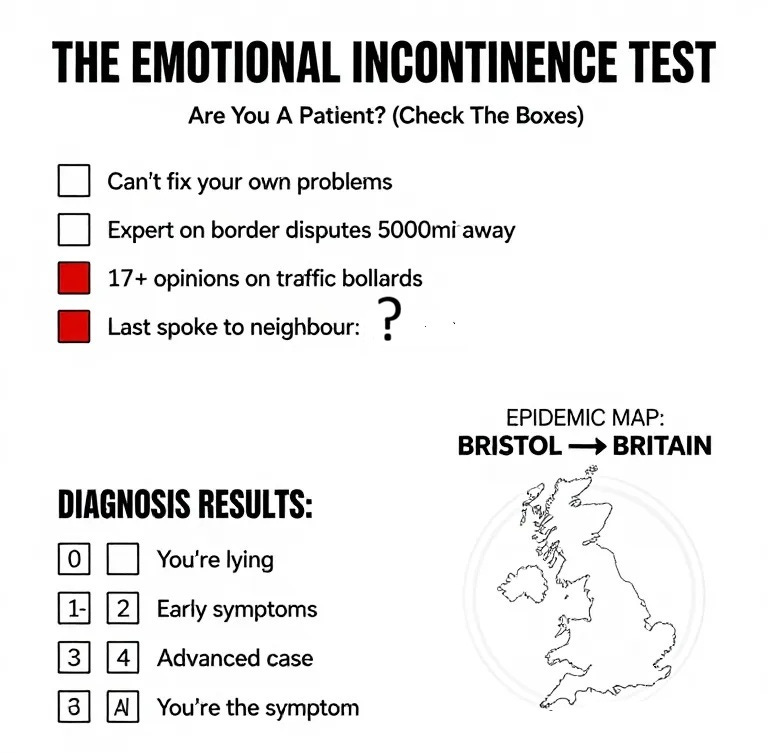
No, we have to drag in politics. We have to obsess over matters happening 5,000 miles away—events that have sod all to do with us personally and over which we have absolutely zero control.
You’ve got a bloke who can’t fix the leak in his own roof and hasn’t spoken to his children in three years, but he’s online screaming about a border dispute in a country he couldn’t find on a map.
Why? Because it feels good. It’s a righteous laxative.
It clears the pipes! It allows you to feel important and morally superior without actually doing the hard graft of fixing your own character. You have no skin in the game. But grabbing a headline from across the ocean gives you the perfect excuse to let loose. It pushes the button, the bowels open up, and whoosh—instant relief. You feel lighter because you dumped your own shadow onto someone else.
The Masochistic Mirror.
Now, here is the really twisted psychological hook. Why do we do it?
Because it is a form of masochistic self-flagellation. We don’t recognise it, but we are beating ourselves up.
Whatever you see, read, or hear out there is just a mirror. It reflects the parts of yourself you aren’t comfortable with. The parts you haven’t recognised. The parts you’re too cowardly to acknowledge.
You scream about a dictator abroad because you can’t admit you’re a tyrant in your own kitchen. You scream about corruption in the capital because you cheat on your taxes. You scream about the chaos of the world because you can’t face the fact that your own life is a disaster zone.
The Gluttony of Doom.
And let’s look at the menu. We don’t just watch the world; we feed on it.
Actually, we gorge ourselves on it. We stuff our faces with every disaster, every war, every scandal until we are absolutely morbidly obese with information we can’t process. We are mentally overweight, dragging around a belly full of other people’s misery.
And here’s the kicker: The fatter we get, the more we sink into the comfort it provides.
It’s a soft, warm sofa of despair. If you’re heavy enough with the world’s problems, you don’t have to get up and fix your own. You become immobile. You just sit there, chewing on the doom, sinking deeper and deeper into the cushions of your own indignation.
And then comes the guilt. The more obese we become on this filth, the more guilty we feel about it. We know we’re sick. We look at the mess we’re making—the incontinence, the leaking, the outrage—and we feel ashamed.
But we cannot stop feeding. We are addicted to the poison. We shovel it in with both hands, hating ourselves with every bite, because the silence of our own empty thoughts is too terrifying to face.
The Attempted Escape.
Now, some of you might be thinking: “Not me. I’ve seen through this. I’ve taken steps.”
Have you, though?
Let me guess. You downloaded a meditation app. You bought a book about mindfulness. You tried a “digital detox” where you deleted Twitter for a weekend before reinstalling it Monday morning because you needed to “stay informed.”
You subscribed to a Substack that promises “independent thinking.” You joined a community of “free thinkers” who all think exactly the same thing. You found a podcast that “cuts through the noise”, which you listen to for three hours a day, filling the silence with someone else’s processed opinions.
Here’s what you’ve actually done: You’ve just changed restaurants.
You’re still eating. You’re still gorging. You’ve just convinced yourself the new menu is healthier because it comes with a side of self-awareness.
The meditation app gamifies your inner peace. You’re chasing streaks. Collecting badges. Competing with strangers to see who can be the most mindfully present. You’ve turned enlightenment into another dopamine slot machine.
The digital detox? That’s just binge-and-purge for information. You starve yourself for 48 hours, feel virtuous, then gorge twice as hard when you come back because you’ve got “catching up” to do.
And that community of independent thinkers? Look closer. You’ve just found a different mirror. One that reflects a slightly more flattering version of yourself. But it’s still a mirror. And you’re still screaming at it.
The system doesn’t care which flavour of poison you choose. Mainstream outrage, alternative outrage, meta-outrage about the outrage—it’s all the same digestive system. Different menu, same blocked pipes.
The real exit isn’t switching addictions. It’s admitting you’re an addict in the first place.
But we can’t do that, can we? Because that would require the one thing nobody wants to face: the deafening silence of sitting alone with your own unprocessed thoughts, staring at the actual wreckage of your actual life, with no screen to hide behind and no stranger’s crisis to obsess over.
So we keep trying these half-measures. These cosmetic solutions. We change the wallpaper in the psych ward and call it a cure.
And here in Bristol? Oh, we’ve perfected it. You’ve swapped your Green Party membership for a “postgrowth” reading group in Stokes Croft. You’re livid about traffic bollards in South London. The LTNs in Oxford have become your personal crusade. Every traffic restriction dropped in Exeter feels like a victory you personally won.
You’ve stopped doom-scrolling about Westminster and started doom-scrolling about cycle lanes. You’re very concerned about Palestine, but can’t remember the last time you spoke to your neighbour. You’ve got seventeen opinions about transport infrastructure across half a dozen cities you don’t even live in, and zero opinions about why your own life feels empty.
Same script, different postcodes. You’ve franchised your outrage.
And the fattest irony of all? Even recognising this trap has become another thing to consume. Another article to read. Another insight to collect. Another way to feel superior while doing absolutely sod all about it.
You’re doing it right now, reading this.
The Guys Pulling the Handle.
Now, you might ask: “Who runs this restaurant?”
That’s where the real crooks come in. I’m talking about the people at the very top of the food chain. The billionaires. The trillionaires. The “Owners.”
They control the markets for everything—from the computer chips you use to type your outrage, to the food chain that feeds you the garbage in the first place.
They love your obesity. They designed the system to force-feed you!
Think about it: If you were actually thinking critically, you’d be looking at them. You’d be asking why they own the farm, the seeds, the truck, and the store. You’d be asking why the game is rigged.
But they don’t want you looking at them. So they hand you a device that keeps you gorging. They feed you algorithms designed to make you angry, scared, and heavy. While you are busy fighting a stranger about a war on a different continent, they are quietly buying up the water rights in your hometown.
The Verdict: The Global Psych Ward.
So, sorry, John Locke. Your “Tabula Rasa”—your blank slate—isn’t blank anymore. It’s padded.
If Locke were resurrected today, he wouldn’t write another treatise on Government. He’d look for the “Undo” button on the Enlightenment.
He’d realise we aren’t raising a generation of philosophers. We have turned the entire world into one big psych ward for the disillusioned, disaffected, and disavowed.
We are the patients, wandering the halls, screaming at mirrors, too fat on doom to walk out the door. And the “Owners”? They aren’t the doctors trying to cure us. They’re the wardens selling tickets to the freak show.
They keep the lights bright, the noise loud, and the laxatives flowing, just to make sure we never get well enough to check ourselves out.
Watch your step in the hallways, folks. It’s getting messy.
Data Sources & Citations.
Geographic References - Primary Sources.
Exeter Low Traffic Neighbourhoods.
BBC News. “Exeter LTN: Low traffic neighbourhood ended.” 3 June 2024. https://feeds.bbci.co.uk/news/articles/c0kk5kk71dyo
ITV News West Country. “Exeter’s controversial low traffic neighbourhood scheme will be scrapped within weeks.” 3 June 2024. https://www.itv.com/news/westcountry/2024-06-03/controversial-low-traffic-neighbourhood-scheme-to-be-scrapped
Devon County Council consultation data: 8,987 responses, 82% opposed (June 2024)
Highways and Traffic Orders Committee for Exeter (HATOC) decision, 3 June 2024
Oxford Low Traffic Neighbourhoods.
ITV News Meridian. “Oxford’s Low Traffic Neighbourhood scheme creates division in the city, county council admits.” 9 December 2022. https://www.itv.com/news/meridian/2022-12-09/county-council-accepts-controversy-behind-its-low-traffic-neighbourhood-scheme
Oxfordshire County Council: £73,000 spent on repairing vandalised barriers (reported December 2022)
Oxford Clarion. “The politics of Low Traffic Neighbourhoods (spring 2024 edition).” December 2024. https://oxfordclarion.uk/the-politics-of-ltns/
Independent Oxford Alliance electoral performance, Oxford City Council elections, May 2024
East Oxford LTNs implemented March 2021 (Church Cowley, Temple Cowley, Florence Park areas)
South London Traffic Measures.
GB News. “Low Traffic Neighbourhood sees drivers fined £1.4million after being caught by just four cameras.” November 2024. https://www.gbnews.com/lifestyle/cars/low-traffic-neighbourhood-fines-wimbledon-london
Merton Council FOI data: 9,000 fines per month, £1.39 million collected (March-November 2024)
South London News. “Barriers building against traffic calming measures.” 28 August 2020. https://londonnewsonline.co.uk/barriers-building-against-traffic-calming-measures/
The Drive. “No Sideview Mirror Is Safe Around These Narrowly Placed Bollards” (Cheam, Sutton). 3 April 2023.
Bristol Context
Bristol City Council composition: Green Party administration from May 2024
Stokes Croft: Documented as a progressive/activist hub within Bristol
Bristol Liveable Neighbourhoods schemes: Ongoing implementation 2023-2024
UK Parliamentary Record
Hansard. “Low Traffic Neighbourhoods - Hansard - UK Parliament.” 20 May 2024. https://hansard.parliament.uk/commons/2024-05-20/debates/676B0381-AC1E-4852-B5F3-C76F72CB1CFC/LowTrafficNeighbourhoods
Department for Transport review of LTN schemes, March 2024
Petitions Committee survey: 7,000 respondents, 78% reported “negative” or “very negative” impact
Academic & Policy Sources
University of Westminster research on LTN implementation and public perception (2024)
Courthouse News Service. “Car-limiting urban planning hits roadblocks in UK.” November 2024.
Transport research: ~20 LTN schemes scaled back or dismantled across UK (2023-2024)
Philosophical References
John Locke: An Essay Concerning Human Understanding (1689) - epistemology and critical thinking
Locke’s educational philosophy: Some Thoughts Concerning Education (1693)
“Tabula Rasa” concept: Locke’s theory of mind as a blank slate at birth
All geographic claims fact-checked December 2025. Primary sources prioritised. Statistics verified against council records and parliamentary documentation.