

The Eurovision Wrong Contest.
Why the debate about rejoining the EU is asking every question except the ones that matter.

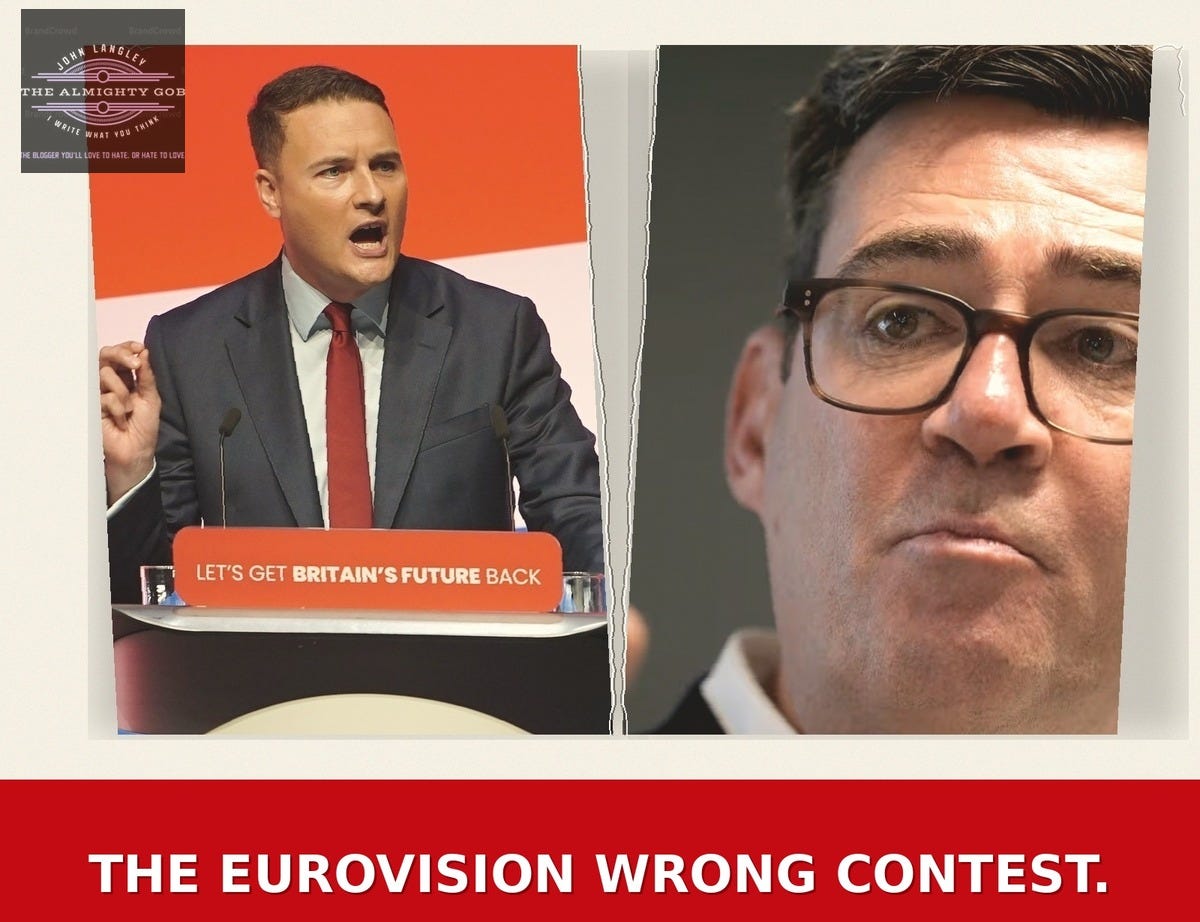
[Last week Wes Streeting declared Brexit a catastrophic mistake and called for Britain to rejoin the EU. Within days, Andy Burnham explicitly ruled it out — in a constituency that voted 65% Leave. Same party. Same week. Different shirts.The Almighty Gob]
Last week Wes Streeting resigned from Cabinet and declared Brexit a catastrophic mistake. Andy Burnham, within days, explicitly ruled it out entirely — saying he respects the referendum result, in a constituency that voted 65% Leave. A YouGov poll last month put support for rejoining at 55%. The noise is back. The contest, as ever, is in full swing.
Nobody seems to have noticed that the loudest voices in the room are not answering the question that actually matters. Not whether Brexit was right or wrong. That argument has been running for a decade and everyone has already picked a corner, put their coat on the chair, and ordered another round. The wound is still there. The building is still broken. And the club is still arguing about the membership fee while the roof falls in.
This article holds no brief for either side. Brexit caused real damage — the evidence is in here and it is not flattering. The question is whether rejoining fixes any of it. Underneath that question, barely visible, sits another one — one that affects your money, your data, your daily life, and your ability to do anything about any of it. Most people debating this loudest have not looked at it once.
If we rejoin, what exactly are we walking back into — and will any of it fix what is actually broken? Or are we just reaching for the glasses nearest to hand, because the alternative is admitting we need the appointment?
Apparently not. Do carry on.
Another Layer Nobody Voted For.
Britain already has more layers of government than most people can name without stopping to count. Westminster. Devolved assemblies. Regional mayors. County councils. District councils. Parish councils. They already argue with each other, duplicate each other, and leave most people with no reliable idea who is responsible for anything when it goes wrong. Which, to be fair, is quite often.
Rejoin the EU and you add another layer on top of all of that. One with genuine power over trade, regulations, and how businesses operate. Nobody votes for it directly. Nobody can remove it when it gets things wrong. It simply continues, issuing guidance, harmonising standards, and occasionally deciding what counts as a luxury item.
Democratic accountability in this country is already stretched so thin you can see through it. Adding Brussels is not a solution. It is another floor in a building where the lifts have never worked and the people at the top stopped returning calls sometime around 2008.
The standard response to all of this is that we are better off inside the club than outside it. It is a persuasive line. It is also the line every club uses to stop people asking what the membership actually costs, who sets the rules, whether the rules can be changed, and what happens to members who try to leave. Clubs are excellent places to be — provided you are not the one paying the bar tab for everybody else while being told you cannot change the drinks menu. This is not an argument about national identity or nostalgia or whether Britain is better than Europe. It is an argument about who makes decisions, how they are made, and whether the people those decisions affect have any meaningful way of changing them.
The Money Behind the Money.
Here is something the Rejoin campaign never puts in the leaflet. Not because they are dishonest. Because it does not fit on a leaflet, it does not photograph well, and it does not make anyone feel hopeful at a street stall in the rain.
The EU does not control its own financial destiny. Its member states carry enormous debts held by American investment firms — BlackRock, Vanguard, State Street — that between them, through pension funds and index holdings, now manage approaching a quarter of all investment on earth. France had its credit rating downgraded in 2025. The EU’s own officials have described the current moment as one of the most turbulent in the bloc’s history, which is the kind of sentence that sounds reassuring until you read it again.
Some will say BlackRock is already in Britain — already in the room, already at Downing Street, already being invited to rebuild the country’s infrastructure by the current government. They are right. However, there is a critical difference between a relationship a sovereign parliament can scrutinise, legislate against, and if necessary end — and a continental regulatory architecture, harmonised across 27 member states, that was shaped with significant input from the very firms it governs. Outside the EU, Britain has a door it could choose to close. Inside, the door is load-bearing. Removing it brings the wall down with it.
And above all of that sits the World Economic Forum — the Davos network where asset managers, central bankers, and heads of government meet annually, produce policy white papers that governments then quietly adopt, and shape the conditions inside which every elected parliament then has to operate. The World Economic Forum does not pass laws. It does something considerably more efficient than that. It shapes the conversation that happens before the laws are written, in rooms that do not have press passes on the door, between people who will never need to ask you how you voted. Lovely people, apparently. Very good at skiing.
Rejoining the EU means plugging back into all of that. Not conspiracy. Architecture. And architecture does not care who lives in the building or how enthusiastically they voted for the move.
The Investment Reality.
The number of foreign investment projects coming into the UK has fallen by nearly a third since 2016. In 2025 alone, AstraZeneca, Merck, Eli Lilly and GSK all paused or scrapped major UK investments. Britain dropped out of the top ten manufacturing nations in the world for the first time in its history. Not relegated. Eliminated. Different category entirely.
Brexit made this worse. The Brexit rejoin debate rarely mentions that a decade of uncertainty knocked between 12 and 18 percent off business investment compared to similar economies. That is real, measurable damage and it deserves to be said plainly rather than argued about endlessly by people who made up their minds in 2016 and haven’t moved since.
However, Brexit did not start it. Britain was already hollowing out its industrial base long before 2016. Thirty years of underinvestment in infrastructure, skills and manufacturing — under governments of every colour, without exception — dug the hole that Brexit then made significantly harder to climb out of. Each of whom, it should be noted, had an excellent explanation for why it was the previous lot’s fault.
Rejoining the EU does not rebuild a single factory. The wound predates the argument about the wound. Dressing it in a different flag is not a treatment plan. It is a photo opportunity.
The Wealth Exodus.
Britain was projected to lose a net 16,500 millionaires in 2025. According to the Henley Private Wealth Migration Report — the dataset governments and financial institutions worldwide rely on — that is the largest outflow ever recorded by any country in a single year. China was projected to lose 7,800. Britain more than double. Filed under: things that did not make the Rejoin campaign’s leaflet. Or any campaign’s leaflet. Because nobody wants to stand in a town square and explain this one.
This is not a Brexit story. It is not a Labour story. It is what happens at the end of a long accumulation of political instability, tax unpredictability, and a governing class that has made Britain feel like a difficult and unrewarding place to build anything worth keeping.
Some will say the answer is simple. Tax the rich. It sounds like justice. It isn’t. You cannot tax someone who is already at the departure gate with hand luggage only, because the accountant moved everything last Tuesday. All you are left with is the hole they made when they left — and that hole does not disappear. It gets filled by everybody else, quietly, in the form of higher prices, fewer jobs, and one less reason for the street around the corner to stay open past six.
Because millionaires do not only pay tax. They spend locally. They employ people. They fund the restaurants, the builders, the small contractors that depend on that money circulating. When 16,500 of them leave in a single year, all of that goes with them. The people who feel it first are not the wealthy. They are the cleaner, the local café, the small firm — the entire economy that existed quietly in the orbit of that spending, and had absolutely no idea how dependent on it they were until it was gone.
Rejoining the EU reverses none of it. Brussels cannot prescribe a cure for a patient it did not examine, has never met, and would struggle to find on a map that does not include motorway services.
What the EU Took. What It Would Bring Back.
Nobody talks about the tampon tax anymore. It is over, filed away, occasionally mentioned as a footnote. Which is strange, really. Because what it actually was — quietly, for 48 years, without anyone being asked — was a foreign institution deciding that something every woman in Britain needed every month was a luxury item. Like a second home. Or a sports car. Or a particularly nice cheese.
From the day Britain joined the European Economic Community in 1973 until the day it left in 2021, British women paid VAT on sanitary products. Tampons. Towels. Basic necessities classified as luxury items under EU law, which set a minimum 5% rate that no member state could remove regardless of how its own parliament voted. Regardless. Of how. Its own parliament. Voted.
In 2016 the British Parliament voted to scrap the tax. Brussels said no. The EU VAT Directive did not permit it. A democratically elected Parliament, representing the expressed will of the British people, was told by a body nobody in Britain had elected and nobody in Britain could remove: not yet. Wait. We will let you know.
On the 1st of January 2021 — the first day Britain was free of EU law — the tampon tax was gone. Not debated. Not delayed. Forty-eight years ended before the New Year hangover had cleared. Because Parliament had already decided years earlier. It had simply been waiting for permission.
That is what EU membership meant in practice. Not in trade statistics or constitutional theory. In the price of something every woman in this country bought every single month for nearly half a century.
Now here is what rejoining would bring back in return. And this is the part that is not being discussed. Not in the studios. Not in the op-eds. Not by the people making the loudest noise about how much better off Britain would be back inside the EU.
Every EU member state is currently required by law to roll out a mandatory Digital Identity Wallet to every citizen by the end of 2026. A single app on your phone. Your identity documents, driving licence, bank account details, medical records, qualifications — all of it, in one place, mandated by Brussels. Banks legally required to accept it. Public services legally required to use it. Nobody voted for it. It is already law across all 27 member states and the rollout is happening now, this year, while this debate about rejoining is being had in television studios and on social media and in op-eds by people who have not mentioned it once.
Some will say it is voluntary. For now. However, banks, public services and regulated industries are legally required to accept it by 2027. When the entire infrastructure of daily life is built around a single system, the word voluntary has quietly stopped meaning anything at all. It is the kind of voluntary that means you can technically say no, right up until the point where saying no means you cannot open a bank account, access a public service, or prove who you are to anyone who needs to know.
Some will say Britain is developing its own digital identity system anyway, so what is the difference. The difference is this. The UK model is voluntary and market-led throughout, with no mandatory acceptance obligations written into law. The EU model has legal compulsion baked into every layer — for governments, for banks, for businesses, for public services. One is a tool you can choose. The other is an infrastructure you cannot opt out of. They are not the same thing. They are not even the same category of thing.
Some will say it is secure. In 2024 and 2025, every single one of Europe’s top financial institutions suffered at least one cyberattack through a supplier or third party. Every one. Not most. All of them. These are organisations with entire departments, billion-pound security budgets, and decades of experience dedicated to nothing except protecting data. They are being breached as a matter of routine. The Almighty Gob has tracked this pattern closely: the more valuable the centralised system, the more relentless and sophisticated the assault on it becomes. The people building the door are not waiting for the building to be finished. They started before the planning permission was approved.
Every wall ever built had someone already designing the door. The people working to break this one are patient, motivated, and increasingly assisted by artificial intelligence that improves faster than any regulation written by any parliament can keep pace with.
The tampon tax cost women money for 48 years. A compromised digital identity does not cost you money. It costs you you.
The Only Questions That Actually Matter.
Here is the test. Not the economist’s test. Not the politician’s test. The kitchen table test. The one nobody in Westminster ever sits down to take because the results are inconvenient and the table is in a constituency they only visit before elections.
For younger readers in particular — the loss of freedom of movement is real, personal, and significant. The ability to live, work, and build a life across Europe was something previous generations had and this one does not. That matters and it deserves to be said plainly. It is also, however, a separate question. Whether rejoining addresses the structural failures making Britain increasingly difficult to live in is another matter entirely.
Will rejoining the EU fix the potholes? No.
Will it cut the wait for a GP appointment? No.
Will it find a school place for the child with special needs who has been waiting eighteen months? No.
Will it stop 16,500 millionaires a year leaving for the UAE? No.
Will it get the person sleeping in a doorway off the street tonight? No.
These are not trick questions. They are the only questions that should be driving British politics right now.
They are also the questions that the Brexit rejoin debate — on both sides — consistently and almost impressively manages to avoid. Like a pub quiz team that revised everything except the subject on the night.
The argument about Europe is, in political terms, a pair of off-the-shelf reading glasses from a pound shop. They deal with the immediate discomfort. They do not fix the underlying problem. And worn long enough, the wrong prescription does not just fail to help.
It makes your vision worse.
Britain needs the optician’s appointment. The full examination. The honest diagnosis that nobody currently sitting in Westminster has shown any serious appetite for delivering. Because the diagnosis is uncomfortable, the treatment is expensive, and the wound is still open — and the patient keeps insisting they just need better glasses.
The building still needs fixing. The architecture of who decides, who benefits, and who pays is still the same whether the address says London or Brussels. None of that changes by moving back in.
There is an African proverb that has survived long enough to mean something. Be careful of the naked person who offers you a shirt.
Here is the question worth sitting with. Not the question of whether to rejoin. A quieter one than that. If the people arguing loudest for rejoining genuinely believed it would fix the potholes, cut the GP waits, find the school places, and stop the wealth leaving — would the debate sound the way it does? Or does the debate sound exactly like what it is: people who care deeply about the wrong thing, with complete sincerity, in a contest that was never going to solve the problem it claimed to be about?
Every time it surfaces on television. Every time a politician makes the case. Every time the polling numbers shift. That question will be there underneath it. Waiting.
Britain is not losing because it entered the wrong contest. It is losing because it keeps mistaking the contest for the point.
The Almighty Gob is a Bristol-based publication founded by John Langley — independent Bristol mayoral candidate 2016 and 2021, and one of the city’s most forensic observers of institutional power. Publishing since 2020, with over 500 pieces across seven platforms and Substack at thealmightygob.com — no party allegiance, no press accreditation, no interest in acquiring either.
© 2026 John Langley / The Almighty Gob. All rights reserved. Reproduction of this article in whole or in part is prohibited without prior written permission. For syndication enquiries contact The Almighty Gob via thealmightygob.com