


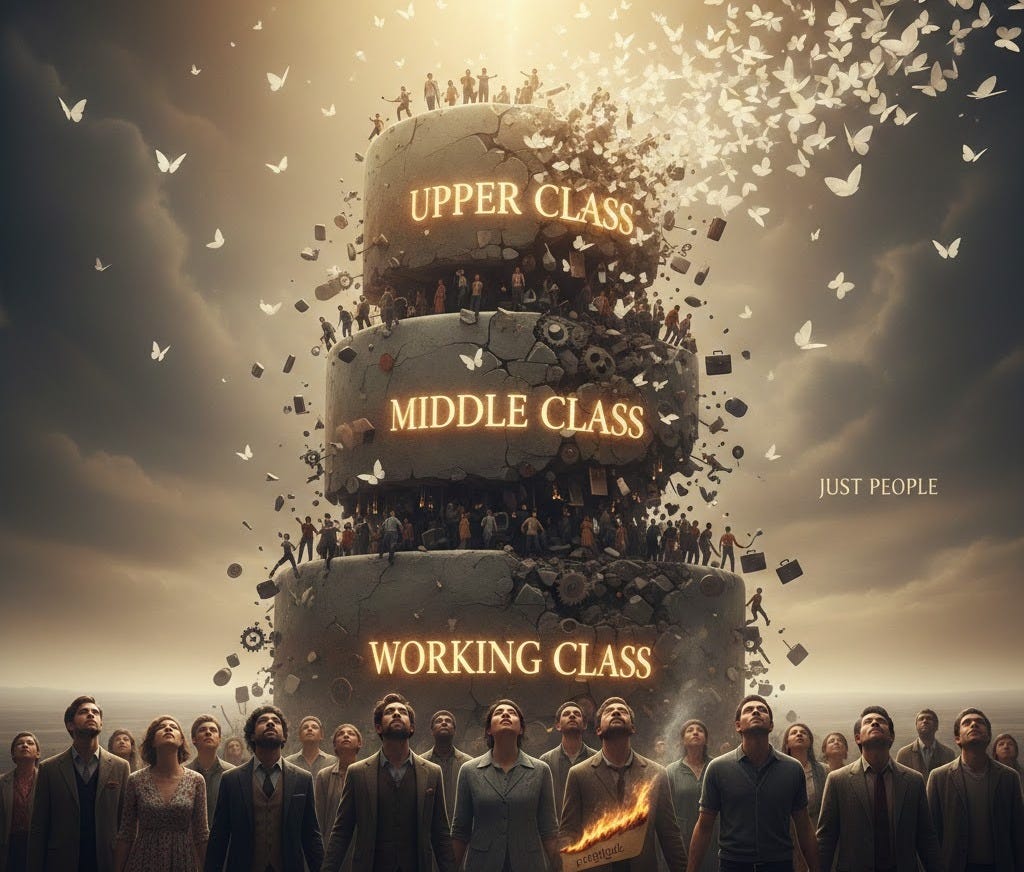
We are a nation of amateur genealogists with a pathological, almost sexual, need to sniff each other’s laundry. We’ve spent generations convinced that “middle class” or “working class” are real, physical things, like gravity or a bad case of shingles. They aren’t. They are just stickers we’ve collectively agreed to slap on our foreheads so we don’t have to do the hard work of actually meeting a person.
It is a massive, expensive, nation-wide hallucination. And the funniest part? We’re all the ones holding the mushrooms. Every time you judge a man by his choice of mustard or the way he pronounces “bath,” you aren’t being clever; you’re just being a volunteer guard in a prison you built for yourself.
The Sorting Office in Your Brain
From the moment we can crawl, we are taught the “Sorting Office” method of human interaction. We see a bloke with a specific accent or a certain type of organic kale in his trolley and we think we’ve cracked his genetic code. It’s pathetic. We are all involved in this—every time we check a postcode before a first date or judge a pair of shoes at a job interview, we’re just another cog in the machine that keeps us all feeling slightly superior or slightly ignored.
We love to blame “the system” or “the elites” for these divisions, but who is checking the brand of the neighbour’s car? You are. Who is making assumptions about someone’s intellect based on their local pub? We are. It is a shared participation in a game that has no winners, only different levels of anxiety.
The Unpredictable Mess of the High Street.
Society isn’t a ladder; it’s a bowl of alphabet spaghetti that we’re trying to read like it’s a prophecy. We treat social standing as a rigid, predictable system—if A happens, then B must follow—but life is actually a mess of complex feedback loops. A tiny, insignificant choice made forty years ago creates a massive, disproportionate shift today. Yet, we still try to fit these messy, beautiful human lives into three neat little buckets.
Is it logical? No, it’s a mental illness. Is it practical? Only if you enjoy living in a cage. What’s the likely outcome of keeping this up? We stay in our little pens, bleating at each other through the fences while the world actually moves on. We’re haunted by the shadows of our grandfathers’ insecurities, acting out scripts written by people who have been dead since the steam engine was high technology.
Who Actually Profits from the Divide?
We have to ask the only question that matters: who gains from us being terrified of being “common” or “pretentious”? The people selling you the “right” kind of watch and the “correct” education for your kids, that’s who. This social hierarchy is the ultimate marketing tool. It’s a way to make you buy things you don’t need to impress people you don’t like to maintain a status that doesn’t exist.
We’ve turned our lives into a performance for an audience that isn’t even watching. We are all the directors, the actors, and the bored teenagers in the back row throwing popcorn. We are all complicit in the great sorting. The moment we realise the scam, the stage lights go out and we’re just left standing in a dark room with a bunch of strangers. And that’s when the fun starts.
The Obsession with the Trivial
We focus on the tiny 20% of differences to justify 100% of our prejudices. We obsess over the “correct” vocabulary, the brand of the gin, or the height of a garden hedge. We spend a disproportionate amount of energy on the things that matter the least. We are so busy looking for the “tag” on the back of a neck that we never bother to look in the eyes.
It’s a feedback loop of nonsense. We judge because we’re afraid of being judged. We sort because we’re afraid of being out of place. It’s a collective insecurity that has been branded as “tradition.” But tradition is just peer pressure from dead people. Why are we letting a bunch of Victorians tell us how to treat each other in the age of AI and space travel?
The Exit: Walking Out of the Theatre.
The only way out is to refuse the category entirely. This isn’t about moving “up” a system; it’s about stepping off the ladder and realising you were standing on the ground the whole time. Maintaining your inner sovereignty means being the one person in the room who refuses to play the “who’s who” game. It means treating the CEO and the cleaner with the same level of detached, polite indifference to their “status.”
When you reclaim your perspective, the walls start to look a lot like cardboard. You stop being a “working-class hero” or a “middle-class striver” and you start being a person. It’s terrifying because once you lose the label, you actually have to figure out who you are. And that’s the real reason we cling to these tags: they’re a convenient excuse for having no personality.
The Myth of the Replacement.
People always ask, “But what can we replace it with?” That’s like asking what we can replace a tumour with. You don’t replace it; you just get rid of it and enjoy the health that follows. We don’t need a new set of boxes. We don’t need new categories for our “contribution” or our “agency.” We just need to stop looking for boxes.
If we must have a metric, let it be character. Let it be how a person handles a crisis, how they treat someone who can do nothing for them, or how they contribute to the collective. Everything else is just wallpaper.
Your bank balance is a number, not a soul.
Your accent is a melody, not a rank.
Your job is a transaction, not an identity.
The Collective Reset.
We are all the architects of this social crust. We are the ones who keep the paint fresh on the fences. If we want to get rid of this system, we have to stop talking about it as if it’s something that happened to us. It’s something we do to each other, every single day, in a thousand tiny, petty ways.
The blame culture is a dead end because it suggests that someone else has the key to the cage. They don’t. The cage isn’t even locked. We’re all just sitting inside because we’re worried about what the people in the next cage will think if we leave.
The Final Truth.
The only solid truth left is this: people are just people. Every attempt to sub-divide that is a lie told for profit or protection. We are a collection of individual stories, messy backgrounds, and unpredictable futures. To try and map that onto a three-tier system is like trying to map the Atlantic Ocean with a crayon.
Is it practical to change? Yes, it saves an enormous amount of mental energy. Is it logical? It’s the only thing that is. What’s the likely outcome? We might actually start liking each other.
We’ve been sorted for so long we’ve forgotten how to just be. It’s time to reclaim the narrative. Take the stickers off. Burn the pedigree. Look at the person in front of you and realise they are just as confused, just as hopeful, and just as human as you are.
The ghost only stays in the house because we keep inviting it for tea. Stop opening the door.