


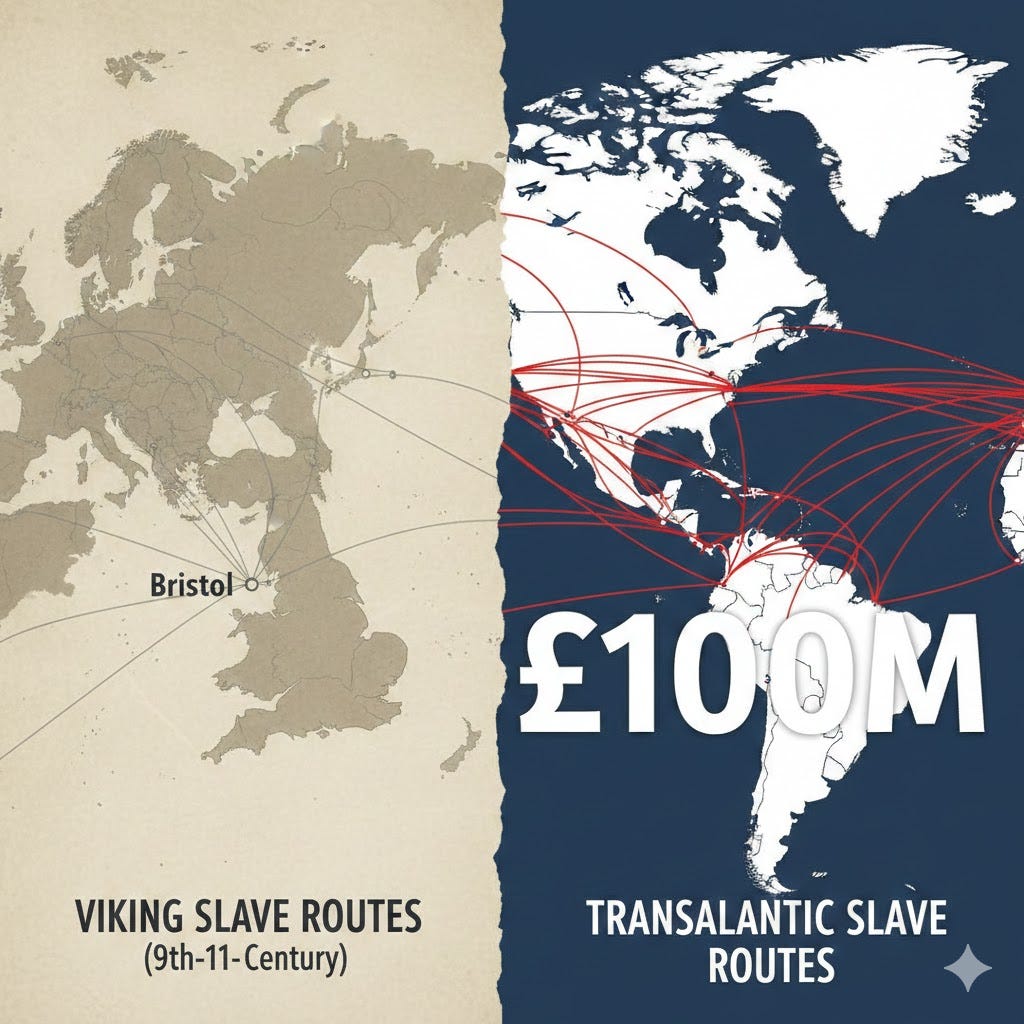
The Church of England’s incoming Archbishop wants to give away a hundred million quid. They’re calling it the FIRE Fund. Reparations for historical slavery. Not her money, obviously. The Tories are against it, progressives are for it, and here’s my question: where exactly do we stop counting?
Because once you start doing historical reparations based on slavery, you’ve opened a door you can’t close. So let’s walk through it and see where it goes, shall we?
Slavery’s a black thing, right? That’s how we talk about it. African victims, European perpetrators, transatlantic trade. That’s the slavery that matters. That’s the slavery getting the hundred million quid FIRE Fund.
But here’s a question: why just that one?
Bristol’s got two slavery histories. Everyone knows the transatlantic trade. Colston statue, protests, rewritten plaques. We’ve done the moral reckoning on that one. But between the 9th and 11th centuries, Bristol was a Viking slave hub. Two hundred years of Norse raiders using it as a transit point, shipping enslaved Britons to Dublin’s slave markets. White people enslaving white people. Same brutality. Same systematic exploitation. Same suffering.
So where’s their FIRE Fund? Where’s Norway’s hundred million? Why doesn’t that count?
Is it because there’s no convenient racial narrative to attach to it? Or is it because we’ve decided some historical slavery matters and some doesn’t, and we’re not being entirely honest about how we’re making that decision?
Think about the Romans for a minute. Enslaved millions across three continents. Didn’t care what colour you were. Lost the war, became property. Simple as that. The Ottoman Empire ran slave markets for centuries. The Arab slave trade lasted longer than European involvement in Africa. The Barbary pirates enslaved over a million Europeans between the 16th and 19th centuries. Raided as far as Iceland.
If we’re establishing that historical slavery creates modern financial liability, who owes what to whom? Does Turkey owe the Balkans? Do North African states owe Southern Europe? Does Scandinavia owe Britain? How far back are we going with this? And who’s doing the calculations?
Here’s the bit nobody wants to talk about, and I’m genuinely asking: what about the African kingdoms that were active participants in the transatlantic slave trade? Dahomey, Ashanti, Oyo. They weren’t victims of European traders. They were business partners. They captured people from rival groups, marched them to coastal forts, sold them for profit. Did this for generations. Built significant wealth from it.
So if profiting from slavery creates modern liability, where’s their bill? Do the descendants of the Kingdom of Dahomey owe money to the descendants of the people their ancestors sold? Or does that complicate the story we’ve decided to tell ourselves?
I’m not being rhetorical here. I genuinely want to know: how does the principle work when you apply it consistently? Because from where I’m sitting, we’re selecting one specific type of slavery - one type of victim, one type of perpetrator - and calling it reparations. That’s not a principle. That’s a choice. And nobody’s explaining the logic behind that choice.
Why Just the Church of England?
And while we’re asking questions nobody seems to want to answer: why just the Church of England?
The Catholic Church blessed the Spanish conquests. Issued Papal bulls authorising slavery. Ran the entire colonial apparatus for centuries. The Vatican’s wealth makes the Church of England look like a charity shop. So where’s their FIRE Fund? Where’s the pressure on Rome to liquidate assets and pay reparations?
There isn’t any. Why not?
Is it because the Church of England will bend to progressive pressure and the Catholic Church won’t? Are we just picking targets based on who’ll comply rather than who bears the most historical responsibility? And if we’re doing that, what does that tell you about whether this is actually about moral principle or institutional positioning?
Let’s ask some practical questions. Who pays this hundred million? The Church as an institution? Where does that money come from - asset sales, reduced charitable spending, cuts to services for current parishioners? So the people making the proposal don’t pay, but the people attending church today do?
Who receives it? Direct descendants of enslaved people? How do you verify that lineage? What about mixed ancestry? Communities historically affected by slavery? Which communities qualify and which don’t? Who decides?
Why a hundred million specifically? What’s the calculation? Is it based on documented Church profits from slavery-related investments? Estimated harm converted to pounds sterling? Or is it just a number that sounds substantial without actually bankrupting the institution?
And here’s the real question: what does this actually achieve? Does paying discharge the historical debt? Can the Church then stop talking about slavery and move on? Or is this a symbolic gesture that changes nothing materially but lets the institution claim moral progress?
The Archbishop hasn’t answered any of this. Has anyone?
What’s This Really About?
Let me ask you something. The Church of England is dying, right? Attendance has collapsed. The median age of parishioners is approximately deceased. So what does a failing institution do when it’s lost its original purpose?
It buys relevance. Aligns itself with whatever moral framework currently dominates. Reparations sound serious. Sound moral. Sound like progress.
But is it? Or is it an organisation that’s lost its theological confidence trying to purchase credibility with other people’s money?
That hundred million won’t come from church leadership personally, will it? It’ll come from the institution. The people making the proposal won’t pay. The people receiving it probably won’t see their lives materially change. But the institution gets to claim it did something.
So let me ask the three questions: Is it practical? Can you create a framework that doesn’t generate infinite liability when applied consistently? Is it logical? Can you explain why this slavery counts but that slavery doesn’t without just admitting you’re being selective? What’s the likely outcome? Symbolic payment that changes nothing, establishes a precedent other institutions will ignore?
The Tories oppose this. But not because they’ve thought through these questions. They oppose it because opposing progressive-sounding things is their entire strategy. That’s not insight. That’s tribalism.
But here’s what bothers me: if the Church genuinely wanted to address its historical relationship with exploitation, what would that actually look like? Open every archive. Document every investment, every benefit derived from empire. Make it public. Then do something about present-day injustice. Stop evicting homeless people from Church property. Use that land to house people. Address current poverty instead of historical wrongs you can’t actually fix.
Would that generate the same headlines as a hundred million quid FIRE Fund? Would that make church leadership feel as morally superior? Or does none of that happen because it requires actual institutional change rather than symbolic gestures?
And has anyone considered what legal precedent this establishes if British institutions start accepting liability for historical injustice? Can descendants sue? Can former colonies demand compensation from corporations? Think a hundred million sounds expensive? What does consistent application of this principle actually cost when you add it all up?
Here’s What Nobody’s Saying
The Vikings stopped using Bristol as a slave hub because they lost military power. Not because they developed moral objections to slavery. The transatlantic trade stopped because it became economically unviable and morally indefensible to enough people with power. Every historical injustice that ended did so because circumstances changed. Not because humanity suddenly became enlightened.
So let me ask you directly: does historical suffering grant anyone moral superiority over anyone else? Does it matter what colour you are or what happened to your ancestors? The suffering was real. The injustice was real. But does it give you special moral standing in 2025?
Why have we created this hierarchy where one group’s historical suffering takes precedence over everyone else’s? Why does being descended from victims of the transatlantic slave trade grant moral authority that being descended from enslaved Britons, or enslaved Europeans, or enslaved anyone else throughout human history apparently doesn’t?
Is it because it serves current political purposes? Because it allows the Church to buy relevance? Because it gives activist movements identity cohesion? Because it provides progressive politicians something to signal with?
Have we built an entire framework around one specific form of historical slavery because it’s politically useful right now, not because it makes logical sense or can be consistently applied?
And if that’s what we’re doing, why are we all pretending not to notice?
The Church of England’s FIRE Fund isn’t about addressing historical injustice, is it? It’s about institutional positioning. And we’re all going along with it because acknowledging what’s actually happening would require admitting we’ve created a hierarchy of victimhood based on current political fashion rather than any consistent principle about historical suffering.
History doesn’t work that way. Suffering doesn’t work that way. So I’ll ask again: where do we stop counting?
Sources for your own research:
Bristol’s Viking slave trade: Stephen Harrison, “Viking Age Trade Networks in the Irish Sea” (2015), Transactions of the Bristol and Gloucestershire Archaeological Society, Vol. 133
Barbary slave trade: Robert C. Davis, “Christian Slaves, Muslim Masters: White Slavery in the Mediterranean, the Barbary Coast and Italy, 1500-1800” (Princeton University Press, 2003)
Ottoman slavery: Ehud R. Toledano, “The Ottoman Slave Trade and Its Suppression: 1840-1890” (Princeton University Press, 1982)
Arab slave trade: R.W. Beachey, “The East African Slave Trade and Its Fallout” (Royal African Society, 1976)
Roman slavery: Keith Bradley, “Slavery and Society at Rome” (Cambridge University Press, 1994)
African kingdoms’ role in transatlantic slave trade: John Thornton, “Africa and Africans in the Making of the Atlantic World, 1400-1800” (Cambridge University Press, 1998); Pernille Ipsen, “Daughters of the Trade: Atlantic Slavers and Interracial Marriage on the Gold Coast” (University of Pennsylvania Press, 2015)
Church of England slavery connections: Kathleen Chater, “Untold Histories: Black People in England and Wales during the Period of the British Slave Trade, c.1660-1807” (Manchester University Press, 2009)
Catholic Church colonial slavery: Andrés Reséndez, “The Other Slavery: The Uncovered Story of Indian Enslavement in America” (Houghton Mifflin Harcourt, 2016)