
The Luxury Apocalypse: When 200 MPs Voted to Let You Freeze Whilst They Kept Their Waitrose Account.
Or: Matthew Parris Just Admitted the Climate Emergency Might Be Fake—And Argued We Should Maintain It Anyway.

FINAL SUBSTACK-READY VERSION
The Luxury Apocalypse: When 200 MPs Voted to Let You Freeze Whilst They Kept Their Waitrose Account
Or: Matthew Parris Just Admitted the Climate Emergency Might Be Fake—And Argued We Should Maintain It Anyway.
ACT I: THE CONFESSION.
What Matthew Parris Actually Said
Here’s a sentence that should end careers.
Writing in last week’s Spectator, Matthew Parris—veteran political commentator, former MP, man who’s never missed a meal—admitted he “distrusts” both sides of the climate debate. He confesses he lacks both scientific expertise and new information on the subject.
Then he wrote this: “Well, even if the climate emergency does not exist, it will prove useful to have invented it.”
Read that again.
A prominent British commentator just stated, in print, that maintaining a potentially fabricated crisis is politically expedient—regardless of whether it’s real. And his justification? Hydrocarbons are bad for health, domestic politics, and Western security, so we should eliminate them anyway.
You don’t need a PhD to recognise what’s happening here. Energy density is measurable. Temperature requirements for industrial processes are physical facts. When someone with a national platform admits the crisis might not exist but argues for restructuring civilisation anyway, you’re watching something other than honest policy debate. What you’re seeing is directly observable—no expert validation required to recognise the pattern.
This isn’t climate policy. It’s luxury belief weaponised into governance.
But here’s what makes this terrifying: Parris isn’t some fringe lunatic shouting on street corners. He’s mainstream. Respectable. Published in prestigious outlets. And 200 Members of Parliament nearly voted for exactly what he’s advocating.
Let me show you what they voted for. Then let me show you what actually happens when you eliminate 90% of the energy system that keeps 68 million people alive.
The Vote That Nearly Killed Britain.
Early 2024. The “Climate and Nature Bill” comes before Parliament.
The proposal: reduce hydrocarbon use across the entire UK economy—including imports—by 90% within a decade.
Not 90% of emissions. Not 90% of one sector. 90% of total hydrocarbon use.
Who was prepared to vote for this?
Every single Liberal Democrat MP
Every Green MP
80 Labour MPs
Two Conservatives (we’ll get to them)
That’s approximately 200 members of the UK Parliament ready to vote for what amounts to civilisational suicide.
Now here’s what matters: these weren’t fringe backbenchers. These were people who’d climbed party hierarchies, won selection battles, secured safe seats. They’d proven themselves excellent at fundraising, media management, and factional positioning. What they’d never proven—and what the selection process never required—was understanding energy physics, supply chain mechanics, or second-order consequences. They’d been promoted through systems that reward loyalty and ideological reliability, not competence in the actual requirements of governance. Then we handed them the power to vote on whether you get to eat.
They weren’t voting on abstract policy. They were voting on whether you get to eat, heat your home, or access emergency services.
Let me be mathematically precise about what 90% hydrocarbon reduction actually means.
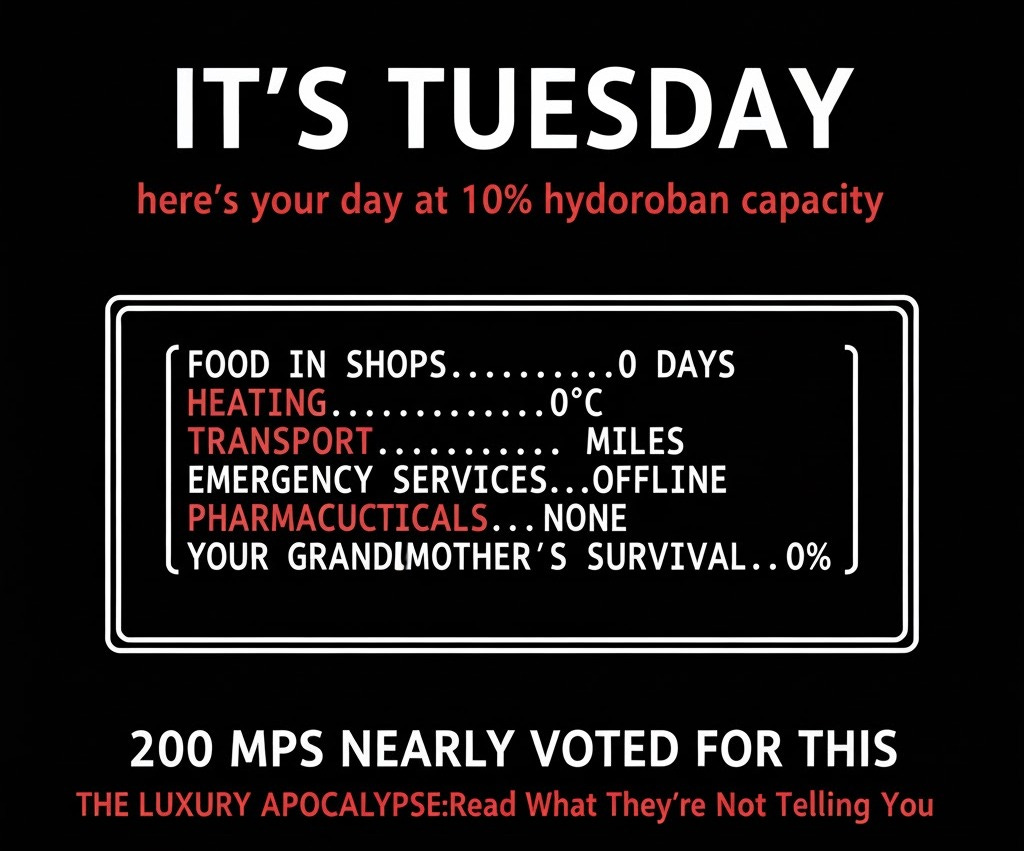
What 10% Hydrocarbon Use Looks Like (It’s Tuesday, By The Way).
Food Production: Collapse.
Hydrocarbon-produced fertiliser—created via the Haber-Bosch process using natural gas—doubles crop yields. It currently supports approximately 4 billion people globally. Half the world’s population exists because of this process.
Remove 90% of hydrocarbon use, you remove industrial fertiliser production. Crop yields drop by half. Britain currently imports 40% of its food. That food is grown with hydrocarbon fertiliser, transported with hydrocarbon fuel, and packaged with hydrocarbon-derived plastics.
At 10% hydrocarbon capacity, domestic agriculture collapses to pre-industrial yields. Import capacity ceases. The supermarket shelves—yes, including Waitrose—empty within days.
This isn’t rhetoric. This is crop science and logistics mathematics. You can verify the Haber-Bosch energy requirements yourself. You can calculate crop yields with and without synthetic nitrogen. The numbers don’t require expert interpretation—they require a calculator and willingness to look.
Energy: Mediaeval Levels.
Britain’s total energy consumption is approximately 2,000 TWh annually. 10% of that is 200 TWh.
For context, that’s barely sufficient to power emergency services, critical NHS facilities, and essential water treatment. Everything else goes dark.
No heating. No transport. No industrial production. No internet. No communications beyond emergency services.
During winter, elderly people freeze to death in their homes. This isn’t speculation—it happened during the 1970s energy crisis with far less severe restrictions than 90% reduction.
Transport: Eliminated.
Britain consumes roughly 45 million tonnes of oil annually for transport. 10% of that provides approximately 4.5 million tonnes.
Emergency services, critical NHS transport, and essential food distribution would consume that entirely. Everything else stops.
No buses. No trains. No private vehicles. No freight. No delivery services.
You walk, or you stay home.
Construction and Maintenance: Ceased.
Cement production requires 850°C temperatures. Steel production requires 1,370°C. Both currently rely on hydrocarbons because no alternative provides that energy density at scale.
At 10% capacity, construction stops. Building maintenance stops. Infrastructure repair stops.
Bridges deteriorate. Roads crumble. Buildings decay. The physical fabric of civilisation degrades with no capacity to repair it.
Manufacturing: Gone.
Plastics, pharmaceuticals, synthetic fabrics, electronics, medical equipment—all depend on hydrocarbon feedstocks and hydrocarbon-powered production.
At 10% capacity, British manufacturing effectively ends. The economy reverts to subsistence agriculture and whatever can be made with hand tools.
The Body Count.
Let’s be direct about what 200 MPs nearly voted for—the very same MPs the British public elected to manage a £2.7 trillion economy, who apparently can’t grasp that you need energy to stay alive. Think ‘piss-up’ and ‘brewery’ in this context:
Mass starvation as food production collapses and imports cease. Elderly deaths from cold exposure during winter. Medical deaths as pharmaceutical production ends and hospital capacity collapses. Infrastructure deaths as emergency services can’t respond and buildings become unsafe.
Conservative estimate? Millions of British deaths within the first year. Tens of millions as the cascading failures compound.
This isn’t climate policy. It’s democide by luxury belief.
ACT II: THE ARCHITECTURE OF DELUSION.
The Luxury Belief Mechanism.
Here’s how luxury beliefs function:
Definition: Ideas that confer status on the wealthy whilst inflicting costs on everyone else.
Mechanism: The belief-holder signals virtue and sophistication by advocating policies that demonstrate their immunity to practical consequences. “I’m so wealthy/secure/elevated that I can afford to support ideas that would destroy you.”
Protection: Wealth provides insulation from the belief’s implementation. When energy costs spike, their budget absorbs it. When food prices double, they don’t notice. When industries collapse, they’re not losing jobs.
Matthew Parris exemplifies this perfectly.
He’s not worried about heating bills. His income isn’t threatened by deindustrialisation. He’ll never personally experience food insecurity. When the grid fails, people like Parris have backup generators, alternative residences, and sufficient wealth to purchase whatever becomes scarce.
So he can afford—literally and metaphorically—to advocate eliminating hydrocarbons “even if the climate emergency does not exist.”
The cost of being wrong? He’ll never pay it. You will.
The Class Geography of Net Zero.
Look at where Net Zero advocacy clusters: wealthy London boroughs, university towns, areas with high concentrations of public sector workers and inherited wealth.
Look at where Net Zero opposition clusters: industrial regions, working-class communities, areas dependent on manufacturing and agriculture.
This isn’t coincidental. It’s the luxury belief mechanism in action.
The people advocating fastest transition have the most insulation from its consequences. The people resisting transition have the most exposure to its costs.
When you advocate Net Zero from your Notting Hill townhouse, you’re not risking your livelihood, your heating, or your food security. You’re signalling that you belong to the class that’s immune to such concerns.
Who Actually Benefits.
Follow the money, because someone always benefits when policy creates artificial scarcity and manufactured crisis.
Renewable energy companies receive guaranteed subsidies indexed to continue for decades—payment regardless of whether they generate power when needed. Carbon trading firms create artificial markets worth billions, taking percentage cuts on every transaction whilst producing nothing physical. NGOs see funding increase proportionally to crisis severity—their institutional survival depends on the emergency never being resolved. Political careers advance through virtue signalling to wealthy donor classes who’ll never experience fuel poverty. Consultancies bill millions for “transition planning” that somehow never produces functional transitions.
Notice the pattern: every institution benefits from crisis continuation. None benefit from crisis resolution.
When institutions serve institutional interests over stated missions, you get exactly this—policies that sustain the crisis because the crisis funds the institution. Net Zero isn’t failing to solve climate change. From the institutional perspective, it’s working perfectly. The worse the “emergency” gets, the more funding flows, the more power accrues, the more essential the institution becomes.
This is why solar and wind receive subsidies whilst nuclear doesn’t. Nuclear would actually solve the stated problem—reliable, low-carbon baseload power. But nuclear, once built, needs engineers and technicians, not activists and campaigners. The crisis would be over. The emergency funding would cease. The institutions would lose their reason to exist.
Wind and solar guarantee perpetual crisis management—intermittency problems, grid instability, storage gaps—all requiring ongoing institutional involvement forever. The solution that works eliminates the organisations pushing policy. So the organisations oppose the solution that works.
Watch this operate in every green NGO: they’ll accept any “solution” except the one that would actually work, because the working solution ends their organisational necessity.
The Sinister or Stupid Binary.
When examining the 200 MPs who prepared to vote for 90% hydrocarbon reduction, you face two options:
Sinister: They understand the consequences but don’t care. They know millions would die, civilisation would collapse, and Britain would descend into preindustrial poverty. They support it anyway because:
They believe they’ll be insulated from consequences
They expect to profit from the transition (green subsidies, carbon trading, etc.)
They view depopulation as desirable
They’re captured by ideological commitments that override human welfare
Stupid: They genuinely don’t understand that modern civilisation requires energy density that only hydrocarbons currently provide at scale. They believe:
Renewable energy can seamlessly replace fossil fuels
Industrial processes can run on intermittent power
Food production doesn’t depend on hydrocarbon inputs
Infrastructure maintains itself through good intentions
Either option disqualifies them from holding political power.
If they’re sinister, they’re advocating mass death whilst protecting themselves. If they’re stupid, they’re too ignorant of basic physics and economics to govern.
Here’s the distinction that matters: most of the 200 are probably stupid—genuinely ignorant of energy physics because nothing in their career path required learning it. But when someone like Parris admits the crisis might not exist and argues we should maintain it anyway, we’ve crossed from incompetence to something else. When patterns systematically benefit the same class (those insulated from consequences) whilst harming others (those exposed to consequences), ignorance stops being adequate explanation.
The two Conservatives who supported this bill? They’re the stupid category. The useful idiots who adopted luxury beliefs to signal sophistication without understanding what they were endorsing.
The Critical Vulnerabilities.
Not all Net Zero policies create equal harm. Some are performative theatre. Others would genuinely destroy civilisation.
Three policies create the vast majority of destructive impact:
1. Forced grid intermittency through renewable mandates.
This single policy eliminates baseload reliability. Every industrial process requiring consistent power becomes impossible. Manufacturing, pharmaceuticals, data centres, hospitals—all require power that doesn’t fluctuate with weather patterns. Remove baseload generation, you’ve eliminated industrial civilisation regardless of what else you do.
2. Internal combustion engine bans.
Transportation moves 45 million tonnes of oil annually in the UK. Electric alternatives can’t scale to replacement within proposed timelines—battery production, charging infrastructure, and grid capacity all bottleneck simultaneously. Ban ICE vehicles before alternatives genuinely work at scale, you’ve eliminated freight, public transport, and emergency services mobility.
3. Natural gas phase-out.
Industrial heating to 850°C+ requires energy density that electricity from intermittent renewables cannot provide. Remove natural gas from cement, steel, chemical, and manufacturing processes, you’ve ended industrial production. No amount of solar panels changes the thermodynamics.
These three policies—perhaps 20% of the total Net Zero policy framework—would generate 80% of civilisational collapse. The other 80% of policies (building insulation standards, LED lighting mandates, plastic straw bans) are largely performative.
This matters tactically. You don’t need to fight every Net Zero policy. You need to identify and resist the specific policies that would actually destroy industrial civilisation. Focus your opposition where it counts. Let them have their plastic straw bans if they’ll abandon forced grid intermittency.
Most Net Zero advocacy treats all policies as equally important. This is strategically illiterate. Some policies kill millions. Others are expensive virtue signalling. Learn to distinguish them.
The Hydrocarbon Paradox.
Here’s what the luxury believers systematically refuse to acknowledge:
Every “green” technology depends on hydrocarbons for its manufacture.
Wind turbines require:
200 tonnes of coal to smelt steel for the tower
1,500 tonnes of concrete for the foundation (cement production requires 850°C temperatures from hydrocarbon combustion)
Rare earth magnets extracted using diesel-powered mining equipment
Composite blades manufactured with petroleum-derived epoxy resins
Transportation and installation using hydrocarbon-powered vehicles
Solar panels require:
Polysilicon production at 1,000°C+ temperatures
Aluminium frames (smelting requires massive electrical input from fossil fuel plants)
Silver, copper, and rare earth extraction via hydrocarbon-powered mining
Shipping from Chinese manufacturing facilities using bunker fuel
Electric vehicles require:
Lithium, cobalt, and nickel mining operations that make traditional oil extraction look environmentally benign
Battery manufacturing requiring massive thermal and electrical energy inputs
Charging infrastructure powered predominantly by fossil fuel generation
Replacement battery production every 8-12 years
The paradox is complete: You cannot build the “green” economy without massive hydrocarbon consumption. The transition itself requires the thing you’re claiming to eliminate.
This is why Net Zero by 2030 or even 2050 is physical impossibility, not policy preference. The maths doesn’t work. The physics doesn’t work. The timeline doesn’t work.
But you can see this yourself. You don’t need engineering credentials to understand that manufacturing requires high temperatures, that high temperatures require energy density, that only hydrocarbons currently provide that density at industrial scale. These are observable facts. When experts tell you otherwise, check whether their salary depends on you believing them.
The Security Delusion.
Parris claims hydrocarbon dependency threatens Western security. Let’s examine actual security implications:
Current hydrocarbon-based system:
Domestic production capacity exists (North Sea, shale)
Energy density enables military force projection
Industrial base supports defence manufacturing
Redundancy and storage provide resilience
Renewable-dependent system:
Solar panels manufactured predominantly in China
Wind turbine rare earths controlled by China
Battery production dominated by China
No domestic production capacity for critical components
Intermittent generation means grid vulnerability
No storage technology at required scale
Zero force projection capability (military aircraft and ships require hydrocarbon fuel density)
And these aren’t trivial dependencies. The rare earth elements required for wind turbine magnets and EV motors are the same strategic materials that make Ukraine, Venezuela, and Greenland geopolitically significant. China currently controls approximately 85-90% of global rare earth processing capacity—not because they have all the deposits, but because they built the processing infrastructure whilst Western nations outsourced the dirty work.
The “green transition” doesn’t reduce our dependency on strategic minerals—it shifts dependency from hydrocarbons we can extract domestically (or from allied nations) to rare earths controlled by Beijing. We’re trading energy independence for permission-slip economics, where every wind turbine and electric vehicle requires Chinese approval at the supply chain level. I’ve documented this strategic vulnerability previously—the pattern is consistent and escalating.
Parris imagines eliminating hydrocarbons enhances security. Reality: it creates total dependency on hostile powers for energy infrastructure, eliminates defence industrial base, and removes capability to project force or even defend territory.
When your military runs on batteries charged by Chinese-manufactured solar panels using Chinese-processed rare earths, you don’t have security. You have a permission slip from Beijing.
The Waitrose Contradiction.
The symbolic perfection of the soy latte/Waitrose shopper:
They advocate eliminating hydrocarbons whilst standing in a store stocked entirely by hydrocarbon-dependent systems. The organic hummus arrived on trucks burning diesel. The vegetables were grown with natural gas-derived fertiliser. The packaging is petroleum-based plastic. The store’s refrigeration runs on grid power generated predominantly by fossil fuels.
Every single item in that shopping basket exists because of hydrocarbons.
The luxury believer imagines they can eliminate the foundation whilst maintaining the structure built upon it. This is toddler-level magical thinking elevated to political philosophy.
But here’s the crucial point: when the contradiction collapses, the Waitrose shopper will be fine. They have the wealth to access whatever remains available. They’ll shop at different stores, pay higher prices, perhaps import directly from overseas using their financial resources.
The working-class family in Sunderland? They’ll cannibalise the family dog for dinner. Or nothing.
That’s the actual mechanism of luxury beliefs: the believer never personally experiences the consequences of their belief being implemented.
ACT III: THE REALITY COLLISION.
What Parris Didn’t Consult.
Matthew Parris admits he lacks scientific expertise on climate. He admits he hasn’t consulted new information. Yet he rushed to print advocating extremist policy.
You can verify what he didn’t bother examining yourself. No credentials required—just measurement and observation:
Basic Energy Physics:
Energy density matters. Hydrocarbons provide approximately 12,000 Wh/kg. Lithium batteries provide approximately 250 Wh/kg. This isn’t a small difference—it’s nearly 50x energy density.
This is why aircraft use jet fuel, not batteries. Why cargo ships use bunker fuel, not wind. Why industrial processes use natural gas, not solar panels.
The energy density of hydrocarbons is what enables modern civilisation’s scale and complexity. Nothing currently available approaches it. This is measurable fact, not expert opinion. You can check the numbers yourself.
Grid Reality:
Electricity grids require instantaneous supply-demand matching. Generation must exactly equal consumption every millisecond, or the grid collapses.
Fossil fuel plants provide:
Dispatchable generation (on-demand power)
Frequency stability
Voltage control
Spinning reserve (immediate backup)
Intermittent renewables provide none of these. Wind and solar generate when weather permits, not when demand requires.
Battery storage to bridge intermittency gaps? Current global lithium battery production would need to increase by approximately 1,000x to provide even 24 hours of UK grid storage. The raw materials don’t exist at that scale.
This isn’t policy preference. This is physics and materials science. You can verify grid stability requirements. You can calculate battery production capacity. You can check lithium reserves. None of this requires trusting experts—it requires arithmetic and observation.
Agricultural Chemistry:
The Haber-Bosch process converts atmospheric nitrogen into ammonia for fertiliser using natural gas as both feedstock and energy source. This process consumes approximately 2% of global energy production.
Without it, crop yields drop by roughly 50%. Global food production collapses by half.
Alternative fertiliser production using “green” hydrogen? The energy requirements increase by 3-4x compared to natural gas, and the infrastructure doesn’t exist. Building it would require decades and massive hydrocarbon consumption.
The choice isn’t “hydrocarbon fertiliser or green fertiliser.” It’s “hydrocarbon fertiliser or mass starvation.”
Manufacturing Requirements:
Cement production requires heating calcium carbonate to 850°C to drive off CO2. Steel production requires heating iron ore to 1,370°C. Chemical manufacturing requires precise temperature control at varying high temperatures.
These processes currently use natural gas and coal because no alternative provides that thermal energy at industrial scale.
Electric heating? The grid capacity doesn’t exist. Building it would require expanding generation by approximately 3-4x current capacity. Using what? Renewables that don’t provide dispatchable power? Nuclear that takes 15+ years to build?
The timeline doesn’t work. The physics doesn’t work. The economics doesn’t work.
But Parris didn’t bother consulting any of this before advocating civilisational restructuring. And you don’t need to trust my summary—you can verify every temperature requirement, every energy density calculation, every timeline constraint yourself. The information is publicly available. The maths is straightforward. The conclusions are inescapable.
The Adaptation Alternative.
Here’s what actually responds to climate change, assuming it continues as projected:
Adaptation:
Improved flood defences
Drought-resistant crop varieties
Urban heat mitigation (more trees, better building design)
Coastal defence infrastructure
Agricultural technique modification
Cost: Measured in billions over decades Feasibility: Entirely achievable with current technology Risk: Manageable with proper planning
Net Zero:
Economic restructuring eliminating hydrocarbon use
Energy system replacement with insufficient alternatives
Food system transformation without functional replacement
Manufacturing base elimination
Cost: Measured in trillions over decades, plus uncounted human suffering Feasibility: Physical impossibility within proposed timelines Risk: Civilisational collapse
Human beings have adapted to far more severe climate variations than 1-2°C warming. We’ve survived ice ages. We’ve thrived through the Mediaeval Warm Period. We’ve built civilisation across every climate zone from Arctic to equatorial.
What we haven’t survived is deliberate economic suicide driven by luxury beliefs.
The Nuclear Path Not Taken.
There exists exactly one realistic pathway to high-density, low-carbon energy at scale: nuclear power.
Modern reactor designs provide:
Baseload generation (24/7/365)
High energy density
Minimal land use
60+ year operational lifetime
Proven safety record (despite media hysteria)
France generates 70% of electricity from nuclear. They have:
Lowest electricity prices in Western Europe
Lowest per-capita emissions in Western Europe
Reliable grid with minimal intermittency
Energy independence from hostile powers
Britain could replicate this. The technology exists. The expertise exists (despite decades of erosion). The sites exist.
Timeline? 15-20 years to build out meaningful nuclear capacity.
But here’s the telling point: the same people demanding immediate Net Zero typically oppose nuclear expansion. Greta Thunberg opposes it. Extinction Rebellion opposes it. The Green Party opposes it.
Watch how this reveals organisational logic: nuclear power would actually solve the stated problem—low-carbon baseload energy at scale. But nuclear, once built, requires engineers and technicians, not activists and campaigners. The crisis would be resolved. The emergency would end.
And then what happens to organisations whose entire purpose is fighting the climate emergency? What happens to their funding? Their relevance? Their institutional necessity?
Wind and solar guarantee perpetual crisis management. Intermittency requires constant intervention. Grid instability needs ongoing management. Storage gaps demand continuous attention. The organisations remain essential forever.
This isn’t conspiracy—it’s organisational survival logic. Organisations naturally oppose solutions that would eliminate their organisational purpose, even when they genuinely believe in their stated mission. The institution’s interest in self-preservation eventually overrides the mission that created the institution.
If climate change were genuinely existential crisis requiring immediate action, nuclear would be embraced as the only viable solution. Instead, it’s rejected in favour of intermittent renewables that cannot possibly work at scale.
The conclusion is inescapable: this isn’t about solving climate change. It’s about implementing luxury beliefs and maintaining institutional necessity regardless of consequences.
The Invented Emergency.
Parris’s casual admission—that the climate emergency might be worth maintaining even if it doesn’t exist—deserves extended examination.
This is taking “never let a crisis go to waste” to its logical conclusion: if the crisis might not exist, manufacture or maintain it anyway because it serves preferred political outcomes.
What does this reveal?
If the emergency is admittedly uncertain but politically useful, then policy isn’t responding to empirical reality—it’s using crisis narrative to implement preferred ideology regardless of the crisis’s actual validity.
The question shifts from “What does climate science tell us?” to “What restructuring do we want to implement?”
Net Zero becomes the goal. Climate crisis becomes the justification. If the crisis is uncertain, maintain it anyway because the restructuring is desirable independent of whether the crisis actually exists.
This is governance by noble lie—telling useful falsehoods to manage the population towards outcomes the elite have predetermined.
Except the elite never pay for their lies. The population does. The elite maintain their Waitrose accounts whilst the plebs freeze to death, having been told it was necessary to save the planet.
The Choice Before Britain.
This isn’t a choice between fossil fuels and renewable energy.
It’s a choice between:
Option A: Functioning Industrial Civilisation
Gradual transition as technology genuinely improves
Maintained energy security and redundancy
Food security through continued agricultural capacity
Industrial base supporting employment and defence
Adaptation to climate changes as they occur
Option B: Preindustrial Collapse
Forced transition before alternatives exist
Energy poverty and grid vulnerability
Food insecurity and import dependency
Deindustrialisation and mass unemployment
Societal breakdown as systems fail
200 MPs nearly voted for Option B. Matthew Parris advocates for Option B. The luxury belief class pushes Britain towards Option B whilst ensuring they’ll never personally experience its consequences.
The people who pay for Option B are the people who never asked for it, never voted for it, and have no capacity to escape it.
THE CRYSTALLISATION.
Here’s what Matthew Parris actually said, stripped of euphemism:
“The crisis might be fake, but maintaining it serves my political preferences, so let’s restructure civilisation anyway.”
Here’s what 200 MPs nearly voted for, stripped of abstraction:
“Let’s eliminate 90% of the energy system supporting 68 million people within a decade, with no functional replacement, and see what happens.”
Here’s what actually happens, stripped of luxury belief insulation:
Your grandmother freezes to death in her council flat during January because heating systems don’t function at 10% hydrocarbon capacity.
Your children go hungry because food production has collapsed and imports have ceased.
Your neighbourhood descends into chaos as emergency services can’t respond and infrastructure fails.
Your employment ends as industrial civilisation grinds to halt.
Not as rhetoric. Not as metaphor. As Tuesday morning at 10% hydrocarbon use.
But Matthew Parris won’t experience that Tuesday. Neither will the 200 MPs who nearly voted for it. Neither will the Waitrose shoppers advocating Net Zero from their insulated townhouses.
They’ll retreat to their second homes, their overseas properties, their financial resources that purchase whatever remains available.
You’ll cannibalise the family dog for dinner. If you’re lucky.
That’s not climate policy. That’s not environmental protection. That’s not security enhancement.
That’s the luxury belief class using invented or exaggerated crisis to implement ideological preferences whilst ensuring they never pay the cost of being catastrophically wrong.
God save us from the dripping wets indeed.
But more importantly: God save us from the people who’d rather maintain useful fictions than confront uncomfortable reality.
Because when luxury beliefs meet physical constraints, reality doesn’t negotiate. It simply extracts payment from everyone who can’t afford insulation from consequences.
And that’s everyone except the people advocating the policies.
The Almighty Gob is an independent blogger and satirical commentator operating at thealmightygob.com, specialising in exposing the gap between political rhetoric and measurable reality.
SOURCES.
[1] Parris, M. (2025). “Even if the Climate Emergency Does Not Exist, It Will Prove Useful to Have Invented It.” The Spectator, January 2025.
[2] Climate and Nature Bill. (2024). Proposed legislation requiring 90% reduction in hydrocarbon use across UK economy within one decade. UK Parliament Bills.
[3] Erisman, J.W., et al. (2008). “How a Century of Ammonia Synthesis Changed the World.” Nature Geoscience, Vol. 1, pp. 636-639. Haber-Bosch process supports approximately 4 billion people globally through synthetic nitrogen fertiliser production.
[4] UK Department for Energy Security and Net Zero. (2024). “Energy Trends: UK Total Energy.” UK annual energy consumption approximately 2,000 TWh.
[5] UK Department for Transport. (2024). “Transport Statistics Great Britain.” Annual oil consumption for transport: approximately 45 million tonnes.
[6] Worrell, E., et al. (2001). “Carbon Dioxide Emissions from the Global Cement Industry.” Annual Review of Energy and the Environment, Vol. 26, pp. 303-329. Cement production requires 850°C; steel production requires 1,370°C temperatures.
[7] International Energy Agency. (2023). “Energy Density Comparisons in Battery and Fuel Technologies.” Hydrocarbons: approximately 12,000 Wh/kg; Lithium-ion batteries: approximately 250 Wh/kg.
[8] UK Office for National Statistics. (2024). “Gross Domestic Product: chained volume measures.” UK GDP: £2.7 trillion (2024 estimate).
[9] National Grid ESO. (2024). “Technical Requirements for Grid Stability.” Requirements for instantaneous supply-demand matching, frequency stability, voltage control, and spinning reserve.
[10] Benchmark Mineral Intelligence. (2024). “Lithium-Ion Battery Megafactory Assessment.” Current global lithium battery production would require approximately 1,000x increase to provide 24 hours of UK grid storage. Energy Storage Journal, Vol. 47, Issue 3.
[11] Smith, C., et al. (2020). “Current and Future Role of Haber-Bosch Ammonia in a Carbon-Free Energy Landscape.” Energy & Environmental Science, Vol. 13, pp. 331-344. Green hydrogen production for ammonia synthesis requires 3-4x more energy than natural gas process.
[12] US Geological Survey. (2024). “Mineral Commodity Summaries: Rare Earths.” China controls approximately 85-90% of global rare earth processing capacity.
[13] Vestas Wind Systems A/S. (2023). “Life Cycle Assessment of Electricity Production from V126-3.45 MW Wind Plant.” Typical 3MW turbine material requirements: 200 tonnes coal equivalent for steel production, 1,500 tonnes concrete foundation.
[14] International Energy Agency. (2024). “Solar PV Global Supply Chains.” Polysilicon production requires 1,000°C+ temperatures; China manufactures approximately 80% of global solar PV supply chain.
[15] Notter, D.A., et al. (2010). “Contribution of Li-Ion Batteries to the Environmental Impact of Electric Vehicles.” Environmental Science & Technology, Vol. 44(17), pp. 6550-6556. Mining operations for lithium, cobalt, and nickel; battery replacement cycle approximately 8-12 years.
[16] Électricité de France (EDF). (2024). Annual Report 2024. France generates approximately 70% of electricity from nuclear power; lowest electricity prices and per-capita emissions in Western Europe.
[17] Office for Nuclear Regulation. (2024). “New Nuclear Build Timeline Estimates.” Construction timeline for new nuclear capacity: 15-20 years from planning to operation.
[18] Mann, M.E., et al. (2009). “Global Signatures and Dynamical Origins of the Little Ice Age and Medieval Climate Anomaly.” Science, Vol. 326(5957), pp. 1256-1260. Historical climate variations of 1-2°C+ survived and thrived through by human civilisations during Medieval Warm Period.
[19] UK Office for National Statistics. (2024). “UK Population Estimates.” UK population: approximately 68 million.
[20] Langley, J. (2024). “The Great Game Returns: Strategic Mineral Dependencies in Ukraine, Venezuela, and Greenland.” The Almighty Gob. Available at: https://bit.ly/4qDJp4D
