
THE MAYOR WHO BUILT NOTHING. NOW LORDING IT.
Bristol's housing scandal. Then, now, and still not fixed.

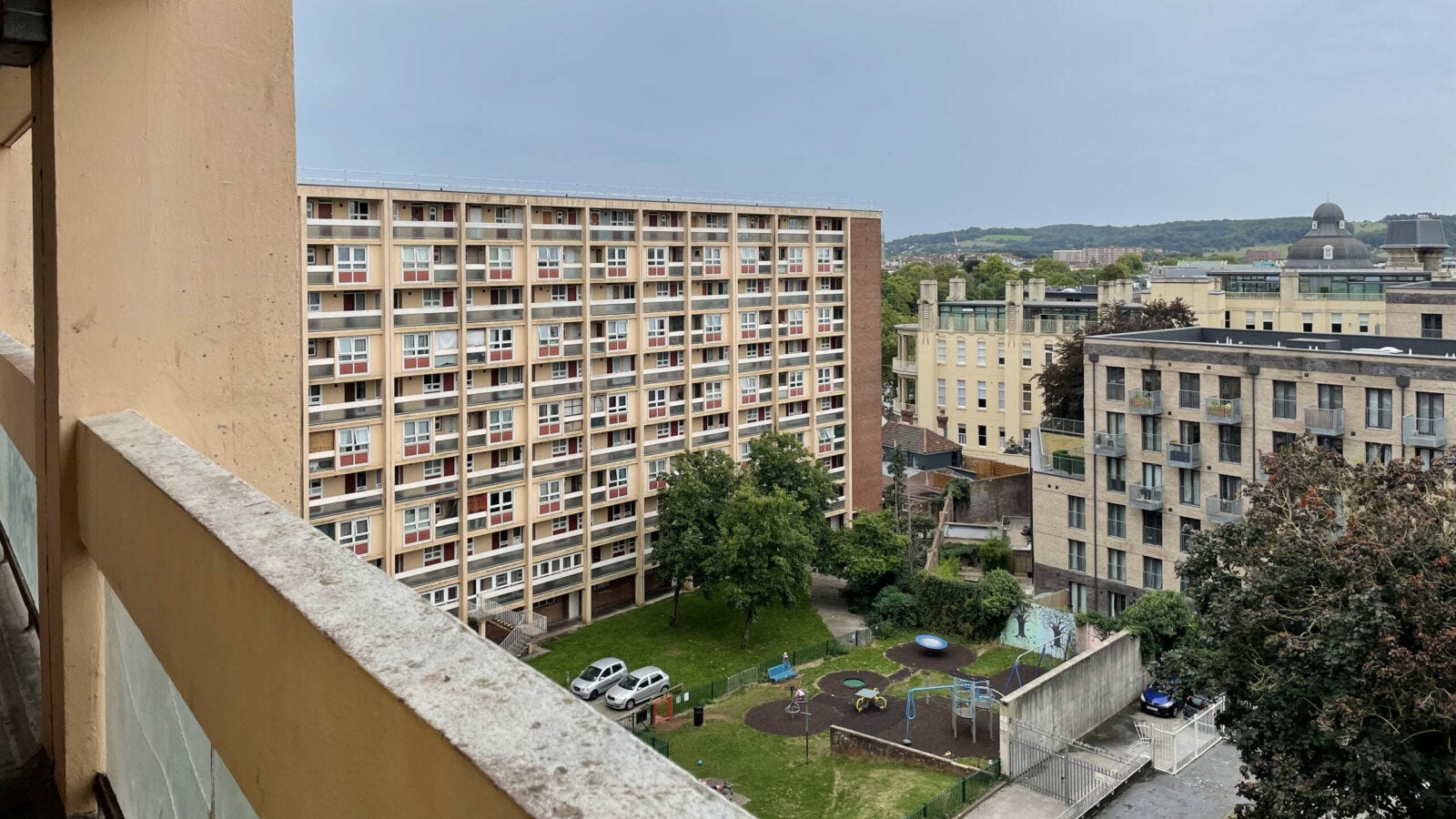
So, you’ve reported the damp three times. Filled in the form, made the call, sent the email. You’ve done everything right.
Nothing has happened.
So here’s a question worth sitting with. If the organisation responsible for your home doesn’t know what state it’s in — who does?
“Bristol CC has low confidence in its reporting of damp and mould, which means it does not have an accurate, up to date and evidenced understanding of the condition of its homes.” — Regulator of Social Housing, July 2024
That sentence comes from a formal regulatory judgement. Published on GOV.UK. Available to anyone who looks. It means the organisation responsible for your home didn’t know what state it was in. Not approximately. Not roughly. Didn’t know.
The Regulator of Social Housing gave Bristol City Council a C3 grade in July 2024. Second worst possible. Serious failings. Significant improvement needed. And it wasn’t handed down because of one bad month or a sudden crisis. It was handed down because someone finally looked.
So let’s look at what they found back then. And what’s happened since. Depending on how brave you are. Or, whether you’re someone who requires alcohol to steady your nerves.
Then: The Numbers.
Electrical safety certificates. Missing for over half of Bristol’s 26,700 social housing properties. The council told the regulator it couldn’t confirm the level of risk from outstanding remedial actions. In homes where people are sleeping.
Smoke and carbon monoxide alarms. The council couldn’t evidence legal compliance for more than 85% of its homes. Roughly 22,700 properties where nobody could prove the alarms worked.
Asbestos. No valid communal surveys for all blocks. No consistent reinspection process. In ageing housing stock where asbestos doesn’t announce itself before it becomes a problem.
Fire safety. Around 3,000 outstanding remedial actions. The council admitted low confidence in its own fire safety data management. This is a council that owns sixty-two high-rise buildings. Seven years after Grenfell. Still 3,000 actions in a queue.
Here’s something worth knowing before we go any further.
Bristol City Council’s own tenancy agreement — a legal contract, signed by every tenant, described as such on the council’s own website — states under section 2.13 that tenants have a responsibility to let council staff into their homes for gas, electrical and fire safety checks. Not a courtesy. Not a suggestion. A contractual obligation. The council can seek a court injunction if a tenant refuses. In urgent cases they can obtain a warrant for forced entry.
The council also publishes a page on its website titled Letting us into your council home. It sets out the legal basis for access. It lists electrical servicing — at least once every five years — as a requirement the council must fulfil. It lists annual fire safety checks as mandatory. It explains that after three failed attempts to gain entry, a housing officer will contact the tenant, and if there’s no response within ten working days, legal action may follow.
This is the same council that couldn’t produce electrical safety certificates for more than half of its 26,700 homes. The same council that couldn’t evidence smoke alarm compliance in 85% of its properties. The same council with 3,000 fire safety actions outstanding across 62 high-rise buildings.
The tenants had signed a contract saying the council must be allowed in. The law backed it up. The council had the right to seek a court order if anyone refused.
So what happened? Either the tenants were refusing en masse — which would itself be a crisis requiring urgent public explanation — or the council simply wasn’t knocking.
There’s no record of a mass refusal. There’s no record of injunctions sought at scale. There’s only the regulator’s judgement and the numbers it contains.
Someone wasn’t knocking, and it wasn’t heads together!
Stock condition surveys. Over 80% conducted more than five years ago. The regulator concluded it had no assurance Bristol understood the condition of its own homes.
Outstanding repairs. More than 16,000. Around half overdue by more than twelve months. Eight thousand repairs someone logged, someone promised to action, and then nothing. The regulator noted even this figure might not be accurate.
So when you made that call about the damp — did it even make the list?
“We do not have assurance that Bristol has a sufficient understanding of its homes to deliver the outcomes in the Safety and Quality Standard.” — Regulator of Social Housing, July 2024
Now: Twenty months on, the council says it has a “good understanding” of what went wrong. More than 40% of its homes have been surveyed in the last five years. The damp and mould data is described as “much clearer.” A December 2025 committee update was declared a milestone.
Progress, then. Of a kind.
The housing scrutiny panel’s 2024-25 annual report acknowledged the improvement. It also noted that housing officers remain difficult to contact or speak to, that residents have seen service charge increases without corresponding service improvements, and that there is “more work to do.” As the saying goes, ‘No shit, Sherlock!”
More work to do, being quite possibly the biggest understatement in the entire history of the council. Twenty months in. And the person in the flat is still waiting for the first visit. Others have no doubt reached state pension age, while others have no doubt died in the queue.
Then: The Man In Charge.
In 2023, Marvin Rees — you do remember him, don’t you — was Mayor of Bristol. Directly elected. Though, there are those who still wonder why... Executive control. Exclusively Labour cabinet. The decisions about where money went, what got prioritised, what got measured — aside from what subsequently transpired to be in rather short supply: political common sense — those were his.
And what he prioritised was thinking big.
There was the underground railway. First announced in his 2017 State of the City Address, it would tunnel beneath Bristol connecting the airport to the city centre to Cribbs Causeway. Rees estimated the cost at £2.5 billion. Then £4 billion. Then £7 billion — after he rejected an independent report by consultants WSP that priced the underground option at between £15.5 billion and £18.3 billion, a figure he dismissed as based on a “flawed approach.” The West of England metro mayor eventually vetoed the whole thing outright, stating plainly there would not be an underground in Bristol. By that point the council had spent £1.5 million exploring the idea, commissioned a £50,000 feasibility study, and pledged a further £15 million toward a business case for a project his own regional partners described as “so unlikely as to be not possible.”
There was the Western Harbour. A grand vision to demolish the Cumberland Basin road network, replace the Plimsoll Bridge, and transform Hotwells, Spike Island and Bedminster into a thriving new waterfront neighbourhood. First floated in 2017. A sales brochure was shown to investors in Asda — or, it could have been Asia — before local residents had been informed. A consultation followed — £150,000 spent on what critics called a sham exercise involving Plasticine and Post-it notes — which produced a vision statement that left most people baffled. Five years later it was still on the drawing board, still generating fresh consultation documents, still going nowhere.
And then there were the houses. Not an abstract vision — a concrete election pledge. In 2016, Rees promised 2,000 new homes a year, 800 of them affordable, by 2020. He didn’t get close. In his fourth year in office Bristol built 1,350 homes, of which 312 were affordable. Less than 40% of the target. The council’s own report quietly revised the ambition downward and blamed Brexit, then Covid.
So in 2021 Rees tried again. New pledge: 2,000 homes a year, 1,000 of them affordable, by 2024. He launched Project 1000 — an entire board dedicated to the delivery plan. He stood in front of cameras and said all the taps were open on housing delivery. His 2021 manifesto declared, in writing, that Labour had “delivered on all of our 2016 pledges.”
They had delivered 312 affordable homes against a pledge of 800. And called it delivered.
By the time Rees left office the waiting list stood at over 21,000 households.
The man pledging 1,000 affordable homes a year while delivering 312, proposing a £4 billion underground railway that independent consultants priced at up to £18 billion, redesigning Bristol’s entire western waterfront from a brochure shown to investors in Asia before local residents had been told — that same man was simultaneously responsible for a housing service that had lost track of electrical certificates for half its properties, couldn’t evidence smoke alarm compliance in 85% of its homes, and had 3,000 fire safety actions sitting in a queue.
With such adventurous ambitions, you could almost be forgiven for thinking Rees was a member of the Green Party.
Yes, the man responsible for your smoke alarm was the very same man busy pitching a £7 billion underground railway his own partners called impossible, redesigning a waterfront from a brochure shown to investors in Asia, and promising homes he never delivered.
Makes you wonder, doesn’t it — when exactly were the tenants on the agenda?
“Bristol CC has stated that it has more than 16,000 outstanding repairs, with around half of these overdue by more than 12 months, and it is not completing repairs in a timely manner.” — Regulator of Social Housing, July 2024
Then: Nobody Went Looking.
The regulator didn’t arrive because Bristol volunteered the information. It arrived because a fire safety survey submission in December 2023 raised enough concern that the RSH began asking questions. An external review was commissioned in February 2024, found the problems, and Bristol self-referred in April 2024 — after the regulator was already circling.
The self-referral was real. The external review was real. But the sequence matters. Nobody went looking. The regulator knocked first.
The problems didn’t arrive in December 2023. They accumulated. Every year the stock condition surveys aged past their useful life, every year the fire actions went unresolved, every year the compliance tracking wasn’t built — the system became more fragile, more sensitive, closer to the point where one external scrutiny would pull the whole picture into view.
Predictable endpoint. Anyone paying attention could have seen it coming. Nobody with the power to act was paying attention.
And while all of this was quietly compounding — what was the man in charge announcing at his next State of the City Address? Yes, you guessed correctly, without so much of a hint. None of the above!
“This is possibly the most challenging time for council housing in a generation.” — Independent housing consultant Michael Scorer, commissioned by Bristol City Council, 2024
Now: The Inheritance.
The Greens took control in May 2024. Green Councillor Tony Dyer became council leader. Green Councillor Barry Parsons chairs the housing committee.
At a December 2025 update Parsons told the committee: “When we set up this committee, we inherited a housing service that under the previous administration was failing our council residents. However, do we care? Of course we don’t, not while we can paint the roads and pathways in pretty colours.”
Wow, did he really say that? No, he didn’t. I just made it up for comedic effect. What he really said was: “When we set up this committee, we inherited a housing service that under the previous administration was failing our council residents. Of the hundreds of housing providers in the country, it was one of only a score to receive a C3 judgement from the Regulator of Social Housing. This was a service that had been neglected and underinvested in for years.”
He’s not wrong about the inheritance. He is, however, leading a council that in January 2025 proposed pausing the wider sprinkler installation programme in high-rise blocks.
Not the emergency Waking Watch sprinklers. The broader programme. A £3.9 million scheme to fit sprinklers across tower blocks, quietly shelved in budget documents due to what the council called “deliverability and affordability challenges.” Or, possibly, lack of writing space. The sprinkler programme is paused, and by all accounts, residents may have to rely on maintaining full bladders in case of fire.
Seven years after Grenfell. Sixty-two high-rise buildings. Sprinkler programme paused.
The same budget round proposed delaying £17 million of tower block renovations not yet started, and selling 1,200 council homes to cover an £8 million shortfall in the housing revenue account — the ring-fenced budget that can only be spent on council homes.
“Their plans also state they are stopping refurbishment works in tower blocks and discontinuing part of the essential sprinkler programme in high rise blocks. They need to come clean and tell tenants affected by these changes.” — Bristol Labour Group, January 2025
That’s the opposition Labour group saying it. Yes, the same party whose mayor presided over 3,000 outstanding fire actions now criticising the Greens for pausing a sprinkler programme. The irony isn’t subtle. Neither is the reality it points at — whoever holds the chair, the tenants in the tower blocks are still having the same conversation about safety, just with different faces at the front of the room.
In that respect, our dear former bricklayer and current council leader should perhaps already be considering his future place in the Upper House — before Cllr Bryher beats him to it. After all, what could possibly go wrong that hasn’t already when it comes to pie-in-the-sky ambitions in Bristol?
He need only look at his predecessor for reassurance. Marvin Rees — the man who couldn’t deliver the homes, couldn’t deliver the underground railway, couldn’t evidence the smoke alarms in 85% of his own properties — is now Baron Rees of Easton, sitting in scarlet and ermine in the House of Lords. Nominated in December 2024. Sworn in February 2025. His maiden speech was on net-zero emissions. You know, net-zero, as in, well, nothing to say really.
The underground railway never got built. The homes never got built. The fire actions sat in a queue. The electrical certificates expired untracked. The damp cases aged past twelve months.
The ermine, however, was delivered on time.
Which raises a question nobody in that chamber seems to be asking. If you can’t evidence the smoke alarms work in 85% of the homes you’re responsible for — what exactly are you being rewarded for? Answers on a postcard, to the Less Honourable Lord Rees, House of Lords, London SW1.
Now: The Timeline.
The council’s own published improvement schedule is unambiguous. December 2025 — all high-risk actions completed, consistent improvement evidenced. October 2026 — all homes compliant with safety and quality standards. March 2027 — fully embedded across all service areas, compliant with consumer standards.
We are now in March 2026. One month past the first milestone. The sprinkler programme is paused. Tower block renovations are delayed. The housing scrutiny panel says housing officers are still hard to reach. Service charges have gone up. The improvement is real but partial, and the council is delivering it while simultaneously cutting the budget that funds it.
Is it practical? A council that didn’t know the condition of its own homes in July 2024 achieving full compliance across 26,700 properties by October 2026 — seven months from now — while pausing safety programmes and delaying tower block works. Draw your own conclusion.
Is it logical? Only if you believe that institutional transformation of this scale runs on schedule when the money is being cut at the same time the work is being done.
What’s the likely outcome? The timeline will move. The December 2025 milestone was declared a success while the scrutiny panel noted ongoing failures in the same breath. Milestones have a way of being reached on paper while the person in the flat is still waiting for someone to come.
Which brings us back to where we started.
The Circle Hasn’t Closed Yet. And Will It Ever?
You’ve reported the damp three times. Filled in the form, made the call, sent the email. You’ve done everything right.
You’re still waiting, and by now may well have grown considerable facial hair, much similar to the men.
In July 2024 there were over 1,900 people in your position. You know, like waiting in the queue for your call to be answered. The council didn’t know the exact number. It said so, in writing, to a government regulator. Twenty months later there’s a programme board, a milestone, a timeline, and an October 2026 target. There’s also a paused sprinkler programme, delayed tower block renovations, and a scrutiny panel still noting that housing officers are hard to reach. Quite possibly due to the volume of work-related nervous breakdowns.
The smoke alarm above your head may or may not have been checked since July 2024. The council says it will all be fixed by October 2026. Seven months from now. Meanwhile, eBay may well have seen a spike in Bristol customers seeking DIY safe room kits. You know, just in case.
You’re still in the flat.
The damp is still on the wall. Probably started a family, engaging in regular conversations with you, and suddenly you’re in further breach of your tenancy for overcrowding, at the very least. Or, alternatively, you’ve since had breathing apparatus installed.
And you still haven’t had an answer to the question you asked three reports ago. Which, by now, you’ve forgotten anyway because, well, ageing just does that. Doesn’t it?
John Langley is The Almighty Gob — independent blogger and satirical commentator.
SOURCES AND CITATIONS.
All facts cited in this article are drawn from primary source documents. Nothing here is argued from assumption, inference, or second-hand reporting.
1. Regulator of Social Housing — Bristol City Council C3 Judgement, July 2024 The source for all regulatory findings: missing electrical certificates (50%+), smoke/CO alarm compliance (unverifiable in 85% of homes), outstanding fire remedial actions (3,000 across 62 high-rise buildings), outstanding repairs (16,000+, half overdue 12+ months), damp and mould cases (1,900+), stock condition survey age (80%+ over five years), council’s stated “low confidence” in its own data. https://www.gov.uk/guidance/regulatory-judgements-and-regulatory-notices
2. Bristol City Council — Tenancy Agreement (Section 2.13) The source for tenant obligations to allow access for safety checks, and the council’s legal right to seek court injunctions or warrants for entry. https://www.bristol.gov.uk/residents/housing/council-tenants/your-tenancy/tenancy-agreement
3. Bristol City Council — Letting us into your council home The source for the council’s published access obligations: electrical servicing every five years, annual fire safety checks, legal remedies available for refused access including access injunctions and warrants for forced entry. https://www.bristol.gov.uk/residents/housing/council-tenants/letting-us-into-your-council-home
4. Landlord and Tenant Act 1985 (Section 11) Implies a right of access into every tenancy agreement for inspection of condition and state of repair. 24 hours written notice required. https://www.legislation.gov.uk/ukpga/1985/70/section/11
5. Housing Act 1988 Implies a term in all tenancy agreements that the tenant will give reasonable access for repairs. https://www.legislation.gov.uk/ukpga/1988/50
6. Bristol City Council — Marvin Rees housing pledges (2016, 2021) 2016 pledge: 2,000 homes/year, 800 affordable, by 2020. Actual delivery 2019/20: 312 affordable homes. 2021 re-pledge: 1,000 affordable/year. Waiting list at time of Rees leaving office: 21,000+ households. Bristol City Council annual reports and budget documents, publicly available via bristol.gov.uk
7. WSP Consultants — West of England Underground Assessment Independent review commissioned on the underground railway proposal. WSP priced the underground option at £15.5–18.3 billion. Rees rejected the figure. The West of England Metro Mayor subsequently vetoed the project, describing it as “not possible.” Reported in Bristol Post and Bristol Live, 2022–2023.
8. Western Harbour Redevelopment — Bristol City Council Consultation cost: £150,000. First floated 2017. Sales brochure shown to Asian investors before residents informed. Documented in Bristol Post reporting, 2017–2022.
9. Baron Rees of Easton — House of Lords Marvin Rees created Baron Rees of Easton. Introduced to the House of Lords 4 February 2025. Maiden speech delivered 3 April 2025, subject: net-zero emissions. https://www.parliament.uk/biographies/lords/baron-rees-of-easton/4928
10. Bristol City Council January 2025 Budget — Sprinkler Programme and Tower Block Renovations Pausing of £3.9 million wider sprinkler installation programme. Delay of £17 million tower block renovations. Proposal to sell 1,222 council homes. Bristol City Council budget documents, January 2025. Confirmed in Bristol Labour Group statement, January 2025.
11. Housing Scrutiny Panel Annual Report 2024–25 Acknowledged improvement but noted: housing officers remain difficult to contact, service charges increased without corresponding service improvement, “more work to do.” Bristol City Council Housing Scrutiny Panel, annual report published 2025.
12. Council Leader Barry Parsons — December 2025 Housing Committee Statement Direct quote: “When we set up this committee, we inherited a housing service that under the previous administration was failing our council residents.” Bristol City Council Housing Committee minutes, December 2025.
13. Independent Housing Consultant Michael Scorer — 2024 Commissioned by Bristol City Council. Direct quote: “This is possibly the most challenging time for council housing in a generation.” Bristol City Council external review, 2024.
14. Bristol City Council Improvement Timeline Published milestones: December 2025 (high-risk actions), October 2026 (full compliance), March 2027 (fully embedded). Bristol City Council Housing Consumer Standards Programme, bristol.gov.uk
Thank you. Very much appreciated 👍😊
I am loving your "Sources and Citations", but they are sending me down a lot of rabbit holes.