


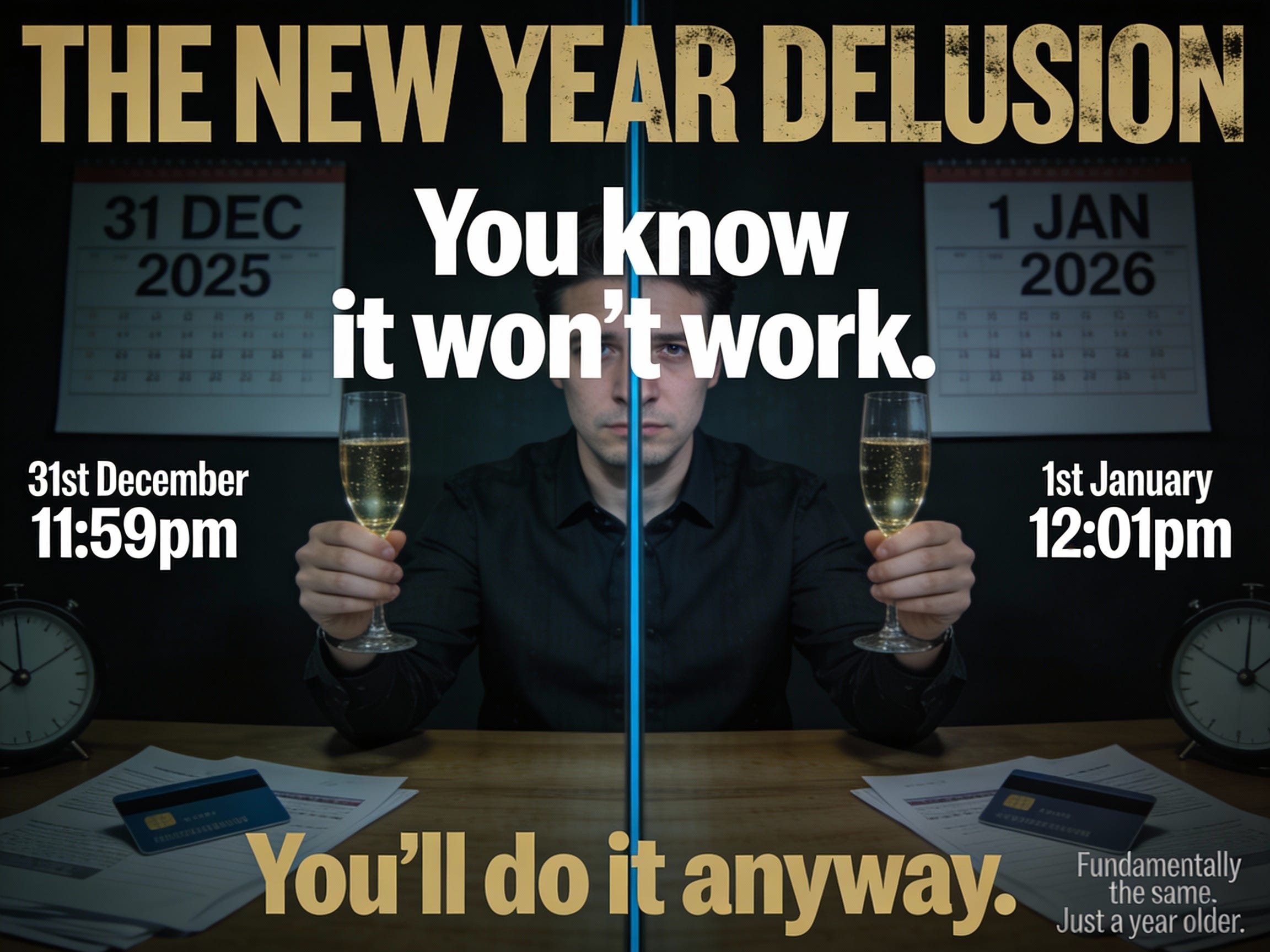
You know the resolution won’t stick. You know midnight on 31st December is just midnight. You know nothing’s actually going to change. But you’re going to toast to it anyway.
Here’s what’s happening right now. You’re planning the performance. The ritual. The collective agreement that when clocks strike twelve, everything becomes different.
It doesn’t. You know it doesn’t. But knowing won’t stop you participating.
This isn’t pessimism. This is the difference between fantasy and reality. You can call recognising that cynical if it makes you feel better. Or you can call it paying attention.
Three questions about New Year’s resolutions:
Is it practical? No. Your circumstances don’t reset at midnight. Income doesn’t increase. Constraints don’t disappear.
Is it logical? No. Same job. Same bills. Same you.
What’s the likely outcome? Same as last year. Brief performance, return to pattern, repeat in twelve months.
You already know the answers. You’ll participate anyway.
When you wake up 1st January with a hangover and a resolution, what’s changed? Your job’s the same. Bills are higher. Political opinions haven’t reversed. You’re still a member of the gym you didn’t attend in 2025. You’re fundamentally the same person you were at 11:59pm.
Here’s your only guarantee: sometime in the next year, you’ll be a year older. Can’t guarantee you’ll be alive. Can’t guarantee you won’t develop some condition you didn’t have before. Can’t guarantee employment, relationships, health. Just that time passes and you age.
But you’ll toast to transformation anyway. Fresh starts. New beginnings. Guaranteed change. When the only guarantee is the one you’re trying not to think about.
You Know How This Ends.
You already know the resolution fails. University of Scranton says 8% achieve their New Year’s resolutions. You don’t need research. You’ve got evidence. How many times have you made the same resolution? How many Januarys have you joined that gym?
Yet you’ll do it again. Because resolutions aren’t about change. They’re about performing intent.
The fitness industry gets it. Memberships spike 12% every January, says the International Health, Racquet & Sportsclub Association. By March, baseline attendance returns. They’ve built entire business models on you knowing you won’t keep coming but signing up anyway.
The mechanics are absurd. On 31st December, you decide: stop drinking, start exercising, learn languages, write novels. Why 31st December? What happens at midnight that didn’t exist at 11:59pm?
Nothing. You know nothing happens. But you’ll treat it like something happens because admitting arbitrary dates don’t create transformation means confronting the uncomfortable truth: change requires work, not calendar transitions.
The Ancient Performance.
This isn’t modern delusion. Romans established 1st January as New Year in 46 BCE when Julius Caesar reformed the calendar. Named the month after Janus - god with two faces, one looking back, one looking forward.
Even the metaphor acknowledged you’re the same entity looking both directions.
Did Romans fundamentally change? No. Same political intrigues. Same economic pressures. Same patterns. Just new calendar dates.
Babylonians celebrated new year around 2000 BCE during spring equinox. Did they fundamentally change? No. Same crops. Same gods. Same patterns their ancestors followed.
Ancient tradition. Ancient delusion. Different eras, same theatre.
And you’re still performing it. In 2026, people will bang pots and pans at midnight. First footing - bringing coal across thresholds for luck. From when people burned coal for heat and survival depended on stored fuel.
How relevant is bringing coal into your house in 2026? You’ve got gas central heating. Coal isn’t keeping you warm. The ritual outlived its practical purpose a century ago. But you’ll perform it because tradition demands it.
Standing there midnight 31st December 2025 toasting to 2026, banging pots, bringing symbolic coal across thresholds - you’re participating in performance running 4,000 years. In all that time, calendar transitions haven’t transformed anyone.
Living in 2026 with inflation, energy costs, survival mathematics - you’re facing the same fundamental human condition people faced in Rome or Babylon. Different technology. Same patterns. Same gap between fresh start fantasy and reality.
The difference? They didn’t have gym memberships to not attend. Or gas central heating making coal rituals obsolete.
The Ledger Gets Worse, Not Blank.
Here’s the cruel bit. You’re not celebrating from stable ground. You’re celebrating while material reality deteriorates.
Your job doesn’t change 1st January. But can you still afford to eat properly? Electricity? Gas? These aren’t lifestyle questions. These are survival calculations more people make each January than the previous one.
Office for National Statistics: food price inflation remained elevated throughout 2025. Energy costs kept climbing despite government intervention. New Year doesn’t arrive as blank page. Same ledger, worsening numbers.
You need more income to maintain the same standard of living. Your income doesn’t increase to match. Those fundamental questions - heating or eating, lights on or off - don’t reset with the calendar. They intensify.
But you’ll toast to renewal. Talk about fresh starts. Because acknowledging you’re celebrating while standing on eroding ground is too uncomfortable. Better to light fireworks and pretend mathematics changed.
Fundamentally the Same.
Maybe you’ll get married. Book different holidays. Actually quit smoking. Circumstantial changes. Still you. Same interests. Same political tribe. Same fundamental patterns.
You know this. Making that resolution, you already know you’re the same person who made it last year. The circumstances preventing you keeping it haven’t disappeared. But you’ll make it anyway because ritual demands it.
Darker reading: maybe we celebrate New Year precisely because we know nothing fundamentally changes. Ritual serves as pressure release. Acknowledge dissatisfaction, perform intent, return to comfortable dysfunction.
Genuine change is uncomfortable. Requires abandoning familiar patterns, confronting difficult truths, restructuring life. Far easier to toast to change, make performative gestures, let gravity restore equilibrium.
New Year becomes containment ritual. You know you won’t transform. Knowing doesn’t stop you celebrating transformation. Because celebration isn’t about change. It’s about permission to imagine change without risking discomfort.
Same Person, Same Script.
You’ll gather. Countdown. Embrace strangers. Make promises. You know promises won’t hold. You’ll make them anyway.
That’s the point. Not to actually change. But to collectively acknowledge change remains theoretically possible, even as you actively choose not to pursue it. New Year isn’t fresh start. It’s scheduled reminder you could have fresh start, if you wanted one badly enough to tolerate what it costs.
You don’t want it that badly. So you light fireworks. Toast to possibility. Carry on exactly as before.
Fundamentally the same. Just a year older. Same script you performed last year. Celebrating nothing changing while calling it everything new.
You know you’re doing this. You’ll do it anyway.
People ask if I have New Year’s resolutions. I do. It’s not to have any New Year’s resolutions.
Same reason I wrote this.
Because participating in delusion doesn’t make it true. Refusing to participate doesn’t make you cynical. It means you’re paying attention to reality instead of fantasy.
Midnight 31st December is just midnight. Resolutions are theatre. You’re the same person you were yesterday.
Just facing another year where the only guarantee is you’ll be older. Everything else? Unknown.
The only difference is whether you admit it.
Further Reading
Academic Research:
Dai, H., Milkman, K.L., & Riis, J. (2014). “The Fresh Start Effect: Temporal Landmarks Motivate Aspirational Behaviour.” Management Science, 60(10), 2563-2582.
Norcross, J.C., & Vangarelli, D.J. (1988). “The Resolution Solution: Longitudinal Examination of New Year’s Change Attempts.” Journal of Substance Abuse, 1(2), 127-134.
Historical Context:
Feeney, D. (2007). “Caesar’s Calendar: Ancient Time and the Beginnings of History.” University of California Press.
Britannica - Ancient Babylonian New Year (Akitu Festival)
Statistics and Data:
University of Scranton, Journal of Clinical Psychology - New Year’s Resolution Statistics
International Health, Racquet & Sportsclub Association (IHRSA) - Annual Membership and Attendance Data
Office for National Statistics - Food Price Inflation and Energy Costs 2025
Related Reading:
British Psychological Society - Research on temporal landmarks and behaviour change
Scottish New Year traditions (Hogmanay and first footing customs)
This is why I only consider making a New Years Resolution using the Pluto calendar (1 Pluto year = 248 Earth years).