
The Polanski-Davey Double Act: How the Green Party and Liberal Democrats Turned British Politics Into Performance Art.
When slick videos and paddleboard stunts replace governance - inside the UK's political legitimacy crisis.

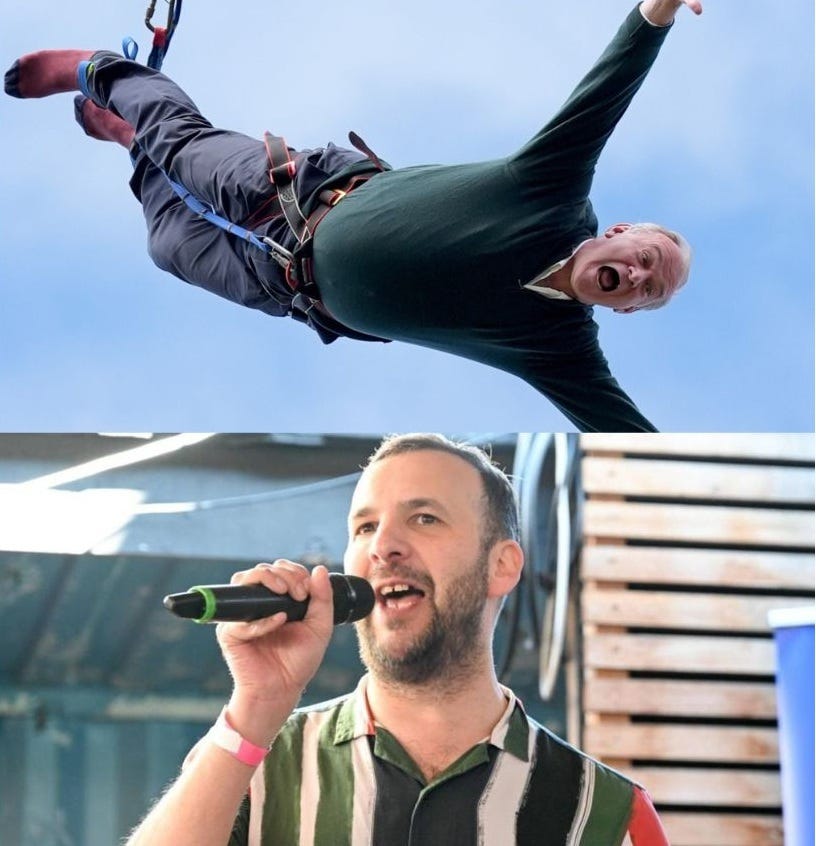
Picture this: Zack Polanski filming golden hour monologues about systemic change. Ed Davey falling out of the sky to prove he’s relatable. Together they’re not a government in waiting - they’re a masterclass in mistaking performance for governance. What would this unholy alliance produce? The answer tells you everything you need to know about the performative emptiness at the heart of British opposition politics.
The Setup.
Let’s be clear about what we’re dealing with here. Polanski has transformed the Green Party from a fringe operation into Britain’s fourth-largest party by membership (170,000+ members at last count, overtaking the Conservatives), largely through professional video content that racks up millions of views. His “Let’s Make Hope Normal Again” broadcast alone hit 14 million eyeballs. The man delivers monologues like he’s directing his own political cinema.
Meanwhile, Davey has spent his leadership turning the Liberal Democrats into a touring circus. Bungee jumping. Paddleboarding. Building Lego. Every stunt screaming the same desperate message: “NOTICE US! WE’RE FUN! WE’RE RELATABLE!” whilst his party polls in single digits.
One has mastered the aesthetic of profound politics. The other perfected the art of looking ridiculous on purpose. Both men are brilliant at modern political performance - just very different genres of the same empty theatre.
The Production Values Would Be Immaculate.
Here’s what a Polanski-Davey collaboration would actually look like in practice:
Polanski delivers earnest monologues about wealth redistribution and climate justice, shot in moody lighting with professional sound design. Cut to: Davey on a zipline, pulling a facial expression that says, “I used to be a government minister, and now I’m doing this.”
Polanski walks through Manchester’s streets reflecting on the “obscene” state of British politics, his words carefully chosen for maximum social media impact. Cut to: Davey attempting to paddleboard whilst journalists shout questions about coalition austerity.
One creates content. The other creates spectacle. Together, they’d create the most polished, high-engagement political theatre that means absolutely nothing.
The aesthetic would be perfect. The production quality is flawless. The engagement metrics are through the roof. And the actual political substance? Well...
Two Parties, One Problem
Let’s examine what these two parties actually represent in 2025:
The Greens under Polanski: Membership surging, media presence strong, four MPs, including Bristol Central. Currently running Bristol City Council, where they’ve managed to:
Promise 1,000 new council homes annually, whilst selling 1,222 existing council homes
Push through East Bristol Liveable Neighbourhoods with 54% resident opposition (760 objections versus 427 in support from public consultation responses)
Rack up Information Commissioner’s Office enforcement notices for transparency failures
Maintain power with exactly 50% of council seats following a Labour defection
If you live in Bristol, this isn’t abstract political theatre. It’s your council houses being sold, your streets being reorganised, and your Freedom of Information requests (the legal mechanism for accessing government documents) being ignored. If you don’t live in Bristol, it’s a warning: this is what happens when performance politicians actually get power.
The Liberal Democrats under Davey: Still trying to rebuild trust after the 2010-2015 coalition years. Still trapped by their historical betrayal of tuition fees. Still performing stunts because actual policy discussion reminds people they enabled five years of Conservative austerity. Currently polling in single digits whilst Davey does increasingly humiliating physical comedy.
What unites them? Both parties have perfected the art of looking busy whilst achieving very little. Both excel at performance over governance. Both attract voters who want to feel good about their political choices without confronting hard questions about power, compromise, or delivery.
The Hypothetical Manifesto.
What would a Polanski-Davey joint platform actually offer?
On Housing: Polanski delivers a stirring monologue about the housing crisis, filmed in golden hour lighting with careful framing. Davey assembles flat-pack furniture as a “relatable” metaphor whilst looking confused. Neither addresses Bristol Greens selling council houses nor explains how their policies differ materially from Labour’s failures. But the video would go viral.
On Transport: Polanski cycles through urban landscapes, discussing sustainable transport infrastructure with the gravitas of a documentary narrator. Davey rides an e-scooter, probably falls off, and definitely generates headlines. Zero mention of the East Bristol Liveable Neighbourhood mess (a scheme redesigning streets to reduce car traffic) or what “genuine consultation” actually means when 54% of residents oppose your plans.
On Democracy: Both denounce the two-party system with genuine passion. Both champion proportional representation with real conviction. This is the one issue where they’re actually sincere. It’s also conveniently the one issue that would most benefit their electoral prospects. Polanski would make it sound revolutionary. Davey would probably celebrate by jumping off something. And proportional representation would remain exactly as far away as it’s always been - because sincerity without power is just performance with better intentions.
On Governance: Slick videos meet fun stunts. Professional monologues meet physical comedy. Lots of social media engagement meets zero answer to the fundamental question: what would you actually do differently when the money runs out, and you have to make real choices about priorities?
One offers vision without implementation. The other offers relatability without competence. Together, they’d offer the illusion of an alternative without the substance of governance.
Why It Would Work (For Them)
Here’s the uncomfortable truth: a Polanski-Davey double act would absolutely dominate the political content space.
Polanski’s already proven the Green Party can weaponise social media more effectively than any other British political operation. His “eco-populism” - linking cost of living with climate change, calling for wealth taxes, acknowledging Gaza as genocide - speaks directly to disaffected left-wing voters who’ve nowhere else to go.
Davey’s stunts, for all their desperation, generate coverage. They get the Lib Dems into news cycles they’d otherwise miss entirely. In an attention economy, visibility is currency.
Together, they’d create the most engaging political content in Britain. The production values would be phenomenal. The shareability, off the charts. They’d rack up millions of views, thousands of new party members, and extensive media coverage.
And here’s what terrifies me: they’re winning. Polanski’s Green Party is polling level with Labour in some surveys. The aesthetic is working. The pratfalls are generating coverage. Meanwhile, actual governance keeps failing, and voters keep mistaking engagement for effectiveness.
British politics would continue its death spiral into complete irrelevance.
The Actual Outcome.
Because here’s what a Polanski-Davey partnership wouldn’t do:
It wouldn’t address why Labour’s sitting on -51% approval despite winning a landslide. It wouldn’t explain the legitimacy crisis facing British institutions. It wouldn’t reconcile the massive gap between opposition rhetoric and governing reality.
It wouldn’t answer why Bristol’s Green administration contradicts nearly every campaign promise it made. It wouldn’t explain how the Lib Dems can be trusted after enabling austerity. It wouldn’t address Reform UK eating into both their potential vote shares by offering simple (if arguably, deeply wrong) answers to complex problems.
Most critically, it wouldn’t confront the central question facing British politics: what happens when people stop believing any party can actually fix anything?
The Performance Politics Endgame.
What Polanski and Davey represent - separately or together - is the final evolution of politics as pure performance.
Polanski’s slick videos work because they offer hope without specifics, vision without implementation plans, passion without the messy compromises of actual governance. He’s perfected the aesthetic of radical politics. When your party runs a council, you can’t hide behind atmosphere anymore. Bristol’s Greens are learning this the hard way.
Compare this to Brighton. In 2011, the Greens took control, promising participatory, transparent, environmentally radical politics. By 2013, they were facing bin strikes triggered by proposals to cut workers’ pay by up to £4,000. By 2015, they’d learned what Bristol’s Greens are learning now: opposition rhetoric dies when it meets actual budget constraints.
Fourteen years later, what changed? The videos got better. The failures stayed the same. Brighton’s Greens lost control in 2023 after twelve years of proving that aesthetic radicalism is still just aesthetic. Bristol’s Greens have 35 seats and think they’ll be different. They won’t be.
Davey’s stunts work because they distract from uncomfortable questions about the Lib Dems’ record. Better to discuss bungee jumping than coalition cuts. Better to show him building Lego than explain how “different” Lib Dem policies would work in practice. He’s perfected the art of generating headlines whilst avoiding scrutiny.
One treats politics as cinema. The other treats politics as circus. Both treat governance as optional.
The approach is identical even if the execution differs: prioritise engagement metrics over actual outcomes, assume voters want to be entertained rather than represented, and never, ever let reality intrude on the performance.
The Questions Nobody’s Asking.
If Polanski and Davey formed a double act, here’s what journalists should immediately demand answers to:
For Polanski:
How do Bristol Greens’ actions square with party values?
What’s your plan when Green councils face the same budget constraints as everyone else?
How does “eco-populism” work when you’re actually responsible for bin collections?
For Davey:
Why should anyone trust the Lib Dems after the coalition?
Do stunts indicate policy substance or desperate attention-seeking?
What would you actually do differently from Labour with the same fiscal constraints?
For Both:
How does your political performance translate into competent governance?
What happens when viral videos meet hard choices about resource allocation?
Why should voters believe you’d be any different from Labour, given both parties’ records in local government?
These questions wouldn’t get asked because both men have successfully shifted the terms of political engagement away from accountability and towards entertainment.
What This Tells Us About British Politics.
The fact that a Polanski-Davey double act is even conceivable as a political strategy tells you everything about where British democracy stands in 2025.
We’ve reached a point where politicians can build careers on production values and stunts rather than policy delivery. Where parties can grow membership through content marketing rather than demonstrable competence. Where performance substitutes for governance and visibility masquerades as relevance.
The educated middle class watch Polanski’s videos and feel politically sophisticated. Working-class Bristol residents watch their council houses get sold, and their bus routes get blocked. Guess which group gets quoted in The Guardian?
Labour governs with historic unpopularity. The Conservatives are in an existential crisis. Reform offers simplistic answers to complex problems. And the “progressive alternative” consists of slick videos and paddleboarding.
The legitimacy crisis isn’t coming. It’s here. And it’s being livestreamed in golden hour lighting whilst someone falls off an inflatable.
The Moment We’re In.
This isn’t about Polanski and Davey specifically. They’re symptoms. When TikTok aesthetics and paddleboard stunts count as political leadership, when going viral matters more than getting results, when we mistake feeling engaged for being effective - that’s not a communications problem. That’s a civilisation problem.
Future historians won’t ask “Why didn’t anyone stop this?” They’ll ask, “Why did people keep filming it?” Because that’s what we’re doing. Bristol residents record council meetings where decisions are made to sell their homes. Then they scroll past Polanski’s latest video promising housing justice. Then they watch Davey on a zipline. Then they go to bed, wondering why nothing changes.
We saw it happening. We documented it happening. We just never stopped watching long enough to make it stop.
The Punchline.
Here’s the kicker: Polanski and Davey don’t need to form a double act. They’re already performing the same function separately.
Both offer their respective audiences a way to feel good about their political engagement without confronting uncomfortable truths about power, delivery, or the messy compromises of actual governance. Both excel at opposition because opposition requires no answers, only critique.
The real double act isn’t Polanski and Davey working together. It’s the one they’re already performing with the entire British political class: the pretence that Westminster theatre matters whilst the institutions crumble and public trust evaporates.
You probably know someone who shares Polanski’s videos whilst complaining about Bristol council’s failures. You might BE that person. I might be that person. We watch the performance, share the performance, critique the performance - all whilst the actual governance keeps failing.
That’s not hypocrisy. That’s worse. Hypocrisy means you know better. This means we’ve been so thoroughly trained to value political aesthetics over political outcomes that we can’t tell the difference anymore. We see Bristol’s Greens selling council houses and think, “Well, at least Polanski’s videos about housing justice are really well-produced.” We see Davey on a paddleboard and think, “At least someone’s trying to be relatable.”
The content brain hasn’t just won. It’s convinced us that watching content IS doing something.
Polanski brings the golden hour lighting and earnest monologues about systemic change. Davey brings the paddleboard pratfalls and desperate relatability stunts. Labour brings the historic unpopularity. The Tories bring the existential chaos. Reform brings the cynical exploitation of genuine grievances.
And British voters? We’re the audience paying for tickets to a show that stopped making sense years ago, watching politicians perform their respective roles whilst the actual work of governance remains undone.
One performs profundity. The other performs accessibility. Neither performs competence.
The lights are perfect. The production values are immaculate. The engagement metrics are through the roof.
And Bristol’s council houses keep getting sold. And your Freedom of Information requests keep getting ignored. And the bins keep overflowing. And Labour’s approval keeps cratering. And the Conservatives keep imploding. And Reform keeps rising.
So here’s the question: What breaks first? The system, or our ability to watch it break?
About The Author
I’m The Almighty Gob - I write about Bristol City Council and UK politics from a politically divorced perspective at thealmightygob.com. I left school at 15, identify as neurodivergent, and approach politics by asking three questions: Is it practical? Is it logical? What’s the likely outcome?
My method is simple: I file Freedom of Information requests, read council documents, analyse policy decisions, and fact-check everything obsessively. Then I write about the gap between what politicians promise and what they actually do, usually while being entirely uncontroversial about it.
I’m not a journalist, not an academic, not an expert. I’m just someone who got tired of performative politics and started documenting the receipts. When I’m not annoying Bristol City Council with FOI requests, I split my time between Bristol and Manchester (where the bins actually get collected).
Subscribe to The Almighty Gob for Bristol accountability commentary and UK political analysis that combines rigorous fact-checking with observational-style brutality.