
The Power of Silence: Why Noise Is the Gatecrasher You Keep Letting In.
Most of us woke up this morning and reached for our phones. I did. You probably did too.

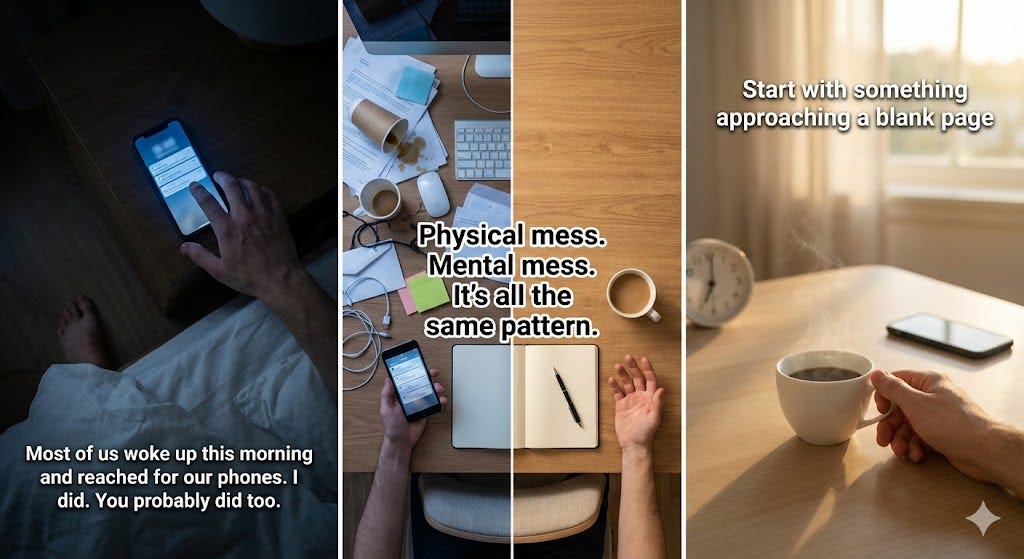
Before our feet touched the floor. Before we’d even properly opened our eyes. And suddenly our heads were full of notifications, messages, news, things other people wanted us to know. Things that had nothing to do with us or our day or what actually matters.
We’ve been conditioned into this. The digital age has reduced us through habits we didn’t even know we were forming. And here’s the problem: we can’t do with it, and we can’t do without it. This technology has been dumped upon us as the way forward. Banking. Work. Communication. Everything runs through these devices now.
So it’s not about the phone itself. It’s about how we choose to use it. Whether we’re in control of it, or it’s in control of us. Whether we’ve learned the difference between attachment and detachment, and found the balance between the two that keeps our mental health intact.
But let’s be clear about something. It’s not just the technology that grips us. Plenty of people who don’t use modern technology in the same way still have mental health that’s up and down like a bloody yo-yo. The incredible highs. The awful lows. The constant cycling between the two.
I know. I’ve had to force myself to use technology while managing an ADHD diagnosis. Learning to be in control of it rather than it being in control of me. Learning to be in control of my own thoughts, my own subconscious, being aware of it. It doesn’t make me anything special. It’s just a tool I use to keep myself rational and stop the cycling.
The real issue isn’t the phone. It’s noise. It’s the constant invasion of our consciousness by things we didn’t invite in. And that noise comes in many forms.
Technology is just the loudest example. Like that person at a party - someone we know, someone we kind of get on with, but we wouldn’t actually choose to invite. And now they’re here. And we’re stuck with them because throwing them out feels more awkward than just letting them stay.
That’s what noise is. The gatecrasher. And we’ve been too polite to ask it to leave.
The Morning Filing System.
I’m sitting in my bedroom right now. There’s ambient noise from the street outside. A clock ticking nearby. That’s it. And in this near-silence, I can actually think. I can file things away. I can start my day with what I call a blank page.
Look around the room. No piles of stuff. No clutter demanding attention. Just the essentials. Because environmental clutter and mental clutter feed each other. The more physical mess you have around you, the more cluttered your mind becomes. It’s the same principle as walking through streets full of rubbish - the tendency is for people to add more rubbish to it. But when streets are clean, when things are less cluttered, people tend to keep them that way.
Your environment matters. The physical space you occupy either enables clarity or breeds chaos.
Most people don’t do that anymore. Haven’t started with a blank page in years. Haven’t cleared their physical space either. Everything piles up - objects on surfaces, clothes on chairs, notifications on screens, thoughts in heads. It’s all the same pattern. Accumulation without sorting.
When you sleep, your brain does something remarkable. It sorts through everything from your day. Discards the rubbish. Hangs onto what might prove useful. It’s doing triage on information, organising memories, and making sense of experiences. Working in silence, by the way. You don’t need a podcast playing while you dream.
But then morning comes. And instead of giving your brain time to finish the job - to file everything away properly - you immediately flood it with more. More information. More noise. More demands on your attention. And you do it while surrounded by physical clutter that mirrors the mental chaos.
Think of your mind as a filing cabinet. Except you never actually file anything anymore because there’s no quiet moment to do it. Everything just piles up on the desk. New stuff arrives before you’ve dealt with the old stuff. And you wonder why you feel overwhelmed, why you can’t concentrate, why simple decisions feel exhausting.
Now look at your actual desk. How much is piled on it right now?
The silence I’m sitting in right now? This is filing cabinet time. This is when I take what my brain sorted overnight and put it where it belongs. When I clear the desk - both literally and metaphorically. When I start with that blank page.
You used to have this. You’ve just forgotten what it feels like.
The Gatecrasher at the Party.
From the moment you wake until the moment you sleep, you’re bombarded with noise of every shape and form. Traffic. Notifications. Conversations you didn’t ask to overhear. News cycles. Social media feeds. Background music in every shop, every lift, every waiting room.
And somewhere along the way, you convinced yourself this is normal. That this is just how life is now.
It’s not. It’s a choice. You’ve just forgotten you had one.
Here’s what happened. You started treating noise like someone you’d invited round. Like something you’re supposed to accommodate. Radio on in the morning. Podcast during breakfast. Music in the car. Background television when you get home. Scrolling, always scrolling, filling every gap with something, anything, because silence feels uncomfortable now.
Except noise was never the invited guest. It’s the one who forced their way in without asking and never left. And you’re too polite to tell them you’d actually quite like your house back.
You know that person at parties? The one who wasn’t on the list but shows up anyway? You can’t just throw them out because technically you know them, you’re vaguely friendly with them, so there’s this awkward social obligation to let them stay, even though you never actually wanted them there in the first place.
That’s noise. Every single day. In your head.
And you’re exhausted from hosting them.
Your Brain Wasn’t Built for This.
Here’s something worth considering. Compared to 20 or 30 years ago, certainly when the internet first came about, our brains are required to process far more information now than ever before.
And it’ll probably get worse as time goes on.
Your brain evolved over thousands of years to handle a certain amount of information. The sounds of your immediate environment. Conversations with people you could see. Problems you could actually do something about. That was it. That was the load.
Now? You’re processing information from across the entire planet. Thousands of opinions. Hundreds of crises. Dozens of conversations are happening simultaneously in your pocket. News from countries you’ll never visit about problems you can’t solve. Updates from people you barely know about lives you’re not part of.
Your brain wasn’t designed for this. Nobody’s was.
To a certain extent, I believe this is what empowers, in a very negative way, a lot of mental unwellness in people. I could be wrong. But that’s my suspicion.
It’s not a coincidence that anxiety, depression, and attention disorders have exploded in the same timeframe that information overload became the default state of existence. Your brain is doing exactly what it evolved to do - trying to process threats, make sense of patterns, and stay alert to danger. Except now the threats are endless, the patterns are contradictory, and the danger never stops coming.
So you feel overwhelmed. Of course you do. You’re running 1970s hardware on 2025 software demands. And instead of recognising this as a fundamental mismatch between human cognitive capacity and modern information load, you’ve been told it’s a personal failing. That you should be able to handle it. That everyone else is managing fine.
They’re not. They’re just better at pretending.
The Friendly Gatecrasher Problem.
Here’s the thing that makes this complicated. I can be the most outwardly friendly, chatty, conversational person you’ll meet. I’ll say hello to everyone I know. I’ll spend time talking, asking how you are, whether you’re alright, all of those things. I’m just a happy, happy-go-lucky person.
Right up until I come through my door. Then it shuts down. Immediately.
I tend to isolate myself from people. Except those whom I choose to come into my space. Which is very, very few people. Not because I’m miserable or antisocial. Because all that noise, all that conversation, all that very sociable clutter needs to stop somewhere.
And it stops at my door.
Breaking away from all that external stimulation, all that friendliness, all that engagement - I need that calming down period. That relaxation. That disconnect from the outside world so I can strike the balance between my ADHD and the peace and calm required to manage it.
You probably do something similar. You’re fine in public. Perfectly pleasant. Then you get home, and you just want everyone to shut up for five minutes. And you feel guilty about it. Like, there’s something wrong with wanting quiet after being “on” all day.
There isn’t. You’re just tired of hosting the gatecrasher.
When Your Brain Won’t Stop.
I have ADHD. That’s not a confession, just a fact. And there was a time when my life was up and down like a yo-yo. Racing at a million miles an hour, trying to do everything and see everyone, connect with this and connect with that. Or crashing. No middle ground. Constant conflict with my own brain.
You might not have ADHD. But you know that feeling. That restlessness. That sense of never quite being able to settle. Always needing the next thing, the next bit of stimulation, the next distraction.
Where I am now is different. I still have ADHD. The diagnosis hasn’t changed. But I’ve learned to treat it as a friend rather than an enemy. And the biggest part of that shift? Understanding that silence isn’t the problem. It’s the solution.
When you have a brain that wants to go in seventeen directions at once, silence isn’t a void that needs filling. It’s a space that allows sorting, filtering, and organising. It’s the difference between having every browser tab open simultaneously and actually being able to focus on one thing at a time.
The noise? The constant stimulation? That feeds the chaos. It gives your brain exactly what it thinks it wants - more, more, more - but not what it actually needs, which is space to process what it already has.
You’ve been treating the symptom instead of the cause. More noise to drown out the mental noise. It doesn’t work. You know it doesn’t work. But you keep doing it anyway because everyone else does, and nobody’s told you there’s another way.
There is.
Asking the Gatecrasher to Leave.
Once you see noise as the gatecrasher, you realise you have the right to ask them to leave.
You wouldn’t let someone barge into your home whenever they fancied it. You wouldn’t let them rifle through your belongings or shout demands at you in your own living room. Yet you allow noise to do exactly that in the space of your mind.
Every notification. Every headline. Every ambient conversation. Every algorithmic recommendation is designed to keep you engaged. It’s all turning up uninvited, demanding attention, taking up space that belongs to you.
I only allow the things in that enable and empower me. Not because I’m being difficult. Because I’m treating my mind with the same respect I’d treat any other valuable resource. You don’t leave your door unlocked for strangers. You don’t hand out your bank details to whoever asks.
Why would you hand out unlimited access to your consciousness?
The same applies to your physical space. You wouldn’t let strangers pile their belongings in your living room. Yet you let clutter accumulate - objects you don’t need, notifications you didn’t ask for, noise you never invited. Physical mess. Mental mess. It’s all the same pattern.
You do, though. Every single day. And it’s exhausting. That constant low-level fatigue that never quite goes away, no matter how much you sleep. That’s not tiredness. That’s mental overload from never having space to process anything.
Starting With a Blank Page.
Every morning, I start with a blank page. Not metaphorically. Literally. I don’t engage with the world until I’m ready. I sit in the near-silence of my bedroom. Clock ticking. Ambient noise from the street. That’s it.
In that space, I file things away. I clear the desk. I prepare for whatever the day might bring, not by frantically consuming information about what might happen, but by creating the mental space to deal with it when it does.
Then I fill the page accordingly. With intention. With choices. With things I’ve decided deserve to be there, not things that forced their way in.
You can do this. You already know you need to. You’ve known for a while now that something has to change. That you can’t keep operating at this pace, with this much noise, with this little space to actually think.
People don’t like silence because silence forces confrontation with yourself. It removes the distractions. It makes you deal with whatever you’ve been avoiding by staying busy, staying stimulated, staying engaged with anything except the contents of your own mind.
But if you can’t be alone with yourself in silence, you’re not really free. You’re dependent on external noise to feel okay. And that’s a vulnerability someone or something will eventually exploit.
Actually, it already is. You know that too.
The Space That’s Yours.
Silence is power. Not because it’s superior or enlightened or any of that nonsense. But because it’s yours. It’s the one space where you get to decide what comes in and what stays out. Where you’re not obligated to react, respond, engage, consume, or perform.
It’s the one space where you’re in control. Not the noise. Not the technology. Not the endless demands. You.
You don’t need permission to claim this. It already belongs to you. You’ve just been giving it away in small increments for so long, you’ve forgotten what it feels like to keep it.
Start tomorrow morning. Don’t reach for your phone. Not immediately. Don’t reach for it before your feet touch the floor. Give yourself five minutes. Just five. Sit in whatever quiet you can find. Let your brain finish filing. Start with something approaching a blank page.
See how it feels. You already know it’ll feel different. Better. Clearer.
Then see how long you can protect that space before you let the gatecrasher back in.
It’s just me, a ticking clock, and the ambient noise of the world I’ll engage with when I’m ready, not before.
References.
On sleep and memory consolidation:
Rasch, B., & Born, J. (2013). “About Sleep’s Role in Memory.” Physiological Reviews, 93(2), 681-766. [Evidence that the brain consolidates memories and processes information during sleep in the absence of external stimulation]
On information overload and cognitive capacity:
Bawden, D., & Robinson, L. (2020). “Information Overload: An Overview.” Oxford Encyclopedia of Political Decision Making. [Documents the exponential increase in information exposure since the 1990s]
Rosen, L.D., et al. (2013). “Is Facebook Creating ‘iDisorders’? The Link Between Clinical Symptoms of Psychiatric Disorders and Technology Use.” Computers in Human Behavior, 29(3), 1243-1254. [Links between technology use and mental health symptoms]
On mental health trends correlating with the digital age:
Twenge, J.M., et al. (2019). “Age, Period, and Cohort Trends in Mood Disorder Indicators and Suicide-Related Outcomes in a Nationally Representative Dataset, 2005-2017.” Journal of Abnormal Psychology, 128(3), 185-199. [Documents rise in anxiety and depression correlating with smartphone adoption]
Przybylski, A.K., & Weinstein, N. (2017). “A Large-Scale Test of the Goldilocks Hypothesis.” Psychological Science, 28(2), 204-215. [On digital technology use and adolescent well-being]
On ADHD and environmental stimulation:
Nigg, J.T. (2013). “Attention-Deficit/Hyperactivity Disorder and Adverse Health Outcomes.” Clinical Psychology Review, 33(2), 215-228. [ADHD executive function and environmental demands]
Hupfeld, K.E., et al. (2019). “Living in the Zone: Hyperfocus in Adult ADHD.” ADHD Attention Deficit and Hyperactivity Disorders, 11, 191-208. [ADHD, attention regulation, and environmental control]
On silence, solitude and mental health:
Nguyen, J., et al. (2018). “Solitude as an Approach to Affective Self-Regulation.” Personality and Social Psychology Bulletin, 44(1), 92-106. [Benefits of deliberate solitude for emotional regulation]
Mortazavi, S., et al. (2018). “The Pattern of Cell Phone Use and Prevalence of Self-Reported Symptoms in Elementary and Junior High School Students in Shiraz, Iran.” Iranian Journal of Medical Sciences, 43(2), 181-188. [Environmental noise and cognitive function]