
The Privilege of Detachment: Why Solitude is Sovereignty, Not Loneliness.
Some people see me as a loner. I see it as self-autonomy most can't even imagine when they're so busy performing for an audience they didn't choose.

Belonging has a price. A church, a political party, a social group, a trade union - structures that promise family, community, purpose. I’ve watched people pay that price their entire lives. The exchange is simple: comfort for autonomy. Safety for sovereignty. I recognised that exchange early, and I walked away.
Not because I’m special. Because I watched what it cost them.
Here’s what changed when I stopped belonging: I could finally see clearly.
Think about the last political discussion you witnessed. The pattern tends to repeat itself - positions defended, failures justified, criticism treated as personal attack. Identity welded to ideology. And something happens to people when that bond forms. They can’t see their own side’s contradictions anymore. They’re too busy protecting the tribe to notice the tribe is lying to them. You might have noticed this yourself.
My limited experience of belonging means I observe without those stakes. When your identity isn’t wrapped up in a group’s success or failure, you see things others explain away. German philosopher Ernst Jünger had a word for this position: the anarch - someone who maintains inner sovereignty while moving through political systems without tribal allegiance.
It’s not a superpower. It’s simply what becomes visible when you’re not defending anything.
Stillness, silence, and solitude make most people uncomfortable. Or perhaps it’s just that we’ve forgotten how to be comfortable with them.
Watch them reach for distraction the moment they’re alone. Podcasts while walking. Music while working. Television as background. Scrolling to fill every gap. Perhaps it’s easier than sitting with whatever’s in there, waiting to be heard.
I know because I used to be one of them. The noise was easier than the silence. Silence meant confronting what I’d been running from - moods that swung like a pendulum, thoughts that wouldn’t shut down, a mind that chewed on itself until there was nothing left but shredded nerves and exhaustion.
For me, silence isn’t empty anymore. It’s freedom. Stillness, silence, solitude - these regulate what was once chaos. They create conditions where my neurodivergent brain can process without overload, where overnight mental activity resolves into morning clarity instead of morning panic.
But I had to learn this. It didn’t come naturally. It came from hitting bottom and realising the noise was killing me.
And you might find, if you ever explore it, that your own mind has its own rhythm too. Different from mine, perhaps. But there nonetheless.
I refuse to answer to the world until ten o’clock.
My brain runs through the night - thoughts spinning, connections forming, questions multiplying until exhaustion forces shutdown or I chemically persuade it to rest. Then comes the slow emergence. Not on society’s schedule. At mine.
Those morning hours aren’t about ticking boxes or being “productive” in any conventional sense. They’re about survival. That semi-conscious drift where breathing and today’s writing are the only things demanding attention. Nothing but the sound of low-volume news radio interrupts those precious moments of waking, of allowing my mind to settle gradually, processing each moment as consciousness assembles itself without force.
Eckhart Tolle called this “the power of now” - beginning each day with a blank page. Free from predetermined thoughts, carried-over anxieties, and obligations imposed by others’ schedules.
I call it the only way I function without falling apart.
You could structure your day differently, too, if you wanted to. Or you might discover you already have been, in small ways you haven’t quite noticed yet.
Six o’clock on a December evening. The world is properly dark outside my window. I’m minutes from Bristol City Centre, but it could be the countryside given the stillness. Blissfully calm.
The sanctuary isn’t these four walls. It’s temporal boundaries. It’s choosing when to engage and when to shut the world out. Even welcomed company requires engagement, social energy, and attention shifting from internal processing to external performance.
Pleasant, certainly. But still an intrusion on the work of staying sane.
And maybe that’s something you’ve felt too, without quite having the words for it.
I’ve learned to find peace in solitude. Not because I’m naturally solitary, but because the alternative - constant connection, perpetual availability, endless social performance - nearly destroyed me. The learning itself becomes the practice.
Here’s where connection and disconnection balance: I’m not advocating withdrawal. I observe, I write, I engage. The difference is what I allow through the filter.
We live in a world where news and social media provide intrusive thoughts that become easy to somehow take ownership of. The war in the Middle East. Climate catastrophe. Political scandal. Scroll, consume, feel... something. Informed, perhaps. Concerned, certainly. Helpless, inevitably.
There’s a line in the Serenity Prayer - you know, the one from AA: “Grant me the serenity to accept the things I cannot change, courage to change the things I can, and wisdom to know the difference.”
Strip the theology, and you’re left with brutal practicality: distinguish between what’s within your power and what isn’t.
I can deal with keeping a roof over my head. Paying bills. Putting food on the table. The war in Gaza? There’s bugger all I can do. I used to doomscroll coverage at 2 am, carrying anger about atrocities I couldn’t influence, letting the weight of distant suffering displace my capacity to deal with immediate reality. None of my concerns changed it. None of my posts influenced it. It just filled my head.
That’s the Serenity Prayer in practice. Many people know that prayer. Many even quote it. But knowing and applying are different animals entirely.
Gaza, Ukraine, climate catastrophe, political scandal - all of it flooding in. And here’s the thing about carrying it all: none of it changes because you know about it. None of it changes because you feel concerned. None of it changes because you post about it. But it fills your head nonetheless, displacing the capacity to deal with what’s actually real and present.
My filter is simple: Can I change this? No? Then it doesn’t get space in my head.
This isn’t callousness. It’s recognising that being “concerned” about everything achieves nothing except noise. And having survived mental unwellness once, I’m not going back.
You might notice, when you pay attention, how much weight you’re carrying that was never yours to begin with.
That filter - that discipline about what I let through - is what makes the work possible.
The world is both increasingly inspirational and intrusive. Political theatre provides endless material - contradictions, dysfunction, the gap between promises and reality. But it’s also noise that drowns clear thinking. Writing becomes the outcome of holding that balance. Too much immersion and clarity disappear. Too much withdrawal and material dries up.
The world gives content. Silence gives capacity. Writing emerges from maintaining both in equilibrium.
And you might find your own balance point differs from mine. That’s the thing about balance - it’s personal.
Society frames solitude as failure. The loner is isolated, missing out, unable to connect, living sadly.
But there’s a script most people carry without realising it was handed to them. Constant connection proves you matter. Isolation proves you’re broken. Worth is measured by how many people need you. If you’re not constantly engaged, you’re somehow failing at being human.
Those scripts can be examined if you’re curious enough. Or they can keep running in the background, unquestioned.
I observed what my mind needs to function and structured my life accordingly. Regardless of what society insists I “should” want.
Political parties, churches, and social groups offer belonging. But there are terms attached. Conditional acceptance dressed as family. Loyalty demanded, dissent discouraged, conformity rewarded.
You might start noticing the terms of your own memberships, once you look for them. Or you might realise you already have been noticing, and just haven’t acted on it yet.
My limited experience of belonging means I observe without certain emotional stakes. When your identity isn’t wrapped up in a group’s success or failure, the view shifts somewhat.
This is how I can observe the political dysfunction around me - document contradictions where I see them firsthand - and apply logical frameworks without protecting ideology. It’s not a superpower. It’s simply what becomes visible when you’re not defending anything.
Some people find comfort in belonging. They build identity around affiliations, find security in their collective allegiances, and feel validated by shared beliefs. That works for them.
I never learned to need that belonging. And that difference - circumstance, neurology, survival instinct, whatever you call it - isn’t a deficit. It’s a different architecture for being human. One that keeps me functional when the alternative nearly didn’t.
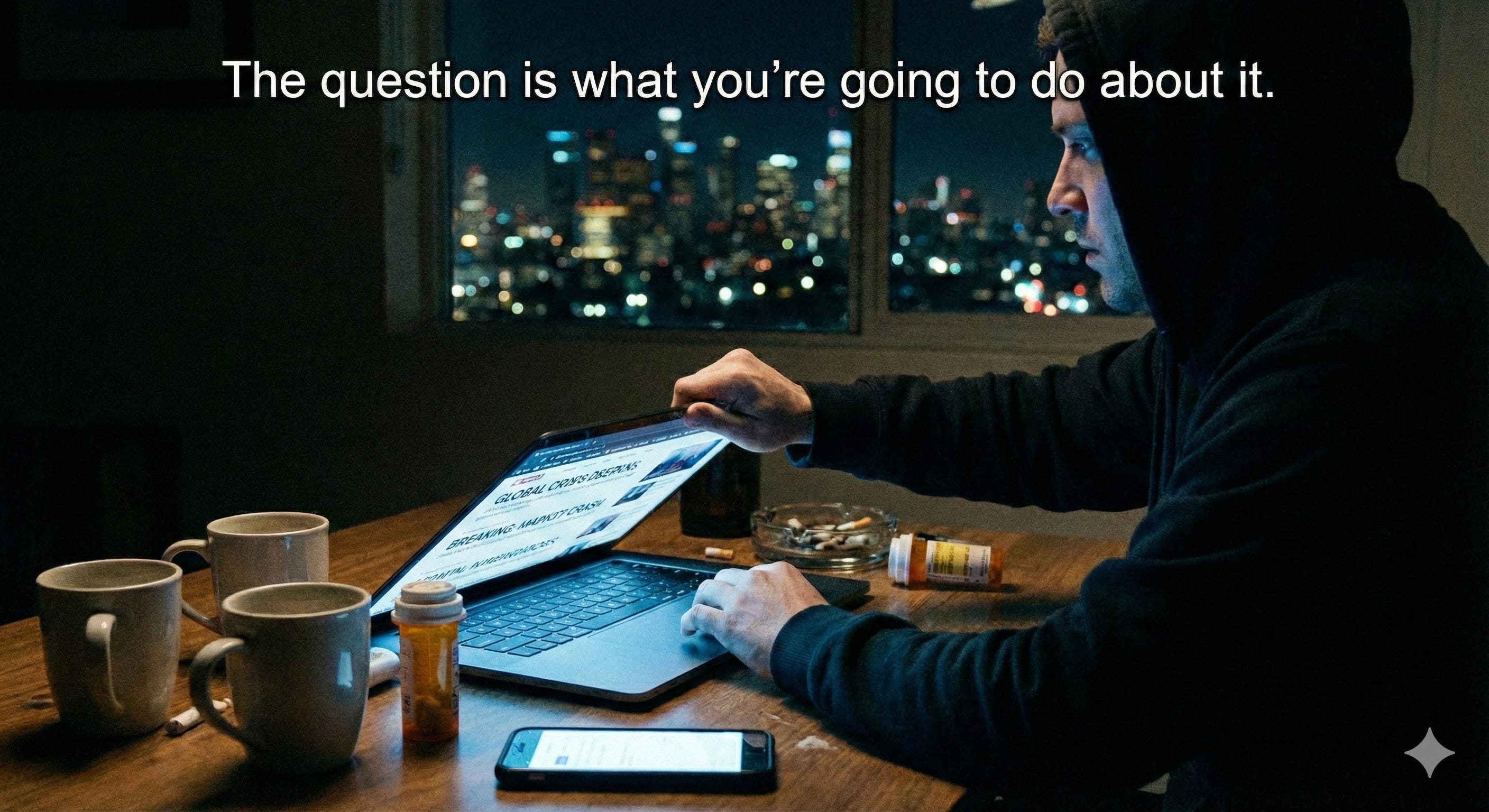
If you’ve read this far, you already know which script you’re running. The question isn’t whether you recognise it. The question is what you’re going to do about it.
True that.
I have gravitated toward Bruce Lee's philosophy of "Be Like Water"
Adaptability: Just as water takes the shape of any container it is in (a cup, a bottle, a teapot), you should adapt your mind and actions to the circumstances you face.
Flexibility: It encourages letting go of rigidity and stubbornness, embracing change, and being open-minded instead of trying to force the situation to fit you.
Formlessness: "Be formless, shapeless, like water" means not being limited by a fixed style, method, or way of reacting.
Fluidity: The philosophy suggests being able to flow with life rather than resisting it, which is essential for overcoming obstacles.
Strength in softness: Water is soft and yielding, yet it can wear away a rigid rock, demonstrating that being fluid is a form of strength.