
The Sledgehammer, The Spine, and The Sultana: How Britain Learned to Worship Self-Inflicted Suffering.
Bristol, August 2024: One spine fractured, six activists starving, zero accountability.

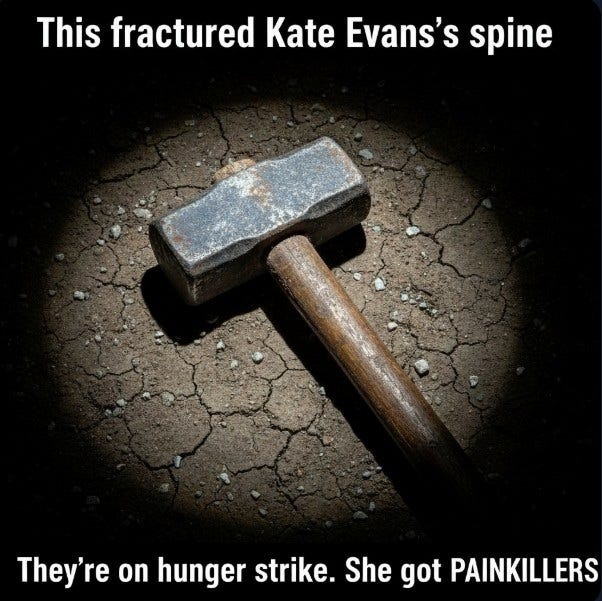
There’s a woman in Britain whose spine was fractured by a sledgehammer. She was kneeling at the time, attempting to arrest someone else, when Samuel Corner - allegedly, because we still believe in legal process around here - swung a sledgehammer into her back with enough force that she thought, in her own words, that her spine had “shattered.”
Police Sergeant Kate Evans spent three months unable to drive, shower, or dress herself. She required painkillers to manage the agony of a fractured lumbar vertebra. The X-rays don’t lie, even if everyone else involved in this story seems pathologically committed to doing so.
You’d think that would be the story. Woman hit with sledgehammer suffers fractured spine. Criminal charges follow. Justice grinds forward in its ponderous, imperfect way.
But you’d be wrong. Because in modern Britain, the story isn’t about the spine. It’s about the hunger strike.
The Fruitcake Philosophy.
Zarah Sultana - and yes, every time I hear that name I think of fruitcake, because that’s where sultanas traditionally end up in my catering experience - has decided these sledgehammer-wielding activists are the real victims here. The MP for Coventry South and co-founder of “Your Party” (which sounds less like a political movement and more like something you’d see on a children’s birthday invitation) has been writing letters, visiting prisons, and accusing Justice Secretary David Lammy of lying about not knowing that Palestine Action members are currently starving themselves in British jails.
Let’s establish the timeline, because the psychology only works if you understand the sequence of agency:
August 2024: Palestine Action members crash a prison van through the gates of the Elbit Systems factory in Patchway, Bristol. They’re armed with sledgehammers, wearing red jumpsuits, and according to prosecutors, “meticulously planned” to cause maximum damage. During the raid, Samuel Corner allegedly strikes PS Kate Evans in the back while she’s on her knees. Her spine fractures. She screams in pain. Her colleague later testifies that he saw Corner hit her twice.
November 2024: Six activists charged with aggravated burglary, criminal damage, and violent disorder begin hunger strikes. They’re on remand awaiting trial. Their demands include immediate bail, access to legal documents, and - in a touch of brass-necked audacity that would make a career politician blush - that the government reverse its decision to proscribe Palestine Action as a terrorist organisation.
December 2024: Zarah Sultana visits the hunger strikers. She writes to David Lammy demanding their immediate release. She calls their extended pre-trial detention a violation of their rights. She describes them as “young Palestine Action activists” facing “political imprisonment” for “alleged actions intended to prevent genocide.”
Notice what’s missing from that description? The spine. Kate Evans’s fractured vertebrae have been abstracted out of existence.
The Psychology of Moral Inversion.
This isn’t just political disagreement. This is a complete inversion of moral cause and effect, and it operates on several psychological levels simultaneously.
First, there’s identity fusion with distant suffering. These activists have achieved something remarkable: they’ve fused their identity with people they’ve never met, experiencing events they’re not witnessing, in a conflict they’re not part of. The psychological term is “vicarious moral injury” - feeling traumatised by events you’re observing from thousands of miles away.
But here’s where it gets pathological: that vicarious trauma becomes more psychologically real than the actual trauma they’re inflicting on people standing right in front of them. Kate Evans’s fractured spine is an abstraction. Palestinian suffering is hyperreal. The woman they can see is invisible. The people they can’t see are everything.
Second, there’s dissociative justification. When Corner allegedly told Evans she was “complicit in genocide” immediately after hitting her with a sledgehammer, he wasn’t being callous - he genuinely couldn’t see what he’d done. The sledgehammer blow wasn’t real violence; it was symbolic resistance. Evans wasn’t a human being with a spine and a family; she was a symbol of state complicity.
This is the psychology of dehumanisation, but with a progressive gloss. It’s not “those people don’t matter.” It’s “this person doesn’t matter because they’re complicit in a system where those people don’t matter.” Same cognitive mechanism, different political aesthetic.
Third, there’s parasuicidal heroism as retrospective justification. The hunger strike isn’t about getting out of prison. If it were, they’d engage with the legal process. The hunger strike is about demonstrating moral purity through self-destruction. “Look how much I’m willing to suffer for this cause; therefore, my cause must be righteous, therefore, the spine I fractured was justified.”
It’s psychological theatre: maximum agency (choosing to starve) weaponised to create an appearance of victimhood (the state is letting us die). If you’re willing to die for something, surely you can’t have done anything wrong in service of it. That’s the unconscious logic.
The Parliamentary Enabler.
And then there’s Sultana, who provides institutional legitimacy to this entire psychological architecture.
She’s not wielding sledgehammers. She’s not refusing food. She’s validating those who do while maintaining her parliamentary salary and institutional access. This is the psychology of the enabler who needs extremists to exist so she can position herself as their defender.
Her demands are instructive. She wants them released on bail - the same people who broke into a facility with sledgehammers and fractured someone’s spine. She claims their year-long remand violates their rights - but remand exists precisely because courts determined they pose a danger to public safety. She calls their pre-trial detention “political imprisonment” - but they’re awaiting trial for violent disorder, not thought crimes.
Most revealing: she can feel enormous empathy for hunger strikers she visits in prison. She can feel enormous empathy for Palestinians she’s never met suffering in Gaza. She apparently cannot feel any empathy whatsoever for Kate Evans, who was hit in the back with a sledgehammer while kneeling.
This is ideological emotional selectivity - empathy as a function of political allegiance rather than human suffering. Evans’s fractured spine doesn’t register as morally significant because she was wearing the wrong uniform when it happened.
The Martyrdom Calculation.
Here’s the truly dark question: what happens when one of these hunger strikers dies?
For the activists: martyrdom validates the cause. Death proves righteousness. The ultimate performative suffering.
For Sultana: martyrdom validates her warnings. Death proves she was the voice of conscience ignored. More letters to write. More prison visits. More positioning as the righteous outsider.
For Kate Evans, her fractured spine remains invisible. Her suffering never entered the moral calculation. She’s still just “complicit.”
This is the psychological horror at the core of this entire performance: self-inflicted death becomes more morally significant than inflicted injury, because the ideology requires martyrs, not accountability.
The Broader Pathology.
This isn’t really about Palestine Action, or Elbit Systems, or even the Israeli-Palestinian conflict. This is about a specific strain of activist psychology that’s metastasised into mainstream political discourse.
It’s the psychology where motive overrides action, intention supersedes consequence, and the righteousness of your cause absolves you of responsibility for whom you hurt along the way. It’s the cognitive framework where you can fracture someone’s spine on Monday and claim victimhood status by Tuesday because you’ve started refusing meals.
And it works because people like Sultana provide institutional validation. She’s the respectable face that says: these aren’t violent criminals, these are heroes. She’s the MP who makes it acceptable to ignore the fractured spine and focus on the hunger strike.
The activists chose to break in. They chose to swing sledgehammers. They’re awaiting trial. They chose to refuse food. They chose to make themselves ill.
Kate Evans didn’t choose to have her spine fractured. She was just doing her job when someone hit her in the back with a sledgehammer.
But in Britain’s inverted moral landscape, guess which suffering we’re supposed to care about?
The self-inflicted kind. Obviously. Because that’s the kind that comes with a parliamentary advocate and a narrative about resistance.
The fractured spine just comes with painkillers and three months off work.
Citations:
LBC, “’My spine is shattered’: Moment Palestine Action activist ‘struck police sergeant with sledgehammer’ during factory break-in,” December 2024. https://www.lbc.co.uk/article/spine-shattered-police-palestine-action-activist-sledgehammer-5HjdNNZ_2/
The Jewish Chronicle, “I thought the sledgehammer blow by Palestine Action attacker had shattered my spine, says police officer,” November 2024. https://www.thejc.com/news/uk/i-thought-the-sledgehammer-blow-by-palestine-action-attacker-had-shattered-my-spine-says-police-officer-svs0hq6p
Middle East Eye, “Zarah Sultana: Lammy claim he did not know about Palestine Action hunger strikers is a ‘lie’,” December 2024. https://www.middleeasteye.net/news/zarah-sultana-lammys-claim-he-did-not-know-about-palestine-action-hunger-strikers-lie
Breitbart, “’Increasingly Likely’ Palestine Activists on Hunger Strike in UK Could Die,” December 2024. https://www.breitbart.com/europe/2025/12/11/increasingly-likely-palestine-activists-on-hunger-strike-in-uk-could-die/
The New Arab, “UK: Pressure mounts on Lammy over Palestine Action hunger strike,” December 2024. https://www.newarab.com/news/uk-pressure-mounts-lammy-over-palestine-action-hunger-strike