
The Tide Goes Out.
Al Quds Day London, Bob Vylan, Rangrez — and the question Britain won’t answer.

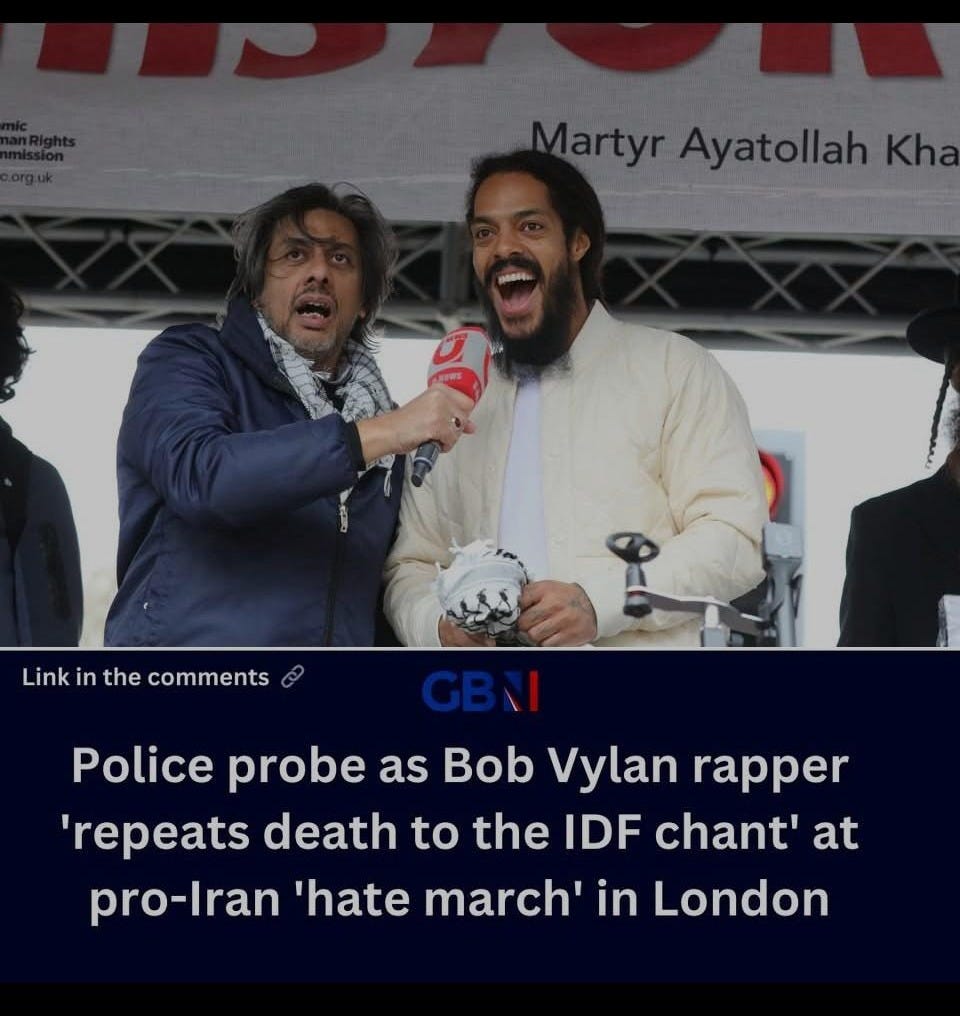
[bob-vylan-al-quds-day-london-2026.jpg]
You probably saw something about it yesterday. A headline. A post. Something that made you stop scrolling for a second.
Let me show you what actually happened — because this publication has been watching both of these stories build for two years, and yesterday they arrived in the same afternoon.
There’s an image I keep returning to.
Not a real one. An imagined one.
Thousands of people. A British city. Grey sky. Carrying photographs of Adolf Hitler. Mourning him. Calling him — and these are real words, applied here to a different man — a rare role model who stood on the right side of history.
You can’t picture it, can you?
Hold that thought.
Sunday, March 15th. London.
On the Albert Embankment, several hundred people gathered to mourn a man.
Not a British man. A man whose regime executed gay people as official policy. Whose Revolutionary Guard ran assassination plots on British streets — plots MI5 has publicly confirmed and parliamentary testimony has documented. Whose government shot, imprisoned and tortured thousands of its own citizens for the crime of removing a headscarf in public.
A truck parked on the embankment beamed a blood-red image onto the crowd. Grey sky above. The Thames behind. The kind of afternoon that looks completely normal from a distance.
They carried his picture. Chanted death, death to the IDF. Some held banners: Choose the right side of history.
Twelve people were arrested. Various offences.
The rest went home at three o’clock as instructed. In time for tea. By five the river looked exactly as it always does.
What does it tell us when the banned march happens anyway and only twelve people are arrested for it?
Now come with me to Hammersmith. Fulham Palace Road. A restaurant called Rangrez.
Sixteen years it had been there. Long enough to have regulars who knew his name. Long enough to have become part of the street. A Sikh man named Harman Singh Kapoor serves jhatka meat — his tradition, his faith. Sign in the window: Proudly we don’t serve halal.
His restaurant. His faith. His sign.
What followed was months of harassment. Fake reviews. Threats by the hundred. Death threats. Rape threats directed at his wife and daughters.
On Saturday night the crowds came again.
Harman Singh Kapoor was arrested.
Released without charge. No explanation given.
The people making threats were not.
When the man protecting his family ends up in handcuffs, what exactly is the law protecting?
Let me be careful here. The Rangrez story has been picked up by people I wouldn’t share a postcode with. The far right has planted its flag in it. That doesn’t make the questions disappear. It means they need asking more carefully, not less.
A man has an absolute right not to serve halal meat in his own restaurant.
A man whose family has received death threats has a right to expect the police to take that seriously.
A Sikh man exercising his religious dietary principles in his own business deserves the same protection the law extends to everyone else.
Whether he received it is a question the Metropolitan Police has not yet adequately answered.
Meanwhile the organisation that arranged Sunday’s gathering — the Islamic Human Rights Commission (a somewhat ironic and contradictory term, when you think about it) — had already published their verdict. They called Ayatollah Ali Khamenei a rare role model. His death would be mourned, they said, by freedom-loving people all over the world.
The IHRC describes itself, for the record, as a family-oriented event. Its chair, Massoud Shadjareh, personally travelled to Tehran to brief Khamenei on UK Islamophobia. He later told an audience the regime was “the most powerful entity backing us.” Very family-oriented. The kind of family, presumably, where Dad comes home from Tehran and talks about what the Ayatollah said.
Freedom-loving.
When Khamenei died, people danced in the streets of Tehran. Young women. Students. People who had watched friends disappear into Tehran’s Evin Prison. People who had buried children shot during the 2022 uprising.
Those are your freedom-loving people.
One protestor told LBC on Sunday: “They value humanity and they stand up for humanity.” He was talking about the regime that shot those women. That buried those students. That filled Evin Prison with people whose only crime was wanting to live freely. Again, the irony not entirely lost, somewhere on a yet unidentified location.
From the river to the sea. Although if we’re talking about rivers, there’s one closer to home worth considering. The English Channel. Boats go back and forth regularly. Just a thought.
If freedom means something different depending on which side of the river you’re standing on, what exactly are we defending?
One of the men leading chants on Sunday was Raza Kazim. IHRC trustee. Fundraiser for the organisation running the rally. And during the week — trainer of mathematics teachers at Middlesex University. On Monday morning he’ll be back in the classroom.
For a man who teaches mathematics, the numbers don’t seem to add up.
His chant: “Say it clear, say it loud, Khamenei makes us proud.”
You may recognise those words. Mike and the Mechanics. The Living Years. 1988. A song about a father and son who never said what needed saying before it was too late. About the cost of silence between generations.
On the other side of the embankment stood the Iranian exiles. The ones who actually lived under Khamenei. Who know exactly what wasn’t said in time.
Then there was Pascal Robinson-Foster — Bobby Vylan — who took the stage and led the crowd in “death, death to the IDF.” The same chant he led at Glastonbury last year, broadcast on the BBC, which Keir Starmer called appalling hate speech. That investigation was dropped. He said he’d do it again. Twice on Sundays.
He did. On a Sunday.
The BBC broadcast the Glastonbury version live to the nation. No complaints upheld.
He goes home and puts the kettle on.
His outrage is the product. The police investigation is the marketing department. He isn’t a revolutionary. He’s a brand.
And while the brand was performing on the embankment, the world outside was paying a different kind of price. The Strait of Hormuz carries roughly a fifth of the world’s oil — a figure consistent across energy analysts and the US Energy Information Administration. It has been under threat since the first strikes began. That finds its way to every petrol pump, every energy bill, every weekly shop — not just in Britain, but across billions of lives worldwide. The instability this regime spent forty-six years building is a tax every family on earth is quietly paying.
If the consequences land on billions of people, why is the conversation still being managed in a two-hour window on the Thames?
“The freedoms being exercised to mourn that regime are the exact freedoms that regime would immediately extinguish.”
Here is the thing that keeps nagging at me. And I suspect it’s nagging at you too.
The IRGC — the Islamic Revolutionary Guard Corps, the enforcement arm of everything Khamenei built — is a proscribed (banned) terrorist organisation in the United States. In Canada. Across much of the western alliance.
In Britain? Still waiting.
Still waiting.
You don’t need to take my word for it. MI5 have been explicit. The plots are documented. The targets are real people living here under the assumption that British law keeps them safe. Iranian dissidents. Journalists. People who left precisely because the regime wanted them dead.
The Home Office keeps finding reasons to hesitate.
That hesitation had a shape on Sunday. Several hundred people on the Albert Embankment carrying portraits of a man MI5 considers an active threat, while a thousand officers managed the situation between one and three in the afternoon.
Not confronted. Managed.
There is a difference between managing something and confronting it.
Britain has become extraordinarily skilled at the former.
When managing a threat becomes indistinguishable from accommodating it, at what point does hesitation become policy?
“The IRGC proscription question has a simple answer. Britain just keeps finding complicated reasons not to give it.”
Now go back to that imagined photograph.
The grey sky. The British city. The crowds carrying the portrait of a man whose regime — in Lord Austin of Dudley’s parliamentary words — slaughtered 36,000 of its own citizens who dared protest against it. Calling him a role model. A martyr. Telling their children he stood on the right side of history.
You still can’t picture it with Hitler’s face, can you?
Sit with that. Really sit with it.
Ask yourself why one version is unthinkable and the other was managed with police boats on the Thames.
Ask yourself what that gap tells you about which victims this country has quietly decided matter.
Ask yourself whether twelve arrests and a stage-managed embankment constitutes a response — or a performance of one.
And then ask the question nobody in any official capacity asked on Sunday. Not out loud. Not on the record.
If the freedoms of a liberal democracy can be used to celebrate the enemies of liberal democracy — on British streets, in broad daylight, with a police escort — how long before those freedoms look less like a principle and more like a vulnerability?
That is the question nobody is asking.
That is the question Britain needs to answer.
Before someone else answers it for us.
And when the tide goes out — what will yesterday have achieved? Forty years of this march. Forty years of the same chants on the same river. Palestine is no closer to freedom. The IRGC is no closer to proscription. The only thing that changes is the face on the portrait.
There’s something else worth saying. The longer this continues without result, the more the protest becomes the point. Not the means to an end — the end itself. The identity. Remove the cause and you remove the self. Which may explain why forty years of failure hasn’t produced forty years of reflection. The march doesn’t exist to free Palestine. Palestine exists to justify the march.
And if the march ended tomorrow, something else would take its place. The flags would change. The chants would adapt. The infrastructure would find a new cause to feed it. It always does. That’s what infrastructure is for.
Yesterday felt like high tide. The banners. The portraits. The chants carrying across the water. By three o’clock the tide had gone out, as tides always do.
The question is what it leaves behind.
“Twelve arrests. A two-hour window. The Thames as a barrier. Britain called it policing. History might call it something else.”
Sources
Al Quds Day — London 2026
Metropolitan Police — ban and arrests statements, March 11–15, 2026
Home Secretary Shabana Mahmood — ban announcement, March 11, 2026
Islamic Human Rights Commission — statement on Khamenei, March 1, 2026
ITV News — twelve arrests confirmed, March 15, 2026
Al Jazeera — rally attendance and arrests, March 15, 2026
Time Magazine — UK police ban, IRGC context, March 11, 2026
Lord Austin of Dudley — parliamentary statement on Iranian regime deaths
Raza Kazim / The Living Years
British Brief — Kazim chants and Middlesex University role, March 2026
Jewish News — investigation into death to the IDF chants, March 15, 2026
Bob Vylan
NME — police investigation into Bobby Vylan chants, March 15, 2026
GB News — Vylan speech and crowd chants, March 15, 2026
Rangrez Restaurant — Harman Singh Kapoor
NewsX / LatestLY — arrest and release without charge, March 15, 2026
Grand Pinnacle Tribune — full timeline of Rangrez controversy
Harman Singh Kapoor — statement on arrest via X, March 15, 2026
IRGC Proscription and Iranian Regime Threat
William Shawcross Independent Review of Prevent, 2023 — IHRC designated as Islamist group aligned with Iranian regime
Jerusalem Post — British MPs and IRGC proscription calls, March 2026
MI5 public threat assessments — Iranian state threat to UK, 2023–2026
House of Commons — parliamentary testimony on IRGC plots on British soil
Strait of Hormuz / Global Impact
US Energy Information Administration — Hormuz oil transit figures
UK Maritime Trade Operations — vessel strike near Ras Al Khaimah, March 2026
The Almighty Gob is a Bristol-based publication covering UK institutional dysfunction, political accountability, and the stories that don’t fit the official version. If this piece made you think, consider making a donation to the British Heart Foundation — the people keeping hearts beating while the rest of us argue about who gets to carry whose portrait through London. bhf.org.uk