
The Trump Card.
Something told him. Something told us. We are just not sure what.

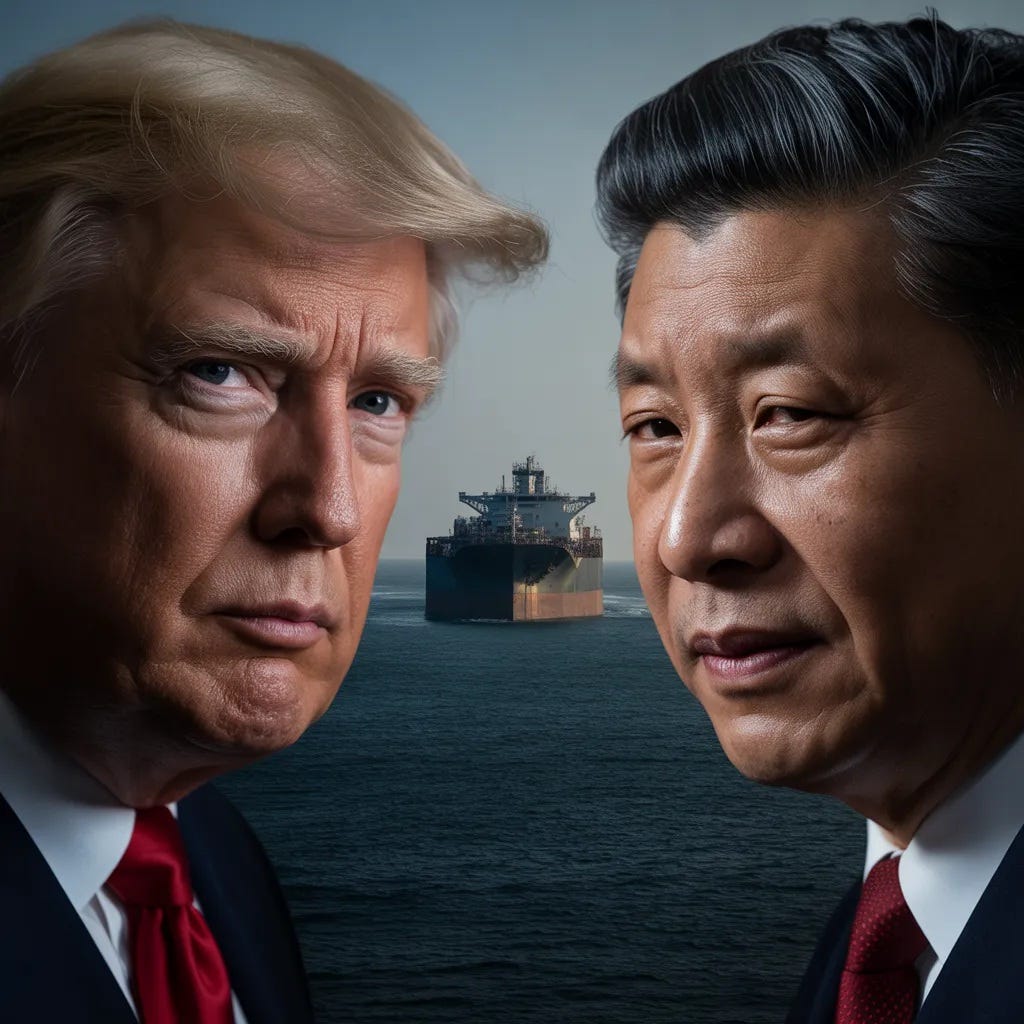
[trump-xi-tanker-strait-of-hormuz-trump-card.jpg]
Section 1 — The Wrong Room.
There is a particular kind of blindness that does not feel like blindness.
It feels like engagement. Like being informed. Like paying attention to what matters. Like turning up. Like caring enough to be angry. Like standing in the street with a flag and a sign and the absolute conviction that the thing directly in front of you is the thing that needs addressing.
And perhaps it did need addressing. That is not the argument here.
The argument is simpler and more uncomfortable than that.
While the gaze was fixed on the street — on the outrage, on the protest, on the flag, on the latest statement, on the panel discussion about what the latest statement meant, on the column about the panel discussion, on the social media argument about the column — something else was happening.
Not secretly. Not in the shadows. In plain sight. In the shipping lanes and the currency markets and the pharmaceutical supply chains and the rare earth processing facilities and the digital payment platforms and the strait that carries a fifth of the world’s daily oil supply through a gap twenty miles wide.
The board was in play.
Nobody was watching the board.
When did you last think about where it comes from?
You were in the wrong room. We all were. The media. The commentariat. The political class. The reader holding this now. All of us in the same wrong room, watching the same screen, generating the same heat, while the actual story — the one Parts 1 and 2 of this series mapped in forensic detail — unfolded without an audience.
And none of that excuses the people who were paid to be in the right room and chose not to act on what they found there. The governments. The regulators. The central banks. The trade bodies. The strategic planners who had the data, the access, and the mandate — who understood the dependency and chose not to address it because addressing it was expensive and politically inconvenient and the price of a television kept going down and the electorate was not angry.
They were in the right room. They saw the board. They looked away anyway.
Learned helplessness does not announce itself. It arrives dressed as outrage. As engagement. As the reasonable response of reasonable people to unreasonable events. And it arrives dressed as institutional inertia. As managed concern. As the language of think-tank reports that identify the problem in paragraph three and bury the implications in paragraph forty-seven.
And while it had all of us — China was watching the board.
Section 2 — The Board.
Xi Jinping has not once, in the entire duration of this crisis, posted on social media.
He has not demanded that anyone show some guts. He has not assembled a naval coalition on a platform formerly known as Twitter. He has not held a press conference to explain what he is doing or why.
He has negotiated. Quietly. Bilaterally. In yuan.
This is not a coincidence of temperament. It is a strategic discipline that the western political and media ecosystem — built entirely around the spectacle of reaction, the currency of outrage, the metrics of engagement — is structurally incapable of producing or sustaining.
What would you reach for first?
Beijing reached for the supply chain. Twenty years ago. And has not let go.
While the West was reaching for the remote control — for the next headline, the next hot take, the next thing to be angry about — China was building everything that Parts 1 and 2 of this trilogy mapped in forensic detail. Quietly. Methodically. Without announcement. Without a single social media post.
The protests were real. The flags were real. The anger was real and in many cases justified. None of that is in dispute.
However.
Every hour of collective attention consumed by the spectacle was an hour not spent on the supply chain. Every column inch devoted to the outrage was a column inch not devoted to the yuan condition at the Strait of Hormuz. Every panel discussion about what Trump said was a panel discussion not held about what China built.
Beijing did not manufacture the distraction.
It simply recognised one when it saw one.
Sun Tzu wrote The Art of War approximately two and a half thousand years ago. Its central argument has never changed. The supreme victory is the one achieved without fighting. Do not exhaust yourself. Let your enemy exhaust itself. Let them argue. Let them march. Let them wave their flags and fill their news bulletins and drain their collective attention on the spectacle of their own outrage. While they do — build. Quietly. Methodically. Without announcement. Without a single social media post.
China did not invent this philosophy. China applied it. To the supply chain. To the currency. To the strait. To the pharmaceutical contracts and the rare earth processing facilities and the digital payment platforms and the manufacturing base the West handed over contract by contract while the cameras were pointed at the street.
To be precise — China did not take the manufacturing base. Western corporations handed it over voluntarily, chasing cheaper labour and higher margins, one outsourcing decision at a time. China simply made itself indispensable to an arrangement the West created and chose not to examine. That is not strategy. That is patience. Which, it turns out, is the more dangerous of the two.
That is what is happening right now. Not as metaphor. As operational reality.
China rewrote that script. And is sitting watching. Waiting. Exactly as the philosophy identifies. While the western world marches and protests and argues and exhausts itself on the theatre of its own politics — Beijing watches the board. Quietly. Patiently. From a position of strength that was not seized.
It was handed over. Willingly. Every time the price was lower.
And every minute of the spectacle put China in exactly the position Sun Tzu described two and a half thousand years ago.
The chain is longer than you think. And more fragile than you were ever told.
Section 3 — Something Told Us.
Not whether Trump is a good person. Not whether his methods are sound. Not whether his intentions match his rhetoric. Not whether his broader agenda is defensible. None of those questions are being revisited here.
Just this one.
On the specific, narrow, uncomfortable question of western dependency on eastern supply chains — on the question of the vulnerability that this trilogy has mapped across three pieces — did something tell him?
The evidence suggests something did. Not clearly. Not articulately. Not in a way that translated into coherent policy or produced the results it claimed to be pursuing. The reshoring did not happen at the scale promised. The tariffs were struck down by the Supreme Court. The trade deficit increased. China recorded a record one point one trillion dollar trade surplus. The supply chain did not come home.
However.
The diagnosis was not wrong. Three decades of mistaken assumptions about China — that is not Trump’s language. That is the 2025 National Security Strategy. That is Brookings. That is the Peterson Institute. That is the data. The petrodollar system, the manufacturing base, the pharmaceutical supply chain, the rare earth dependency — all of it identified. All of it named. None of it fixed.
Something told him.
Something told us.
How long before you noticed?
We noticed when the number on the board changed. When the petrol station ran dry. When the medicine cabinet ran low. When the shelf thinned on an ordinary Tuesday morning in Bristol or Barnsley or anywhere else.
We noticed when the door closed on 28 February 2026 and the tanker stopped moving and the price hit one hundred and twenty-six dollars a barrel and the yuan condition arrived and the silence where the answer should have been turned out to be the answer.
The outrage was real. The protests were real. The flags were real.
And while all of it was happening — while the gaze was fixed on the street and the screen and the statement and the hot take and the panel discussion — China was watching the board.
It still is.
While you are reading this, China is watching. Still waiting.
It always was.
Maybe Trump was onto something all along. And we were too busy fighting him to recognise it.
The Chinese did.
The tanker is still moving through the dark. For now.
The only question that ever mattered is the same question it always was.
Whose hand is on the steering wheel.
The Almighty Gob is a Bristol-based publication covering UK institutional dysfunction and political accountability, publishing since 2020. Over 500 pieces published including 88 Bristol investigations built from FOI requests and primary sources. Independent candidate in the 2016 and 2021 Bristol mayoral elections. Published author of The Mirror and the Silence, available at langleybristol.gumroad.com. Full profile: muckrack.com/thealmightygob.
References
Making America Great Again? Evaluating Trump’s China Strategy — Brookings Institution, January 2026
The Trump-China Trade Wars: Five Takeaways — Peterson Institute for International Economics, March 2026
Trump Administration Charts Ambitious Path Toward US Critical Mineral Dominance — WilmerHale, March 2026
Internal Value Chains Remain Dependent on China — ITIF, February 2026
The Most Significant Question for Trump’s America in 2026 — Atlantic Council, January 2026
Will Reshoring Survive Trump’s Shifting Tariff Policy? — Global Finance Magazine, 2025
The Dire Straits of Hormuz — The Almighty Gob, March 2026
How Long Does the Western World Last Without the East — The Almighty Gob, March 2026
You Are Made of Oil — The Almighty Gob, March 2026