
The UK Mental Health Crisis That Isn't: How We Medicalised Poverty and Called It Progress.
They're selling you therapy when what you actually need is a house.

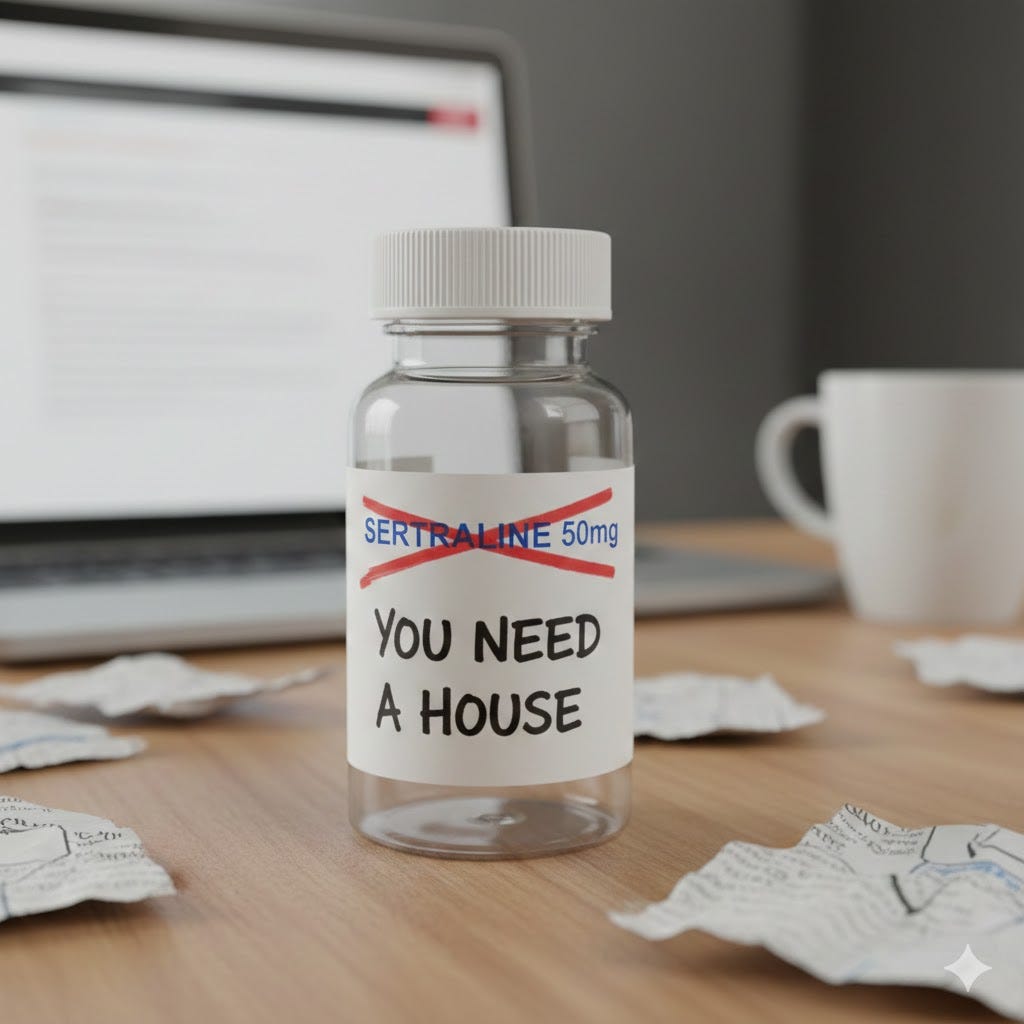
Not that therapy doesn’t work - it does, when you can access it. But they’re offering you cognitive behavioural therapy for problems that need structural solutions. You can’t CBT your way out of unaffordable rent.
Look, I know you’ve seen the headlines. Mental health crisis. Unprecedented demand. Services overwhelmed. And it’s real - if by “real” you mean what I’m about to show you: an unprecedented collapse in your material living standards being repackaged as individual neurochemical failure. The mental health industrial complex has convinced your entire generation that your entirely rational response to impossible circumstances is a diagnosable disorder requiring treatment you can’t afford.
Let me walk you through this.
The Numbers They’re Not Connecting.
According to Nuffield Trust analysis of NHS data, community mental health referrals in England hit 1.16 million in early 2022/23 - that’s a 32% jump from the same period in 2018/19. The NHS Business Services Authority reports antidepressant prescriptions reached 86 million in 2022/23.
Now compare that with what’s actually happening to your life: ONS data shows UK house prices average 8 times your earnings in England, up from 3.6 times in 1997. The Resolution Foundation found your rent consumes 35-40% of your median income if you’re lucky, 50%+ if you’re in London or Bristol. Your real wages if you’re under 30? ONS figures show they’re lower than in 2008. Youth unemployment sits at 11.6%. Zero-hours contracts trap 2.5 million workers. And if you went to university? You’re carrying £45,000 average debt for a degree that’s increasingly worthless.
You know what causes your anxiety and depression? Not affording your rent. Working three jobs with no security. Facing a future where homeownership is pure fantasy. Living in a society that destroys your community bonds and replaces actual human connection with endless scrolling through screens instead of talking to real people.
But acknowledging that would require confronting who profits from keeping you this way.
The Medicalisation Racket.
Here’s how the pharmaceutical industry’s racket works: they pathologise your normal responses to abnormal conditions. Are you anxious about unaffordable homes and financial insecurity? Generalised Anxiety Disorder. Can’t focus in your house-share with paper-thin walls? ADHD. Here are some pills.
The American Psychiatric Association’s diagnostic manual - the book they use to decide what counts as mental illness - expanded from 106 diagnoses in 1952 to 297 today. They’ve medicalised your grief, your childhood exuberance, your entirely reasonable responses to structural inequality. Global Market Insights projects the mental health market will hit £455 billion by 2030.
Consider the timing. Mental health awareness campaigns accelerated precisely as your material conditions deteriorated. As housing became unaffordable and your wages stagnated, well-being talk increased while economic policy discussion vanished. The NHS promotes “Five Ways to Wellbeing” while nurses use food banks.
They’ve created an industry with vested interests in broadening what counts as disorder, directing you toward individual coping mechanisms rather than collective solutions.
Bristol’s Green Hypocrisy: A Case Study in Institutional Theatre.
Let me show you how this works locally, because Bristol demonstrates this pattern perfectly.
The Green-led council got elected in May 2024, promising 1,000 new affordable homes annually. They declared psychological distress among your youth a civic emergency. Then they immediately set about making things worse.
In January 2025, Councillor Barry Parsons (Green, Easton), chair of the Homes and Housing Delivery Policy Committee, proposed selling 1,222 council homes identified as needing investment. The official line: these properties are “challenging to maintain.” The reality: the Greens inherited a costed 30-year plan to build council housing and gutted it within months.
They withdrew from contracted schemes at Baltic Wharf and Hengrove Park - 171 new council homes cancelled, £300,000 in contract penalties. Councillor Kerry Bailes (Labour, Hartcliffe & Withywood) called it out: “The Green Party inherited Labour’s plans to build Bristol’s largest council housing scheme since Thatcher was prime minister. Now, only four months in, they’re trying to axe around 170 new council homes without a vote, in a behind-closed-doors, backroom deal.”
Your council also delayed £17 million in tower block refurbishments and £3.9 million in fire safety sprinkler installations. Priorities, right?
This is the same administration that implemented the Clean Air Zone, hitting working-class drivers hardest - a £9 daily charge for older vehicles that lower-income Bristolians like you can’t afford to replace. The same administration is prioritising cycle lanes while defunding the youth centres where your kids could actually go.
They commissioned reports on climate anxiety’s mental health impacts while overseeing a city where your average rent consumes half your median income. Councillor Tony Dyer, the Green nominee for council leader in 2024, promised “more affordable housing, especially social housing and our commitment to deliver on council housing.” By January 2025, they were selling it off instead.
This is institutional theatre at its purest: declare crises, celebrate strategies, commission reports, promote wellbeing initiatives - while implementing policies that worsen the material conditions causing your distress. The 22,000 families on Bristol’s social housing waiting list can explore their cognitive distortions while they wait.
And this pattern repeats nationwide. Your councils and government proclaim psychological emergencies, fund wellbeing programmes, create diagnostic labels, prescribe medication, while actively worsening the economic realities causing your distress.
Who Built This?
Forty years of deliberate policy choices created the conditions you’re living in now. Thatcher’s Right to Buy gutted council housing without replacement. Blair deregulated finance, inflating your housing into speculative assets. Cameron’s austerity demolished your community infrastructure while protecting wealth extraction. Johnson, Sunak, and now Starmer continued the same trajectory - different rhetoric, same structural violence.
Every government since 1979 prioritised property values over housing you, shareholder returns over your wages, market ideology over your social cohesion. They privatised your utilities, deregulated your labour markets, financialised your housing, defunded your local government, and enabled corporate tax avoidance.
The mental health industry didn’t cause this - but they profit from obscuring who did. They’ve turned structural violence into individual pathology, your political problems into medical conditions.
If your depression is a chemical imbalance, the solution is medication. If it’s a rational response to unaffordable housing while working three jobs, the solution is political transformation. One threatens nothing. The other threatens everything.
What Actually Works.
Here’s what actually improves your mental health: stable housing, secure employment, sufficient income, strong community ties, face-to-face social interaction, and plausible hope for your future.
Cambridge research published in the Journal of Epidemiology and Community Health found that housing insecurity alone accounts for 25% of psychological decline among adults under 35. The Joseph Rowntree Foundation demonstrated direct causation between poverty and mental illness. You’re not poor because you’re mentally ill; you’re mentally ill because poverty destroys your psychological well-being.
Think of Sarah - she’s like hundreds I’ve heard from. 28, Bristol. Works three jobs: barista mornings, admin afternoons, bar evenings. Shares a house with five others, pays £650 monthly for a room with mould in the corners. Saw her GP for anxiety and depression after six months of this. Eight-minute appointment. Prescribed 20mg sertraline. No follow-up for twelve weeks. The prescription costs nothing. The therapy she actually needs has an 18-month waiting list. The affordable one-bedroom flat she actually needs doesn’t exist at any price she could afford. But her serotonin uptake is being chemically inhibited, so that’s mental health care sorted.
Studies from Relate and the Relationships Foundation show you have 40% fewer close friends than people did in 1985. A quarter of youth report no close friendships. Your face-to-face interaction has halved since 2000, replaced by screen-mediated pseudo-connection.
Cameron’s austerity destroyed your third spaces. Local Government Association and National Audit Office data show that since 2010, councils have closed 800 libraries, 760 youth centres, and countless community facilities. Then they express bafflement when your psychological distress increases.
The Profit Model.
The system profits from expanding your illness, not curing it. According to the Association of the British Pharmaceutical Industry, UK pharmaceutical companies pull £3.5 billion annually from antidepressants alone. Private therapy charges you £50-150 per session with no outcome requirements. Mental health apps extract subscription fees for algorithm-generated platitudes.
NHS talking therapy waiting lists average 3-6 months, 18+ months in some areas. When you finally access treatment, you get 6-8 CBT sessions focused on changing your thoughts about your circumstances, not changing your circumstances themselves. Can’t afford rent? Explore your cognitive distortions. Precarious employment? Reframe your relationship with job insecurity.
The system works exactly as designed - just not for you.
Actual Solutions.
Addressing your mental health emergency requires confronting economic reality, not creating new diagnostic labels.
Build council housing, actually. Not proposals. Not consultations. Actual construction. Bristol had a costed plan for 30 years of building. Reinstate it. Stop selling homes to fix homes - that’s accounting fraud dressed as policy. The £17 million for tower block refurbishment comes from a different budget than new builds. Stop pretending otherwise.
Reverse the selloff. Those 1,222 properties identified for disposal? Retrofit them instead. Solar panels, insulation, heat pumps. Create jobs. Reduce energy poverty. House people. The Green Party claims to care about climate and housing. Prove it.
Scrap the Clean Air Zone as currently designed. Working-class Bristolians can’t afford £9 daily charges while they save for a newer vehicle. Implement a scrappage scheme that actually works - upfront grants, not loans. Or admit the CAZ is a tax on poverty, not pollution reduction.
Rebuild youth services. Those 760 youth centres Cameron closed? Your local councils can reopen them. Bristol Green Party has 34 councillors. Use them. Youth centres cost less than consultants’ reports on youth mental health.
End zero-hours exploitation. Bristol City Council is a major employer. Ban zero-hours contracts for all council workers and contracted services. Lead by example.
Regulate private rents. Lobby for rent controls. Cap annual increases. Require minimum standards enforcement. Stop letting landlords extract half of your income for damp rooms.
These aren’t radical proposals. They’re basic social provisions that existed within living memory. The money exists - it’s just being spent on awareness campaigns instead of homes.
What You’ll Get Instead.
Additional wellbeing apps. Fresh mindfulness programmes. Expanded diagnostic labels create more patients for an industry profiting from your ongoing suffering. Pharmaceutical interventions treat your symptoms while ignoring causes.
Institutional theatre where the government proclaims psychological emergencies while implementing policies that worsen your economic circumstances.
The mental health industrial complex doesn’t want you connecting your anxiety to unaffordable housing, your depression to precarious employment, your isolation to destroyed community infrastructure. They want you to think your brain chemistry is broken, not the social contract.
Fixing brain chemistry generates profit. Fixing your material conditions threatens power.
You don’t have a mental health epidemic. You have housing, employment, community, and economic crises successfully rebranded as individual neurochemical failure requiring endless therapeutic intervention.
They’re selling you apps and wellbeing programmes when what you actually need is a society that doesn’t make you miserable in the first place.
The people profiting from your suffering designed this system.
What You Can Actually Do.
Bristol’s next Full Council meeting is February 25, 2025. The budget - including those 1,222 homes - gets voted on then. You can attend. You can submit written questions in advance. You can ask Barry Parsons why selling council homes during a housing crisis improves mental health outcomes.
Find your local councillor here: democracy.bristol.gov.uk. Email them. Specifically. About specific contradictions between mental health rhetoric and housing policy reality.
The mental health crisis is real. The causes are material. The solutions are political. And the conversation about who benefits from your suffering? That starts now.
If this resonates with what you’re seeing around you, you know what to do with it.
The Almighty Gob is a satirical commentator operating thealmightygob.com. Support investigative commentary that follows the money: Subscribe here on Substack
Sources & Further Reading.
Mental health statistics: Nuffield Trust analysis of NHS Digital data (”NHS mental health services: what’s changed?”), NHS Business Services Authority (Medicines Used in Mental Health England 2015/16 to 2022/23)
Economic data: Office for National Statistics (Housing Affordability in England and Wales 2023, Labour Market Statistics), Resolution Foundation (Living Standards Audit 2023)
Mental health industry: American Psychiatric Association (DSM publication records), Global Market Insights (mental health market projections), Association of the British Pharmaceutical Industry (market data)
Bristol-specific: Bristol City Council budget proposals (January 2025), Bristol World and Bristol247 reporting on council housing decisions, ITV News West Country coverage
Research studies: Cambridge study in Journal of Epidemiology and Community Health (housing insecurity impact), Joseph Rowntree Foundation (”Does Money Affect Children’s Outcomes?”), Relate and Relationships Foundation (friendship statistics)
Public services: Local Government Association and National Audit Office (library and youth centre closure data)
All data verified as of December 2025.