
The Uninvited Heckler: Bristol City Council's Full Council Meeting, March 2026.
30 minutes. One decision. Nobody voted for it.

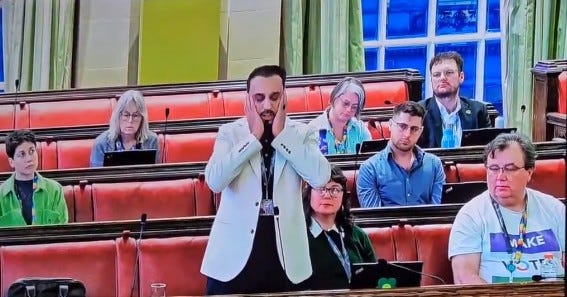
[It may appear like a midlife crisis on first look. However, this is actually Councillor Abdul Malik performing the Adhan during Bristol City Council's Full Council meeting, 10th March 2026.]
It’s a personal thing. Late evening, the house still, just catching up on Bristol news the way you do — scrolling through, nothing urgent, volume down as the day winds down.
And then the thumb stops.
Not because I went looking. Because something in the image snagged before the brain had time to explain why. A man I know, standing in what I recognised as a council chamber. Hands pressed hard against his ears. Eyes closed, or very nearly. Head at an angle that didn’t quite fit the geometry of a public meeting. The people around him wearing that particular expression — you’ll know it if you’ve seen it — of not quite knowing where to look.
I watched for a moment.
My first thought was that something had gone wrong. Not mildly wrong — not the kind of wrong that gets you a glass of water and a sympathetic look from a colleague. The kind of wrong that gets you an ambulance.
The hands. The eyes. The stillness of everyone around him.
Was this a seizure? Was this a man in the middle of a medical emergency, broadcast live to the people of Bristol while the camera kept rolling and nobody moved?
And then a second thought, quieter and more troubling than the first.
Was this a mental health crisis? Was this a man in genuine psychological distress who had, without fully knowing where he was or what was happening around him, wandered into the frame of a public broadcast? Had Bristol City Council — knowingly or otherwise — just put a man in crisis on the stream and left him there for the city to watch?
Because if so, the broadcast was the least of the problems. If so, the first question wasn’t about democracy or civic space or thirty minutes or any of the things I’m about to discuss.
The first question was: why is nobody helping him?
Those are not comfortable thoughts to sit with.
As it turned out, they weren’t necessary ones.
He wasn’t having a seizure.
He wasn’t in crisis.
He was praying.
When the penny dropped, there was a moment — brief, involuntary — where the relief was immediately followed by something else. Something between absurdity and the faint, guilty awareness that you’d just been genuinely worried about a man performing an act of sincere religious devotion.
And then the second thought arrives. The one that isn’t funny at all. If this is what I was watching — what was everyone else watching?
If the person watching couldn’t immediately tell the difference between a man in crisis and a man at prayer, what does that tell you about whether that was the right room for it?
The room has a job. It isn’t a chapel. It was never a chapel. And the people of Bristol never voted for it to become one.
The man in that video is Councillor Abdul Malik. Green Party. Ashley ward. Bristol City Council. I’ve known Abdul for years. His record of community work is genuine. His commitment is real. He has every right to be in that chamber.
He is not a villain in this story.
It is about what he did. And what nobody did in response.
He is a man who made a unilateral decision in a room that exists specifically to prevent unilateral decisions.
And nobody stopped him. That’s what passes for leadership in that building.
That room is the Council Chamber at Bristol City Hall. It belongs to the people of this city. All of them. Every faith. Every absence of faith. Every person paying their council tax into a system that is supposed to serve them equally.
Once a month, the public are allowed in. Actually in. Actually standing. Actually speaking to the people who make decisions about their housing, their streets, their money, their lives.
Thirty minutes. That is it. For a population of around 726,000. The total worth. Administratively, of course.
Thirty minutes a month. That’s what democracy looks like in Bristol in 2026. And someone used part of it for something else.
On the 10th of March 2026, Councillor Abdul Malik performed the Adhan — the Call to Prayer, always delivered in Arabic regardless of the practitioner’s background — at Bristol City Council’s Full Council meeting.
Before anyone reaches for the word Islamophobia like a fire extinguisher to spray at an argument they haven’t finished reading — this is not an attack on Islam. This is not an attack on Abdul Malik. This is a defence of the room.
Suppose the Catholics wanted a moment. Then the Protestants — allow extra time, several distinct flavours, each with its own relationship with brevity. Then the Jewish councillors, the Sikhs, the Hindus, each with entirely legitimate claims on that same courtesy.
You would not be out of the building before midnight.
Every faith is equal in that room. Which means no faith gets the room.
Bristol City Council has spent considerable time and money building equality and diversity frameworks. Policies. Officers. Strategies. Entire departments dedicated to ensuring no single group feels excluded from civic life.
In the moment that framework was needed — in the room it was built to protect — it was completely silent.
Where were the equality officers when the broadcast went out? Where was the diversity policy when the Adhan was performed in a room that belongs to people of every faith and none? Submissively filed away, in an office somewhere else in the building.
The very apparatus built in the name of inclusion presided over an act of exclusion. And said nothing.
This is the same council whose members walked out of their own chamber, held up placards, and made national headlines over gender-critical statements from the public gallery. The same council that mobilised its entire moral apparatus over one kind of perceived exclusion.
When the Adhan played to 195,000 people who hadn’t asked for it, the placards stayed at home. Perhaps saved for another time. Another time of less importance.
There’s a word for that. It isn’t consistency.
The hypocrisy is breathtakingly obvious.
Consider the street preacher. Absolute conviction. Carrying voice. Standing on the corner between you and wherever you’re going. Here is the thing — you can walk away. Cross the road. Headphones in. Nobody has to stand there and receive it.
Take it outside. Literally.
195,000 views on that post at time of writing. Most of them had the sound up. They knew exactly what they were hearing. They still hadn’t asked for it.
The imposition doesn’t end at the chamber walls. It travels down the wire. Into every living room. Every phone screen. Every thumb that stopped, as mine did, on something it didn’t expect and wasn’t asked to receive.
195,000 people became members of a club they never joined. Nobody asked. The membership was conferred anyway.
And when those people wanted to ask why, they had exactly one place to go. The very people who let it happen.
That’s the closed loop. You tune in for democracy. Democracy does something you didn’t ask for. You complain to democracy. Democracy is the people who did the thing you’re complaining about.
Nobody expects a councillor to sit in Full Council with a bottle of wine. Nobody expects one to light a cigar mid-session. Because when you walk through that door in an elected capacity you are not there as a private individual. You are there in a public role. On public time.
The wine. The cigar. The prayer.
Same category. Personal choices. Things that belong to the individual and not to the chamber.
The fact that one of them is sacred does not change the category it sits in.
And the moment you decide it does — the moment you create a hierarchy of personal choices — you have ended the principle. Not bent it. Ended it.
Bristol City Council is democratically elected by everyone. Christian. Muslim. Jewish. Sikh. Hindu. Atheist. Agnostic. The mandate comes from all of them. Not some of them. All of them.
A council elected by everyone cannot conduct itself in a way that makes some of those people feel the room belongs to someone else. The moment it does, it has broken the contract it was elected to honour.
That is how democracy dies in practice. Not in a coup. Not with tanks in the street.
In a chamber in the centre of Bristol. In minutes. While the camera rolled and everyone looked at the ceiling.
The Adhan was not on the agenda. It will not appear in the minutes. It was not proposed, seconded, debated, or recorded.
How many people voted for it?
And this is where democracy failed. Only in part. But it still failed. This is where autocracy begins.
One person. One decision. No vote. No mandate. No consent. A room that exists specifically to prevent exactly that — and it happened anyway.
The Greens run Bristol City Council. The chamber is their responsibility. The broadcast is their responsibility.
Someone in that building must have known what was coming.
Read that again. They said nothing.
No backbone required.
That silence is the real story. Not the prayer. The silence after it.
The next person. Of whatever faith. With whatever act of personal devotion they’d like to bring into the chamber.
They have a template now.
Or do they?
Because somewhere in Bristol tonight, someone is thinking about the cross they made at the polling booth.
And wondering if this is the political cross they have to bear.
One final thought.
This happened in Bristol. We know it happened in London. There are reports of similar incidents in Birmingham and Bradford. Manchester and Leicester have their own Full Council broadcasts, their own thirty minutes, their own public forums conducted in their name.
The question is whether anyone is watching them with the same attention.
If you’re reading this outside Bristol — when did you last watch your Full Council meeting? Do you know what happens in that room in your name?
It found me on a Tuesday evening. Volume down. Not looking for anything. Just scrolling.
Check your own council. Check your own broadcast. Check your own thirty minutes.
You might want to know what’s on.
UPDATE — 13th March 2026
Since publication, information has come to light that adds significant context to this piece.
Permission was apparently given — so far, at least — by the chair of the meeting. This was not therefore a unilateral act by Councillor Malik alone. Someone in authority apparently sanctioned it. Which raises an immediate question. Under what policy? Under what precedent? Under what democratic authority was that permission given?
The answer, so far, appears to be none. Bristol City Council has no formal policy governing prayers or acts of religious observance at council meetings. No framework. No equality impact assessment. No guidance on how such requests should be handled or how permission should be granted or refused consistently across all faiths.
One person decided. Informally. Without process. Without record.
Which raises a further question. Bristol City Council employs an entire equality and diversity apparatus — departments, officers, strategies, frameworks — whose core purpose is to ensure equal and fair treatment across all faiths, backgrounds and identities. As the article above made clear, that apparatus was silent when it mattered most. But the silence runs deeper than a single evening. If there is no policy governing devotional prayer at council meetings, one is entitled to ask what that apparatus has been doing. Because ensuring equal treatment of all faiths in civic spaces would appear to be precisely their remit. The clue, as they say, is in the name.
Equality and diversity. Not equality and diversity for some. Not equality and diversity when it’s convenient. Equality. And diversity. Both words. All the time.
If the department responsible for that principle didn’t think a policy was necessary — didn’t think to ask the question before it was asked for them on a civic broadcast to 195,000 people — then what exactly is the point of the department?
Which makes this not just a question about what happened in that chamber — but about who gets to decide what happens there, and on what basis.
An FOI request will be submitted to Bristol City Council seeking clarification on whether any formal policy exists, whether permission was sought and granted, and if so, under what authority. The FOI will also ask whether Bristol City Hall has any existing provision for devotional prayer or multi-faith reflection.
Bristol City Council’s own website has been checked. It apparently offers no facility whatsoever for devotional prayer. No prayer room. No quiet room. No multi-faith space of any kind listed among its facilities.
Bristol City FC has one. Bristol Airport has one. The University of Bristol has several. Bristol City Council — which governs a city of 726,000 people of every faith and none — apparently does not.
The football club beat them to it. Make of that what you will.
I won’t be holding my breath for the FOI response. Previous FOI requests to Bristol City Council have taken 61 days — three times the statutory 20 working day deadline — before the council even acknowledged it had breached the law. A second request ran to 80 days before a refusal arrived. The council’s relationship with transparency is, shall we say, complicated.
The solution is straightforward. Bristol City Council should establish a dedicated space for devotional prayer, available equally to all faiths and none. The right to pray is absolute. The question was never whether — only where.
Perhaps it’s time the council answered that question. Before someone else decides for them.
Bristol City Council Full Council Meeting, 10th March 2026 — Official broadcast, Bristol City Council YouTube channel
Original viral video post — X/Twitter, @sarah_owl3 👉

— 195,000+ views at time of writing
Bristol City Council — Full Council meeting schedule and public forum procedures — bristol.gov.uk
Bristol City Council Equality and Diversity Policy — bristol.gov.uk
Bristol population data — Office for National Statistics, Census 2021 — approximately 726,000 residents — ons.gov.uk
The Adhan — Islamic Call to Prayer — always performed in Arabic regardless of practitioner’s background — islamicfinder.org
Bristol City Council Green Party walkout, gender-critical statements, Full Council — documented in previous coverage at thealmightygob.com
Previous investigation — civic space and religion in UK council meetings — thealmightygob.com
Eyewitness source — anonymous, present at Full Council meeting, 10th March 2026
Bristol City Council website checked 13th March 2026 — no devotional prayer facility listed — bristol.gov.uk
Bristol City FC multi-faith room — bcfc.co.uk/accessibility/multi-faith-room
Bristol Airport multi-faith facility — Bristol Airport
University of Bristol multi-faith spaces — bristol.ac.uk/multifaith-chaplaincy
Previous FOI breach — Bristol City Council Lead Disclosures Officer, 28th November 2025, reference 64545569
@ChrisMcAvoy
That man apparently applied to the person leading the meeting who granted permission. I was there, it was uncomfortable.